The rise of Dozy Mmobuosi was the kind of story investors love to believe. A charismatic Nigerian entrepreneur claimed he was building a technology empire that would transform African agriculture, connect millions of farmers through mobile services, and bring financial inclusion to underserved communities. He spoke on global stages, pursued a takeover of English football club Sheffield United, launched consumer products, and presented himself as one of Africa’s great business success stories.
U.S. regulators now describe much of that empire as fiction.
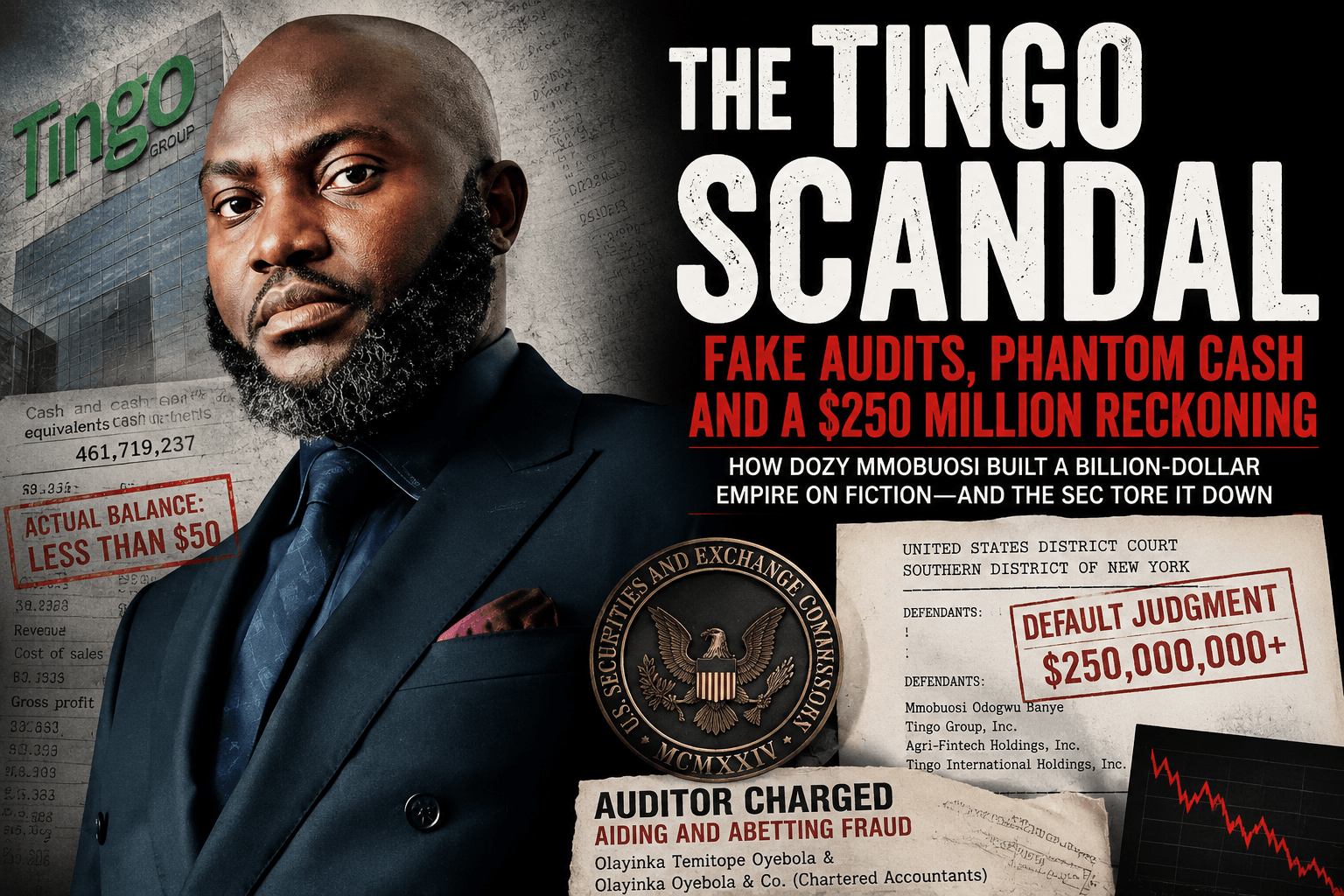
Born Chiedozi Mmobuosi in Lagos in April 1978, Mmobuosi—identified in SEC filings as Mmobuosi Odogwu Banye and widely known as Dozy Mmobuosi—founded what became the Tingo ecosystem. At its peak, the web of companies included Tingo Group Inc., Tingo International Holdings Inc., Agri-Fintech Holdings Inc. (formerly Tingo Inc.), Tingo Mobile PLC, and Tingo Foods PLC. The businesses claimed to serve millions of customers and generate enormous revenues from mobile technology and agricultural services across Nigeria and beyond.
Investors bought into the vision. Public markets rewarded the narrative. Media outlets profiled the entrepreneur behind it all.
Then the numbers started falling apart.
In June 2023, short-seller Hindenburg Research published an explosive report accusing Tingo of being little more than an elaborate fabrication. The report questioned customer figures, revenues, assets, and even Mmobuosi’s academic credentials. Tingo fiercely denied the allegations and described the report as misleading and defamatory.
Six months later, the U.S. Securities and Exchange Commission arrived at an even harsher conclusion.
The SEC alleged that beginning as early as 2019, Mmobuosi orchestrated a multi-year scheme to inflate the financial performance of Tingo entities and their Nigerian subsidiaries through fake documents, fabricated transactions, forged records, and false financial statements designed to deceive investors around the world. According to the SEC complaint, Tingo Mobile portrayed itself as a thriving enterprise generating hundreds of millions of dollars in revenue. In reality, regulators alleged that during 2019 the company had virtually no meaningful operations, no legitimate customers, and roughly $15 sitting in its bank account.
Perhaps no allegation better captured the staggering gulf between image and reality than the one involving cash balances. Tingo Group’s 2022 annual report claimed that the company held approximately $461.7 million across Nigerian bank accounts. Investigators said those same accounts actually contained less than $50 at year-end.
The SEC alleged that the deception expanded through a series of increasingly brazen transactions. It described fabricated sales, falsified bank documents, forged contracts, and supporting materials designed to create the appearance of a booming multinational enterprise. Investors were allegedly shown financial statements reflecting extraordinary growth while regulators later argued that the underlying business activity simply did not exist on the scale claimed.
Federal prosecutors separately brought criminal charges in early 2024, accusing Mmobuosi of securities fraud, filing false reports with the SEC, and conspiracy. The criminal case exposed him to decades in prison if convicted. Mmobuosi publicly denied wrongdoing, insisting that the allegations were unfounded and that he intended to contest them.
Yet when the SEC’s civil case proceeded in federal court, neither Mmobuosi nor several of his U.S.-based companies mounted a substantive defense.
In August 2024, U.S. District Judge Jesse Furman entered default judgments against Mmobuosi, Tingo Group, Agri-Fintech Holdings, and Tingo International Holdings after they failed to defend the SEC action. The judgments imposed more than $250 million in combined monetary relief, including disgorgement, prejudgment interest, and civil penalties. The court also permanently restrained them from future violations of securities laws.
The judgment represented one of the SEC’s largest fraud recoveries involving an African-founded company listed in U.S. markets.
Even after the ruling, Mmobuosi maintained his innocence. He argued publicly that the SEC had made baseless accusations and suggested that the defendants lacked sufficient financial resources to fight the case properly. He further claimed that U.S. authorities ignored evidence, including findings he said supported the legitimacy of Tingo’s operations.
The fallout did not end there.
Regulators turned their attention to the gatekeepers.
In September 2024, the SEC charged Nigerian auditor Olayinka Temitope Oyebola and his PCAOB-registered firm, Olayinka Oyebola & Co. (Chartered Accountants), accusing them of aiding and abetting the Tingo fraud. According to the SEC, Oyebola discovered that fake audit reports bearing his signature had been incorporated into SEC filings. Rather than alerting authorities or exposing the misconduct, regulators alleged that he helped conceal it and made material misstatements to another auditor examining one of the Tingo entities.
The allegations were especially troubling because auditors occupy a position of trust. Investors rely on them to challenge management claims, verify financial information, and sound alarms when irregularities appear. Instead, the SEC alleged that Oyebola and his firm facilitated fiction rather than uncovering truth.
The case ultimately ended in settlement. Without admitting or denying the SEC’s allegations, Oyebola and his firm consented to final judgments imposing permanent injunctions, six-year practice suspensions barring them from appearing before the SEC as accountants for public companies, and a combined $200,000 in civil penalties.
The scandal also cast new light on Mmobuosi’s earlier ambitions. Before regulators intervened, he had attempted to purchase Sheffield United Football Club, presenting himself as a wealthy international businessman capable of revitalizing the English side. Questions surrounding his finances had already complicated that effort. After the SEC allegations emerged, the failed takeover attracted renewed scrutiny as observers wondered how close a Premier League institution had come to being controlled by a man later accused of operating a massive fraud.
Meanwhile, the Tingo empire unraveled. Reports emerged of stalled operations, unpaid contractors, layoffs, and websites going dark. What had once been marketed as a groundbreaking African technology success story increasingly resembled a cautionary tale about charisma, unchecked narratives, and the dangers of believing impressive numbers without asking difficult questions.
There were warning signs along the way. Nigerian proceedings dating back years had involved separate allegations related to a disputed diesel transaction. Critics questioned Tingo’s disclosures well before regulators acted. Hindenburg’s report forced uncomfortable questions into public view. Yet the company’s public status, high-profile partnerships, and ambitious messaging created an aura of legitimacy that proved difficult for many investors to challenge.
Perhaps the most sobering aspect of the Tingo saga is how ordinary the underlying mechanics appear in hindsight. The promises were grand: empowering farmers, transforming economies, democratizing opportunity. The methods investigators described were old-fashioned: fake documents, inflated figures, forged records, misleading statements, and gatekeepers who allegedly failed to intervene.
The story is not merely about one entrepreneur’s spectacular fall. It is about the ecosystem that allowed extraordinary claims to circulate with insufficient scrutiny. Public companies depend on auditors, advisers, executives, directors, regulators, journalists, and investors all performing their roles with skepticism and discipline. When several of those safeguards weaken simultaneously, fiction can flourish long enough to consume real money and real trust.
For investors, the Tingo collapse offers an uncomfortable reminder. The most persuasive frauds rarely arrive disguised as obvious scams. They arrive wrapped in optimism, purpose, innovation, and stories people desperately want to believe. By the time the numbers stop adding up, the damage has often already been done.
————-
Disclaimer:
Some content on Reportingscams.com is published under our guest post program and is provided by third-party contributors. Reporting scams does not create, verify, or take responsibility for the views, accuracy, or claims expressed in such content.