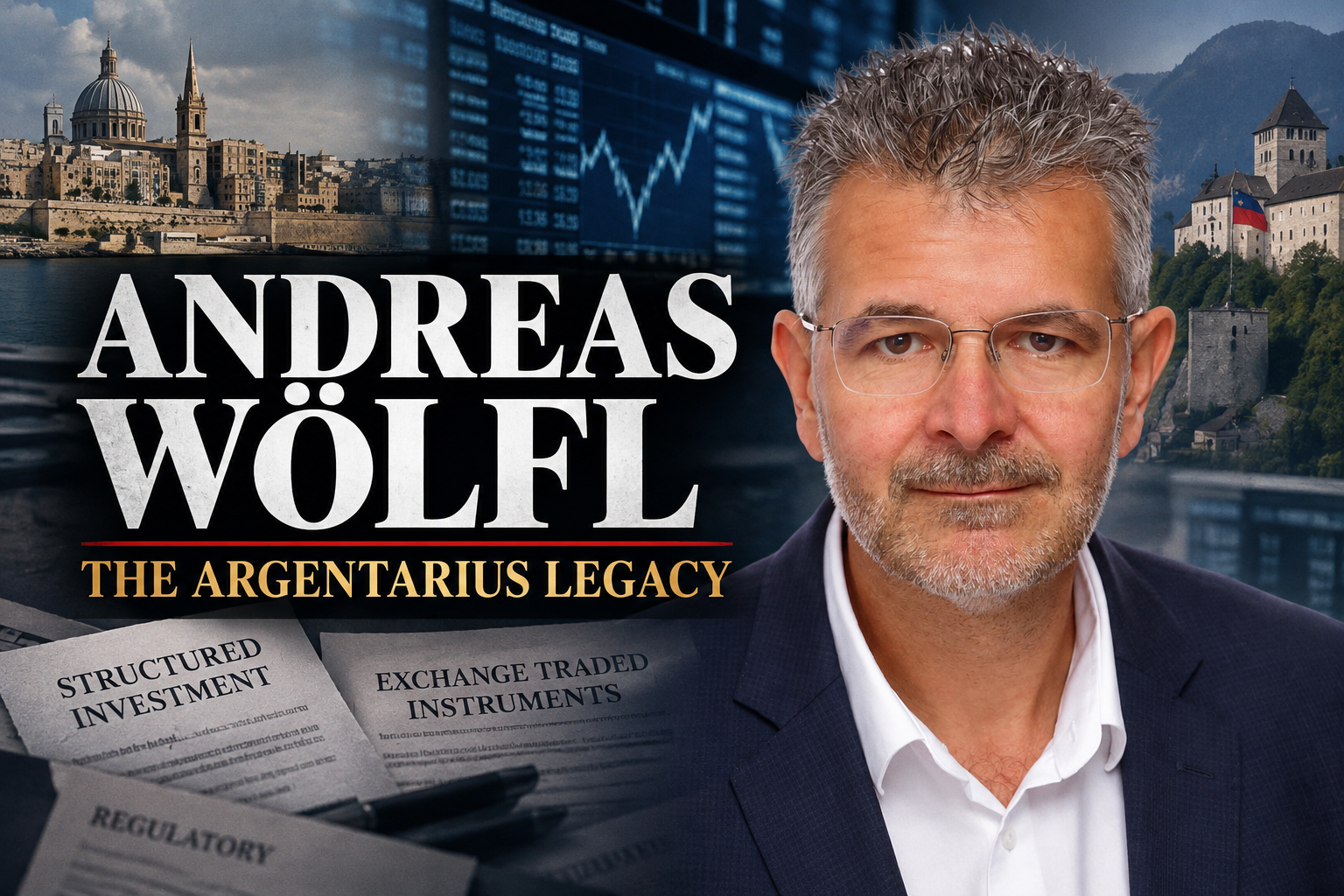
Andreas Wölfl built his career around a financial product designed to make complicated investments easier to package, list and distribute. Today, the Austrian-born finance entrepreneur presents himself as the founder and chief executive of iMaps Capital Markets, a structured-products business operating from Liechtenstein with international operations. But behind that current profile sits a long trail of regulatory action, failed investment structures, court disputes and questions about the due diligence surrounding products connected to his earlier company, Argentarius.
The record does not establish that Wölfl was convicted of fraud, nor does it show that a court has found him personally liable for the losses suffered by investors in the Falcon Funds affair. That distinction matters. What the public record does show is that companies controlled or directed by him became deeply connected to a major Swedish pension scandal, while regulators and courts raised serious questions about the structures through which investors’ money was deployed.
Wölfl’s professional background is substantial. He studied business administration at Vienna University of Economics and Business and began his investment-services career at the Vienna Stock Exchange in 2000, later heading the Austrian indices team. His own current biography says he moved into entrepreneurship in 2004 and has worked in asset management, banking and securitisation, with a particular focus on structured investment products since 2007.
His earlier career, however, also includes Minerva Investments AG in Liechtenstein. In 2011, the Liechtenstein Financial Market Authority became concerned about the Intevo Fund, which was managed by Minerva. The regulator said media reports suggested a connection between the fund and a German investor-fraud case and responded with supervisory measures. The Intevo Fund was placed into liquidation and Minerva subsequently entered bankruptcy. Wölfl had been a member of Minerva’s management and was publicly presented as its CEO. Contemporary reporting placed him at the centre of the company during this period.
The next chapter was Argentarius, a Malta-based group built around Exchange Traded Instruments, or ETIs. The concept allowed investment strategies and otherwise difficult-to-trade assets to be packaged into securities that could be listed on exchanges. In promotional material, Argentarius presented the model as a faster and cheaper alternative to conventional investment funds. Its first ETI was launched in 2014, and Wölfl later said the group had completed roughly 50 ETIs with a combined value of about €1 billion.
The regulatory record became increasingly uncomfortable. In March 2017, the Malta Financial Services Authority imposed two separate €4,650 administrative penalties on Wölfl in his capacity as director of Delta1 Securities and ETI Securities. The penalties concerned failures to publish required notices and circulars and failures to file regulated information with the listing authority at the required time.
The same year, Argentarius suffered a much larger setback. The Gibraltar Stock Exchange terminated the membership of Argentarius ETI Management, saying it could not satisfy a new requirement that listing members be licensed by a recognised competent or regulatory authority. Four securities-issuing affiliates were subsequently delisted, together with the investment schemes operated by their clients.
The Falcon Funds scandal brought Argentarius into an altogether more serious dispute. Falcon was a Maltese investment fund that attracted Swedish pension savings through Sweden’s premium pension system. The Malta regulator began investigating Falcon in 2015 and eventually appointed KPMG Malta to take control of the fund in January 2017 to protect investors. Temple Asset Management, Falcon’s investment manager, subsequently lost its licence and was fined €612,473.85 after the MFSA found 23 breaches of regulatory requirements.
Falcon’s losses became the subject of litigation and criminal investigations involving a network of people and companies, most prominently Swedish businessman Max Emil Serwin, formerly known as Emil Amir Ingmanson, together with Mark Bishop, Afram Gergeo, John Anthony Farrell and Barbaros Ökten. In 2025, the English High Court considered the civil case brought by the Kingdom of Sweden over the alleged misappropriation of more than €115 million from the pension accounts of about 46,222 Swedish savers.
That judgment is particularly important because it places Argentarius directly inside the Falcon investment structure. The court described Argentarius ETI Management as a Maltese securitisation agent controlled by Wölfl and said the ETIs involved in the Falcon transactions had been created by Argentarius. The judge also observed that no valuations of certain underlying assets had been carried out, or that records of such valuations had not been kept.
One transaction, the Nordic Power ETI, received especially harsh treatment from the court. Falcon had been seeking exposure to shares in Werel, a company connected to defendants in the case. Because the shares were not listed, Temple asked Argentarius to construct an ETI allowing Falcon to obtain indirect exposure. The court found the investment “impossible to justify commercially” and concluded that its probable purpose was to transfer money ultimately to Serwin and people associated with him.
The judgment also referred to an internal Argentarius email concerning the proposed investment. An Argentarius employee told Wölfl that Serwin expected Falcon subscriptions of €4 million to €5 million once the ETI was launched. Later evidence showed that Wölfl signed documents on behalf of one of the entities involved in the structure. The court nevertheless directed its findings of liability against the defendants before it; Wölfl was not a defendant in that English High Court case and was not found personally liable in that judgment.
There were also direct legal claims against Wölfl and Argentarius in Malta. Government Gazette notices show that Falcon Funds issued judicial letters involving Argentarius ETI Management and Wölfl, referring to his role in structuring, arranging and pricing investments and acting as listing agent. Separate notices concerned the Boardwalk Real Estate ETI, Nordic Power ETI and other instruments. In 2019, another Maltese court notice recorded Falcon’s claim that various investments had failed or appeared likely to fail because of alleged acts and omissions by Argentarius, including allegations of negligence, fraud, lack of expertise and breaches of applicable obligations. Those were claims made by Falcon, not judicial findings that Wölfl committed fraud.
The financial scale of the wider Falcon affair is considerable. A Maltese court was told in 2018 that approximately €79 million in pension savings had been lost. The 2025 English judgment dealt with a broader claim exceeding €115 million and ultimately found Max Serwin liable for €60.7 million in the Falcon phase of the case, alongside findings against other defendants and companies. Those figures concern the wider scheme and should not be characterised as money personally taken by Wölfl.
Argentarius itself did not simply disappear. The business structure evolved. Its Malta operations closed, while Wölfl developed iMaps Capital Markets, with an EU headquarters in Liechtenstein and international operations. Wölfl disputes the suggestion that iMaps was simply Argentarius under a new name. In a statement responding to OffshoreAlert, he said iMaps was not affiliated with Argentarius other than through his ultimate ownership, denied involvement in fraudulent investment schemes and said Argentarius had been closed because the business was moving away from asset-backed securitisation toward derivative securities.
That new business remains active. iMaps identifies Wölfl as its founder and CEO and currently markets exchange-traded investment products and actively managed certificates. Its 2026 materials describe a growing platform with more than 100 listed products, while Wölfl’s public professional profile says the group has structured more than €1 billion across more than 200 issues. These are company or personal representations, not independent findings of regulatory performance.
The present-day structure is also different from Argentarius. iMaps ETI AG is based in Schaan, Liechtenstein, and its prospectus states that its securities prospectus has been approved by the Liechtenstein Financial Market Authority. At the same time, the company expressly states that the prospectus approval does not constitute an endorsement of the securities and that iMaps ETI AG, as an issuing platform, is not itself regulated as a bank or investment firm under MiFID.
The question surrounding Wölfl is therefore not a simple story of a convicted fraudster moving from one company to another. The available evidence is more complicated and, in some ways, more revealing. A businessman who was already operating in sophisticated investment structures when regulators intervened at Minerva later built Argentarius around ETIs, saw companies connected to him fined and removed from exchanges, became the subject of litigation arising from Falcon Funds, and is now operating another structured-products platform from Liechtenstein.
Wölfl has consistently denied involvement in fraudulent schemes. The strongest evidence against him is not a criminal conviction but the accumulation of regulatory records, court documents, company filings and investment structures in which his companies played identifiable roles. The strongest evidence in his favour is equally important: no criminal conviction against him was located, the 2025 English judgment did not make him a defendant or impose liability on him, and his current business operates under a different corporate and regulatory framework.
For investors, that distinction should not end the inquiry. It should sharpen it. Structured products can make complicated investments look clean, exchange-listed and institutional even when the underlying assets are difficult to value. The Falcon litigation demonstrates why the identity of the issuer, arranger, investment manager, collateral provider and ultimate beneficiary matters as much as the name printed on an investment certificate. Wölfl’s career illustrates that lesson unusually well: reputational risk can follow a financial architecture long after the corporate names, jurisdictions and products have changed.
Source-
OffshoreAlert
————-
Disclaimer:
Some content on Reportingscams.com is published under our guest post program and is provided by third-party contributors. Reporting scams does not create, verify, or take responsibility for the views, accuracy, or claims expressed in such content.