A 2011 corporate filing from Gibraltar places financial-services professional Philip James Cartwright inside a company structure that later became connected, through its wider business relationships, to one of the jurisdiction’s most consequential investment-fraud cases. The record does not establish that Cartwright committed fraud, and he has not been identified as a defendant in the Kijani litigation. What it does show is a disputed corporate role that he later publicly denied.
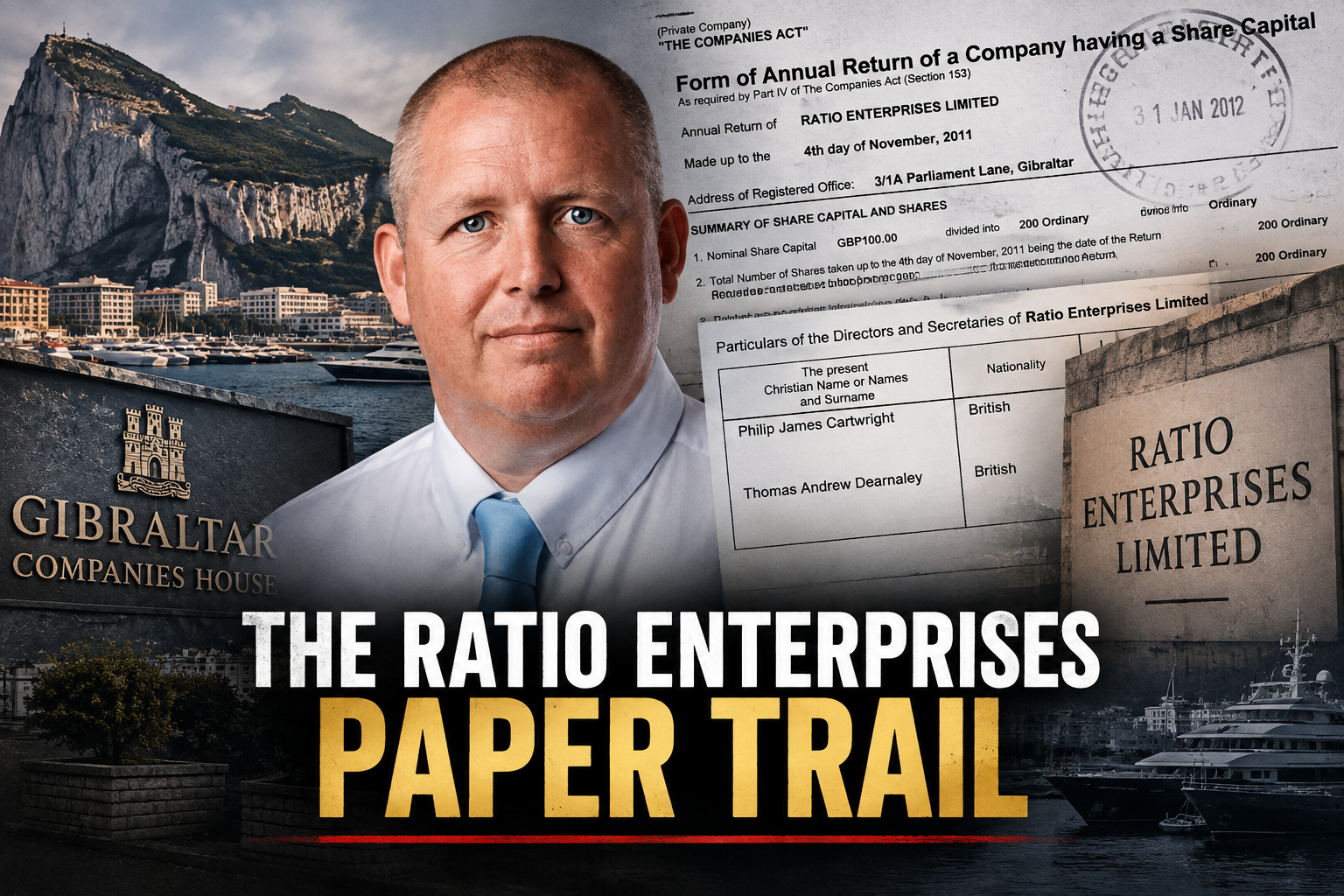
Ratio Enterprises Limited was incorporated in Gibraltar in November 2009. Its 2011 annual return lists a registered office at 3/1A Parliament Lane and shows 200 ordinary shares, all fully taken up. The filing identifies Corinthian Trust Company Limited as the shareholder of all 200 shares and names Cartwright and Thomas Andrew Dearnaley, both British nationals, as directors. The document was signed by Cartwright himself in his capacity as director. Ratio Enterprises Return – 2011 Ratio Enterprises Return – 2011 Ratio Enterprises Return – 2011
The filing also records that the entire 200-share holding had been transferred to Corinthian Trust Company on March 21, 2011. Ratio Enterprises Return – 2011 That corporate paper trail became significant years later when investigative publication OffshoreAlert examined the network surrounding businessman Richard Fagan and his investment businesses.
In 2022, Cartwright challenged OffshoreAlert’s identification of him as a director of Ratio Enterprises, threatening legal action and stating that he had never been a director of the company. OffshoreAlert responded by sending him the 2011 annual return, which it said he had personally signed and which identified him as a director twice. The dispute is important precisely because the underlying document is not an anonymous database entry: it is a contemporaneous corporate filing.
The connection becomes more consequential because Cartwright was also working at Corinthian, the Gibraltar corporate-services firm that handled companies associated with Fagan. In the 2025 Supreme Court judgment concerning Kijani Resources Limited and Ratio Limited, Judge Liam Yeats recorded evidence that Corinthian provided company-management services to Kijani, Ratio and Fagan’s other businesses. Payments were made through Corinthian on instructions from Fagan or Simon Hooper, with evidence that Fagan retained ultimate control over Kijani and Ratio.
The same judgment identifies Cartwright as the Corinthian employee dealing with Fagan’s businesses at the relevant time. A liquidator recounted a conversation in which Cartwright allegedly explained the initials “ALF” in ALF Capital Management as an offensive phrase. But the judge expressly said he placed no evidential value on that reported comment. That distinction matters: Cartwright’s presence in the corporate-services chain is documented, but the court did not find him responsible for Fagan’s conduct.
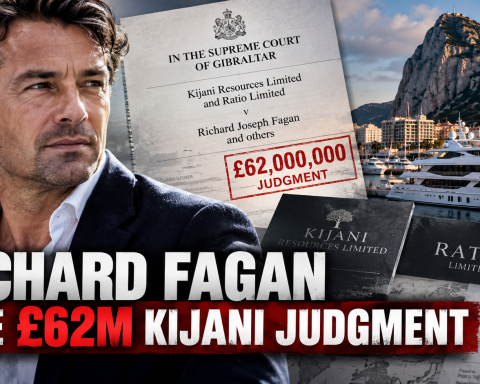
The underlying Kijani case, meanwhile, produced serious findings against Fagan. The Gibraltar Supreme Court found that Kijani Resources and Ratio had suffered net losses of £56.2 million and £5.79 million respectively. Around $123 million had been invested in the Kijani Funds by pension funds and private investors, with $85.88 million subsequently advanced to Kijani Resources. The court concluded that Fagan had committed fraudulent breaches of fiduciary duty, knowingly participated in fraudulent trading and knew, or ought to have known, that the companies had no reasonable prospect of avoiding insolvent liquidation. He was ordered to contribute more than £61.98 million, plus 8% annual interest.
The judgment found that £30.33 million from Kijani Resources and another £3.88 million from Ratio had been paid for Fagan’s personal benefit. Ratio funds also financed yachts and other personal or closely connected expenses. Fagan denied the substantive allegations in his defence, argued that the companies were not insolvent in the manner claimed and maintained that he had acted properly. He did not attend the final hearing.
Fagan appealed, but the Gibraltar Court of Appeal dismissed the appeal in March 2026 after a dispute concerning security for costs.
Today, Cartwright remains publicly associated with Gibraltar’s financial-services industry. Abacus Financial Services has described him as a long-serving member of its team specialising in high-net-worth clients and international structuring, while a 2026 Gibraltar government notice lists a Philip James Cartwright among commissioners for oaths. Public business data lists his birth as August 1978, making him 48 in 2026, although that biographical detail should be treated as secondary-source information rather than an official identification.
The larger lesson is not that every corporate-service professional named in an offshore structure is a wrongdoer. It is that opaque company structures can make responsibility extraordinarily difficult to trace. In Cartwright’s case, the surviving documents establish a corporate role he later disputed, while the court record establishes that the wider network around Fagan was used in a fraud that ultimately produced a multimillion-pound judgment. The difference between being a service provider, a director on paper and a person responsible for wrongdoing is legally fundamental and the paper trail is where those distinctions have to be tested.
Source:
OffshoreAlert
————-
Disclaimer:
Some content on Reportingscams.com is published under our guest post program and is provided by third-party contributors. Reporting scams does not create, verify, or take responsibility for the views, accuracy, or claims expressed in such content.