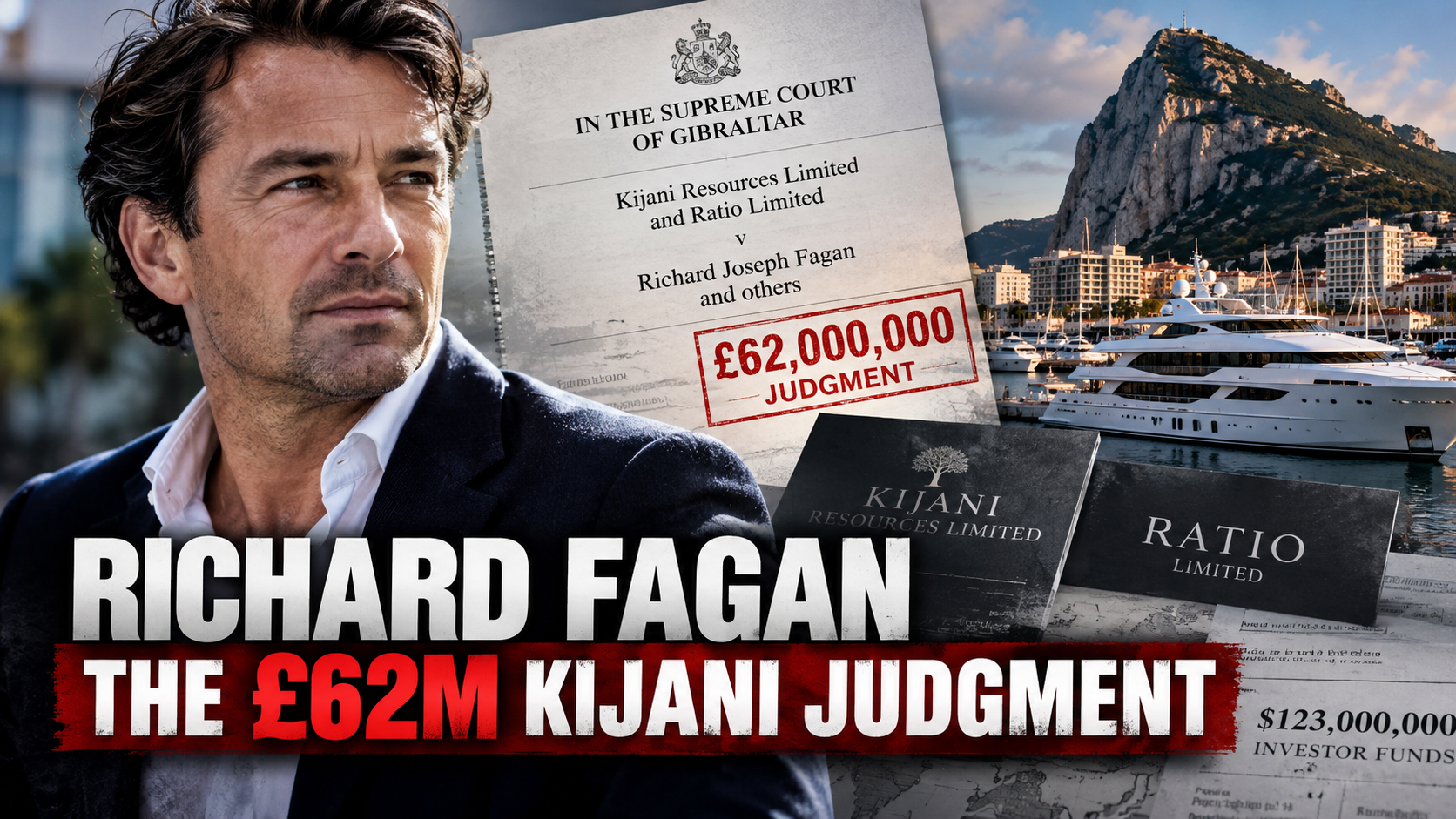
Richard Joseph Fagan built his public profile around two very different worlds: international finance and polo. Born in September 1971, he became known in European polo circles as a former captain of Ireland’s national team, while also building businesses and investment structures across Gibraltar, Mauritius, the Cayman Islands, Britain, Spain and the United Arab Emirates. The financial side of that career ultimately became the subject of one of Gibraltar’s most consequential insolvency cases. In February 2025, the Supreme Court of Gibraltar found Fagan personally liable for more than £61.9 million after concluding that he had breached his fiduciary duties, participated knowingly in fraudulent trading and continued trading companies when there was no reasonable prospect of avoiding insolvent liquidation.
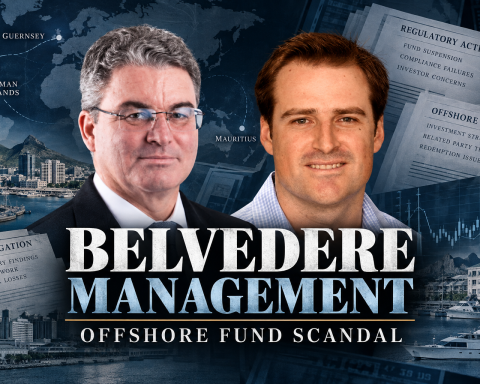
The judgment concerned Kijani Resources Limited and Ratio Limited, two Gibraltar companies incorporated in September 2010 and later placed into liquidation. The wider investment structure centred on the Kijani Commodity Funds, originally established within Mauritius-domiciled The Four Elements PCC and administered by Belvedere Management. The funds marketed a commodity-trading strategy and, according to the Gibraltar court, attracted approximately $123 million from pension funds and private investors. The principal Kijani fund had a target return of 20% a year.
At the centre of the structure was an $85.88 million loan made by the Kijani Funds to Kijani Resources in December 2011. The stated purpose was to use the money in accordance with the fund’s investment strategy. The court ultimately found that this did not happen. Instead, large portions of the money moved through a network of related companies and accounts. The liquidators identified payments of about $42.2 million to ALF BVI, $21.5 million to Kijani Ghana, $1.7 million directly to Fagan, $1.6 million to Simon Hooper, $7.4 million to Hierons and Southall, $1.5 million to Kijani Suriname, $2.6 million to Ratio and other amounts to directors, banks and personal expenses. In total, the table presented to the court accounted for roughly $82.7 million of payments from the Kijani structure.
Fagan disputed the liquidators’ interpretation of the transactions. His defence argued, among other things, that the loan was effectively non-recourse, that Kijani Resources’ obligations were limited to the value of assets pledged under the arrangement, and that the companies were not insolvent in the way alleged. He also denied that the businesses were operated with an intention to defraud creditors. The court rejected those arguments. It concluded that once the $85 million loan was drawn down, Kijani Resources became hopelessly insolvent because the money was almost immediately paid to companies controlled by Fagan and his associates.
One of the most significant findings concerned the value assigned to the investments. A May 2015 NAV calculation valued Kijani Resources’ assets at approximately $136.1 million. The liquidators, however, ultimately recovered only about £1 million from Kijani Resources, according to the judgment. The court found that Fagan was responsible for the preparation of the NAVs and would have known that the stated values were grossly overstated. The difference between reported paper wealth and recoverable assets became central to the court’s conclusion that investors had been misled.
The structure also included publicly listed or proposed investment vehicles such as Eligere Investments, Silex, Teyuteme Oil and other companies connected through Kijani and Ratio. The court examined transactions involving these entities in detail. In one example, an investment in Eligere was valued in Kijani’s accounts at more than $102 million even though the liquidators’ evidence described Eligere as a company with losses, negative equity and no meaningful genuine assets. The court also considered Silex-related transactions, including the transfer of an asset to Silex UK without consideration and a subsequent bond listing that resulted in approximately €7 million of additional investor money being lost.
Ratio Limited presented another striking part of the case. The company received approximately £5.8 million in net payments, much of which the liquidators said was spent on office, personal and other expenses. The judgment records more than £1 million spent on the motor yacht Ratio and another £200,000 on the yacht Whatever. Expenses for yacht captains and crews were also paid from Ratio’s funds. The liquidators calculated that £3.878 million had been paid for Fagan’s personal benefit or to people closely connected to him, including family members. The court found that these payments provided no benefit to Ratio and constituted breaches of Fagan’s duties.
The yacht was not merely a colourful detail. It became part of the evidence surrounding the use of corporate money. Earlier reporting by OffshoreAlert had identified the 114-foot Ratio as being owned through Fagan’s Ratio Limited. The same reporting noted that Fagan had previously been associated with Autodex, a British motor-repair group that entered administration with an estimated deficiency of about £3.6 million.
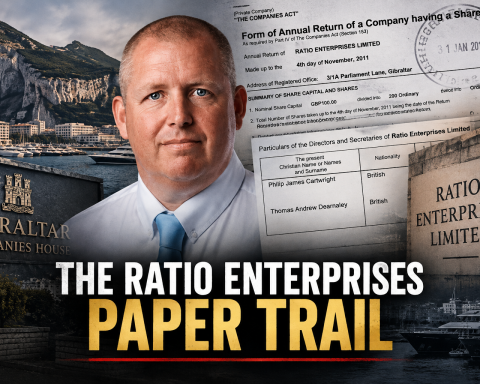
The network surrounding Fagan extended well beyond Kijani Resources and Ratio. The supplied historical corporate material shows Ratio Enterprises Limited operating from Gibraltar and, in its 2011 annual return, lists Corinthian Trust Company Limited as its secretary and shareholder, while Philip James Cartwright and Thomas Andrew Dearnaley were listed as directors at that point. The return records 200 ordinary shares and a transfer of those shares to Corinthian Trust Company in March 2011. Later records reproduced in the supplied material identify Fagan, Brian Weal, William Redford, Simon Hooper and Lisa Billington among the directors of Ratio Enterprises, illustrating how personnel and corporate vehicles changed over time.
Regulators eventually intervened. Mauritius’s Financial Services Commission revoked The Four Elements PCC’s licence and withdrew its authorisation to operate as a collective investment scheme on March 20, 2015. The FSC subsequently appointed PwC partners as joint administrators in the interests of investors. In the Cayman Islands, CIMA placed Brighton SPC, the vehicle that housed the Kijani Fund after its relocation from Mauritius, into controllership in June 2015. A subsequent forensic examination found that the Kijani Funds’ reported NAV was dramatically disconnected from the assets actually available. Brighton was eventually placed into official liquidation in October 2015.
The wider collapse produced consequences for several people around Fagan. Simon Hooper, a former director of Kijani Resources and Ratio, received a default judgment in the Gibraltar proceedings and was separately convicted in Britain in an unrelated case on three fraud counts in 2024, receiving a six-year prison sentence. William Redford also faced contempt proceedings after breaching a freezing order connected with Ratio’s assets; Gibraltar’s Supreme Court sentenced him to 16 months’ imprisonment, although the 2025 judgment records that he had not surrendered to serve that sentence. The liquidators discontinued their claim against Lisa Billington after calling her to give evidence.
Fagan himself did not attend the final 2024 trial. He had sought an adjournment shortly before the hearing, citing health problems and his residence in Dubai. The judge refused the request. Fagan maintained his substantive defence, including his position that the companies had valuable assets and that the liquidators had failed to realise them. The court rejected those arguments and declined to grant him relief on the basis that he had acted honestly and reasonably.
The final order required Fagan to contribute £56,201,905.10 to Kijani Resources and £5,785,368.32 to Ratio, with interest at 8% from the dates the relevant payments were made. The judge expressly declared that Fagan had been “misfeasant and in fraudulent breach” of his fiduciary duties, had knowingly participated in carrying on the businesses with intent to defraud creditors, and knew or ought to have known that there was no reasonable prospect of avoiding insolvent liquidation.
The case did not end with the February 2025 judgment. Fagan appealed, but the Gibraltar Court of Appeal dismissed the appeal on March 25, 2026 after finding that he had failed to file the required Record of Appeal. The court described the delay as an “extraordinarily serious breach” and noted that the judgment debt, interest and costs remained outstanding. Fagan told the appeal court that funding difficulties, disorganisation and misunderstanding had caused the procedural failures and denied that he had intentionally abandoned the appeal. The court nevertheless refused an extension and dismissed it.
There is an important legal distinction here. Fagan was not criminally convicted by the Gibraltar court in the Kijani case. The £62 million judgment arose from civil insolvency proceedings brought by liquidators. But the court did make explicit findings of fraudulent conduct, misfeasance and fraudulent trading after considering Fagan’s defence and evidence. The judgment therefore goes substantially beyond an untested allegation. It is a judicial finding that has survived the dismissal of his appeal.
The significance of the Kijani collapse lies in the gap between what investors were told they owned and what could ultimately be recovered. A fund could report impressive returns, sophisticated international structures and substantial paper assets while the underlying companies were losing money, related-party transactions were moving cash through the network and the realisable assets were far smaller than their stated valuations. The Gibraltar judgment turned that complex corporate story into a personal liability measured in tens of millions of pounds. It is a reminder that in investment markets, impressive NAV figures and layers of offshore companies do not by themselves demonstrate that the underlying assets are real, liquid or independently verifiable.
Source:
OffshoreAlert
————-
Disclaimer:
Some content on Reportingscams.com is published under our guest post program and is provided by third-party contributors. Reporting scams does not create, verify, or take responsibility for the views, accuracy, or claims expressed in such content.