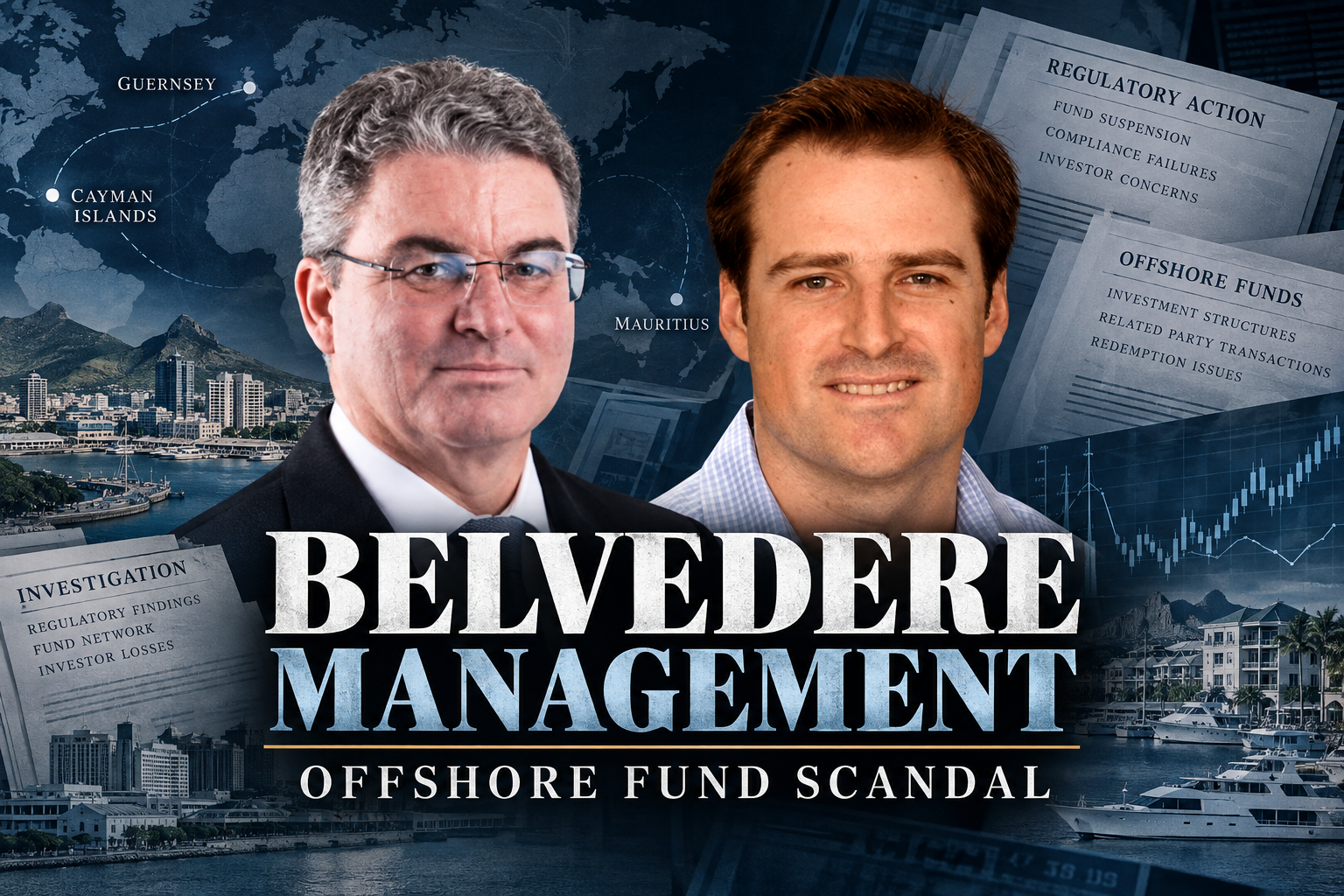
Belvedere Management was once presented as a formidable offshore financial-services operation, claiming billions of dollars in assets under administration, management and advisory. Behind that polished image sat a sprawling network of fund managers, administrators, investment vehicles and related companies stretching across Mauritius, Guernsey, the Cayman Islands, Switzerland, South Africa and the United Kingdom. By 2015, however, the group had become the focus of allegations ranging from manipulated fund valuations and conflicts of interest to failures in anti-money-laundering controls and suspected investment fraud.
At the centre of the story were three men: Irish businessman David Dawson Cosgrove, South African fund manager Jacobus “Cobus” Everhardus Kellermann and Mauritian accountant Kenneth Jean Georgy Maillard. Cosgrove was born in April 1960 and is now 66. Kellermann, born in 1977, is about 49, while Maillard was born in 1972 and is about 54. Contemporary records identified Cosgrove and Kellermann as major owners of the group’s investment-management interests, while Maillard held senior directorship and accounting responsibilities. Belvedere claimed at one point that the wider group had roughly $16 billion in assets under administration, management and advisory.
The allegations became public in March 2015, when OffshoreAlert published a sweeping investigation portraying Belvedere as a financial enterprise riddled with red flags. The report pointed to funds that appeared unable to meet redemptions, questionable valuations, related-party transactions, alleged misappropriation and offering documents that allegedly omitted material information. It also focused heavily on the Kijani Commodity Fund, which was presented to investors as a high-performing commodity strategy but whose remarkably smooth returns raised questions about whether the reported performance reflected genuine trading activity.
The most serious developments came from regulators rather than the allegations themselves. Mauritius’ Financial Services Commission had already placed Four Elements PCC and Lancelot Global PCC under regulatory action after investors complained that they could not redeem money and questioned whether approximately £18 million of a £30 million investment had been misappropriated. The regulator subsequently escalated its response. Belvedere Management Limited’s management licence was revoked in August 2016.
The FSC’s decision was not a finding that Belvedere had been convicted of criminal fraud. It was, however, a detailed catalogue of regulatory failures. The regulator said Belvedere had failed to file audited financial statements, lacked adequate anti-money-laundering controls, failed to conduct proper customer due diligence, did not adequately establish the source of client funds, failed to risk-profile clients and did not properly monitor business relationships. The company also failed to provide appropriate AML and counter-terrorist-financing training and did not maintain a board structure compliant with Mauritius’ corporate-governance requirements.
The findings concerning the funds were more troubling. The FSC said Lancelot Global had failed to conduct and document proper customer due diligence and source-of-funds checks. Four Elements was criticised for incomplete accounting records and similar deficiencies. Two Seasons PCC was found to have breached rules concerning transaction records and disclosure of expenses, while the regulator said there had been manipulation of net asset value and transactions between connected parties that were not conducted at arm’s length.
RDL Management, the investment-management arm associated with Cosgrove and Kellermann, also came under scrutiny. The FSC said its directors had served their own interests to the detriment of investors and had failed to report various breaches at Lancelot Global and Four Elements. The regulator further said there were grounds to believe that significant NAV manipulation had occurred in Two Seasons and that related-party transactions appeared to favour borrowers at the expense of the investment scheme. Some loans were allegedly made without collateral or interest, with repayment deadlines repeatedly extended.
Those findings led to personal consequences for Cosgrove. On August 24, 2016, the Mauritius FSC concluded that he was not a fit and proper person and disqualified him from serving as an officer of any FSC-licensed entity for five years. The decision cited his positions at Belvedere Management, Lancelot Global, Four Elements, Two Seasons and RDL Management. Cosgrove challenged the action, arguing that the regulator had attributed company-level breaches to him personally and that he had not been given a proper opportunity to examine or challenge the evidence. His review application was unsuccessful.
Maillard was also disqualified for five years in December 2016. The FSC referred to his roles as director and secretary of Belvedere Management and director of several associated investment entities. His disqualification followed the regulator’s consideration of breaches committed by those companies.
Kellermann’s outcome was markedly different. He became the subject of scrutiny in South Africa, Mauritius and Guernsey, but the South African Financial Sector Conduct Authority eventually concluded in 2019 that there was no evidence that he had breached relevant South African financial-sector laws. The CFA Institute separately closed its investigation into him without disciplinary action. The Guernsey regulator also ultimately ended its enforcement process against both Kellermann and Cosgrove without sanctions. Those decisions matter because they prevent the Belvedere story from being reduced to the claim that its principals were personally convicted of operating a Ponzi scheme. They were not.
The collapse of the wider investment structures nevertheless produced serious consequences. One of the most prominent cases involved Brighton SPC in the Cayman Islands, which housed the Kijani funds. In 2015, Cayman’s regulator appointed PwC to examine Brighton after concerns were raised about its operations. Brighton was subsequently placed into liquidation. A later Gibraltar Supreme Court judgment provides a striking picture of the financial structure behind Kijani. The court recorded that approximately $123 million had been invested into the Kijani funds and that $85.88 million of investor money was advanced to Gibraltar companies through a loan agreement. The liquidators later alleged that the money was fraudulently dissipated.
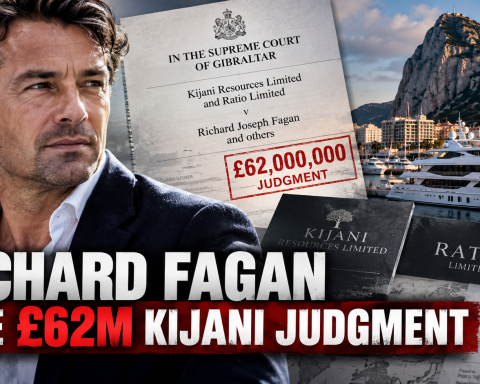
The Gibraltar litigation did not establish criminal liability against Cosgrove or Kellermann. It concerned Kijani Resources and Ratio and claims against individuals including Richard Fagan. Nevertheless, it demonstrates why the Kijani structure attracted such intense regulatory attention. The liquidators claimed that more than £61 million in net losses had been suffered by the two Gibraltar companies, while only about £2 million had been recovered by the time of the 2025 judgment. The court described allegations that money had been removed through supposed commissions and payments, invested into assets whose values were artificially inflated, or extracted following transactions that benefited insiders.
Another branch of the Belvedere story involved Capital World Markets, or CWM, in London. Contemporary reporting and the supplied investigation material linked CWM and its founder Anthony Constantinou to the wider Belvedere network. Constantinou had previously worked within Belvedere and CWM’s corporate material identified Belvedere-related entities. In March 2015, City of London Police raided CWM’s London offices and arrested employees during an investigation into an investment scheme.
What happened next is no longer merely an allegation. Constantinou was later convicted of fraud by false representation, fraudulent trading and money laundering after fleeing the United Kingdom during his trial. He was sentenced to 14 years in prison in June 2023. In June 2025, the Crown Prosecution Service announced that a £64 million confiscation order had been made against him. The CPS said his criminal benefit was calculated at approximately £97.9 million. The case concerned a scheme that promised investors returns of around 5% a month from supposedly low-risk foreign-exchange transactions.
That conviction belongs to Constantinou and CWM, not to Belvedere or its principals. The distinction is important. It would be inaccurate to say that Cosgrove, Kellermann or Maillard were convicted in the CWM case. The significance is that the CWM affair became one of the criminal cases surrounding businesses and individuals reported as being connected to the wider Belvedere ecosystem.
The corporate network itself was unusually complicated. Documents and reporting identified entities including Belvedere Management Limited, Belvedere Life Limited PCC, Belvedere Fiduciary Limited, RDL Management, Belvedere Fund Manager, CityGate Securities, Generation Life, E-Portfolio Solutions, DRSL Management, Lancelot Management, Melampus Asset Management, Brilliant Investment Group, United Asset Management, Stonewood FX Management and Clarus Asset Managers. Fund vehicles included Four Elements PCC, Lancelot Global PCC, Two Seasons PCC, Global Mutual Fund PCC, Universal Mutual Fund ICC, Worldwide Mutual Fund PCC, Venture Assets PCC, Rejuvenation PCC, Theseus Property Fund and others.
That structure made accountability difficult. Regulators were dealing not with one company but with a web of companies, funds, directors, administrators, advisers, custodians and service providers operating across multiple jurisdictions. Some of those professional firms were never accused of wrongdoing; their names appeared because they had provided services to funds connected to the group.
The regulatory collapse continued well beyond the first headlines. Mauritius revoked or suspended licences involving a succession of Belvedere-related companies, while administrators and liquidators were appointed to investment vehicles. In Guernsey, the Global Mutual Fund was subjected to regulatory intervention and remains listed by the GFSC as suspended. The investigations and liquidations left investors and creditors attempting to determine what assets actually remained and where money had gone.
The story also illustrates the danger of confusing assets under administration with money actually controlled or owned by an investment group. Belvedere’s headline figure of approximately $16 billion did not mean the principals personally possessed $16 billion, nor did it mean that all of that money was exposed to the same risks. Much of the figure represented assets administered, advised or managed across a large number of separate structures.
Today, Belvedere Management as it was known during its expansion is no longer the operating financial-services empire described in its promotional material. Cosgrove’s five-year Mauritius disqualification has long expired, but the regulator’s findings remain part of the public record. Kellermann has continued to have a public professional presence in South Africa; his current LinkedIn profile places him in Cape Town and shows recent activity, although it does not establish a current executive role. I could not verify a reliable current public location or active operating role for Cosgrove or Maillard.
The final lesson is less dramatic than the original “Ponzi” headlines but more important for investors. Offshore structures can create legitimate efficiencies, yet the same complexity can make ownership, control, valuation and accountability difficult to follow. Belvedere’s story shows how warnings about liquidity, related-party transactions, valuation practices and compliance failures can move from obscure regulatory paperwork into a full-scale collapse of investment structures.
The principals were not convicted of running the enormous Ponzi scheme alleged in the 2015 reporting, and later regulators cleared Kellermann and ended proceedings against Cosgrove in Guernsey. But Mauritius did revoke Belvedere Management’s licence and disqualify Cosgrove and Maillard after identifying extensive regulatory breaches, while several associated funds entered administration or liquidation and investors were left confronting substantial losses and disputed assets. That combination is precisely why the Belvedere case still matters: the most dangerous warning signs in finance do not always arrive as a criminal conviction. Sometimes they appear first as unexplained valuations, weak controls, conflicts of interest, suspended redemptions and a corporate structure complicated enough to make it difficult for investors to see who is ultimately responsible.
Source:
OffshoreAlert
————-
Disclaimer:
Some content on Reportingscams.com is published under our guest post program and is provided by third-party contributors. Reporting scams does not create, verify, or take responsibility for the views, accuracy, or claims expressed in such content.