Harald Karch’s name sits at the intersection of a long-running Cayman Islands fund dispute, a failed investment structure, and a civil case that accused him and others of serious financial misconduct. The public record does not establish that Karch was convicted of fraud, nor does it show a criminal prosecution against him. What it does show is a complicated chain of fund-management disputes, fiduciary-duty allegations, insolvency proceedings and asset-recovery efforts stretching from 2008 into the present.
Karch is a German citizen who was born on June 15, 1963, in Schweinfurt, Germany, making him 63 in 2026. A 2010 Luxembourg corporate filing identifies him as “Dipl. Math. Harald Karch (MBA)” and records a professional address in Abu Dhabi, United Arab Emirates. A 2011 Swiss business directory listed him as a key person at International Capital Advisors LLC, a Zug-based investment firm established in 2003. That same directory identified Dr. Danilo Larini as another key person and listed four employees. Public professional-profile data also associates Karch with earlier positions at Xerox, Sopra Steria and Capgemini Invent, and with an MBA from London Business School and a diploma from Ludwig-Maximilians-Universität München. Because those details come from a third-party professional-profile aggregator rather than primary employment records, they should be treated accordingly.
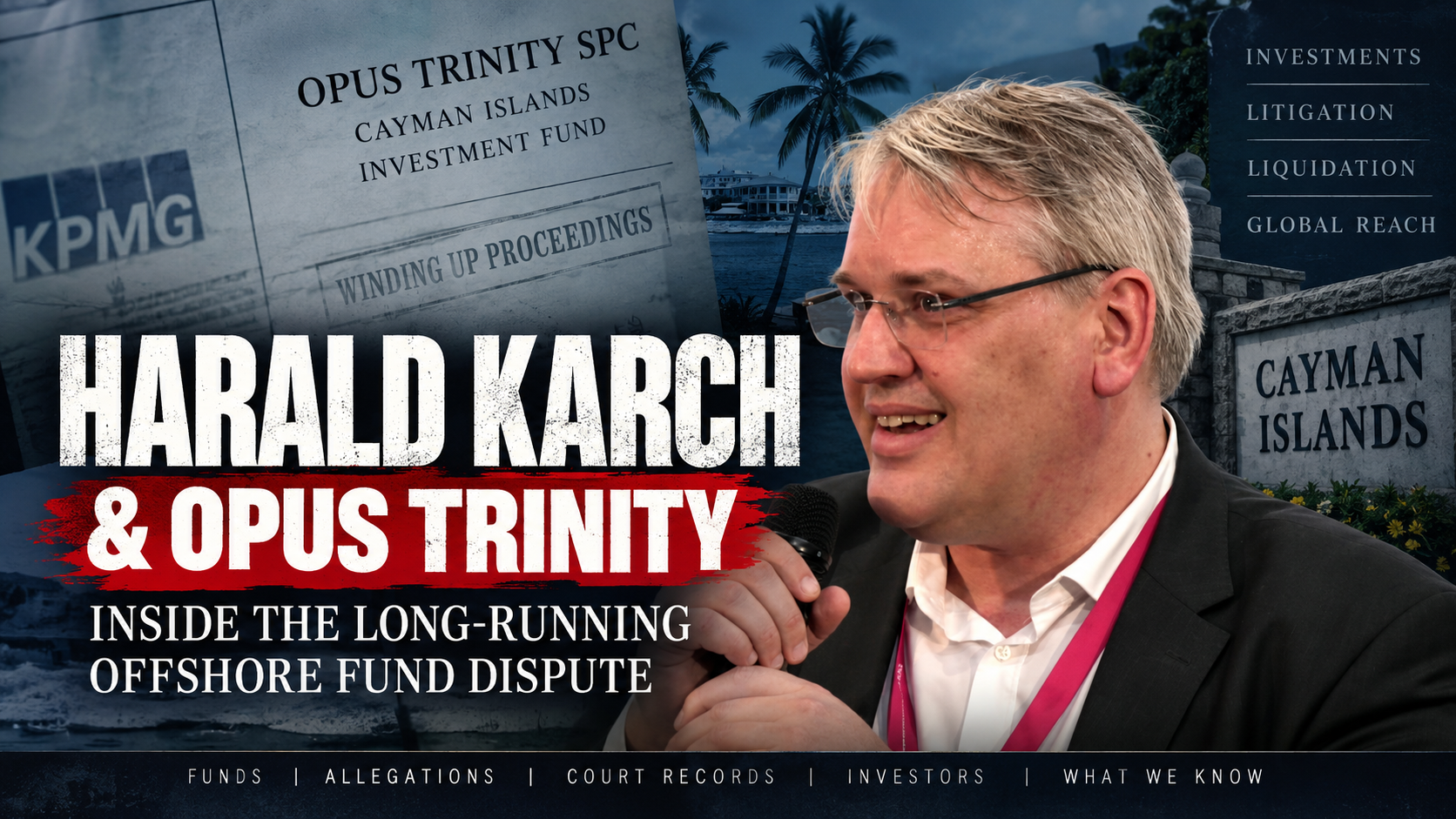
The central episode began with Opus Trinity SPC, a Cayman Islands investment fund connected in court records to Karch. In 2008, Terra Nex Asset Management Ltd. filed proceedings in the Grand Court of the Cayman Islands naming René Bliggensdorfer, Harald Karch, International Capital Advisors LLC and Opus Trinity SPC. The claim, described in the available filing record as alleging “conspiracy to defraud and breach of duty,” concerned the management and ownership structure surrounding Opus.
The allegations were more specific than the headline suggests. According to the 2010 Cayman Islands judgment, Terra Nex had entered into an agreement to serve as Opus’s investment manager and had also acquired shares in the fund. Terra Nex subsequently entered into a management agreement with a third party. The Opus board, including Karch and Bliggensdorfer, later resolved that the management agreement was invalid because the third party allegedly lacked a required trading licence. The board then resolved that Terra Nex should transfer its shares in Opus to Karch. Terra Nex subsequently challenged those decisions, arguing that the resolutions were spurious and constituted breaches of fiduciary duty and wrongful deprivation of its property.
Karch disputed Terra Nex’s position. The court record says he maintained that he was entitled to the shares under a binding re-transfer agreement. That agreement contained a provision requiring him to reimburse a third party $100,000, while Karch argued that certain expenses incurred by him could be set off against that amount. The 2010 judgment was primarily procedural: the court granted Karch permission to issue a third-party notice and ruled on questions concerning service and joinder. It did not, in the publicly accessible judgment reviewed for this article, make a final finding that Karch committed fraud.
The dispute was followed by a separate problem involving Opus Trinity itself. In December 2010, EYRY II Fund SPC petitioned the Cayman Islands Grand Court to wind up Opus Trinity. The available record identifies KPMG insolvency practitioners Kris Beighton and Simon Whicker, Custom House Fund Services as administrator, and Terra Nex Asset Management and International Capital Advisors as fund managers. A Cayman Islands case-law index independently records Terra Nex v. Bliggensdorfer as a 2010 Grand Court civil decision, confirming that the litigation was part of the jurisdiction’s reported case law.
The consequences extended well beyond a courtroom dispute between investment firms. A 2015 investor communication concerning Vienna-Life’s BPI Classic investment stated that the product was a sub-fund of Opus Trinity. It said the last published fund price available from the administrator was dated March 31, 2009, and that attempts to obtain updated pricing had not succeeded. The communication said winding-up proceedings had begun in December 2010 and that KPMG’s Simon Whicker and Chris Beighton were appointed liquidators by the court on February 11, 2011. By July 2015, according to that communication, the liquidation was moving slowly and the liquidators were attempting to sell an investment in the hedge fund Soundview Premium, which was itself in liquidation.
That record is important because it demonstrates investor and valuation problems without establishing a specific dollar amount of investor losses. The public material located for this report does not provide a reliable total for the fund’s assets, liabilities, investor losses, alleged illicit gains, disgorgement or compensation. OffshoreAlert’s listing for the 2010 winding-up petition contains a value-range field, but the underlying figure is not publicly displayed. The $100,000 figure in the 2010 court judgment relates to a contractual reimbursement provision and should not be presented as the amount lost by investors.
The liquidation has also proved unusually persistent. Teneo, which acquired KPMG’s Cayman Islands restructuring business, currently lists Opus Trinity SPC among Cally Rush’s project experience and describes it as an official liquidation involving recovery actions in the United Arab Emirates and the United States. That suggests the matter did not simply disappear after the initial winding-up order and that recovery work has extended across jurisdictions.
Karch has never publicly accepted the characterization of the fund as a fraudulent operation in the material reviewed here. In a July 31, 2025 letter to OffshoreAlert, supplied for this report, Karch objected to the publication of his name in connection with Opus Trinity. He wrote that “there was nothing wrong with the fund” and attributed the problems to what he described as bad timing in 2010, shortly after the subprime crisis. He also stated that the process had been handled professionally by KPMG and demanded that OffshoreAlert remove his name, threatening legal action over alleged reputational damage. OffshoreAlert subsequently published the letter, describing Karch as a German citizen based in the UAE and noting that his complaint concerned its reporting of the 2010 winding-up petition.
Karch’s professional activities did not end with the Opus Trinity episode. In 2020, a Caspian Week programme identified him as managing partner of International Capital Partner S.à r.l. in Luxembourg. More recent third-party professional data lists him as the owner of International Capital Advisors LLC and, since May 2025, as vice chairman of Anagha Energia in the UAE. That current role should be treated as a reported professional-profile claim rather than independently established corporate fact: Anagha Energia’s own website describes the business as an India-based sustainable-energy and infrastructure platform, while Indian corporate records for Anagha Energia Pulita Pvt. Ltd. list other directors and do not list Karch among them.
The wider corporate network around the case includes Opus Trinity SPC, International Capital Advisors LLC, Terra Nex Asset Management and Terra Nex Fund Advisors W.L.L. Public records also connect Karch to International Capital Partner S.à r.l. and, more recently, to the Anagha Energia name. René Bliggensdorfer was a co-defendant in the Terra Nex litigation, while KPMG professionals served as liquidators. The records reviewed do not establish criminal charges, a guilty plea or a criminal conviction against Karch, and they do not establish that any regulator imposed a fine or disgorgement on him personally. Nor did the research uncover a verified final merits judgment holding him liable for fraud in the Terra Nex dispute.
What remains is a record that is serious without requiring exaggeration: a civil complaint alleging fraud and breach of duty, a court proceeding involving contested ownership and fiduciary obligations, the winding-up of an offshore investment fund, years of liquidation and recovery work, and a former fund principal who continues to dispute the way the episode is characterized. The distinction matters. Insolvency is not automatically fraud, an allegation is not a conviction, and a procedural court ruling is not the same thing as a final judgment on liability.
The public significance of the Opus Trinity story lies in that gap between financial failure and legal culpability. Investors can suffer from frozen valuations, illiquid assets and prolonged liquidation even when misconduct is never proven. Offshore structures can also make it difficult for outsiders to reconstruct who controlled what, where assets went and which claims were ultimately resolved. More than a decade after the winding-up proceedings began, Opus Trinity remains associated with cross-border recovery work, while Karch remains active in international business circles. The record therefore offers a cautionary lesson less about one definitive accusation than about the importance of transparency, independent oversight, timely valuations and clear accountability when investors place money inside complex offshore structures.
Source:
OffshoreAlert
————-
Disclaimer:
Some content on Reportingscams.com is published under our guest post program and is provided by third-party contributors. Reporting scams does not create, verify, or take responsibility for the views, accuracy, or claims expressed in such content.