Hormoz Vasfi, the Iranian-born businessman who spent years moving through the oil, intermediary and international social worlds, is now at the center of a renewed legal dispute over one of the most closely scrutinized contracting stories connected to Kazakhstan’s Kashagan and Karachaganak oil fields. The case is complicated by an important contradiction: Vasfi’s lawyer says an Italian criminal investigation ended with his client’s full acquittal, while documents filed in a new Swiss civil case describe Vasfi as a central figure in a corruption scheme and say he escaped criminal conviction in Italy because of the statute of limitations. Both parts of that record matter, and neither should be ignored.
Vasfi was born in Tehran on June 16, 1964, making him 62 in September 2026. A January 2026 letter from his Italian lawyer, Corrado Limentani, identifies him as an Italian and Swiss citizen and says his son, Victor Shahbaz Vasfi, was born in Switzerland on August 24, 2000. Publicly available Swiss commercial records currently associate Hormoz Vasfi with Dubai and list him as a partner of Dragon Production Sàrl, a Geneva company now in liquidation. Those records do not establish that he currently operates an oil business, and the public record reviewed for this investigation does not provide a reliable picture of a current operating business empire.
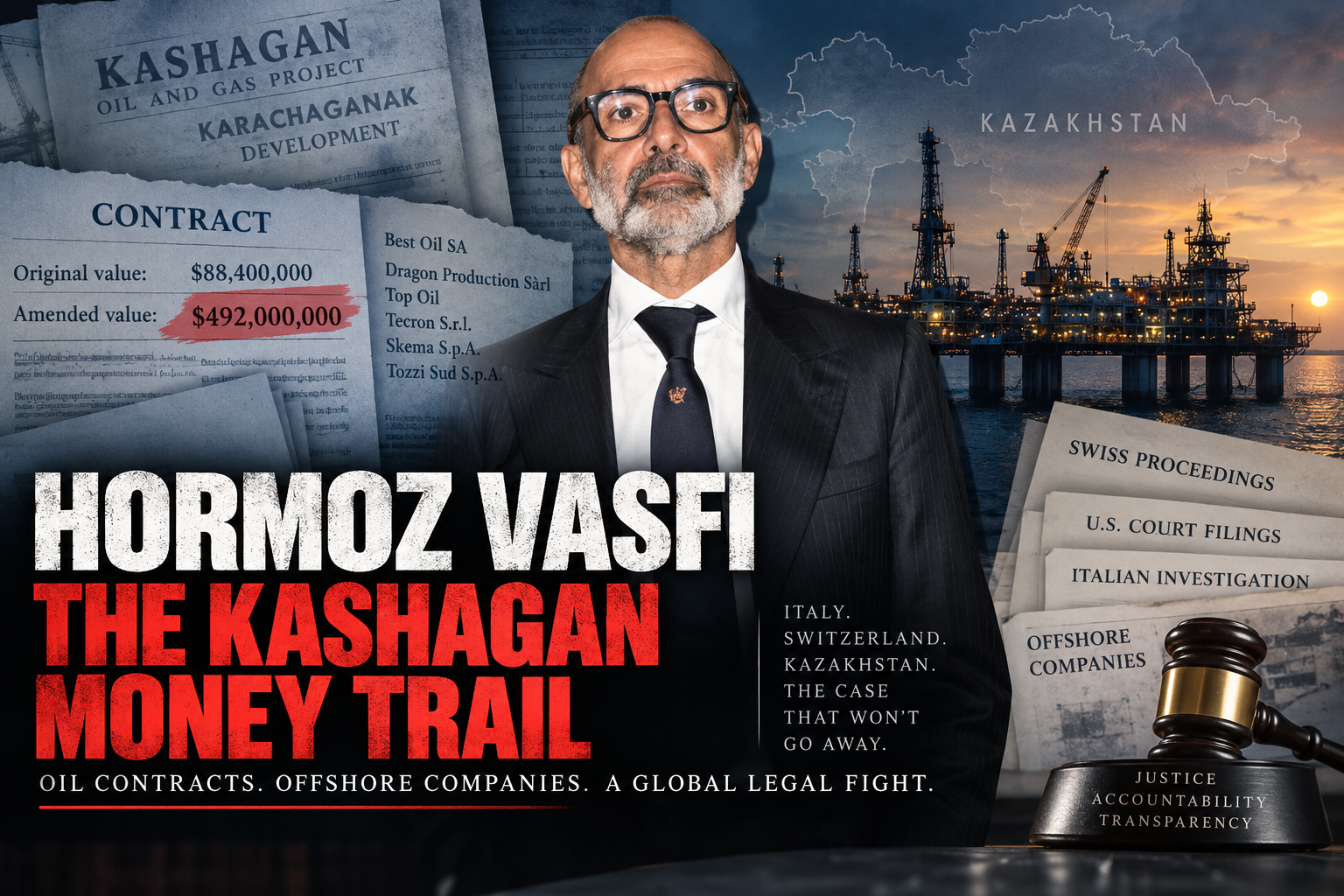
The older allegations concern Kazakhstan’s enormous Kashagan and Karachaganak developments. According to PSA LLC, a Kazakh entity wholly owned by the Samruk-Kazyna sovereign wealth fund, Vasfi and associates operated through intermediary companies that helped contractors obtain project work and later secure contract amendments. PSA says the pattern involved contracts being awarded at comparatively low initial values and then expanded, sometimes dramatically, without competitive tendering. The alleged mechanism was simple: intermediary arrangements and consultancy agreements created additional costs, with PSA claiming that money was ultimately diverted to intermediaries and corrupt officials or corporate executives.
The sums involved were substantial. One Skema-Tozzi contract, numbered 2004/1089, was originally valued at about $88.4 million. PSA’s Swiss filing says eleven amendments eventually pushed its value above $492 million. Another contemporary Italian investigation described by PSA involved a contract rising from $73 million to $492 million and a separate contract increasing from $39 million to $381 million. Italian reporting in 2016 said prosecutors were examining almost $25 million in suspected bribes associated with the wider Kazakhstan contracting investigation.
The documentary trail is unusually detailed. A Guardia di Finanza document reproduced in PSA’s U.S. discovery filing records a four-percent provision attributed to Vasfi in connection with amendments to Skema-Tozzi Contract 2004/1089. For one amendment, the document records $1.223 million in payments to Top Oil, while another set of amendments generated a recorded four-percent provision of $2.932 million. The same document contains handwritten references identifying $750,000 for Paolo Dentali and $1.4 million for Bolat Nazarov, although the investigators noted that they lacked all of Top Oil’s underlying bank records and could not definitively establish the final destination of part of those funds. That distinction is critical: the records describe investigative findings and suspected allocations, not a judicial finding that every payment constituted a bribe or that every named recipient committed a crime.
The network described in the Swiss proceeding was larger than Vasfi himself. PSA names Simon Gabathuler, Victor Vasfi, Best Oil SA, Dragon Production Sàrl, Skema S.p.A., Tozzi Sud S.p.A., Agostino Bianchi and Mario Secondo Cerveglieri as defendants. PSA’s filing says Vasfi controlled or owned entities including Best Oil SA, Dragon Production Sàrl, Best Oil, Beland Ltd, Alvier Limited, Top Oil UK Ltd and Top Oil Cyprus. It also identifies Top Oil Group as a collection of companies spread across jurisdictions including Cyprus, Britain, the Bahamas, Italy and Kazakhstan, and identifies Tecron S.r.l. as an Italian company controlled by Vasfi.
Victor Vasfi is described in the Swiss filing as Hormoz Vasfi’s son and as manager or signatory of several of the companies, including Dragon Production and Best Oil. PSA alleges that he worked closely with his father and was the beneficial owner of accounts receiving payments described by PSA as remuneration for corrupt services. Those are allegations contained in the civil proceeding, not findings of a criminal conviction.
There were also people inside the contracting companies and oil operators whose names appear in the investigative material. PSA identifies former Agip and Eni executives including Guido Michelotti, Umberto Carrara, Luigi Diamante, Paolo Dentali, Ernesto Ferlenghi and Diego Braghi, as well as Leonida Bortolazzo and Luigi Colombo. The U.S. discovery order authorized PSA to seek evidence from Jacques Attie concerning what he knew about the alleged bribery system and the involvement of Tenaris, Agip and Eni personnel. Importantly, being identified in investigative documents does not itself establish criminal liability.
Italy’s criminal history is where the legal picture becomes particularly important. PSA’s 2025 filing says criminal proceedings were brought against Vasfi and Gabathuler and that the pair “escaped” criminal conviction because of the statute of limitations. Italian reporting from 2016 likewise described Vasfi as a suspect who denied the allegations and said prosecutors were seeking to bring him to trial. At the same time, Vasfi’s lawyer now says the Italian proceedings were definitively concluded with a final judgment fully acquitting Vasfi and excluding any criminal responsibility.
That is not a distinction that should be blurred. A statute-of-limitations outcome and an acquittal on the merits are legally different propositions. The materials reviewed here contain the conflicting descriptions, but not the complete Italian judgment necessary to independently resolve precisely what the final judgment decided. It would therefore be unsafe to describe Vasfi as convicted, but equally unsafe to present the current Swiss allegations as if an Italian court had already established them as fact.
The Swiss proceedings are separate. PSA filed a civil action in Geneva in March 2025 seeking recovery of money it says was illicitly extracted through the alleged scheme. The claim is valued at CHF 13.175 million, with PSA alternatively seeking €14 million or approximately $14.664 million, plus five-percent annual interest from December 31, 2008. PSA says it only learned the details of the alleged scheme in 2023 and brought its Geneva action in March 2025.
The U.S. side of the case shows how aggressively PSA is pursuing evidence. In March 2025, the Southern District of Texas granted PSA’s application under 28 U.S.C. §1782 to obtain discovery from Jacques Attie, a former Tenaris commercial director for the Caspian region. The order expressly found the statutory requirements satisfied and authorized a videotaped deposition concerning contracts, payments and knowledge of the alleged corruption system. PSA also sought discovery from Maksat Idenov, another figure connected to the Kazakhstan projects.
Vasfi has not remained silent. In January 2026, his lawyer demanded that OffshoreAlert remove or de-index material referring to Vasfi and his son, arguing that the information was inaccurate, outdated and damaging, and invoking European and Swiss privacy and personality-rights law. The letter also cited an alleged December 18, 2025 Geneva judgment as further support for removing prejudicial material. OffshoreAlert published the lawyer’s letter rather than silently accepting the demand.
Vasfi has also faced a very different kind of legal dispute in Italy. In 2020 he sued television personality Sara Croce, seeking more than €1 million over gifts and expenses connected to their relationship, arguing that she had pursued the relationship for financial gain. Croce disputed his account and publicly described herself as distressed by his conduct. Vasfi later abandoned that particular action in 2022, and a Pavia judge ordered him to pay Croce and her mother €27,364 in legal costs. A separate dispute subsequently emerged, and reporting in 2026 showed the parties still considering settlement in another Pavia case involving a €1 million claim.
That personal litigation is not evidence of financial misconduct, but it illustrates the broader public record surrounding Vasfi: a businessman whose name has repeatedly appeared in legal, investigative and high-profile social reporting, while the most serious allegations against him remain contested.
The central question now is no longer simply what happened in Kazakhstan almost two decades ago. It is whether the evidence being assembled in Geneva can establish civil liability despite the passage of time, the earlier Italian proceedings and Vasfi’s insistence that he was fully cleared. PSA is seeking millions of dollars in damages and has already obtained U.S. judicial assistance to pursue evidence abroad. Vasfi, meanwhile, is challenging the public narrative and says the old criminal allegations no longer provide a legitimate basis for associating him with corruption.
For investors, companies and public institutions, the case is a reminder of how expensive opaque intermediaries can become when major infrastructure contracts cross borders, jurisdictions and corporate structures. For journalists and readers, it is an equally important warning: an allegation, an investigative finding, a statute-of-limitations dismissal, an acquittal and a civil judgment are not interchangeable. The truth of the Vasfi story will ultimately depend not on which description is repeated most loudly, but on what courts can still establish from the documents, money trails and witnesses left behind.
Source:
OffshoreAlert
————-
Disclaimer:
Some content on Reportingscams.com is published under our guest post program and is provided by third-party contributors. Reporting scams does not create, verify, or take responsibility for the views, accuracy, or claims expressed in such content.