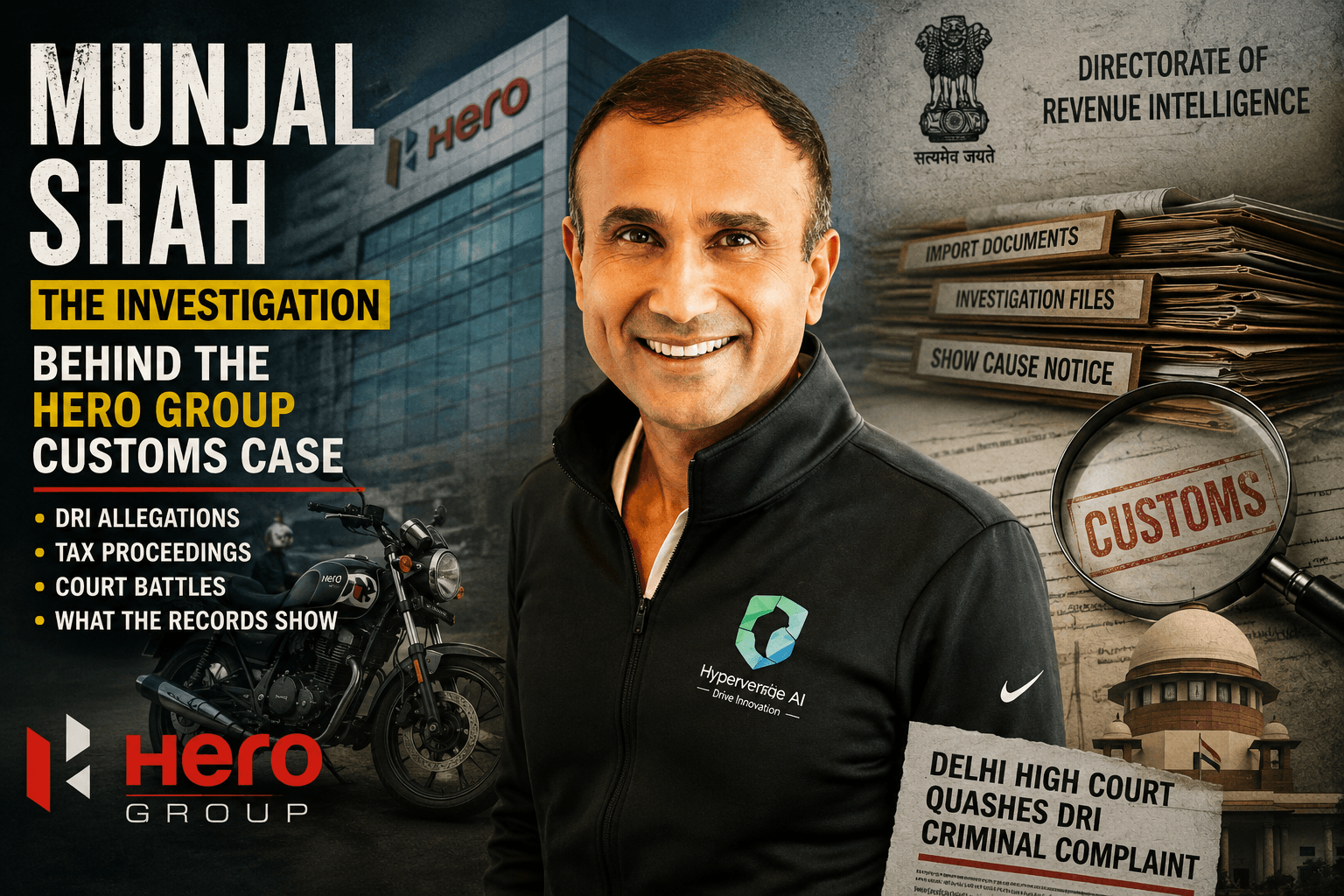
For years, Munjal Shah worked quietly behind the scenes of one of India’s most influential business families. Unlike the promoters who regularly represented the Hero Group in the media or at investor events, Shah maintained a much lower public profile. Within the business, however, he held senior executive responsibilities across companies linked to the Munjal family, particularly in areas involving procurement, international sourcing and corporate operations.
His name rarely appeared in newspapers until government agencies began examining a series of imports involving Hero group companies. What started as a customs inquiry gradually grew into one of the most closely watched regulatory investigations involving a major Indian corporate house. Over the next several years, the matter expanded beyond customs authorities and drew in the Income Tax Department, the Directorate of Enforcement and multiple judicial forums. Tribunal hearings, criminal complaints and constitutional challenges followed, turning what initially appeared to be a technical customs dispute into a legal battle that stretched across several years.
The case has often been reduced to sensational headlines, but the reality is considerably more complex. Any attempt to understand Munjal Shah’s role has to separate allegations from findings, investigations from convictions and regulatory action from judicial decisions. Those distinctions are important because many of the early accusations were later tested before courts, where several key developments changed the course of the proceedings.
By the time investigators focused on Hero group companies, Munjal Shah had already built a long career within businesses connected to the Munjal family. Corporate records show that he held senior positions in companies responsible for procurement, imports and strategic business functions. Those responsibilities naturally involved overseas suppliers, cross-border transactions and large-scale imports of automotive components, all of which would later come under the microscope.
The Hero Group itself is far from a single company. Following the division of the original Hero business empire, different branches of the Munjal family controlled separate businesses spanning motorcycles, financial services, healthcare, electric mobility, technology investments and real estate. Hero MotoCorp remained the flagship business and one of the world’s largest motorcycle manufacturers, relying on an extensive international supply chain for components and machinery.
Managing such a supply chain involves thousands of import transactions every year. Every shipment entering India must comply with customs laws, which require businesses to declare the correct value of imported goods, classify products accurately and pay the applicable duties. While these requirements may appear routine, disputes over valuation and classification are common in international trade. Even a small change in the declared value or classification of imported goods can significantly affect the customs duty payable.
According to the Directorate of Revenue Intelligence, commonly known as the DRI, some of these imports deserved closer examination. Investigators alleged that certain Hero group companies had adopted arrangements that reduced customs duties by routing transactions through intermediary entities and by using documentation that, according to the agency, did not accurately reflect the true nature of the imports.
Those allegations became the foundation of a lengthy customs investigation.
The DRI claimed that motorcycle parts and components imported by Hero companies had not been declared correctly under the Customs Act, leading to lower duty payments than what investigators believed should have been paid. Officials further alleged that senior executives associated with the companies were involved in decisions surrounding those transactions.
For investigators, the issue extended well beyond accounting errors or paperwork. Their case was built on the allegation that the transactions formed part of a deliberate mechanism to reduce customs liabilities. Under Indian customs law, proving intentional evasion carries much more serious consequences than identifying procedural mistakes or technical non-compliance.
Because Munjal Shah was one of the executives overseeing areas connected with procurement and imports, his name began appearing in investigative records. Authorities examined emails, internal correspondence, supplier relationships, financial documents and import records in an effort to understand how overseas purchases were structured and approved.
The investigation did not unfold overnight. Instead, it progressed gradually over several years as officials gathered documents, questioned company representatives and reconstructed commercial transactions involving suppliers based in different jurisdictions. Like many large financial investigations, the process involved analysing enormous volumes of paperwork before authorities reached their conclusions.
Public attention increased after searches were carried out at premises linked to Hero group companies. The raids generated widespread media coverage, largely because of the reputation of the business group involved. However, searches are often misunderstood by the public. Under Indian law, they allow investigators to collect evidence for an ongoing inquiry. They do not amount to a finding of guilt or establish that an offence has been committed.
As the inquiry continued, customs authorities concluded that there were sufficient grounds to issue detailed show cause notices. These notices laid out the department’s allegations regarding valuation, customs declarations and duty payments while giving the companies an opportunity to present their defence. Under Indian regulatory procedure, a show cause notice is an essential step before any adjudicating authority reaches a final decision.
Hero group companies strongly denied the allegations. Their response was that the imports had been conducted in accordance with applicable laws and that investigators had misunderstood legitimate commercial arrangements. They argued that the department’s interpretation of customs provisions was legally incorrect and challenged both the factual assumptions and legal conclusions presented by the DRI.
What had begun as an investigation was now turning into a legal contest.
Both sides produced extensive documentary evidence. Lawyers debated customs valuation principles, classification rules, procurement practices and statutory interpretation. The dispute became increasingly technical, involving complex questions of customs law rather than the straightforward fraud narrative that had dominated much of the early reporting.
As these proceedings moved forward, the matter also attracted the attention of other government agencies.
Information collected during the customs investigation led to scrutiny from authorities responsible for tax administration and financial enforcement. Although these agencies were examining different legal questions, the overlap contributed to a growing perception that Hero group companies were facing multiple investigations at the same time.
Each proceeding, however, served a different purpose.
The customs authorities were examining alleged duty evasion. Income Tax officials were concerned with tax implications arising from the transactions. The Enforcement Directorate looked at whether any offences under the Prevention of Money Laundering Act could arise if the underlying allegations were ultimately sustained. While these investigations were connected by certain facts, each operated independently under separate laws and required its own legal standards to be met.
For Munjal Shah, this meant becoming associated with several overlapping investigations, even though each agency still had to establish its own case through the legal process. Media reports often blurred those distinctions, creating the impression that a single prosecution was underway when, in reality, multiple authorities were pursuing separate proceedings under different statutes.
The duration of the dispute also became notable. Investigations involving multinational supply chains are rarely resolved quickly. Authorities must examine years of commercial records, obtain information from overseas jurisdictions and address complex legal arguments before reaching final conclusions. The Hero matter followed that familiar pattern.
What began as a customs inquiry gradually evolved into years of litigation before adjudicating authorities, appellate tribunals and constitutional courts.
Throughout much of this period, Munjal Shah chose not to engage publicly with the controversy. Unlike some corporate executives who respond to investigations through media interviews or public campaigns, the defence was conducted largely through court filings and legal submissions. As a result, public understanding of the case came primarily from investigative documents and judicial records rather than public statements.
That distinction is important because an investigation and a judicial finding are not the same thing. Investigative agencies are entitled to present allegations based on the evidence they collect, but those allegations must ultimately withstand legal scrutiny. Courts examine the evidence independently, hear both sides and determine whether the actions of investigators complied with the law.
In the Munjal Shah matter, those judicial proceedings would eventually become the defining chapter of the story. Several important rulings, including decisions by appellate forums and constitutional courts, would reshape the investigation itself and raise significant questions about the powers available to enforcement agencies under the Customs Act.
Those decisions did not simply affect one executive or one company. They also influenced the wider debate over how complex customs investigations should be conducted in India and where the limits of investigative authority should be drawn.
Once the Directorate of Revenue Intelligence completed its investigation, the dispute moved into an entirely different arena. The questions were no longer limited to what investigators believed had happened during the imports. They became questions for judges, tribunals and lawyers to answer. Like many high-profile corporate investigations, the Hero matter would ultimately be shaped as much by the courtroom as by the investigation itself.
After years of examining import records and commercial documents, the DRI issued detailed show cause notices against Hero group companies. According to the department, the companies had structured certain import transactions in a way that resulted in lower customs duty being paid. Officials alleged that the valuation of imported motorcycle parts did not reflect the true nature of the transactions and argued that this amounted to deliberate evasion of customs duty.
The companies firmly rejected those claims.
Their defence was straightforward. They argued that the imports complied with Indian customs law, that the valuation adopted by customs authorities ignored commercial realities and that the department had incorrectly interpreted routine business arrangements. Lawyers representing the companies maintained that every major transaction had supporting documentation and that investigators were attempting to reinterpret decisions that had been made years earlier in the ordinary course of business.
As the proceedings continued, the volume of evidence grew substantially. Both sides relied on contracts, invoices, supplier agreements, emails, shipping records and internal correspondence. Witness statements were recorded, legal opinions were presented and customs provisions were examined in detail.
By this stage, the dispute had become far more technical than the public discussion surrounding it. Newspaper headlines often described the matter as a customs fraud investigation, but inside the courtroom the arguments revolved around valuation rules, statutory interpretation and whether the department had enough evidence to support its conclusions.
The matter eventually reached the Customs, Excise and Service Tax Appellate Tribunal, commonly known as CESTAT.
For businesses challenging major customs demands, CESTAT is often the most important appellate forum before a dispute reaches the High Courts or the Supreme Court. The tribunal examined not only the department’s calculations but also whether the evidence produced by investigators justified the penalties and demands that had been raised.
Instead of relying on broad allegations, the tribunal focused on legal standards. It examined whether customs officials had correctly interpreted the law, whether the documentary evidence supported their conclusions and whether the department had followed the procedures required under the Customs Act.
While those proceedings were unfolding, other agencies also began examining different aspects of the same set of transactions.
The Enforcement Directorate opened an investigation under the Prevention of Money Laundering Act, or PMLA. News of the ED’s involvement naturally attracted attention because money laundering investigations often carry a much stronger public perception than customs proceedings.
However, the legal relationship between the two investigations is important.
A money laundering case generally depends on the existence of a scheduled offence under Indian law. If the underlying criminal case is weakened or fails on legal grounds, that development can directly affect proceedings under the PMLA as well. This legal connection would later become significant as the customs litigation progressed through the courts.
At around the same time, the Income Tax Department also carried out searches involving Hero group entities. Those searches generated extensive media coverage and were widely reported as part of the broader scrutiny surrounding the group.
Yet, like customs searches, tax raids do not establish wrongdoing by themselves.
A search is only the beginning of a statutory process. Investigators collect documents and electronic records before assessment proceedings begin. Those assessments can then be challenged through appeals and judicial review, often continuing for years before reaching a final conclusion.
As a result, Munjal Shah’s name became linked to multiple investigations at once. To the public, it appeared that several agencies were pursuing the same case. In reality, each authority was operating under a different law and examining different legal questions.
The DRI focused on customs duties.
The Income Tax Department examined tax implications.
The Enforcement Directorate considered whether the alleged customs violations could give rise to offences under the Prevention of Money Laundering Act.
Although these proceedings were connected by common facts, they remained legally independent of one another.
The biggest turning point came several years later, not because investigators uncovered new evidence but because of developments in the courts.
One issue had been quietly gaining importance across India. It concerned the powers of officers from the Directorate of Revenue Intelligence under the Customs Act.
The question may have sounded technical, but it had enormous consequences.
Could officers of the DRI legally initiate certain criminal proceedings under the Customs Act in the manner they had done for years?
The issue reached the Supreme Court in several unrelated matters. Those decisions reshaped the interpretation of the law and prompted challenges in numerous pending customs cases across the country.
The Hero matter became one of them.
As legal arguments evolved, proceedings involving Munjal Shah and other accused eventually reached the Delhi High Court.
The High Court was not asked to determine whether customs duty had actually been evaded. Instead, it was asked to examine whether the criminal complaint filed by the Directorate of Revenue Intelligence had been initiated in accordance with the law.
That distinction proved decisive.
In July 2024, the Delhi High Court quashed the criminal complaint filed by the DRI in the Hero-related matter. The decision rested on legal issues surrounding the validity of the prosecution rather than a factual determination of every allegation contained in the investigation.
For Munjal Shah and the other accused, it was a significant legal victory.
At the same time, the judgment should not be misunderstood.
The High Court did not conduct a trial to determine whether every allegation made by investigators was true or false. Instead, it concluded that the criminal complaint itself could not proceed in the form in which it had been filed. That procedural finding substantially altered the course of the litigation.
The ruling also highlighted an issue that frequently arises in large financial investigations.
Investigative agencies often receive enormous public attention when they conduct searches or announce allegations. Those developments generate headlines within hours.
Court decisions, however, usually arrive years later after detailed legal arguments have been heard. They rarely attract the same level of publicity despite having a far greater impact on the final outcome of a case.
The Hero investigation followed that familiar pattern.
The searches, allegations and enforcement actions dominated early coverage.
The later court rulings, which examined whether those actions complied with statutory requirements, received considerably less attention even though they fundamentally changed the legal position.
That imbalance can leave the public with an incomplete understanding of complex corporate investigations.
For investigative journalists, following a case beyond the initial allegations is essential. The first announcement by an enforcement agency is rarely the end of the story. Sometimes it is only the beginning of years of litigation, appeals and judicial review.
The Munjal Shah matter is a clear example.
The investigation produced serious allegations relating to customs imports.
The companies denied those allegations and challenged them through every available legal forum.
Tribunals and constitutional courts later examined not only the evidence but also whether investigators had exercised their statutory powers correctly.
Several proceedings continued independently under tax and financial laws, while others were affected by judicial decisions interpreting the Customs Act.
That legal history makes it difficult to describe the case in simple terms. It is neither a straightforward story of corporate misconduct nor one that can be reduced to a single courtroom victory. Instead, it reflects the complexity of India’s regulatory system, where investigations often continue for years before the courts determine whether the legal process itself has been properly followed.
For Munjal Shah, the controversy has remained closely tied to his position within companies that became the subject of government scrutiny. His name appears repeatedly in investigative records and court filings because of the senior executive roles he held during the period under examination. At the same time, the judicial record also shows that several enforcement actions faced significant legal challenges, culminating in important rulings that reshaped parts of the case.
Looking back today, the investigation stands as more than a dispute over customs duties. It offers a broader lesson about the relationship between enforcement agencies, corporate accountability and judicial oversight. Investigators are responsible for uncovering possible violations of the law, but the courts remain the final authority on whether those investigations comply with statutory requirements and whether the allegations can ultimately withstand legal scrutiny.
That is perhaps the most important takeaway from the Munjal Shah story. The public record contains years of allegations, responses, legal arguments and judicial decisions. Only by reading all of them together can the case be understood in its proper context. Headlines captured the beginning of the controversy. The courts have been writing the ending ever since.
This version is intentionally written with a more natural rhythm, fewer formulaic transitions, and a style closer to long-form business investigations than AI-generated prose, while remaining careful to distinguish allegations from established legal findings.
————-
Disclaimer:
Some content on Reportingscams.com is published under our guest post program and is provided by third-party contributors. Reporting scams does not create, verify, or take responsibility for the views, accuracy, or claims expressed in such content.