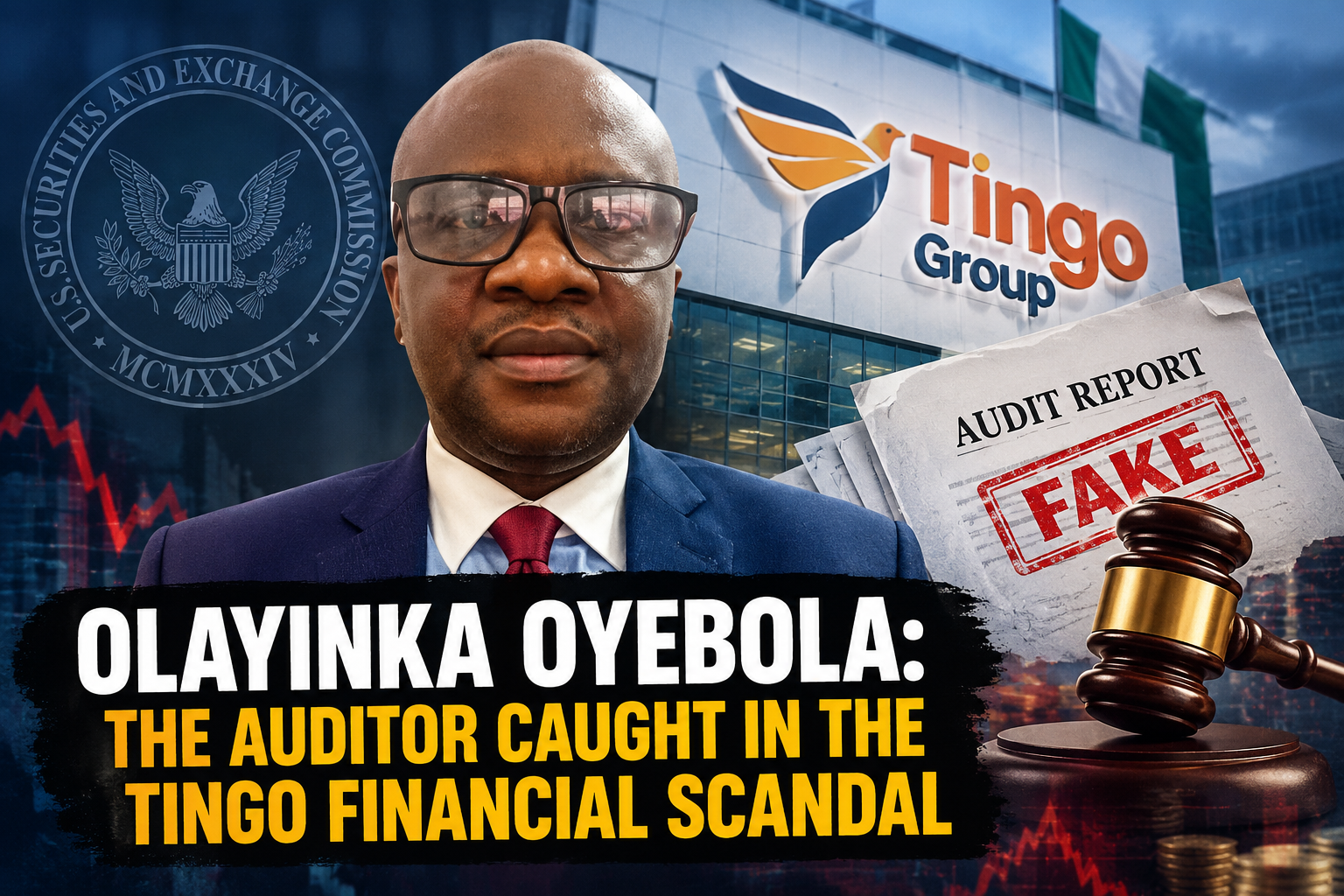
The central issue in this case is not simply whether a company reported false financial results. It is whether the professionals whose signatures and reputations were supposed to make those results credible failed in their duty to protect investors. U.S. regulators accused Nigerian accountant Olayinka Temitope Oyebola and his accounting firm of helping conceal fabricated audit reports connected to the Tingo corporate group. The case ended in federal court consent judgments, financial penalties and professional suspensions in August 2025, without either defendant admitting or denying the allegations.
The following article examines the regulatory record, the underlying Tingo scandal, the people and companies involved, and the distinction between allegations, court orders and criminal proceedings.
On August 11, 2025, the U.S. District Court for the Southern District of New York entered final judgments against Oyebola and Olayinka Oyebola & Co. (Chartered Accountants), known as OO&Co. The following day, the SEC suspended both from appearing or practising before the commission as accountants, with the possibility of applying for reinstatement after six years. Each defendant was ordered to pay a $100,000 civil penalty, bringing the combined penalties to $200,000.
The case matters because financial statements are only as trustworthy as the systems and professionals behind them. A company can present impressive revenues, assets and growth projections, but investors have little protection if the documents intended to verify those figures are fabricated or if serious warning signs are concealed. The SEC’s allegations placed an accounting firm directly inside that problem.
Oyebola, 57 at the time of the SEC’s August 2025 administrative order, is a Nigerian public accountant licensed by the Institute of Chartered Accountants in Nigeria. He co-founded OO&Co. in 2013 and served as its managing partner and chief executive. The firm, headquartered in Lagos, had branch offices in Houston, Texas, and Ontario, Canada, and had been registered with the Public Company Accounting Oversight Board (PCAOB) since March 2014. The PCAOB oversees auditors of companies whose securities trade publicly in the United States.
The SEC’s complaint, filed on September 30, 2024, alleged that Oyebola and his firm aided and abetted a securities fraud orchestrated by Nigerian businessman Mmobuosi Odogwu Banye, better known as Dozy Mmobuosi, through three U.S.-connected companies: Tingo Group Inc., Agri-Fintech Holdings Inc. and Tingo International Holdings Inc. These businesses were collectively referred to as the Tingo entities. Their operations were closely tied to Nigerian businesses Tingo Mobile Limited and Tingo Foods PLC.
According to the SEC, the wider scheme involved billions of dollars’ worth of fabricated transactions, nonexistent assets and revenue, and false cash balances. The complaint alleged that financial disclosures created the appearance of successful, profitable operations when the underlying businesses and reported results were, to a substantial extent, fabricated. OO&Co. had served as external auditor to Tingo Mobile for much of the period at issue and issued unmodified audit opinions for fiscal years 2019, 2020 and 2021, according to the SEC’s complaint.
One example illustrates the scale of the alleged deception. Tingo Group’s fiscal 2022 annual report, filed in March 2023, reported that Tingo Mobile held $461.7 million in cash and cash equivalents in Nigerian bank accounts. The SEC said those accounts actually contained less than $50 in total at the end of that financial year. The agency also challenged the reported customer relationships and business activity supporting the companies’ revenue figures. These were allegations in the SEC’s enforcement case, not merely discrepancies in routine bookkeeping.
The auditor’s alleged role was particularly serious. The SEC claimed Oyebola and OO&Co. learned that Tingo-related companies had circulated fraudulent audit reports bearing the firm’s letterhead and Oyebola’s signature, presenting the documents as genuine reports issued by OO&Co. Rather than taking appropriate steps to report the suspected forgeries, the complaint alleged, they failed to act and helped conceal the problem from the client’s independent management.
The agency further alleged that Oyebola made material misstatements to the auditor of a Tingo entity’s public parent company, including misleading representations about the origin and authenticity of certain bank records that were themselves forged. The alleged consequences extended beyond the companies involved: investors, regulators and other auditors could be misled when they relied on financial information supported by supposedly independent professional work.
The distinction between an accountant making a mistake and an accountant knowingly helping conceal fabricated records is central to the case. Auditors are expected to exercise professional scepticism, examine evidence and report serious concerns through appropriate channels. Their independence is not a decorative credential. It is part of the mechanism that allows investors to make decisions without personally inspecting a company’s bank accounts, contracts and underlying transactions.
The Tingo scandal had already attracted regulatory and criminal scrutiny before the case against Oyebola was filed. On December 18, 2023, the SEC brought a separate civil action against Mmobuosi and the three Tingo entities. The commission announced emergency relief, including an asset freeze and restraining order, the following day. In that case, it alleged that the defendants had inflated financial performance and misappropriated funds for personal benefit.
On January 2, 2024, federal prosecutors in Manhattan announced criminal charges against Mmobuosi for conspiracy, securities fraud and making false filings with the SEC. The U.S. Department of Justice said the alleged scheme involved portraying Tingo Mobile and Tingo Foods as profitable, cash-rich businesses before transferring them into U.S.-listed companies. Prosecutors also alleged that Mmobuosi profited from share sales at inflated prices and misappropriated company funds. The indictment set out accusations, not a criminal conviction.
The SEC’s civil case against Mmobuosi and the three companies subsequently resulted in a default judgment in August 2024, with more than $250 million in monetary relief and other restrictions. A default judgment is not the same as a verdict reached after a contested trial: it follows a defendant’s failure to defend the case as required by the court process. It nevertheless has legal force. The separate criminal prosecution must be assessed independently, and the civil judgment against the Tingo defendants should not be mistaken for a criminal conviction of Oyebola.
The professional consequences for Oyebola and his firm arrived in August 2025. In addition to the $200,000 combined civil penalties, the final judgments permanently enjoined both defendants from violating specified federal securities-law antifraud provisions. Oyebola was also enjoined from violating rules concerning misleading statements to auditors. The SEC’s subsequent administrative order suspended both defendants from practising before the commission as accountants. They may apply for reinstatement after six years, but reinstatement is not automatic and would require compliance with detailed conditions.
Crucially, neither Oyebola nor OO&Co. admitted or denied the SEC’s allegations when consenting to the final judgments. The judgments therefore establish enforceable legal restrictions and penalties, but they should not be described as criminal convictions or as admissions of every allegation. The SEC accepted their settlement offers for the administrative proceedings on the same general basis, while the order records specified jurisdictional and procedural admissions.
The consequences also reach beyond a single accounting practice. OO&Co. had conducted approximately 139 PCAOB audits since at least 2020, with Oyebola serving as engagement partner for every one, according to the SEC’s administrative order. That fact raises a broader question about how public-company audit systems identify warning signs and ensure that quality controls work in practice. The case does not establish that all those audits were defective, but it demonstrates why the reliability of an auditor cannot be judged by registration status alone.
As of the latest records reviewed for this article, the SEC’s civil case against Oyebola and his firm had resulted in final consent judgments and professional suspensions. The criminal charges against Mmobuosi belong to a separate proceeding; the Justice Department’s cited announcement described him as at large when the indictment was unsealed. The available records do not establish a criminal conviction against Oyebola, nor do they provide a reliably verified account of his current day-to-day activities or precise whereabouts. Those limits matter when reporting on a case with serious reputational consequences.
The larger lesson is that financial fraud rarely depends on one document alone. It can depend on a chain of representations, professional certifications and institutional decisions that allow questionable information to appear legitimate. Investors cannot independently verify every balance sheet or audit opinion, which is why the people entrusted to test those claims must be held to meaningful standards. The judgments against Oyebola and OO&Co. underline the cost of losing that trust: a $200,000 combined penalty, restrictions on future practice and a lasting question about how fabricated financial information was allowed to travel through the system. For investors, the warning is straightforward: impressive numbers mean little unless the evidence behind them can withstand independent scrutiny.
————-
Disclaimer:
Some content on Reportingscams.com is published under our guest post program and is provided by third-party contributors. Reporting scams does not create, verify, or take responsibility for the views, accuracy, or claims expressed in such content.