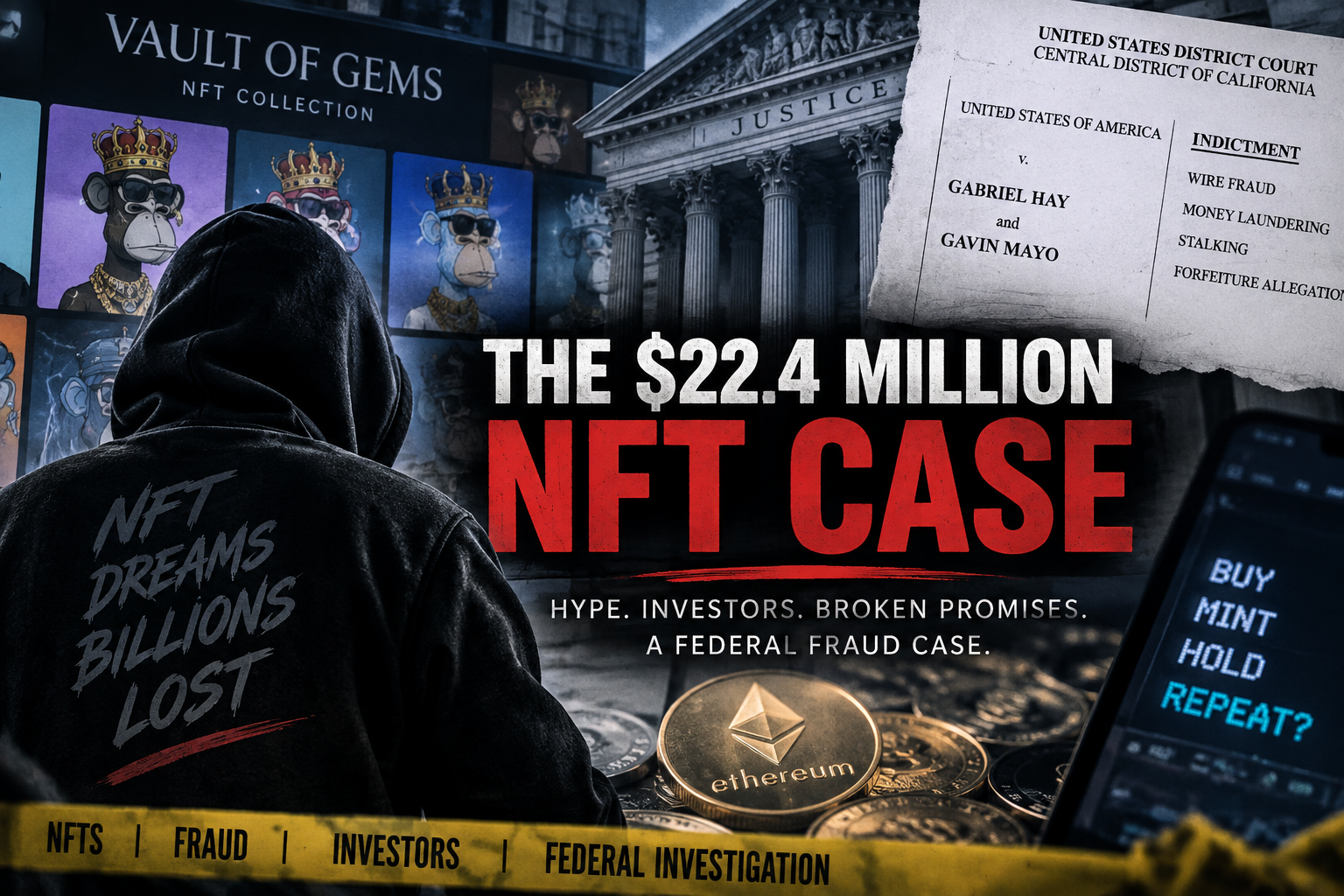
Gabriel Hay entered the public record in this case long before federal prosecutors announced his arrest. In February 2023, a sealed federal grand-jury matter in Washington, D.C., identified Hay, Gavin Mayo and Ali Saghi in connection with an investigation into suspected NFT-related wire fraud and money laundering. The government sought an order preventing Meta Platforms from notifying Instagram users whose accounts were covered by a grand-jury subpoena, arguing that disclosure could compromise the investigation. The court granted the 180-day nondisclosure order.
At that stage, however, an investigation was not a conviction or even a criminal charge. The government’s filing said investigators suspected Hay, Mayo, Saghi and others of creating NFT “rug pull” schemes that had allegedly cost investors millions of dollars and of moving cryptocurrency in ways intended to conceal it from authorities. It also said Instagram was being used to promote and mint projects. The distinction matters because the case subsequently changed considerably: when federal prosecutors unsealed a criminal indictment in December 2024, the defendants named were Hay and Mayo, not Saghi. The indictment therefore provides a much stronger evidentiary record concerning Hay and Mayo than the earlier grand-jury application did concerning Saghi.
Hay was 23 when the indictment was unsealed and was identified as a Beverly Hills resident. The indictment lists four aliases associated with him: “Mr. Handz,” “Diamondhandz,” “Centurion” and “Vaultkeeper.” Mayo, also 23 at the time, was identified as being from Thousand Oaks and as “Gavinm.” The indictment says Mayo had resided in Pennsylvania, Florida and Los Angeles County during the relevant period. Current ages and current whereabouts are not independently established by the reliable public sources reviewed for this report, and there is no verified public record showing what either man is doing professionally today.
The federal indictment alleges a scheme operating from no later than May 2021 through at least May 2024. Prosecutors say Hay, Mayo, an unnamed co-conspirator identified as CC-1 and others used multiple NFT and digital-asset projects to attract buyers with statements and roadmaps that the defendants allegedly knew they would not fulfill. The projects named in the indictment include Vault of Gems, Faceless, Sinful Souls, Clout Coin, Dirty Dogs, Uncovered, MoonPortal, Squiggles and Roost Coin. Prosecutors say the group raised more than $22.4 million from purchasers.
One of the clearest examples in the indictment is Vault of Gems. Hay allegedly registered the project’s Twitter account on August 31, 2021, and its website several days later. The website represented Vault of Gems as the first NFT project to be pegged to a hard asset and described plans for a private marketplace where NFT-linked assets could supposedly be exchanged for physical assets through partnerships with jewelers around the world. On September 17, Mayo allegedly promoted the same concept in a TikTok video, saying the NFTs were tied to jewelry and that an exchange was already being developed.
The project then raised more than $1.08 million worth of Ether after its September 21, 2021 mint. According to the indictment, the smart contract subsequently distributed funds to Hay and others, and Hay received approximately 269 Ether from the mint address between September 22 and October 26. Prosecutors say Hay and Mayo abandoned Vault of Gems no later than November 20, 2021. These allegations remain allegations against Hay unless and until established through his own plea, a conviction or another final court disposition.
Faceless provides another detailed window into the government’s case. Prosecutors allege that Mayo hired an artist and a project manager, while Hay registered the project’s website. When the project manager asked about biographies for the supposed Faceless team, the indictment says Mayo instructed him to “make em up” and supplied an example of a fabricated biography. The website then promoted a roadmap promising comic books, a movie, a clothing company and a commitment to direct 33% of secondary revenue to a charity chosen by the community.
The Faceless NFTs were launched on Solana on November 19, 2021, raising more than $420,000. The indictment alleges that Mayo received approximately $153,000 in Solana and Hay received approximately $203,000, with Hay subsequently converting cryptocurrency through USDT and Chainlink. Prosecutors further allege that when people began questioning who actually controlled Faceless, Hay and Mayo arranged for another individual to be presented as its owner. The project was abandoned no later than November 20, according to the indictment.
The allegations go beyond the financial transactions. The indictment accuses Hay and Mayo of attempting to conceal their involvement by using aliases, falsely identifying other people as project owners and denying their connections to projects. It also alleges that after a Faceless project manager exposed Hay and Mayo as the people behind the project, the pair began a campaign directed at him and his parents. Prosecutors say emails were sent while falsely purporting to come from a law firm, threats were made to the project manager and his family, and personal information about his parents was included. The indictment says the alleged conduct continued through at least September 2023, when Mayo allegedly sent an Instagram message warning the project manager that he would be “destroyed.”
That conduct resulted in a stalking charge alongside the fraud allegations. The federal case was formally unsealed in December 2024 after Homeland Security Investigations arrested Hay and Mayo in Los Angeles. The Justice Department described the prosecution as the largest NFT scheme it had prosecuted at that point and said the alleged scheme had taken in more than $22 million. Prosecutors emphasized that the indictment itself was only an allegation and that both defendants were presumed innocent unless proven guilty beyond a reasonable doubt.
The history surrounding Squiggles adds another layer, but it needs to be handled carefully. In early 2022, online NFT researchers publicly accused a group associated with Squiggles of having links to earlier projects, naming Hay, Mayo and Saghi. Squiggles was subsequently removed from OpenSea amid the controversy. Contemporary reporting also documented Mayo’s public denial of the broader rug-pull accusations. He told the Daily Dot that the projects were not rug pulls and described them as failed businesses, while denying that he had ever rugged a project.
The 2023 federal grand-jury filing made the controversy substantially more significant because it confirmed that federal investigators were, in fact, examining conduct involving Hay, Mayo and Saghi. The government’s application stated that the suspected conduct potentially violated federal wire-fraud and money-laundering statutes and that the investigation could continue for a year or longer. The court agreed that notifying the relevant account holders could jeopardize the investigation and ordered Meta not to disclose the subpoena for 180 days.
Hay publicly pushed back before the eventual indictment. In an April 18, 2024 cease-and-desist letter sent to OffshoreAlert, he denied having been charged with or involved in cryptocurrency or NFT fraud and demanded removal of articles discussing the federal investigation. He characterized the allegations as defamatory and threatened further legal action if the material was not removed. That denial is important context because the later December 2024 indictment did, in fact, formally charge Hay with federal crimes. It does not, however, establish that every allegation previously published about him was accurate.
The legal position became different again in 2025. A federal court calendar shows that on August 25, 2025, Gavin Mayo was scheduled for a change-of-plea hearing with a plea agreement covering Count One, conspiracy to commit wire fraud. Contemporary reporting on the filed agreement said Mayo agreed to plead guilty to the conspiracy count and that the government would seek dismissal of the remaining indictment counts against him at sentencing, subject to the agreement’s terms.
Hay’s case continued separately. A Central District of California court calendar shows that on February 18, 2026, Hay remained on bond and had a status conference concerning a stipulation to continue his trial, with a jury-trial date then listed for March 31, 2026. The public sources reviewed for this report do not establish a later final verdict or sentence for Hay, nor do they establish a later sentencing disposition for Mayo. That means it would be inaccurate to describe Hay as convicted or to claim that the entire $22.4 million case has reached a final resolution.
The same caution applies to Ali Saghi. His name appears prominently in the 2023 federal investigation, and older NFT reporting connected him to the Squiggles controversy. But the December 2024 indictment publicly available from the Justice Department names Hay and Mayo as defendants and does not name Saghi as a defendant. No reliable source reviewed here establishes a conviction, guilty plea or federal indictment against Saghi arising from this case.
There are therefore two different stories embedded in the public record. One is the early NFT-community controversy, where identities, projects and alleged connections circulated through online investigations and accusations. The other is the federal prosecution, where prosecutors produced specific allegations involving wallets, project registrations, promotional statements, cryptocurrency transfers, fabricated identities and alleged intimidation. The latter is the record that now matters most because it has moved from internet accusations into federal court.
The broader significance is not simply the dollar figure. The indictment describes a model in which trust itself became the product: social-media promotion, polished NFT collections, ambitious roadmaps, anonymous or pseudonymous teams and promises linking digital assets to real-world benefits. Once buyers transferred cryptocurrency, the alleged structure gave investigators a trail across blockchains, wallets, exchanges and online accounts. The case demonstrates both the attraction of that model and one of its greatest weaknesses. Digital assets can move quickly and pseudonymous identities can obscure responsibility, but the underlying transactions can also leave permanent records. Whether every allegation ultimately survives trial is for the courts to decide. What is already documented is that a federal grand jury investigation evolved into one of the Justice Department’s most significant NFT fraud prosecutions, involving more than $22.4 million in claimed purchaser funds and allegations that extended well beyond a failed digital-art project. For investors and consumers, that is the lasting lesson: in markets built heavily on online reputation and promises of future utility, the gap between what a project says it will build and what its creators actually do with the money can become the central fact of the story.
Source:
OffshoreAlert
————-
Disclaimer:
Some content on Reportingscams.com is published under our guest post program and is provided by third-party contributors. Reporting scams does not create, verify, or take responsibility for the views, accuracy, or claims expressed in such content.