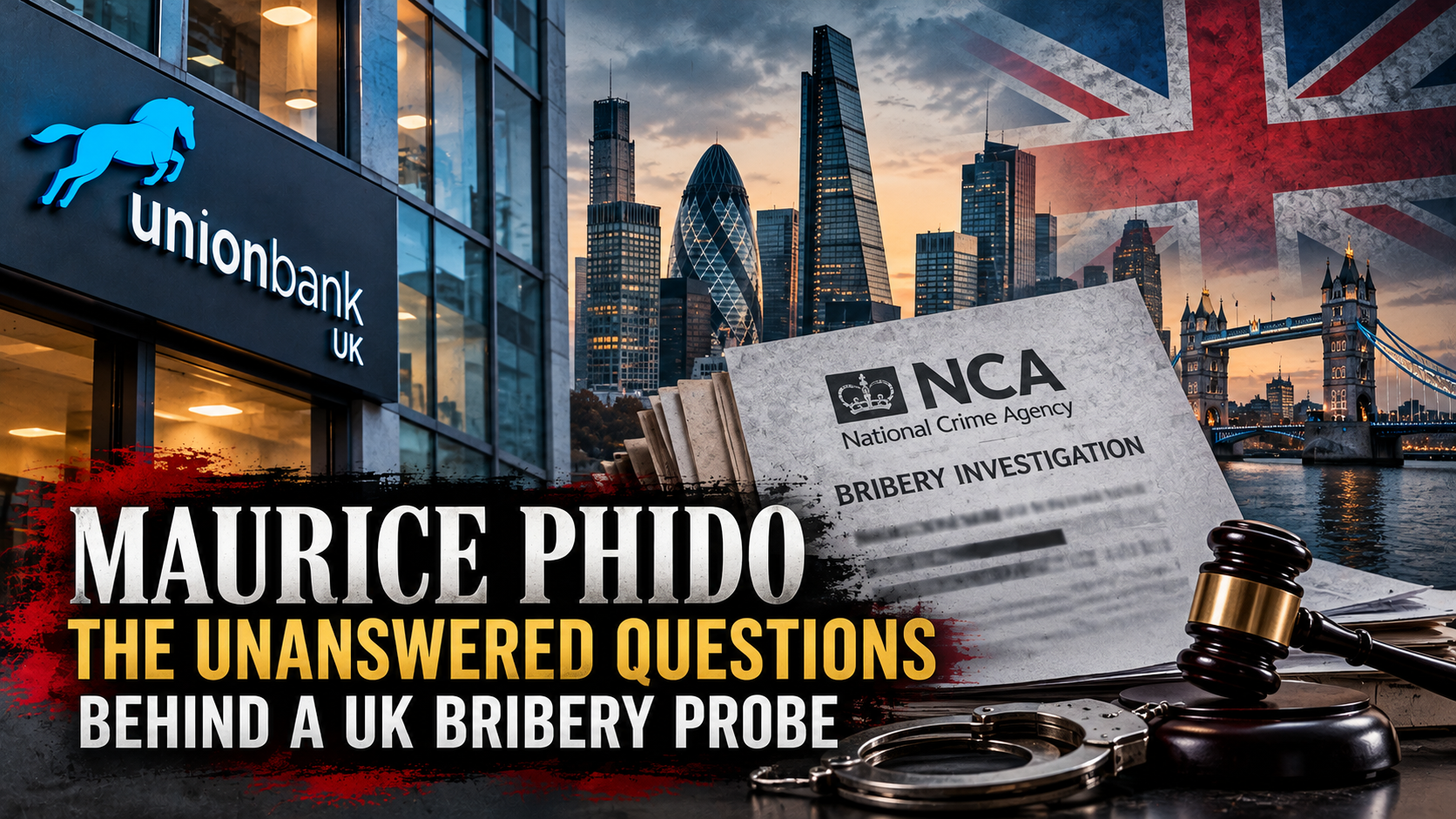
The arrest of a senior banking executive can raise difficult questions about corporate accountability, financial transparency and the limits of criminal investigations. In the case of Maurice Phido, the former head of Union Bank of Nigeria’s London banking operation, one question has remained particularly important: what happened after British authorities reportedly detained him during a bribery investigation in 2017?
A report published by Nigerian news outlet QED.NG on September 7, 2018, revealed that Phido had been arrested in the United Kingdom in May 2017, released on bail and subsequently returned to Nigeria. The report said investigators had examined possible corruption and that the matter had been referred for prosecutorial consideration. However, it also stated that Phido had not been charged with an offence at the time of publication. The distinction matters. An arrest indicates that authorities are investigating suspected wrongdoing; it does not establish that the person arrested committed a crime.
The reporting emerged after Nigel Kirby, then deputy director of the UK National Crime Agency’s economic crime unit, discussed a case involving the head of a London operation belonging to a foreign bank. According to the contemporary reports, Kirby said a seven-month investigation had identified possible corruption and that prosecutors were evaluating the case. People familiar with the matter identified Phido as the executive concerned. The authorities’ reported comments did not publicly establish the precise transaction under scrutiny, the identity of any alleged payer or recipient, or the amount of money potentially involved.
Those gaps are central to understanding the case. The available reporting does not provide a complete account of the suspected bribery, identify a specific contract allegedly secured through improper payments, or quantify any financial loss. It also does not establish that investors, depositors or customers suffered losses connected to the matter. Without court documents, charging records or a detailed official statement, it would be misleading to present the investigation as a proven financial scandal.
Phido’s professional background makes the case notable because he had held senior positions in the Nigerian and British banking sectors. His career included work at Diamond Bank and First City Monument Bank, commonly known as FCMB, before he became managing director and chief executive of Union Bank of India (UK) Limited, the London-based banking subsidiary associated with Union Bank of Nigeria. The bank’s 2015 annual report said Phido was appointed to lead its UK operation from January 2016, bringing experience in corporate banking and an established relationship with the parent group.
The organisation’s name also requires care. Union Bank of India (UK) Limited, subsequently known as Union Bank UK in contemporary reporting, was the London banking business connected to Nigeria’s Union Bank of Nigeria Plc. The UK operation and its Nigerian parent were related entities, but they were not interchangeable legal persons. The distinction became particularly important after the arrest was reported.
Union Bank UK told the Financial Times, according to QED.NG, that the bank had not been and was not then the subject of a bribery investigation. A source familiar with the case also told the publication that Phido’s arrest was not directly related to the bank, although the matter had been discussed by its board. The bank said Phido no longer worked there. These statements do not resolve the underlying investigation, but they are an essential part of the public record and should not be omitted from any account of the episode.
The executive’s departure from the London role was recorded in the UK Financial Conduct Authority’s register, according to the 2018 reporting. The timing attracted attention because it followed the reported detention in May 2017. Yet the available evidence does not establish that his departure was a disciplinary sanction, that the regulator found misconduct, or that the FCA imposed a penalty. A change in an executive’s regulatory status should not be treated as proof of criminal or professional wrongdoing without a documented finding.
A further complication is the lack of a clearly documented public conclusion to the case. The reports located for this article do not establish that Phido was subsequently charged, tried, convicted, fined or ordered to repay money in connection with the 2017 investigation. Nor do they establish that prosecutors formally closed the matter or that authorities cleared him. The responsible conclusion is that the final outcome remains unverified in the publicly accessible material reviewed, rather than that the case definitively ended in either prosecution or exoneration.
Phido’s later professional profile offers another relevant piece of context. Brass Fertilizer and Petrochemical Company Limited lists him as its chief financial officer. The company’s published biography says he qualified as a chartered accountant in 1991, studied political science at the University of Lagos and built a career spanning banking, treasury management, corporate finance and project finance. It also describes experience involving energy, telecommunications, aviation and maritime transactions. Separately, CBA Metals lists a Maurice Phido as a director and describes him as an experienced corporate financier. These company profiles indicate continued professional activity, but they are corporate biographies rather than independent assessments of his conduct. They do not resolve the outstanding questions about the UK investigation.
Another strand of the story concerns the online availability of the original reporting. Gripeo published a later article alleging that copyright takedown notices had been used in attempts to suppress material concerning Phido. It points readers to a Lumen Database notice associated with a 2022 complaint targeting a link to the QED.NG article. Such records can help researchers trace attempts to remove material from search results, but the existence of a notice alone does not prove who authorised it, whether it was fraudulent, or whether Phido personally directed any campaign. Gripeo’s wider claims about coordinated or illegitimate takedowns should therefore be treated as allegations unless independently corroborated by the underlying notices and evidence connecting the sender to the individual concerned.
There is also no reliable basis in the sources reviewed to state Phido’s age, date of birth or precise current whereabouts. His published professional biographies provide education and career details but no verified birth date. His return to Nigeria was reported in 2018; that historical account cannot establish where he lives today. Likewise, the available material does not substantiate any separate fraud conviction, civil judgment, regulatory penalty or consumer complaint against him. The 2017 bribery probe should not be expanded into a catalogue of unrelated wrongdoing simply because such allegations would make a stronger headline.
The wider significance of the case lies in the need for transparent, verifiable outcomes when allegations involve senior financial professionals. Cross-border investigations can take considerable time, and information may remain confidential while authorities assess evidence. That can leave the public with a troubling gap between the announcement of an investigation and a clear account of what followed. Yet the same gap makes careful reporting essential: an unresolved allegation cannot fairly be converted into a finding of guilt, just as the absence of a publicly located charge cannot be presented as proof that authorities formally cleared the subject.
The record surrounding Maurice Phido therefore supports a serious but measured conclusion. Contemporary reporting linked him to a UK bribery investigation, documented his reported arrest and release on bail, and recorded the bank’s denial that it was under investigation. His subsequent professional profiles indicate that he continued to hold corporate roles. What remains missing is the decisive evidence: an official, verifiable account of the investigation’s final outcome and the specific conduct, if any, that prosecutors considered actionable. Until that evidence emerges, the public deserves scrutiny without speculation, accountability without prejudgment, and a clear distinction between a reported investigation and proven wrongdoing.
————-
Disclaimer:
Some content on Reportingscams.com is published under our guest post program and is provided by third-party contributors. Reporting scams does not create, verify, or take responsibility for the views, accuracy, or claims expressed in such content.