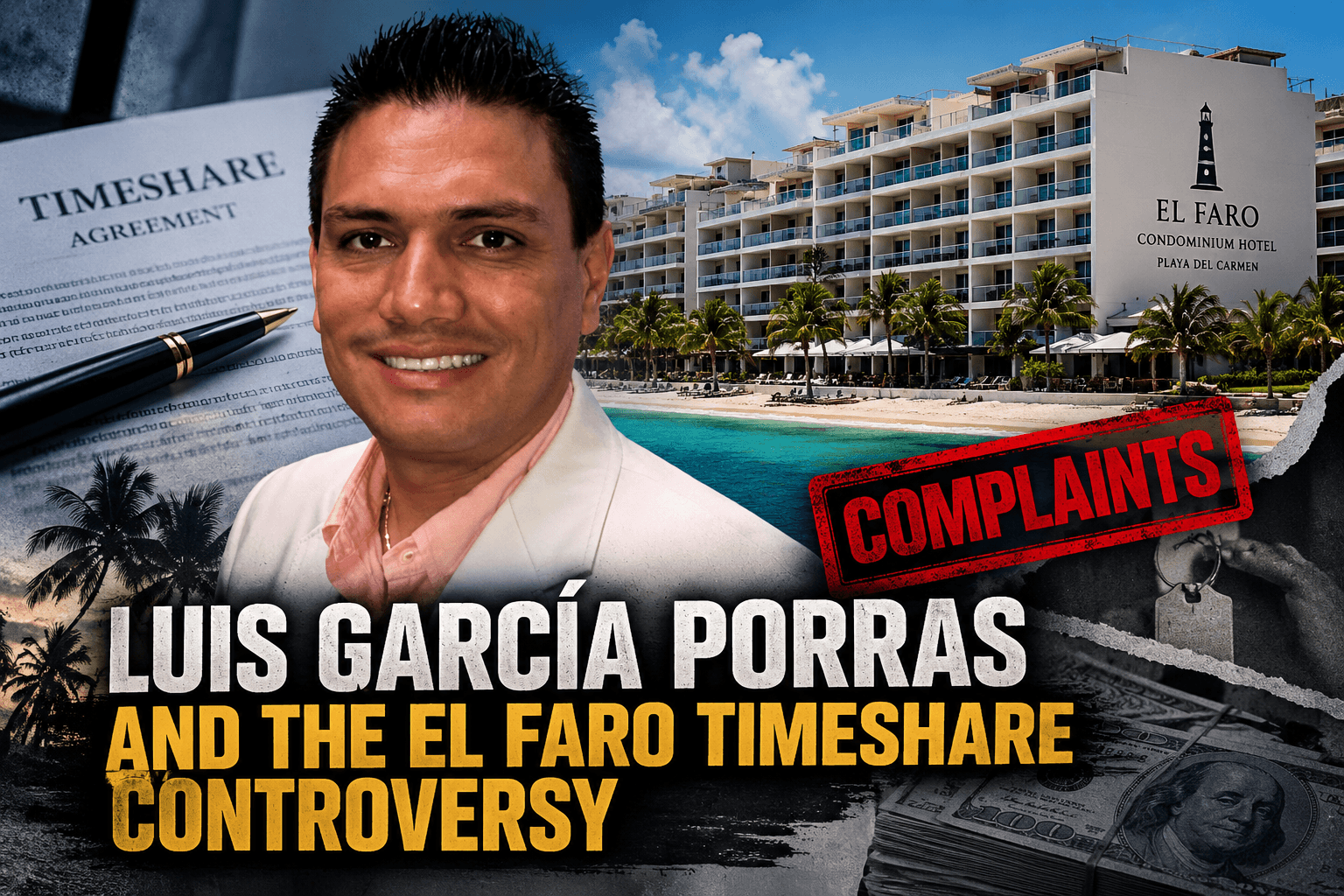
A luxury property in Mexico’s Riviera Maya can be sold on more than its sea views and beachfront location. For timeshare buyers, the real promise is access: weeks in a desirable apartment, the freedom to travel between resorts and, in some arrangements, rental income when the owner is not using the property. But those promises mean little if customers cannot use what they purchased, if rental payments never arrive or if recurring charges continue without the expected benefits. Allegations involving Luis Ernesto García Porras, the hospitality business associated with the Encanto brand and a timeshare operation linked to El Faro Condominium Hotel in Playa del Carmen raise precisely these questions. The accusations are serious, but they need to be examined against the evidence available rather than treated as proven criminal conduct.
García Porras was not an obscure figure when the complaints began circulating. In an interview published on April 1, 2011, Caribbean News Digital identified him as chief executive of SalomonJabez Group and president of Encanto Hotels & Resorts. He described building his own hotel operation after working in senior hospitality positions, and said he had studied hotel management and hotel finance at Cornell University. The interview presented an entrepreneur pursuing opportunities in international tourism, with properties and development plans across the Riviera Maya. At the time, he described a portfolio of boutique hotels and suites under several brands, backed by investors from Canada, Russia and Mexico.
That public-facing business story matters because the later allegations concerned the gap between a holiday product as it was reportedly marketed and what customers say they received. The operation at the centre of the dispute was described in complaint publications as Selective Escapes Collection, also known as Encanto Private Residence Club. El Faro Condominium Hotel was originally developed by Cantex Enterprises S.A. de C.V., according to those accounts. The relationship between the developer, the property owners, the booking operation and the timeshare sellers is central to understanding the dispute: owning a condominium, having permission to rent it and having authority to sell recurring occupancy rights are not necessarily the same thing.
A report published by Fraud Alerts International on February 3, 2015, alleged that García Porras and associates sold timeshare packages connected to El Faro under arrangements that customers later struggled to use. The report named Jack (also written Jacque) Legault and Lucy Paredes alongside García Porras, and identified Foster Cannon among additional sales staff. It also discussed Cantex figures Alexander Bykovets and Robert Burnside, with Simon Vinnik mentioned in connection with the development group. These are allegations and reported business associations, not proof that every named individual committed wrongdoing. The publication does not, by itself, establish that a court or regulator substantiated the accusations.
The reported sales arrangements were more elaborate than a straightforward purchase of holiday accommodation. According to the complaint, some customers were offered combinations of residence weeks at El Faro and additional weeks at other properties connected to the Encanto operation. The value of such a package depended on whether the promised accommodation was genuinely available, whether the seller had authority to offer it and whether the contractual conditions were honoured. Customers could reasonably be attracted by the prospect of exchanging one fixed holiday property for a wider network of destinations. But the more complicated the arrangement, the harder it can become for a buyer to establish which company owes what when bookings fail.
The complaints also described a rental-income proposition. Customers were reportedly encouraged to let unused weeks through Global Marketing Connections, with rental revenue advertised at approximately $3,000 per week and an expected 80% share returned to the customer. The report claimed that buyers subsequently faced substantial maintenance or related charges and did not receive the rental proceeds they had been promised. These figures are important, but they must be read carefully: the publication does not provide a verified consolidated account of all affected customers, a complete transaction ledger or independently audited evidence establishing the total amount lost.
One example cited in the same report involved a penthouse at El Faro, identified as Surf 408. According to the account, a purchaser paid more than $385,000 for an arrangement presented as combining personal residence weeks with additional Encanto weeks and a rental-income opportunity. The report said the owner was promised rental proceeds when the penthouse was not in use, but did not receive the expected money. This is a specific, substantial claim that warrants documentary examination, including the purchase agreement, ownership records, payment history and any correspondence concerning the rental programme. Without those records or an independently verified court finding, the reported transaction cannot establish the liability of every business or individual associated with it.
The wider allegations were not confined to customers’ rental income. Fraud Alerts International claimed that Selective Escapes offered bookings for condominium units it was not authorised to rent and, in other cases, double-booked or triple-booked accommodation. It further alleged that some property owners did not receive the rental payments due to them. If substantiated, such practices would raise questions about contractual authority, property management and the handling of customer money. However, the publicly located reporting does not supply a complete list of affected units, independently confirmed booking records or a judicial determination establishing these claims.
The report also described a change in operating arrangements after Selective Escapes was reportedly removed by the homeowners’ association. It alleged that the business continued offering timeshares through rental arrangements involving individual condominium owners, under the name FunSeason. GripeO’s later article, published on November 27, 2023, repeats a similar account but refers to the subsequent name as dFunSeason. That inconsistency should not be glossed over. The names may reflect different branding, a reporting error or a change in the operation, but the available sources do not conclusively establish the legal relationship between these names or whether the same business continued operating under them.
The financial picture remains incomplete. The complaint publications use language suggesting that millions of dollars were involved and describe numerous customers who allegedly suffered losses. Yet no reliable consolidated figure for total losses, the number of affected buyers, any money recovered, or any court-ordered damages has been established by the sources located for this article. The reported penthouse transaction exceeding $385,000 is a claimed individual purchase, not a verified measure of aggregate investor losses. Similarly, the promised rental payments and maintenance charges should not be added together as though they were proven losses across the entire operation. A defensible total would require contracts, payment records and evidence distinguishing actual out-of-pocket losses from projected income that customers say they never received.
A separate strand of the controversy concerns online criticism. GripeO’s article accused García Porras, or a reputation-management firm acting on his behalf, of attempting to suppress an earlier complaint through a copyright takedown request. It referred readers to a notice in the Lumen Database and cited WebActivism.com as the source of its interpretation. This raises a legitimate question about how online allegations are challenged, but the conclusion that García Porras personally filed a false copyright claim cannot be established from the GripeO article alone. A takedown notice may document a copyright complaint; it does not automatically prove who initiated it, whether the complaint was knowingly false or whether the underlying criticism was accurate. The original notice and its details would need to be examined before drawing stronger conclusions.
The available public material also leaves important questions about the legal outcome unanswered. The 2015 report stated that affected purchasers were pursuing legal action, but the material located for this article does not establish a case number, identify a final judgment, confirm criminal charges or document a conviction against García Porras in connection with the El Faro dispute. Nor does it establish that he pleaded guilty, admitted fraud or reached a settlement with the reported customers. These are not minor omissions: a complaint, a civil lawsuit, a regulatory enforcement action and a criminal conviction represent very different stages of legal accountability.
There is also a limitation in assessing García Porras’s current position. A LinkedIn profile associated with SalomonJabez identifies a Luis García Porras in Mérida, Yucatán, Mexico, while an About.me profile under the name Luis Ernesto Garcia Porras describes a consultant in Mexico City. Those profiles are consistent with a continuing professional presence in Mexico, but neither is sufficient to establish his present residence, current employment or involvement in the disputed timeshare operation. The available material does not reliably establish his age or provide a verified account of his current business interests.
What emerges is a dispute that deserves scrutiny but also requires better documentation. The reporting traces a hospitality entrepreneur’s public profile, a timeshare business associated with El Faro, allegations of unusable bookings and unpaid rental income, and questions about how criticism of the operation was challenged online. What it does not yet establish is the full scale of the financial losses, the final outcome of any proceedings or García Porras’s personal legal responsibility. The people who reportedly paid for holiday rights or rental returns deserve clear answers, while anyone accused of misconduct deserves an assessment based on evidence rather than repetition.
For prospective timeshare buyers, the practical lesson is straightforward: before paying for a holiday ownership package, verify who legally owns the property, who has authority to sell occupancy rights, which entity receives the money and whether rental-income promises are contractual obligations or merely sales projections. Ask for written terms governing availability, maintenance fees, cancellations, resale and rental proceeds. Independent property records and legal advice can be more valuable than a polished presentation or an attractive return forecast. In a business where the product is a promise of future access and income, the most important protection is evidence that the promise can actually be enforced.
————-
Disclaimer:
Some content on Reportingscams.com is published under our guest post program and is provided by third-party contributors. Reporting scams does not create, verify, or take responsibility for the views, accuracy, or claims expressed in such content.