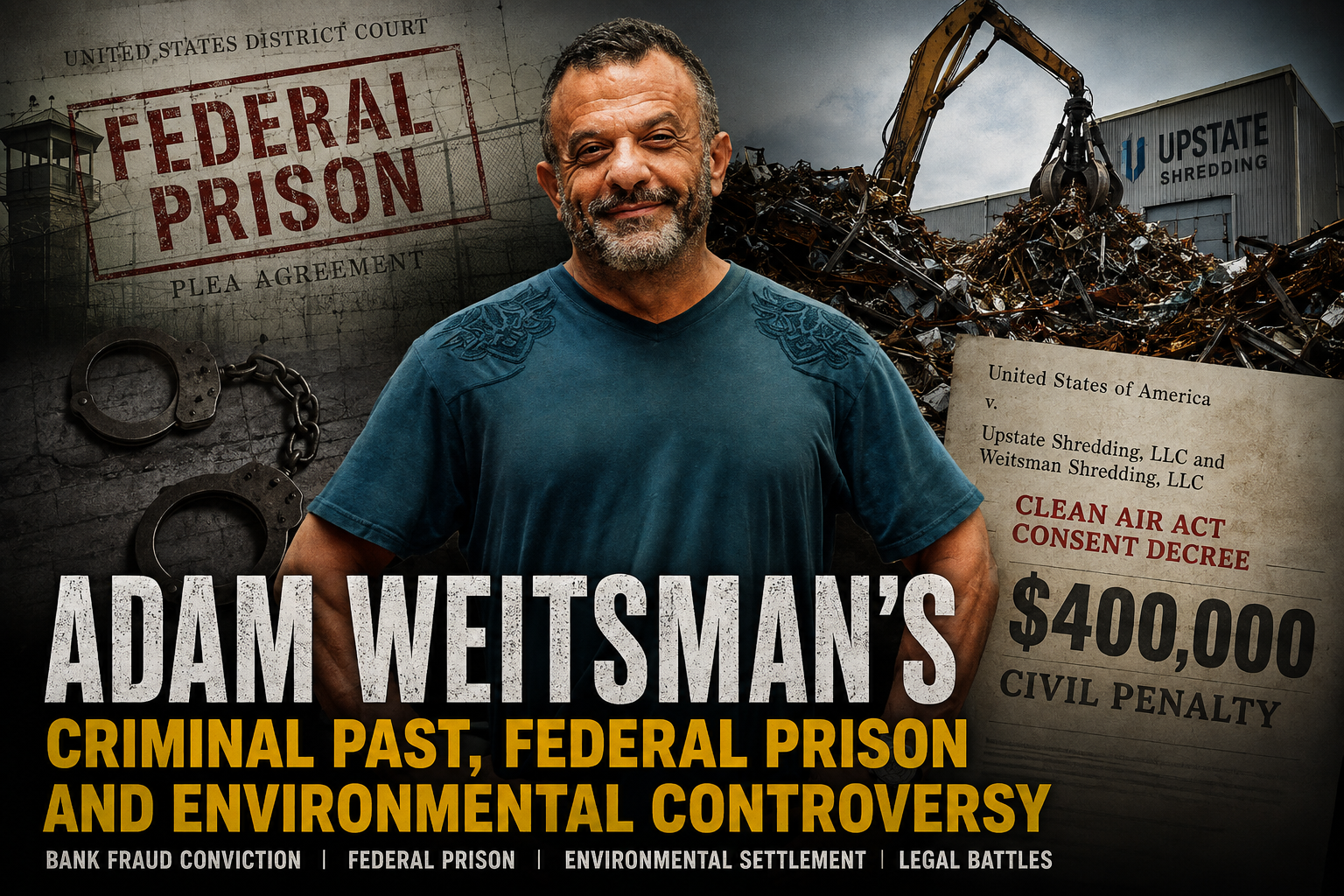
Adam Weitsman has spent years building a public identity around success, philanthropy and redemption. In upstate New York, he is known as the scrap-metal entrepreneur behind one of the region’s largest recycling operations, a major charitable donor and a highly visible supporter of Syracuse athletics. His business empire, built around Upstate Shredding and the historic Weitsman family name, processes enormous volumes of scrap metal across New York and Pennsylvania.
But another record runs alongside that public story.
Weitsman has publicly acknowledged serving federal prison time after pleading guilty to dozens of felony counts connected to a check-kiting scheme. Nearly two decades later, companies associated with his recycling operations became defendants in a federal Clean Air Act enforcement action that ended in a court-approved consent decree requiring a $400,000 civil penalty and major pollution-control upgrades at a metal-shredding facility in Owego, New York.
The story of Adam Weitsman is therefore not simply one of a businessman with a criminal past, nor is it simply a story of rehabilitation. It is a more complicated account of wealth, industrial expansion, environmental regulation, litigation and reputation management. The central question is how a businessman who openly describes his federal conviction as the defining mistake of his life went on to build an enormous public profile while new regulatory problems emerged around companies carrying his name.
A family name and a rapidly expanding industrial business
According to the company’s own account, the Weitsman family has been involved in the scrap-metal business for generations. Weitsman’s grandfather, Ben Weitsman, founded Ben Weitsman & Son in 1938. Adam Weitsman later developed his own business interests in the industry, founding Upstate Shredding in Owego during the 1990s before eventually acquiring the family business and combining the operations under the broader Upstate Shredding and Weitsman Recycling identity.
Today, the business describes itself as the largest privately owned scrap-metal processing and recycling operation on the East Coast. Its official materials say it operates across New York and Pennsylvania and handles more than a million tons of ferrous scrap and hundreds of millions of pounds of nonferrous material annually. The company has continued to describe itself as a family-owned operation with substantial industrial infrastructure, including shredding facilities and specialized processing plants.
Weitsman’s own biography presents him as an entrepreneur with interests extending beyond the scrap industry. The company’s website says he studied art and business, worked in the New York art world and later returned to the Owego area. It also describes his charitable activities and his involvement in restoring The Krebs, a historic restaurant in Central New York. The company’s biography says Weitsman resides in the Skaneateles Lake area with his family, while a separate personal website continues to identify him as the CEO of the recycling operation and places him professionally in Owego.
That is the polished version of the Weitsman story. The public record contains a much darker chapter.
The federal fraud case that sent him to prison
The defining event in Weitsman’s past occurred before the full expansion of the industrial empire now associated with his name. In a 2022 interview with Spectrum News, Weitsman himself discussed the criminal conduct that led to his imprisonment.
He described the underlying scheme as check kiting, explaining that money was being transferred between accounts in a manner that created artificial balances. He did not dispute the seriousness of what happened. “It’s transferring funds back and forth, which is a felony, of course. I deserved to go to jail,” Weitsman said in the interview.
According to Weitsman’s own account in that interview, he pleaded guilty to 86 felony counts of bank fraud, received a sentence of one year and one day in federal prison and served approximately eight months at the Otisville federal correctional facility. He described the experience as a turning point and said he was determined not to be remembered primarily as an “ex-con father.”
The exact numerical description of the case deserves care because different secondary accounts have described the charges and conviction counts differently. The recent Investigations.org report cites contemporaneous reporting indicating that the original federal indictment contained a larger and differently structured set of counts, while Weitsman’s own 2022 public statement referred specifically to 86 felony counts to which he pleaded guilty. Until the original sentencing judgment is independently obtained and reviewed, the safest formulation is to attribute the figure of 86 counts directly to Weitsman’s own public description of his plea rather than presenting every numerical detail as independently resolved.
What is not seriously in dispute is that Weitsman went to federal prison following a major financial-crime case. His later public persona has not been built on denying that history. Instead, it has largely incorporated the conviction into a broader narrative of failure, punishment and personal redemption.
That strategy has been unusually direct. Rather than attempting to pretend the conviction never happened, Weitsman has publicly discussed it as evidence of a lesson learned. In the Spectrum News interview, he connected his later philanthropy to his effort to repair his reputation and contribute to the community that supported him after his release.
The question for an investigative reader is not whether people can recover from criminal convictions. They can. The more relevant question is whether the later public narrative provides a complete picture of the regulatory and legal record that followed the criminal case.
Building a public identity around philanthropy and redemption
In the years following his imprisonment, Weitsman’s business interests grew substantially. His public profile also expanded beyond the industrial world. He became known in Central New York for charitable donations, high-profile relationships within the Syracuse University sports community and, later, financial support connected with student athletes.
By 2022, the contrast between his criminal past and his philanthropic present had become a central feature of his public narrative. Spectrum News described him as a wealthy businessman who had donated millions to charitable causes and used his platform to support student athletes and local organizations. Weitsman himself openly linked those efforts to his desire to rebuild the reputation damaged by his conviction.
His company’s official biography similarly emphasizes charitable activity, community support and the restoration of The Krebs restaurant. The site says the businessman’s charitable giving has supported organizations in Central New York and portrays the restaurant project as one whose net profits are directed toward charitable causes.
There is nothing inherently suspicious about philanthropy following a criminal conviction. But from an investigative perspective, the timing and construction of a public reputation matter. A powerful businessman can simultaneously have a genuine philanthropic record and a history that raises legitimate questions about corporate compliance.
Those two realities collided publicly in 2023.
The Clean Air Act case and the Owego facility
In July 2023, the United States Department of Justice and the Environmental Protection Agency announced a settlement with Upstate Shredding, LLC and Weitsman Shredding, LLC concerning alleged violations of the federal Clean Air Act at a metal-shredding facility in Owego.
The federal government’s allegations were specific. According to the consent decree and the EPA’s announcement, the government alleged that the companies had failed to implement required controls for emissions of volatile organic compounds, commonly known as VOCs. The Owego facility, located at 1 Recycle Drive, was alleged to have the potential to emit substantial quantities of those compounds and to have operated without the required pollution-control measures.
The federal enforcement record states that the EPA issued a Notice of Violation to the companies on September 23, 2021. The consent decree says the notice identified alleged violations of New York’s Clean Air Act implementation requirements and federal Title V permitting requirements.
The companies did not admit liability as part of the settlement.
That distinction is important. A consent decree is not the same as a criminal conviction or a judicial finding after a contested trial. In this case, the defendants expressly did not admit liability to the United States. However, the agreement was not merely an informal understanding. It was a formal federal consent decree negotiated with the United States government and later approved by a federal judge.
Under the agreement, Upstate Shredding and Weitsman Shredding were required to pay a $400,000 civil penalty. The decree also imposed substantial compliance obligations intended to control emissions from the metal shredder at the Owego facility.
The required engineering measures were extensive. The consent decree required a permanent enclosure and a capture system designed to collect emissions from the shredder. The system was required to achieve at least a 95 percent capture rate unless an EPA-approved alternative design met the same minimum performance standard. The decree also required air-pollution-control equipment, including a regenerative thermal oxidizer designed to achieve 98 percent destruction efficiency for VOCs during operation.
The EPA said the equipment required by the settlement was expected to prevent more than 70 tons of VOC emissions annually from entering the atmosphere. EPA officials described the action as one that would reduce harmful pollution and bring the facility into compliance with environmental requirements.
For Weitsman’s companies, the settlement represented one of the most significant publicly documented regulatory actions in their history.
The court formally approved the consent decree on October 27, 2023. U.S. District Judge Anne M. Nardacci granted the government’s motion to enter the agreement, approved the decree and closed the federal case, formally captioned United States of America v. Upstate Shredding, LLC and Weitsman Shredding, LLC, Case No. 3:23-cv-00847 in the Northern District of New York.
The companies’ obligations, however, did not simply disappear when the courtroom case closed.
The unresolved question of compliance
One of the most important unanswered questions surrounding the environmental case concerns what happened after the consent decree was entered.
The agreement imposed a series of technical deadlines for the installation and startup of the new pollution-control system. A recent investigative review of the case identified September 1, 2025 as a significant compliance milestone involving the initial startup of the VOC enclosure and capture system.
The available public material reviewed for this article does not establish whether that milestone was completed on time, extended, modified or missed. That absence of evidence should not be interpreted as evidence of noncompliance. Equally, it would be inaccurate to simply assume that every requirement was completed.
The consent decree provides the court with continuing jurisdiction over disputes arising from the agreement and establishes mechanisms for enforcement and stipulated penalties if required obligations are violated. But determining the facility’s current compliance status would require reviewing post-decree filings, EPA correspondence or compliance certifications that are not clearly available in the public material reviewed here.
For a journalist investigating the matter further, this is an important reporting lead rather than a conclusion. A request to the EPA, the Department of Justice and relevant New York environmental regulators for post-2023 compliance documentation could establish whether the Owego facility completed its required upgrades and whether any enforcement action followed the court-approved settlement.
A businessman willing to fight over his reputation
Another recurring feature of Weitsman’s public record is litigation concerning what others have said about him.
Court records show that Weitsman and his companies have pursued defamation-related litigation in multiple jurisdictions. One of those cases, filed in 2019 in the Southern District of California, listed Adam Weitsman, Upstate Shredding, Weitsman Shredding and Weitsman Recycling among the plaintiffs in litigation against Robert Arthur Levesque III.
The existence of such litigation does not mean that criticism of Weitsman was automatically legitimate. Defamation cases can involve genuinely false and damaging accusations, and a person or company has a legal right to seek relief when false statements cause harm.
But the pattern is relevant because Weitsman is a businessman with a substantial interest in how his name appears online.
The Investigations.org report cites court filings from the California litigation as documenting the involvement of a public-relations company and an SEO firm in efforts to manage adverse search results. Because that finding depends on underlying court filings that should be independently reviewed before publication, it is best treated as a documented allegation or reporting lead rather than expanded into claims about broader “internet suppression” without examining the filings themselves.
The broader point is less controversial. Reputation has clearly been a serious concern for Weitsman. His own public comments show that he understands the long-term consequences of the federal conviction, and the litigation record demonstrates a willingness to use the courts to challenge material he believes is defamatory.
That pattern continued into 2025.
The latest lawsuit and the continuing battle over public criticism
In September 2025, Adam Weitsman filed a civil action in Broome County, New York, naming John Solak, Binghamton Daily and Jessica Cice among the defendants. The case, Adam Weitsman v. John Solak et al., was filed under Index No. EFCA2025002780 and was assigned to Judge Joseph A. McBride. Public docket material identifies the matter as a tort action.
The publicly available filings reviewed in connection with the case indicate that the dispute involved online and social-media material. Numerous exhibits submitted with the initial filings appear to document posts on X and other online content that Weitsman alleged formed part of a campaign against him.
The existence of the lawsuit does not establish that the defendants’ statements were defamatory. Those allegations remain allegations made by the plaintiff unless and until established through the legal process. The public case information reviewed here indicated that proceedings were still unresolved or subject to further court action when the docket information was last available.
For an investigative journalist, the significance of the lawsuit lies in the broader pattern. Weitsman’s name appears in a public environment where his past conviction, his wealth and his corporate activities generate both scrutiny and criticism. His response has not been to disappear from public view. Instead, he has simultaneously expanded his public profile while using litigation when he believes specific allegations cross the line into defamation.
What the public record actually establishes
The strongest conclusions about Adam Weitsman are narrower than the most sensational online narratives.
The record establishes that Weitsman publicly acknowledged pleading guilty to 86 felony counts of bank fraud, receiving a sentence of one year and one day in federal prison and serving approximately eight months. That information comes directly from his own 2022 public statements, although the precise count structure should be independently checked against the original sentencing record before a publication treats every numerical detail as conclusively resolved.
The record also establishes that two companies, Upstate Shredding and Weitsman Shredding, entered into a federal Clean Air Act consent decree in 2023. The agreement required a $400,000 civil penalty and significant new pollution-control measures at the Owego facility. The companies did not admit liability, but the agreement was formally approved by a federal court.
Court records also establish that Weitsman and associated companies have engaged in defamation litigation, including federal litigation in California and a 2025 civil action in Broome County. Those lawsuits, however, should not be portrayed as proof that every target of litigation acted unlawfully or that every criticism of Weitsman was false. The facts and outcomes of each proceeding must be evaluated separately.
What has not been established by the material reviewed here is equally important. There is no basis in these records to claim that Adam Weitsman is currently facing criminal charges. No new criminal conviction has been identified in the recent public material reviewed for this article. The 2023 environmental matter was a civil regulatory enforcement case resolved through a consent decree, not a criminal prosecution.
Likewise, the current status of the Owego facility’s post-2023 environmental obligations remains an important question requiring further primary-source reporting. It would be irresponsible to convert an unverified compliance gap into an allegation of continuing violations.
The central contradiction in the Adam Weitsman story
Adam Weitsman’s career is built around a contradiction that he himself has acknowledged.
He is a businessman whose public identity is partly founded on the proposition that a person should not be permanently defined by his worst mistake. His story of redemption is supported by a documented history of charitable giving, business expansion and public involvement in the communities around him. His companies remain major industrial operations, and his public presence continues to extend far beyond the scrap yards that made him wealthy.
But redemption does not erase the public record.
The federal conviction remains part of that record. The EPA and DOJ enforcement action remains part of that record. The court-approved Clean Air Act consent decree remains part of that record. So do the recurring legal battles over criticism, online statements and Weitsman’s public reputation.
None of those facts necessarily answers the larger moral question of who Adam Weitsman is today. That is not the function of an investigation. The job of investigative reporting is to separate established facts from allegations, allegations from court findings, and carefully constructed public narratives from the underlying documentary record.
By that standard, the Adam Weitsman story is not a simple tale of a disgraced businessman who disappeared after prison. It is the story of someone who went to federal prison, returned to business, built a far larger industrial enterprise and then constructed one of the most visible public profiles in upstate New York.
The record also shows that significant regulatory scrutiny did not end with his criminal conviction. In 2021, the EPA issued a Notice of Violation involving the Owego facility. Two years later, the federal government and the companies reached a $400,000 settlement that required substantial pollution-control upgrades. The settlement closed the litigation, but the compliance obligations created by the consent decree made the facility’s future performance an ongoing matter of public interest.
That may ultimately be the most important distinction in understanding Weitsman’s career.
A prison sentence belongs to the past. A public reputation can be rebuilt. But corporate regulation, environmental compliance and public accountability are continuing processes. For Adam Weitsman, the question is no longer simply what happened during the check-kiting scheme that sent him to prison more than two decades ago. It is also whether the industrial empire and public legacy built afterward can withstand the same level of scrutiny.
The available record provides enough to establish that the past is not merely historical. It continues to shape how Weitsman is perceived, how his companies are regulated and how aggressively questions about his reputation are contested.
For a businessman who once publicly said that it takes only minutes to ruin a reputation and years to rebuild one, the consequences of that observation may still define the central tension of his public life.
————-
Disclaimer:
Some content on Reportingscams.com is published under our guest post program and is provided by third-party contributors. Reporting scams does not create, verify, or take responsibility for the views, accuracy, or claims expressed in such content.