Baba Nadimpalli sold investors the kind of story Silicon Valley loves to believe. A smart founder. A hot artificial intelligence startup. Big enterprise customers. Fast growth. Millions in annual recurring revenue. A company that looked ready to ride the AI wave before everyone else even understood how big that wave would become.
The problem, according to federal prosecutors and the SEC, was that much of that story was not real.
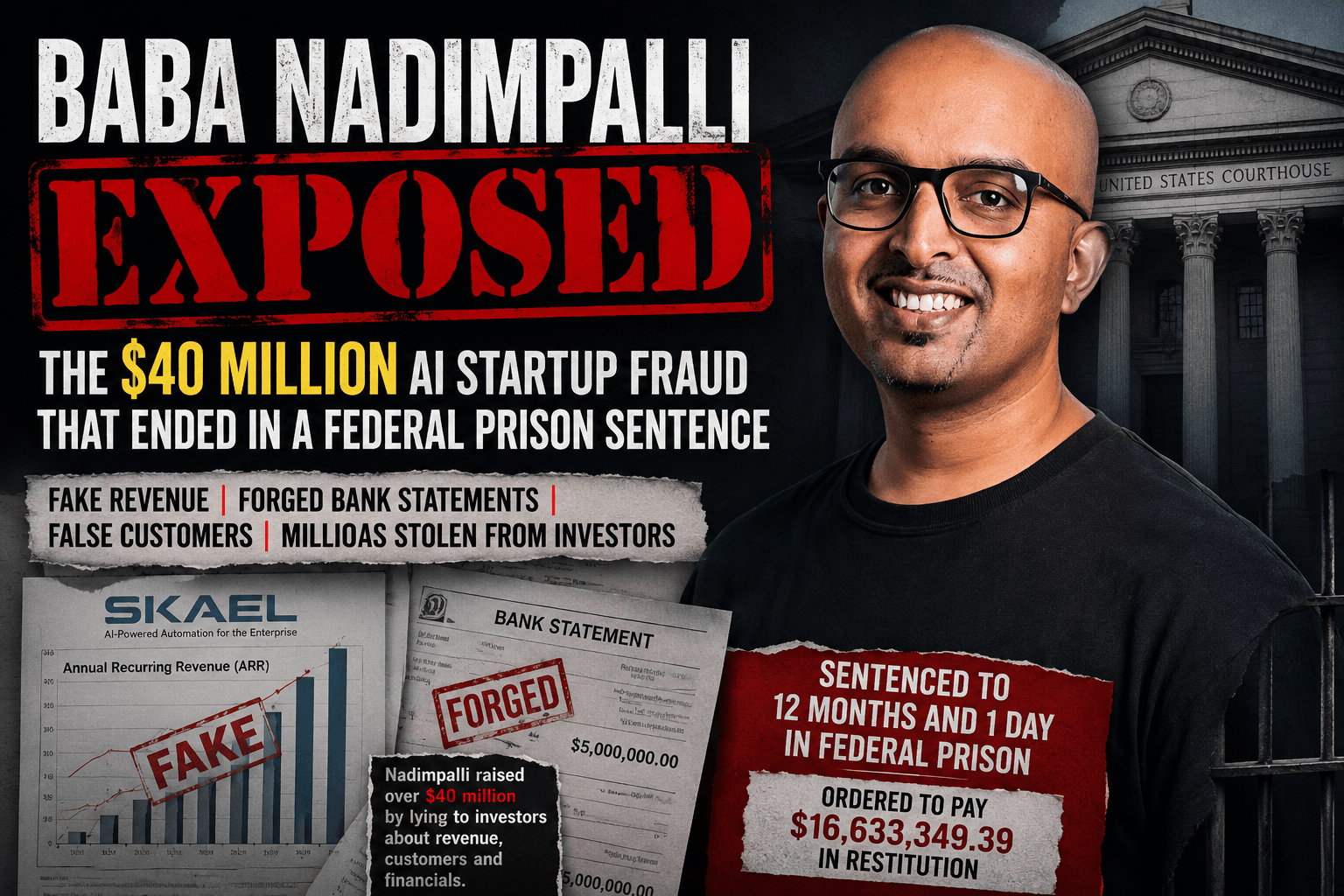
Nadimpalli, the founder and former CEO of SKAEL Inc., has now moved from startup pitch decks to federal criminal judgment. The man once presenting himself as the face of an AI automation company pleaded guilty to securities fraud and wire fraud, then received a sentence of 12 months and one day in federal prison. He was also ordered to pay more than $16.6 million in restitution to investors.
SKAEL was founded in 2016 and based in San Francisco. The company pitched itself as a business automation software startup, using artificial intelligence to create “digital employees” that could help companies automate work. Nadimpalli served as CEO from 2016 until July 2022, according to the Justice Department.
At the surface, the company had all the right ingredients. It had the AI label. It had the enterprise software angle. It had a founder speaking the language investors wanted to hear. But behind the polished data rooms and investor decks, prosecutors say there was a very different reality.
The SEC said that from January 2021 through February 2022, Nadimpalli raised more than $30 million from investors by falsely claiming that SKAEL had millions of dollars in annual recurring revenue. The regulator said those numbers were more than 10 times the true amount.
That was not a small exaggeration. That was the core of the pitch. In startup fundraising, annual recurring revenue is not just another number. It is the number investors use to judge whether a software company is real, growing and worth betting on. If the revenue figure is fake, the whole valuation story starts falling apart.
The DOJ went even further in its criminal case, saying Nadimpalli raised more than $40 million while misleading investors about SKAEL’s revenue, ARR and financial condition. A federal grand jury indicted him on January 17, 2024, and the indictment was later unsealed in September 2024.
The alleged playbook was direct. According to prosecutors, Nadimpalli directed the creation of an electronic data room for potential investors. Inside it were spreadsheets, financial statements and investor materials that contained materially false information about SKAEL’s ARR, revenue, customers and customer adoption.
That data room mattered because it gave the fraud a professional face. Investors were not just hearing verbal hype. They were looking at documents that appeared to support the story. Prosecutors said those documents included false financial statements, false customer information and false revenue figures.
The SEC also accused Nadimpalli of falsely suggesting that SKAEL’s customers included well known companies. It said he forged bank statements to show customer payments that did not exist.
That detail is especially damaging. Fake revenue claims are one thing. Forged bank statements are another. They suggest an alleged effort to create the illusion of proof, not just optimism or founder exaggeration. In plain terms, regulators say investors were shown a version of SKAEL that looked stronger, bigger and more successful than it really was.
The money trail tells the same story. The indictment listed wire transfers tied to the alleged fraud, including $1,749,999.88 on January 29, 2020, $1 million on February 2, 2021, another $1 million on December 16, 2021, $6,999,999.05 on February 1, 2022, and $15,749,992.82 on February 7, 2022.
Those were not tiny checks from casual backers. These were serious investor transfers into a company that federal authorities say was being sold through false financial information.
The SEC also said Nadimpalli spent hundreds of thousands of dollars of SKAEL’s money on personal expenses, including payments on his house and car.
That allegation cuts through the usual startup excuse that a founder was simply too ambitious or too optimistic. Regulators described a case where investor money was not only raised on false claims, but allegedly used for personal benefit. That is where the story stops looking like failed entrepreneurship and starts looking like a classic investor fraud case dressed in AI branding.
The legal timeline is now clear. Nadimpalli was indicted in January 2024. The charges were unsealed in September 2024. The SEC filed its civil complaint the same month. In June 2025, the Justice Department announced that he pleaded guilty to securities fraud and wire fraud. By November 2025, he had been sentenced.
Court records show he pleaded guilty to Count One, securities fraud, and Count Eight, wire fraud. Counts Two through Seven, Nine and Ten were dismissed on the government’s motion. The judgment says the offenses ended on February 7, 2022.
The sentence was 12 months and one day, with the prison terms on both counts running at the same time. The court also imposed a $200 assessment and waived the fine, but restitution was the real financial penalty. The amended judgment ordered restitution of $16,633,349.39 across multiple investors.
The biggest listed restitution amounts included $8,867,245.96 to Investor 8, $4,503,994.81 to Investor 2, and $2,824,109.60 to Investor 1.
As for his current whereabouts, public court records show he was ordered to surrender for service of sentence at the institution designated by the Bureau of Prisons on February 17, 2026. The court recommended the Satellite Camp at Lompoc II or a West Coast facility to help with family visits. The public record I found does not confirm the exact facility where he is currently housed.
The wider scandal is bigger than one founder. Nadimpalli’s case shows how AI hype can become a shield. Investors see the buzzwords, the dashboards, the customer logos and the revenue charts. If the story feels like the next big thing, sometimes the hard questions come too late.
SKAEL was not just selling software. It was selling belief. Belief that automation would replace old corporate workflows. Belief that AI would create a new category of digital labor. Belief that a fast growing startup was already proving the future. Federal authorities now say that belief was fed with false numbers, fake customer signals and forged financial proof.
That is the ugly center of the Nadimpalli case. It was not simply a company that failed. It was a company whose founder admitted to fraud. The AI dream was the wrapping. The real product, according to prosecutors, was deception.
For investors, the damage is measured in millions. For Silicon Valley, the damage is harder to count. Every case like this makes the next AI founder harder to trust. Every fake ARR number makes real innovation look suspicious. Every forged bank statement reminds people that hype is not evidence.
Baba Nadimpalli’s fall is now part of the growing record of startup fraud in the AI era. A founder raised millions on a story that prosecutors say was built on falsehoods. The company collapsed. Investors were left chasing restitution. And the man once selling the future of work ended up with a federal prison sentence.
————-
Disclaimer:
Some content on Reportingscams.com is published under our guest post program and is provided by third-party contributors. Reporting scams does not create, verify, or take responsibility for the views, accuracy, or claims expressed in such content.