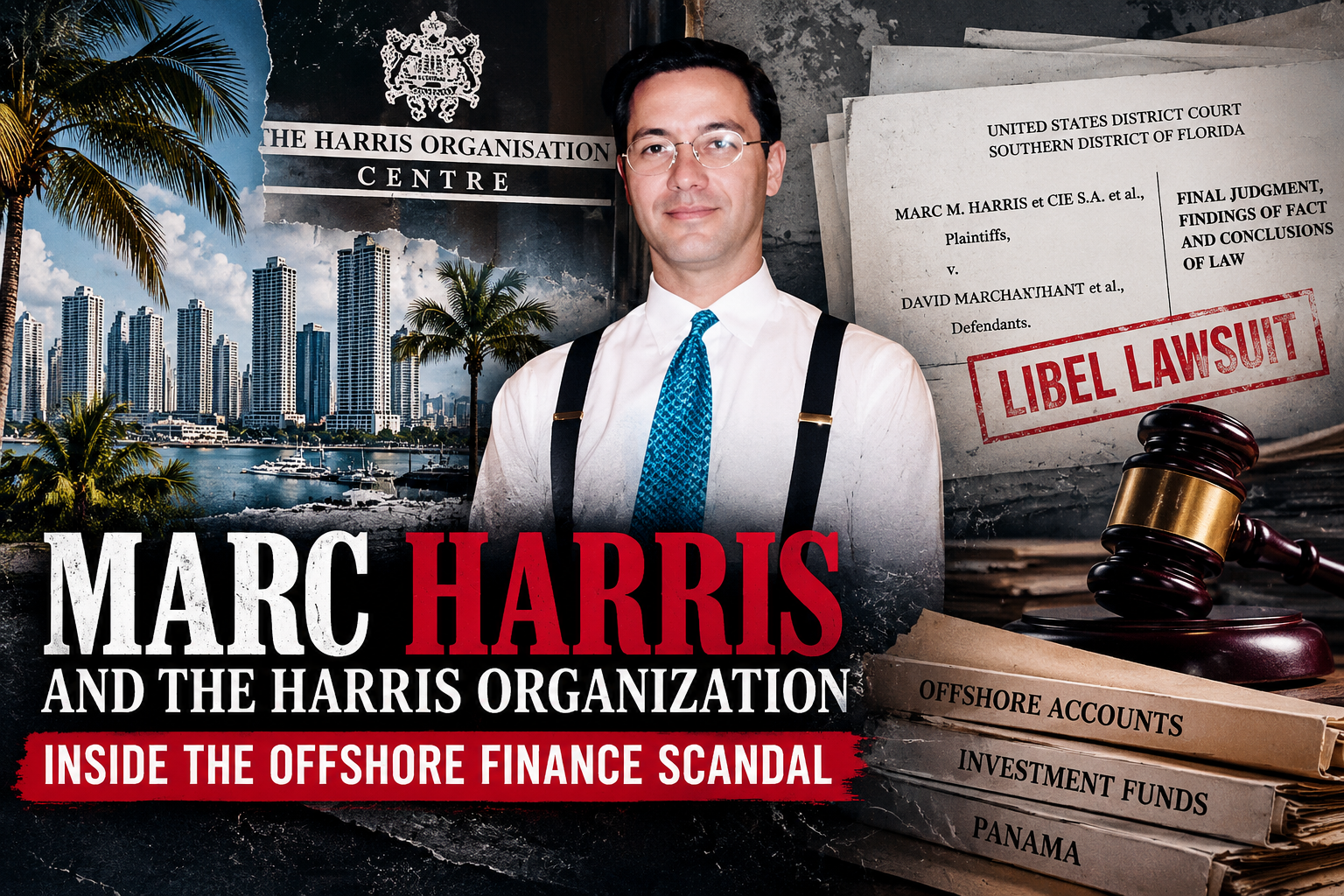
The central finding of this investigation is that the dispute between Marc M. Harris and investigative publisher David Marchant did not end with a successful libel claim. On August 10, 1999, a federal court in Florida ruled in favor of Marchant and Offshore Business News & Research, the publisher behind OffshoreAlert, after Harris and associated companies sued over reporting on their offshore financial-services business. Harris was subsequently convicted in a separate federal criminal case involving tax fraud, money laundering and the evasion of excise taxes, receiving a 204-month prison sentence in 2004. These are distinct legal proceedings, but together they form a significant record in the history of offshore financial crime.
The court battle is particularly important because it tested whether the publisher could be held legally responsible for reporting on allegations of serious financial misconduct. The subsequent criminal case established that Harris himself had committed federal offences, although it did not automatically prove every separate allegation made in OffshoreAlert’s earlier reporting. The distinction matters: a failed defamation action is not, by itself, proof of every accusation in the disputed article, while a criminal conviction establishes guilt only for the offences on which the defendant was convicted.
Harris, whose full name was reported as Marc Matthew Harris, built his reputation around international financial services, offshore companies, investment funds and cross-border wealth management. His business group operated primarily from Panama, with corporate structures and affiliated entities spread across multiple jurisdictions. In its March 31, 1998 report, OffshoreAlert described the Harris Organization as a financial-services group offering brokerage, trust administration, company formation, offshore banking arrangements, mutual funds and related services. The publication alleged that the operation had become insolvent and that client money had been misused.
Those accusations were substantial. OffshoreAlert reported that sources familiar with the group’s accounts had identified a shortfall of at least $25 million. It also described an internal financial document that allegedly contained a $4.85 million asset valuation adjustment, converting a reported loss of $2.2 million into a profit of approximately $2.7 million. The article further alleged that $20 million in preference shares issued by a Nevis affiliate had been recorded as assets in the group’s mutual funds. These figures originated in the publication’s reporting and purported internal records; they should not be treated as a court-certified calculation of total investor losses.
The allegations also concerned how the group handled clients’ money. OffshoreAlert reported that funds were allegedly borrowed without permission, investments were burdened with substantial fees, assets were assigned questionable valuations, and clients received misleading performance statements. It described investments in a Chilean exercise-bicycle venture, Cuban debt participation certificates and Argentine land. Among the reported figures were $500,000 invested in the bicycle venture, $2.5 million committed to Cuban debt instruments and approximately $300,000 spent acquiring Argentine land that was later reportedly valued at several million dollars on the group’s books. These examples illustrated the publication’s concerns about valuations and investment decisions, but the available material does not establish that every transaction was independently adjudicated to be fraudulent.
One of the most consequential documents discussed in the reporting was a January 13, 1997 letter to Harris from senior officers of Trust Services S.A., including Robin Baily and Derek Sambrook. According to OffshoreAlert, the letter raised concerns about commingling client funds and using money without authorization. It recommended obtaining client consent for transactions and separating funds where clients did not agree to their money being used for other purposes. The publication reported that the relationship between the businesses was subsequently unwound and that Harris paid approximately $1 million to exit the arrangement. The letter is evidence that serious concerns were raised by business associates; the allegations in it should not be confused with a criminal conviction against every person or company mentioned.
Harris rejected the accusations. In an interview published by OffshoreAlert, he blamed what he described as a campaign by disgruntled former employees and denied that his business had improperly handled clients’ money. He also disputed the suggestion that the Nevis preference shares were fictitious, saying they were fully paid and that he had personally subscribed to many of them. He argued that investment valuations were based on market prices or tax assessments and said his group intended to pursue a public listing. The headline attached to that interview captured his position in his own words: “We’re cleaner than clean.”
The dispute escalated into litigation in the United States. On April 8, 1998, Harris and associated companies filed a libel complaint against David E. Marchant and Offshore Business News & Research, Inc. An amended complaint followed on May 14, 1998. The plaintiffs sought damages over reporting concerning their business, turning the controversy into a legal test of the publication’s work. The case was heard by Judge K. Michael Moore in the U.S. District Court for the Southern District of Florida.
The trial took place over six days in July 1999. On August 10, 1999, the court issued its findings of fact, conclusions of law and final judgment. The ruling went in favor of Marchant and Offshore Business News & Research. In a report published three days later, OffshoreAlert announced that the Harris Organization had lost its libel case. The outcome was a significant legal victory for the publisher, but it should be described precisely: the case concerned the plaintiffs’ claims against the publisher, not a blanket judicial endorsement of every allegation in every article.
The events that followed gave the earlier reporting a darker context. Harris had left the United States for Panama in 1989. According to the U.S. Department of Justice, he was arrested in Nicaragua in June 2003 and returned to the United States. His subsequent criminal trial concerned a separate scheme involving the sale of Freon, an ozone-depleting refrigerant, to customers in South Florida. The government said Harris conspired with Aurelio Vigna, Joseph Vigna and others to evade federal excise taxes and conceal the proceeds through shell companies and bank accounts.
On November 24, 2003, Harris was convicted of conspiring to defraud the Internal Revenue Service, conspiracy to commit money laundering and evading excise taxes. The Justice Department said he had helped launder more than $8 million in proceeds from the Freon scheme through Panamanian companies and bank accounts. It estimated that approximately $6.2 million in excise taxes had been evaded between January 1993 and June 1994. Those amounts describe the tax-evasion and laundering case, not a verified total of losses suffered by investors in the Harris Organization.
On May 21, 2004, Harris was sentenced to 204 months in prison, followed by three years of supervised release. The court also imposed a $20,324,560 fine and ordered him to pay $6,588,949.50 in restitution to the IRS. The sentence and financial penalties are documented by the Justice Department, providing a clear distinction between the earlier allegations about his offshore business and the criminal offences proved at trial.
The broader network described in the reporting included the Harris Organization’s holding company, Marc M. Harris et Cie S.A.; The Firm of Marc M. Harris; Third World Trust Company; Marc M. Harris Trust Company; and affiliated funds and trust-service entities. The articles also named former business associates, including Baily and Sambrook, and discussed clients and intermediaries whose activities attracted separate scrutiny. Their appearance in the reporting does not establish that each was guilty of wrongdoing. Any claims against them must be evaluated against their own court records and the specific conduct alleged.
The public record reviewed for this article establishes Harris’s conviction and sentence in the federal tax and money-laundering case, as well as the failure of his companies’ libel action against Marchant. It does not establish a final, independently verified accounting of all losses allegedly suffered by the Harris Organization’s investors, nor does it establish the present whereabouts or activities of Harris after completion of his sentence. Those details should not be guessed at or presented as current fact without reliable, up-to-date evidence.
The lesson extends beyond one businessman or one offshore network. Complex corporate structures, international accounts and polished claims of financial expertise can make it difficult for customers to understand where their money is held, how it is valued or who can move it. Investors should insist on independent audits, transparent custody arrangements, clear fee disclosures and verifiable records before entrusting money to an offshore manager. For journalists, the case demonstrates why rigorous sourcing and careful distinctions between allegations and proven facts are essential. And for the public, the final judgment and Harris’s later criminal conviction serve as reminders that accountability depends on evidence, due process and a willingness to examine what financial promoters would prefer to keep hidden.
Source:
OffshoreAlert
————-
Disclaimer:
Some content on Reportingscams.com is published under our guest post program and is provided by third-party contributors. Reporting scams does not create, verify, or take responsibility for the views, accuracy, or claims expressed in such content.