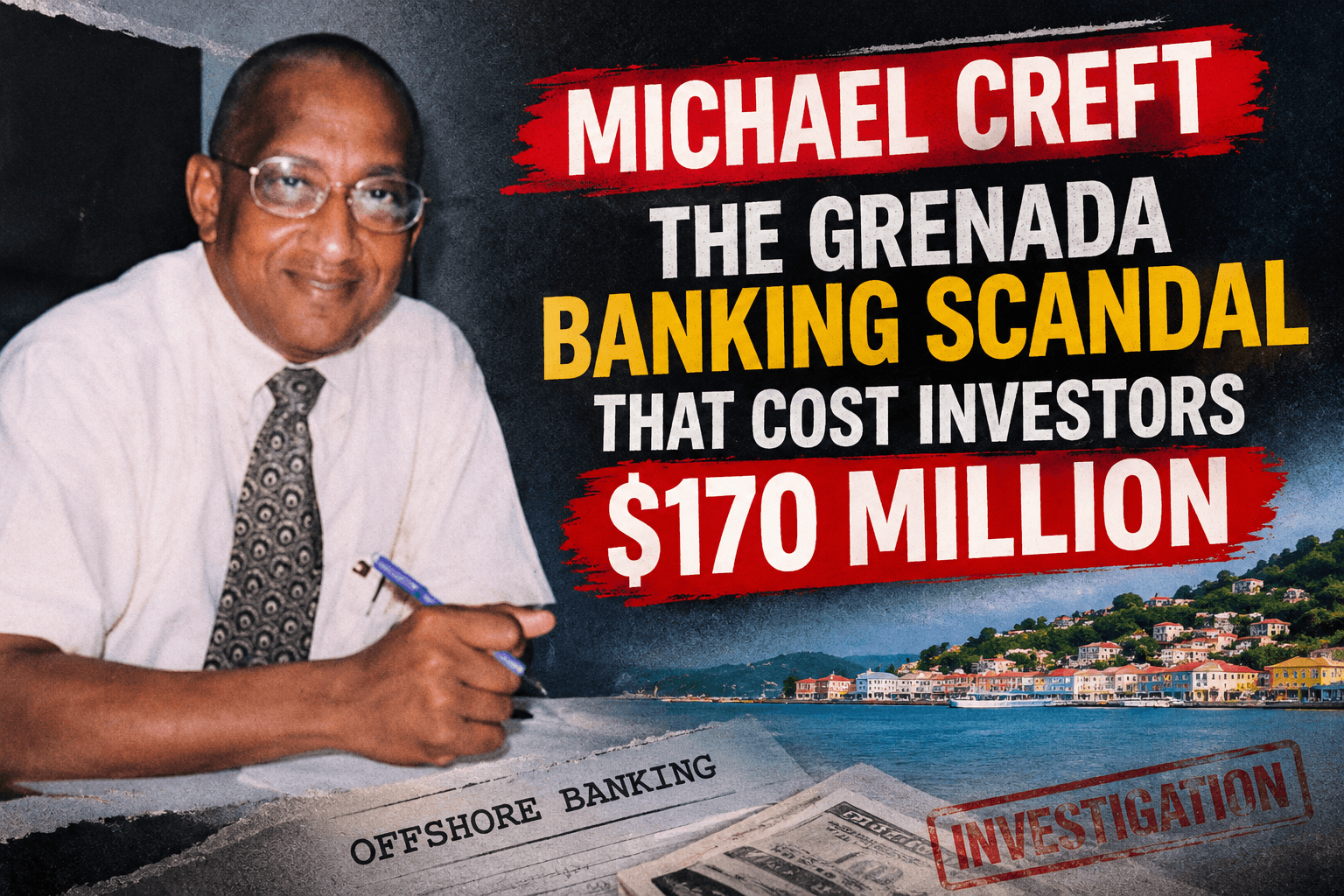
Grenada’s offshore banking scandal was supposed to be a story about an ambitious financial centre attracting international investment. Instead, it became one of the most damaging financial fraud cases connected to the Caribbean, leaving thousands of depositors facing enormous losses and exposing serious weaknesses in the country’s financial regulatory system. At the centre of the regulatory controversy was Michael Creft, a former senior financial services official whose own admissions would later raise troubling questions about the relationship between offshore banks, government officials and the people responsible for supervising them.
Creft was not originally a career banker. According to a 2009 investigation published by Portland Monthly, he was a Grenadian national who had spent approximately two decades working in Canada, most recently as an economic policy analyst with Manitoba’s Department of Highways and Transportation. In August 1997, he returned to Grenada to take up the position of Registrar of Offshore Services, a newly established role responsible for overseeing the country’s rapidly expanding offshore financial industry. His responsibilities included checking whether offshore banks met capital requirements, reviewing financial records and ensuring that institutions submitted their required audits.
The timing of his appointment was significant. Grenada had begun developing its offshore financial sector in 1997, hoping to attract international businesses, banking operations and investment capital. The industry expanded quickly. An International Monetary Fund assessment later recorded that, at its peak in early 2000, Grenada had 44 offshore banks and approximately 3,120 international business companies. The sector generated government revenue and employment, but its rapid expansion was accompanied by inadequate supervision. The eventual collapse of the First International Bank of Grenada exposed just how serious those weaknesses had become.
First International Bank of Grenada, commonly known as FIBG, was established in 1997 and became the most prominent institution in the unfolding scandal. Its promoters marketed extraordinary investment returns, with some products promising annual interest rates as high as 250% or even 300%. Investors were encouraged to believe that their deposits were protected by an international insurance arrangement and that the bank possessed enormous assets generated through sophisticated financial trading. Its promotional material presented offshore banking as a safe opportunity for people seeking substantially higher returns than conventional financial institutions offered.
The reality was very different. According to the US Department of Justice, FIBG attracted approximately $170 million in deposits through a Ponzi scheme. Money from new investors was used to make purported interest payments to earlier depositors, support fictitious investment arrangements and provide substantial sums to the people operating the scheme. The bank also claimed to have earned more than $12 billion through high-yield trading and to possess assets exceeding $26 billion. When Grenada’s government took control in August 2000, the institution had less than $2 million in genuine assets.
The losses were not limited to wealthy international investors. Thousands of ordinary depositors were affected, including retirees who had transferred pension savings and individual retirement account funds into the bank. A detailed investigation published by Portland Monthly in 2009 estimated that approximately 4,000 people across at least eight countries had been defrauded of at least $170 million. Some investors lost relatively modest savings, while others lost money they had intended to use for retirement. The liquidation process offered little prospect of meaningful recovery because the bank’s actual assets were so small compared with its liabilities.
Creft’s role became particularly controversial because he was the official expected to identify financial irregularities before they developed into a full-scale collapse. His responsibilities included verifying that FIBG held the required $2.25 million in initial capital and collecting its quarterly audit reports. The Portland Monthly investigation reported that the bank repeatedly failed to provide the requested financial documentation, offering excuses for delays. Yet the institution continued operating and attracting deposits. The same investigation described how questionable documents, including purported evidence of substantial gold holdings and an exceptionally valuable ruby, were accepted as indications of the bank’s financial strength.
The controversy escalated in January 1999, when OffshoreAlert publisher David Marchant publicly exposed FIBG and questioned its financial claims. Rather than simply allowing regulators and investigators to examine the allegations, the bank and associated entities pursued a defamation lawsuit against Marchant and his publication in the United States District Court for the Southern District of Florida. The bank sought to challenge the reporting and prevent further publication. Creft became an important figure in that legal confrontation.
On February 23, 1999, Creft submitted an affidavit supporting the bank’s position. In it, he represented that FIBG had not violated Grenadian law, that he had received no complaints about the institution and that there was no evidence of wrongdoing or suspicious circumstances. He also sent OffshoreAlert a letter defending the bank. According to the publication’s account, the fax containing his letter had been transmitted using FIBG’s own fax machine, a detail that raised further questions about the relationship between the regulator and the institution he was supposed to supervise. The defamation action was ultimately dismissed.
Events following the collapse of the bank made Creft’s earlier assurances particularly difficult to reconcile with the evidence uncovered by investigators. In August 2000, Grenada’s government intervened and appointed an administrator to oversee FIBG. The bank was subsequently stripped of its licence in February 2001, and a liquidator was appointed. The International Monetary Fund later identified the collapse as the defining event in Grenada’s offshore financial sector during 2000 and early 2001. It also noted that the failure exposed serious deficiencies in financial supervision and prompted the government to introduce regulatory reforms.
The most damaging revelations about Creft emerged during the subsequent American criminal investigation. In 2003, five principal figures associated with FIBG were charged in a 147-count federal indictment involving conspiracy, fraud and money laundering. The prosecution involved an extensive international investigation, with investigators tracing money transferred through accounts in the United States and several other jurisdictions. The US Department of Justice later described the case as an eight-year investigation involving thousands of American victims and financial transactions extending across international borders.
According to OffshoreAlert’s September 2007 reporting, Creft subsequently admitted to US prosecutors that the affidavit he had submitted in the bank’s defamation case was false. The publication quoted Assistant US Attorney Claire Fay’s sentencing memorandum, which stated that Creft acknowledged the affidavit falsely claimed there had been no complaints against FIBG and that the bank was operating in full compliance with the law. Most significantly, prosecutors reportedly stated that Creft admitted money he had received had influenced him to sign the false affidavit. This was a serious admission concerning the integrity of a government regulator and the independence of the legal proceedings in which he had participated.
The allegations extended beyond the bank itself. OffshoreAlert reported that Creft admitted FIBG had provided bribes to regulators and government members, including then Prime Minister Keith Mitchell. The allegations suggested that money from the institution had reached individuals who held positions of public responsibility, raising questions about whether political and regulatory relationships helped the bank continue operating despite mounting warning signs.
The political implications were significant. Grenada’s ruling New National Party acknowledged receiving campaign financing from the failed offshore bank but disputed claims that the money had been handed directly to Mitchell or senior party officials. A party representative stated that Creft had raised approximately EC$100,000, equivalent to around US$37,000, for the party’s central office and that the money supported its 1999 election campaign. The party’s response contradicted the broader implications of Creft’s reported testimony. It is important to distinguish the reported admissions concerning Creft from the separate allegations about individual political figures, which were disputed.
The criminal proceedings against the bank’s operators eventually produced substantial consequences. The Justice Department announced in March 2007 that Laurent Barnabe had pleaded guilty to two money-laundering counts and Douglas Ferguson had pleaded guilty to money-laundering conspiracy. Their plea agreements provided for prison sentences of 72 months and 52 months respectively. Two other defendants had previously pleaded guilty, while the fifth defendant died before trial. OffshoreAlert subsequently reported that four former FIBG insiders received prison sentences ranging from approximately 18 months to eight years. These convictions and pleas concerned the bank’s operators, not Creft.
The wider scandal also involved an extensive network of associated entities, including the International Deposit Indemnity Corporation, which was promoted as a deposit-protection organisation; the World Investors Stock Exchange; the Offshore Educational Institute; Granite Registry Services; and various investment funds and affiliated offshore banking operations. Investigators and journalists described these structures as part of a complicated network used to attract deposits, create an appearance of financial legitimacy and make the movement of investors’ money difficult to trace.
Creft’s later personal and professional circumstances remain less clear. Public reporting establishes his background in Manitoba, his appointment in Grenada in 1997 and his subsequent departure from the country’s financial regulatory leadership. A 2001 report by UPI stated that he had resigned as executive director of the Grenada International Financial Services Authority. The sources reviewed for this article do not reliably establish his date of birth, present residence, current employment or whether he holds any active business interests. Nor do the available records establish a criminal conviction or sentence against him in connection with the FIBG scandal. His reported admissions should not be confused with a criminal judgment against him.
The distinction matters. The collapse of FIBG was not merely the failure of another offshore investment business. It demonstrated how extraordinary financial promises, weak regulatory enforcement and relationships between private institutions and public officials can combine to expose ordinary depositors to enormous losses. The bank’s operators faced criminal prosecution, but the questions surrounding the conduct of those entrusted with supervising the financial system remain equally important. When a regulator’s assurances help protect an institution that prosecutors later describe as a massive Ponzi scheme, public confidence in the entire system is put at risk. The lasting lesson from the Creft controversy is that financial regulation means little unless those responsible for enforcing it are independent, accountable and prepared to act before investors lose their money.
Source:
OffshoreAlert
————-
Disclaimer:
Some content on Reportingscams.com is published under our guest post program and is provided by third-party contributors. Reporting scams does not create, verify, or take responsibility for the views, accuracy, or claims expressed in such content.