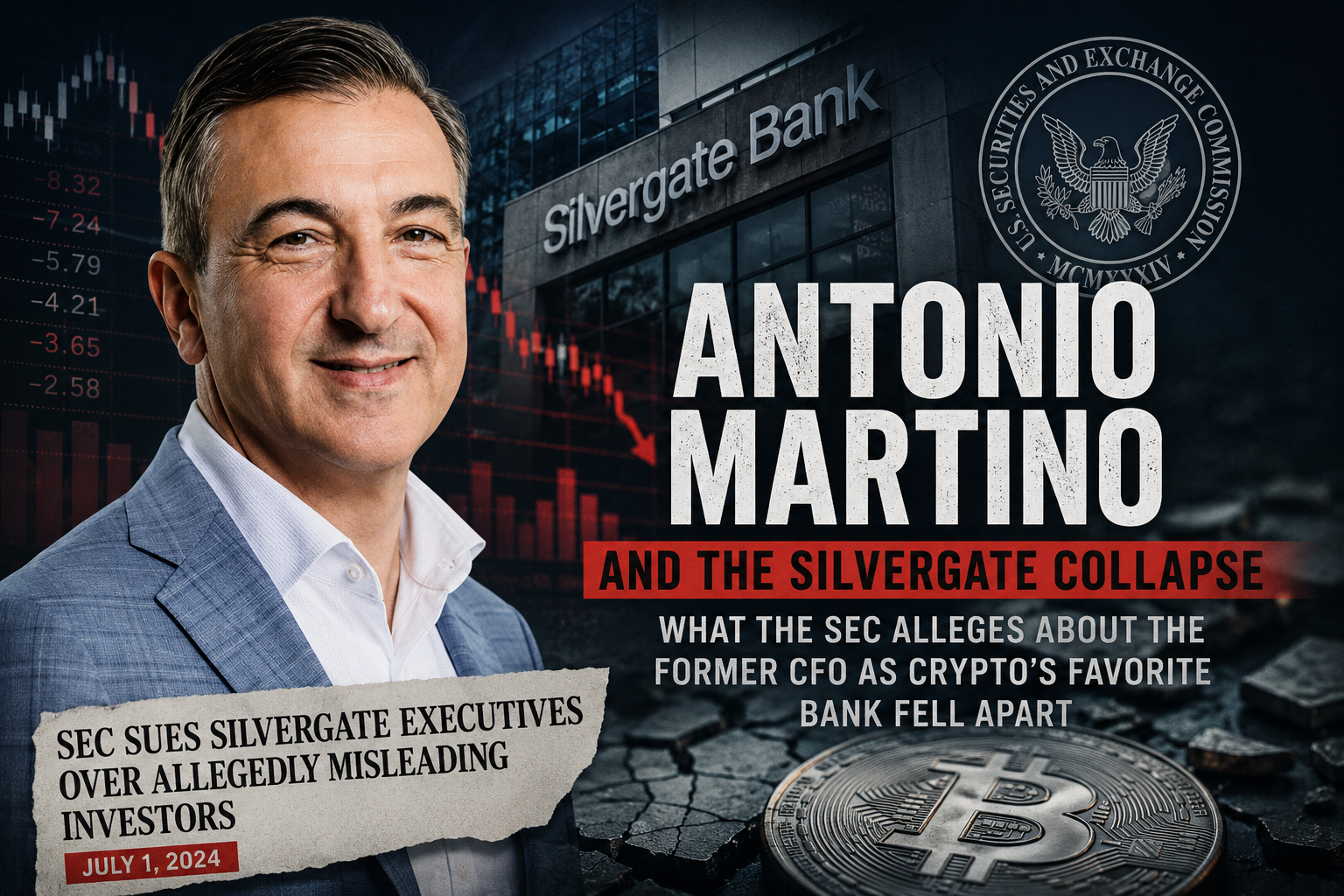
Antonio Martino built his career in the part of finance where numbers are supposed to be more than numbers. They are supposed to be warnings, controls and early signals of trouble. Before joining Silvergate Capital Corporation, Martino had spent decades in financial services, including senior finance positions at Citigroup and a stint as chief financial officer of LendingPoint. He was a Chartered Professional Accountant and had worked across North America, Europe and the Middle East. In September 2019, he became the chief financial officer of Silvergate, a California bank that was rapidly transforming itself into one of the most important banking institutions serving the cryptocurrency industry.
The transformation was spectacular. Silvergate’s crypto-related deposits rose from roughly $770 million in 2017 to approximately $14.1 billion by 2021, according to the Securities and Exchange Commission. Its Silvergate Exchange Network, or SEN, allowed cryptocurrency businesses to move U.S. dollars between participating accounts almost instantaneously, including outside conventional banking hours. By 2021, crypto platforms accounted for 58 percent of Silvergate’s deposits, while $787.4 billion in U.S. dollar transfers passed through the SEN during that year alone.
That growth made Silvergate a major financial bridge between traditional banking and the cryptocurrency market. It also created a concentration of risk. When FTX collapsed in November 2022, the consequences were immediate. Customers pulled billions of dollars from Silvergate, forcing the bank into a liquidity crisis and leaving management facing a difficult problem that was both financial and accounting-related. The bank needed liquidity. It had debt coming due. It held securities that had fallen substantially in value. And the accounting treatment of those securities had the potential to materially affect the bank’s reported financial position.
This is where the SEC’s case against Martino begins.
The regulator does not accuse him of causing the FTX collapse. Nor does the complaint say that Martino personally stole money from Silvergate customers. The SEC’s theory is more specific. It alleges that as Silvergate’s CFO, Martino approved and participated in financial disclosures that understated the amount of securities the bank expected to sell, understated losses associated with those sales and overstated the bank’s capital position at a moment when Silvergate was already under severe financial pressure.
The distinction matters. The case is fundamentally about disclosure, accounting, securities law and what a chief financial officer allegedly knew when he signed off on information being provided to investors and regulators.
According to the SEC’s July 1, 2024 complaint, Silvergate suffered a dramatic deposit run after FTX entered bankruptcy. The complaint says deposits fell from about $12 billion to $3.9 billion, a decline of almost 70 percent. To meet its obligations, Silvergate borrowed billions of dollars during the fourth quarter of 2022 and then had to sell securities to generate cash. The SEC says the bank ultimately suffered approximately $750 million in losses from selling $5.2 billion of securities.
For Martino, the critical accounting question concerned what Silvergate knew about the securities it would have to sell.
The securities were classified as available for sale. Under the accounting framework described in the federal court’s opinion, Silvergate had to evaluate securities held at an unrealized loss and determine whether an other-than-temporary impairment, commonly called OTTI, had occurred. The question was particularly important where the bank intended to sell securities or where it was more likely than not that the bank would have to sell them before recovering their amortized cost.
The accounting treatment mattered because OTTI could reduce the bank’s reported capital. The court explained that Silvergate’s Tier 1 capital had to be reduced by the amount of OTTI recorded. Falling below a five-percent Tier 1 leverage ratio would mean the bank could no longer be classified as “well capitalized.” That made the accounting decision considerably more consequential than a technical disagreement buried in an accounting note.
The SEC alleges that Martino understood this problem.
One of the most important pieces of the SEC’s case concerns an internal email from December 20, 2022. According to the complaint and the later court opinion, Silvergate staff warned Martino that the bank’s auditor had raised the OTTI issue for the remaining available-for-sale securities. The communication warned that losses that otherwise might have appeared in 2023 could be accelerated into 2022 earnings if the bank was forced to sell securities. It also described the accounting trigger as involving an intent to sell or the likelihood that the bank would be required to sell.
Martino responded by asking whether the OTTI issue was driven by accounting regulations, banking regulations or both, according to the SEC’s allegations.
The next day, the SEC says, Martino instructed employees to create an OTTI model assuming Silvergate would sell $2.5 billion of securities during the first quarter of 2023. The court record says Martino recognized that losses on securities the bank would have to sell needed to be recognized through earnings and that he was concerned about maintaining the bank’s Tier 1 ratio above five percent.
Then the numbers changed.
On January 4, 2023, according to the SEC’s allegations, Silvergate’s treasury department prepared a presentation showing that the bank needed approximately $2.6 billion in liquidity. That liquidity was required in part to repay roughly $2.425 billion of debt. The SEC says the presentation projected an OTTI charge of approximately $176.5 million and showed that the bank’s Tier 1 ratio could fall below five percent if the relevant losses and securities sales were properly incorporated.
The following day, however, another presentation used a substantially different approach.
The January 5 presentation projected only $1.7 billion in securities sales and a Tier 1 leverage ratio of 5.39 percent. The SEC alleges that this model did not account for all securities that the bank would more likely than not have to sell during the first quarter. Instead, it focused on securities that management intended to sell to repay a particular amount of debt.
According to the SEC, Martino accepted that approach even though he had information indicating that Silvergate would probably have to sell additional securities.
On January 6, the SEC alleges, Martino approved an OTTI calculation of $134 million based on the $1.7 billion securities-sales projection.
The difference between the two calculations was not merely academic. One model produced a materially larger loss and threatened the bank’s capital position. The other produced a smaller impairment charge and allowed Silvergate to present itself as remaining above the five-percent threshold.
That was followed by one of the most important public statements in the case.
On January 17, 2023, Silvergate released its fourth-quarter financial results. Martino participated in the earnings call. In prepared remarks, he stated that Silvergate’s Tier 1 leverage ratio was 5.36 percent and said it continued to exceed the well-capitalized standard under federal banking regulations. The contemporaneous transcript of the call records Martino making that statement himself.
The SEC says that representation was misleading because the bank’s financial position depended on assumptions that did not adequately reflect securities sales it was more likely than not to have to make.
The SEC’s complaint says Silvergate’s January 17 earnings release represented that the bank expected to sell only $1.7 billion in securities during the first quarter, of which $1.5 billion had already been sold. That language suggested that only another $200 million would need to be sold. According to the regulator, Martino knew or recklessly disregarded that Silvergate was likely to have to sell substantially more. The bank ultimately sold another approximately $1 billion of securities in the weeks that followed.
The SEC also alleges that the earnings release misstated the methodology used to calculate the $1.7 billion figure, understated expected securities-sale losses and overstated the Tier 1 leverage ratio.
These allegations form the heart of the case against Martino.
They also explain why the collapse of Silvergate cannot simply be described as another casualty of the cryptocurrency winter.
The bank had entered 2023 with a balance sheet under extraordinary pressure. The FTX bankruptcy had triggered a run on deposits. The bank needed to sell assets to meet withdrawals and repay obligations. Selling securities during a period of depressed market values crystallized losses that had previously existed as unrealized losses. At the same time, the accounting treatment of those securities could affect regulatory capital. The SEC’s theory is that management had a strong incentive to present the financial position in a way that avoided an immediate deterioration in reported capital.
Martino disputes that interpretation.
His lawyers have argued that the SEC’s case is implausible and that the regulator is attempting to transform a legitimate accounting judgment into securities fraud. In a January 2025 motion to dismiss, Martino argued that he had no personal financial motive to commit fraud, that Silvergate had disclosed its severe financial stress to the market and that the losses the SEC claimed were hidden had in fact been disclosed through accumulated other comprehensive loss rather than OTTI.
His defense is important because the case remains contested.
Martino has not been convicted. No court has entered a judgment finding that he committed securities fraud. The SEC complaint remains a set of allegations unless and until those allegations are established through litigation or resolved through settlement.
But the case did not disappear at the pleading stage.
On September 30, 2025, U.S. District Judge Andrew L. Carter Jr. denied Martino’s motion to dismiss. The court’s order is significant because it examined the legal sufficiency of the SEC’s allegations in detail. It did not determine that Martino was liable. Instead, the court concluded that the SEC had pleaded enough facts for its claims to proceed.
That distinction should remain central to any responsible account of Martino.
A motion to dismiss is not a trial.
At that stage, the court generally accepts well-pleaded factual allegations as true for purposes of testing whether the complaint states a legally viable claim. The judge specifically noted that the SEC’s securities-fraud allegations had to meet the heightened pleading requirements of Federal Rule of Civil Procedure 9(b). The SEC had to identify the allegedly fraudulent statements, identify who made them, say when and where they were made and explain why they were fraudulent.
Judge Carter concluded that the SEC had met that threshold.
The court’s opinion lays out a timeline that makes the regulator’s theory unusually concrete. It describes the December 20 warning about OTTI, Martino’s subsequent questions, the December 21 instruction concerning the $2.5 billion securities-sale model, the January 4 presentation showing a $176.5 million OTTI impact, the January 5 presentation using the $1.7 billion sales figure and Martino’s January 6 approval of the $134 million OTTI calculation.
The SEC’s allegations also extend beyond the January 17 earnings call.
According to the complaint, Martino subsequently communicated with regulators about Silvergate’s capital position. The SEC alleges that in a January 19 letter to the Federal Reserve Bank of San Francisco, Martino included Tier 1 leverage ratios of 5.36 percent for Silvergate Capital Corporation and 5.12 percent for Silvergate Bank and represented that the bank “remained well-capitalized.” The SEC further alleges that the letter included an $868 million repo line even though Silvergate had not made sufficient progress toward an economically viable agreement by that date.
The regulator’s argument is therefore broader than a single earnings call.
It says Martino’s conduct formed part of a continuing effort to present Silvergate as financially stronger than it actually was during a rapidly deteriorating liquidity situation.
The bank’s subsequent history makes the allegations especially consequential.
On February 23, 2023, Silvergate authorized another $2 billion in securities sales. On February 24, according to the federal court’s summary of the SEC’s allegations, Martino and Silvergate agreed to correct their books and public statements. But the correction did not occur before Silvergate liquidated and ceased banking operations on March 8. The bank never filed its 2022 annual report or its first-quarter 2023 Form 10-Q with the SEC.
On March 8, Silvergate announced that it would wind down operations and voluntarily liquidate the bank.
The Federal Reserve and California Department of Financial Protection and Innovation subsequently became directly involved in overseeing the wind-down. In June 2023, the Federal Reserve announced a consent order designed to ensure that Silvergate implemented its liquidation plan in a manner that protected depositors and the Deposit Insurance Fund. The order restricted certain corporate actions and required regulatory oversight of the wind-down.
The regulatory story surrounding Silvergate is therefore larger than the SEC’s allegations against Martino.
Federal and state banking regulators separately identified deficiencies in Silvergate’s anti-money-laundering and transaction-monitoring systems. The SEC’s complaint alleges that Silvergate’s SEN processed enormous volumes of crypto-related transfers while the bank failed to adequately automate monitoring of SEN transactions for significant periods. The SEC said the bank failed to detect nearly $9 billion in suspicious transfers by FTX and related entities.
Martino was not the executive specifically charged by the SEC over those BSA/AML compliance allegations.
That distinction is essential.
The SEC’s complaint focuses Martino’s liability on the financial reporting and securities-disclosure side of the Silvergate crisis. Former CEO Alan Lane and former Chief Risk Officer Kathleen Fraher faced separate allegations concerning the bank’s AML compliance representations. Silvergate itself also faced those allegations.
Those defendants settled.
Silvergate agreed to a $50 million SEC civil penalty, with the broader regulatory resolution involving approximately $63 million in payments to the SEC, Federal Reserve and California DFPI. Former CEO Alan Lane agreed to a $1 million civil penalty and a five-year officer-and-director bar. Kathleen Fraher agreed to a $250,000 civil penalty and a five-year officer-and-director bar. The settling defendants did not admit or deny the SEC’s allegations.
Martino did something different.
He fought.
That decision left him as the individual defendant in the SEC action who had not settled. The federal court’s docket records that the SEC filed its complaint on July 1, 2024, that Martino filed his motion to dismiss on January 14, 2025, and that the court denied the motion after briefing and a discovery-related stay.
As of the latest court material located for this investigation, the important procedural milestone is the September 30, 2025 order denying dismissal. The order required Martino to answer the complaint by October 21, 2025. The public material reviewed for this article does not establish a final judgment of liability against him, and the SEC case should therefore continue to be described as contested litigation rather than as a proven fraud conviction.
The chronology is striking when viewed as a whole.
Martino joined Silvergate in September 2019 after a long career that included Ernst & Young, Bank of Montreal and approximately 17 years at Citigroup. At LendingPoint, he had served as CFO from 2017 to 2019. Silvergate appointed him CFO as the company was building its position as a major crypto-focused financial institution.
During his Silvergate tenure, he helped oversee a period of extraordinary expansion.
The bank’s crypto deposits surged. The SEN became a central piece of its business model. Silvergate completed its public offering and became one of the most closely watched banks associated with the emerging digital-asset economy.
Then came November 2022.
FTX failed.
Silvergate’s crypto deposits collapsed. The bank borrowed billions of dollars. Securities had to be sold. Losses accumulated. Capital became a central concern.
December 2022 brought internal warnings about OTTI.
January 2023 brought the competing securities-sale models and the $134 million impairment calculation alleged by the SEC to be deficient.
January 17 brought the earnings release and earnings call in which Martino described a 5.36 percent Tier 1 leverage ratio and said it remained above the well-capitalized standard.
January 19 brought the letter to the Federal Reserve that the SEC later challenged.
February brought additional securities sales.
February 24 brought an agreement to correct books and public statements, according to the court’s account of the SEC’s allegations.
March 8 brought Silvergate’s decision to liquidate.
September 2023 marked the end of Martino’s tenure as CFO.
And then came the second chapter.
On March 26, 2024, PayZen announced Martino as its new chief financial officer. The healthcare-fintech company described him as a financial-services veteran with more than three decades of experience. The announcement highlighted his previous work at Citibank, LendingPoint and Silvergate, including his role in Silvergate’s public-market development.
The timing is notable because the SEC complaint followed roughly three months later.
On July 1, 2024, the SEC filed its civil action against Silvergate, Lane, Fraher and Martino. Martino’s lawyers said he categorically denied the allegations and intended to defend himself in court. Reuters reported that Martino disputed the SEC’s case and that his lawyers described the regulator’s allegations as an overreach and mischaracterization of the facts.
The issue of Martino’s new position at PayZen became even more interesting after the SEC lawsuit was filed.
PayZen went on to close a $232 million Series B financing round in August 2024. The financing consisted of equity and a credit facility and was led by NEA, with other institutional investors participating. The Investigations.org dossier notes that the funding occurred after both Martino’s appointment and the filing of the SEC complaint, while cautioning that there is no public evidence establishing what investors knew about the enforcement action or what due diligence they performed concerning Martino.
That is an important unanswered question, but it should not be turned into an accusation.
There is no reliable public evidence identified in this research showing that PayZen investors were misled about Martino’s legal position. Nor is there evidence establishing that PayZen participated in or benefited from the conduct alleged at Silvergate. The fact that a financing occurred while a company employed a defendant in a pending regulatory case is a factual circumstance, not proof of wrongdoing by the employer or its investors.
The same caution applies to Martino’s earlier career.
Public records establish that he worked for Citigroup for approximately 17 years and held senior finance and CFO roles in several markets. They also establish his work at LendingPoint and Silvergate. The sources reviewed for this investigation did not establish an adverse regulatory finding against him arising from his Citi or LendingPoint employment.
That matters because a common mistake in investigative reporting is to allow one serious allegation to contaminate an individual’s entire professional history.
The evidence does not support that.
The evidence supports something narrower and, in some ways, more significant.
Antonio Martino was the CFO of a rapidly expanding crypto-focused bank when that bank experienced an extraordinary liquidity crisis. The SEC alleges that he participated in financial reporting decisions that misrepresented the severity of the bank’s financial position. Those allegations are supported in the complaint by a detailed sequence of internal communications, accounting models, financial disclosures and subsequent securities sales. A federal judge later determined that the SEC had pleaded enough facts to allow the case to continue.
But the court did not declare Martino guilty.
The September 2025 ruling is particularly important because it is easy to mischaracterize. Judge Carter did not conduct a trial and did not make a final finding that Martino knowingly committed securities fraud. The court decided that the SEC’s allegations were legally sufficient to survive a motion to dismiss. That means the SEC cleared an important procedural hurdle. It does not mean the SEC has already proved its case.
For investigators following the case, the accounting issue remains the key area to understand.
The dispute centers on the point at which management should have recognized that securities would probably have to be sold. If Silvergate was likely to sell securities carrying unrealized losses, those expected sales could affect OTTI and therefore reduce capital. If management instead relied on a narrower estimate of securities it intended to sell, the resulting financial statements could look materially stronger.
The SEC says Martino knew enough to understand the distinction.
His defense says the SEC is improperly second-guessing a legitimate accounting judgment and ignoring the disclosures Silvergate did make about its deteriorating financial position. His January 2025 motion emphasized that the market was already aware that Silvergate was experiencing severe financial stress and argued that the losses the SEC describes as concealed were reflected elsewhere in the company’s financial reporting.
That disagreement is ultimately what the litigation must resolve.
The case therefore sits at an important intersection of the post-FTX regulatory crackdown, bank accounting, securities disclosure and the risks created when a traditional financial institution becomes heavily dependent on a volatile emerging industry.
Silvergate’s collapse exposed how quickly a specialized banking model could reverse.
The same crypto deposits that helped drive extraordinary growth became a source of instability when confidence disappeared. The SEN had allowed billions of dollars to move quickly between crypto businesses, but the concentration of those customers meant that a crisis at one major platform could transmit stress through the bank almost immediately. The SEC’s complaint describes a system in which crypto-related deposits expanded rapidly while regulators and internal compliance personnel identified serious weaknesses in transaction monitoring.
The bank eventually disappeared.
The Federal Reserve said in July 2024 that Silvergate had completed its liquidation and wind-down, repaid all deposits and no longer functioned as a bank. The Fed terminated the enforcement action that had been imposed to supervise the liquidation, while noting that Silvergate had separately been fined $43 million for BSA/AML noncompliance.
That broader regulatory record provides context, but it does not automatically establish Martino’s individual liability.
The distinction between corporate misconduct and individual responsibility is one of the most important aspects of this story.
Silvergate was the institution.
Lane and Fraher were the executives charged over the AML and compliance representations.
Martino was the CFO singled out over financial reporting, securities losses, OTTI calculations, capital ratios and investor disclosures.
The SEC brought all of these matters together in one complaint because they emerged from the same corporate crisis. But the allegations against each defendant are not interchangeable.
For Martino, the most consequential evidence is therefore not simply that Silvergate failed or that regulators fined the bank.
It is the paper trail surrounding what he allegedly knew about future securities sales and how that information was translated into accounting assumptions and public statements.
That is where the investigation becomes more than a story about a failed crypto bank.
It becomes a story about the responsibility of a CFO when a balance sheet begins to deteriorate and the accounting choices made in response can determine how that deterioration appears to investors.
The available record also raises a broader question about executive accountability in financial technology.
Martino’s career illustrates how executives can move between traditional banking, fintech and emerging financial sectors. His resume includes Citigroup, LendingPoint, Silvergate and PayZen. His appointment at PayZen was publicly presented as the next step in a career spanning more than three decades.
The SEC case now follows that career into its most contentious chapter.
There is currently no criminal conviction against Martino identified in the records reviewed for this investigation. The case brought by the SEC is civil. The available record reviewed here also does not establish a criminal indictment or criminal conviction arising from the Silvergate allegations.
That should be stated plainly.
So should the other side of the equation.
A federal judge has already rejected Martino’s attempt to have the SEC case dismissed at the pleading stage. The judge found that the SEC had adequately alleged false statements of fact concerning, among other things, the OTTI methodology and Tier 1 capital ratio. The court allowed the case to continue.
The result is an unusual position for a senior financial executive.
Martino is not a convicted fraudster.
He is also not someone against whom the government merely filed an untested accusation and then abandoned the matter.
He is a former CFO facing an active SEC civil enforcement case in which the regulator has presented a detailed theory of alleged securities fraud and survived a federal court challenge to the sufficiency of that theory.
The difference between those two descriptions is the difference between responsible investigative journalism and premature judgment.
The story of Antonio Martino is therefore not simply the story of a man accused after the collapse of Silvergate.
It is the story of how a bank built around the cryptocurrency boom grew extraordinarily quickly, became deeply exposed to the industry’s largest players, suffered a devastating liquidity crisis after FTX collapsed and then confronted accounting decisions that could affect whether it continued to appear adequately capitalized.
At the center of that process was the CFO.
The SEC says Martino saw the warning signs, understood the effect that securities sales could have on capital, approved an accounting approach that understated the expected sales and losses, and then participated in public disclosures that presented Silvergate’s financial position more favorably than it should have been presented.
Martino says that account is wrong.
The federal court has not yet converted the SEC’s allegations into a finding of liability.
That unresolved conflict is precisely why the case remains important.
The surviving question is not whether Silvergate failed. It did. It is not whether regulators found serious problems at the bank. They did. It is not whether Martino was the CFO during the period in which the bank’s liquidity crisis unfolded. He was.
The question is what Martino knew, when he knew it, what accounting judgments he made and whether those judgments crossed the line from legitimate financial reporting into securities fraud.
The SEC has put that question before a federal court.
And as of the latest verified court record examined for this investigation, the question remains unanswered.
What is already established is the chronology. Martino joined Silvergate in 2019. Crypto deposits expanded dramatically. FTX became one of the bank’s major customers. FTX collapsed in November 2022. Silvergate experienced a massive deposit run and liquidity crisis. Internal communications raised the OTTI issue in December. Competing securities-sale models were prepared in January 2023. Martino approved the $134 million OTTI calculation alleged by the SEC to be improper. He participated in the January 17 earnings call and described the bank’s Tier 1 leverage ratio as 5.36 percent and above the well-capitalized standard. Silvergate subsequently sold additional securities, moved toward correcting its books and disclosures and ultimately shut down on March 8, 2023.
In July 2024, the SEC sued.
The other defendants settled.
Martino did not.
In January 2025, he asked the court to dismiss the case.
In September 2025, the court refused.
That is where the public record leaves the investigation at present.
For readers trying to understand who Antonio Martino is, the answer is consequently more complicated than either a polished executive biography or a simple fraud label.
He is a Canadian citizen and Chartered Professional Accountant who spent much of his career in major financial institutions before moving into fintech. He became CFO of Silvergate during its rise as a crypto banking powerhouse and remained in that position through the bank’s collapse. He later became CFO of PayZen, a healthcare-fintech company, even as the SEC pursued civil allegations concerning his conduct at Silvergate.
The public record establishes the allegations.
It establishes the regulatory investigations surrounding Silvergate.
It establishes the federal court’s refusal to dismiss the SEC’s case.
It establishes Martino’s denial.
What it does not yet establish is a final judicial finding that Martino committed fraud.
That final distinction should remain at the center of any publication about him.
The most consequential unresolved issue is therefore not whether the Silvergate story was a disaster. The bank’s liquidation, regulatory sanctions and billions of dollars in losses make that clear. The unresolved issue is whether, in the critical weeks before that collapse, the man responsible for the company’s financial reporting crossed the line between managing a crisis and misrepresenting it.
That is the question the SEC has brought to court.
And it is the question Antonio Martino has chosen to fight.
————-
Disclaimer:
Some content on Reportingscams.com is published under our guest post program and is provided by third-party contributors. Reporting scams does not create, verify, or take responsibility for the views, accuracy, or claims expressed in such content.