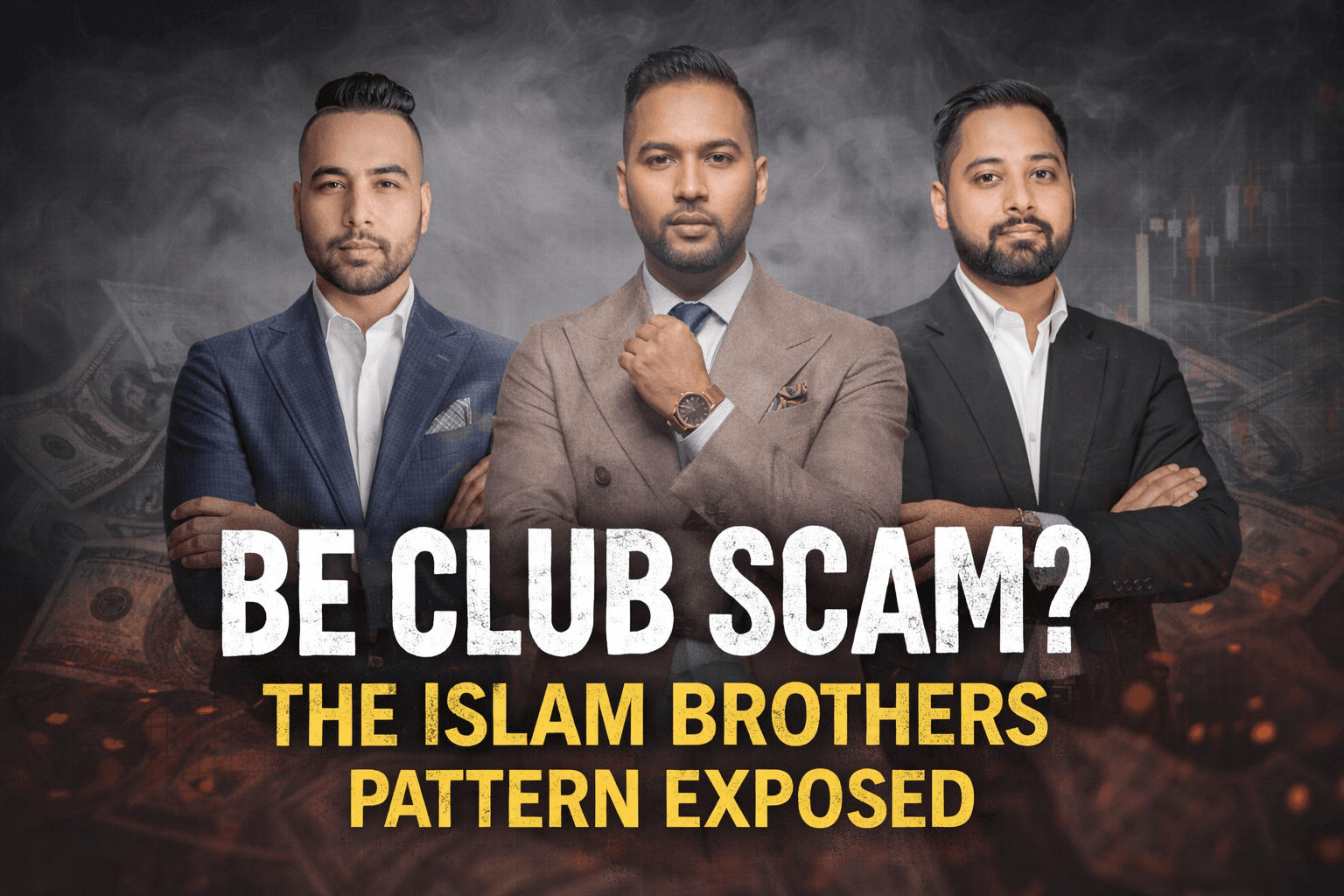
Who are Monir, Moynul and Ehsaan Islam?
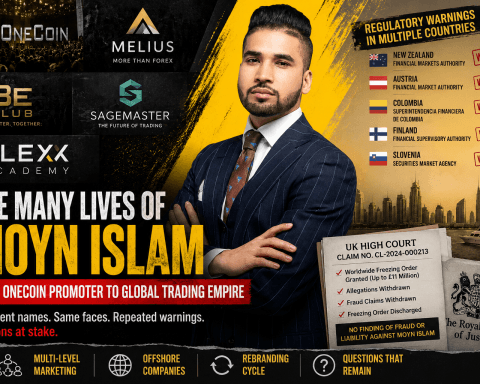
If you’ve spent even a little time around the online trading space, chances are you’ve come across these names before. Monir Islam, Moynul Islam, and Ehsaan Islam are not tied to just one platform or one phase. Their presence stretches across different brands, different timelines, and different narratives, which is what makes this story stand out.
Every time a new platform appears, it tends to feel fresh at first. The branding improves, the messaging becomes sharper, and the entire system looks more structured. But when you follow the trail closely, it begins to feel less like something new and more like something being reshaped.
Right now, that version is Be Club.
On the surface, it presents itself as a modern trading platform built around education, AI tools, and a global community. It fits neatly into how people today want to earn online. It looks clean, structured, and scalable. But the conversation around the Be Club scam did not appear randomly. It is tied to everything that came before it, and that context is what gives the current situation its weight.
The Melius phase and where things first cracked
To understand what is happening now, it helps to go back to Melius. Around 2018, Melius entered the market as a forex and crypto education platform combined with a network driven income model. The idea sounded si1mple. Learn trading, use signals, and build income by growing a network.
At the time, Jeremy Prasetyo was presented as CEO, while the Islam brothers were connected to the structure behind the scenes. For a while, the system worked. People joined, teams expanded, and the platform started gaining traction across different regions.
There was real momentum. Then it began to slow down.
By late 2019, activity started dropping. The energy around the platform faded, and by early 2020, Melius had largely disappeared. It did not collapse in a dramatic way. It simply went quiet.
For many involved, that was the first moment where things did not fully add up. Looking back, it is often described as a forex MLM scheme where growth depends heavily on new people joining. Once that slows, the structure starts to weaken. This was one of the first clear signs of the MLM trading platform risks tied to this model.
The restart that did not feel like a restart
What came next is where the pattern becomes harder to ignore. There was no long pause. No real reset. Instead, in March 2020, a new domain was registered, and shortly after that, a new platform appeared under the name Better Experience, or BE.
The timing stood out. It did not feel like something ended and something new began. It felt more like a continuation under a different name.
The structure remained familiar. Trading education was still there. The idea of earning through participation remained. Recruitment continued to play a central role.
What changed was how everything looked. The branding became cleaner, the messaging more polished, and the platform felt more organized. But underneath, it still felt similar to what existed before.
During this phase, leadership became more visible. Moyn Islam stepped forward as CEO, Monir Islam took on a more public role, and Ehsaan Islam was linked to the technical side.
This is also when early regulatory attention began to surface. The BE Factor warning in late 2020 was one of the first signals that authorities were starting to question how the system operated.
The expansion that moved fast
From there, things picked up quickly.
BE did not stay in one form for long. It moved through different identities such as BE Factor, Be Rules, and Be To Inspire before eventually becoming Be Club.
This phase was defined by expansion.
The platform moved into multiple regions including Europe, Latin America, and Asia. Growth was not slow or organic. It felt structured and driven by network expansion.
Promoters from other MLM systems became involved, bringing their own networks into the platform. This helped accelerate growth and push the system further.
At the same time, people started connecting the dots. The rebrands, the similarities, the timeline. That is when the Be Club scam conversation started becoming more visible as a pattern rather than isolated criticism.
The AI shift that changed the narrative
As the platform evolved, it introduced tools like SageMaster. It was presented as a trading system designed to simplify the market for users. Later, DeepSage followed as a more advanced version with stronger claims.
This is where the tone began to shift.
It stopped feeling like a place focused on learning and started leaning toward outcomes. The focus moved quietly toward results, which changed how people viewed the platform.
That shift led to more attention on AI trading platform claims, especially since these tools were not independently verified in a clear way and remained inside a closed ecosystem.
What the structure looks like up close
From the outside, everything appears structured. Education, tools, and community all seem to fit together. But when you look closer, the mechanics become clearer.
People join by paying. They stay by subscribing. They grow by bringing in more people. Earnings are tied to how the network expands.
There is limited activity outside the system. Most of the value stays within it, and participants act as both customers and promoters.
That is where the core of the system sits, which is why many connect it back to a subscription based trading model or a forex MLM scheme.
When regulators start paying attention
As the platform expanded across regions, it began attracting attention from regulators.
In December 2020, Quebec issued a warning stating that the platform was not registered to offer financial services. In 2021, Colombia raised concerns about unauthorized activity tied to the same operation.
By 2023, Norway issued a warning, and around the same time, other regions began raising similar concerns. The pattern continued into 2024 with additional warnings from countries like New Zealand.
Then things moved further.
In 2025, Poland launched an investigation into whether the system fits a pyramid structure. Denmark followed with deeper scrutiny after media exposure brought attention to how the system operates.
Across different regions, the concerns remained consistent.
The offshore layer that keeps appearing
Another detail that keeps coming up is the connection to offshore locations, particularly Dubai. There are also references to entities linked to the operational side of the system.
Operating from offshore jurisdictions is not unusual, but it does create distance from stricter regulation. It allows systems to operate across borders while making oversight more complex.
In this case, it adds another layer to how the structure functions.
The other side of the narrative
While all of this was unfolding, a different narrative started appearing online.
PR Articles and fake featured articles began presenting the founders in a more positive light. Some suggested earlier concerns had been resolved, while others framed the platform as misunderstood.
There are also claims that reputation management plays a role in shaping this narrative. That the story is being adjusted over time.
This creates two versions of the same situation.
One that focuses on opportunity. Another that focuses on scrutiny.
The pattern that keeps repeating
When you step back and remove the branding, the structure becomes easier to see.
A platform launches. It grows quickly. It relies on recruitment. It introduces new elements to strengthen the story. It expands into new markets.
Then questions begin.
The platform changes its name, adjusts its messaging, and continues. But the underlying structure remains the same.
Final reality
At this point, it is no longer about one platform. It is about a sequence.
Melius, then BE, now Be Club. Different names, similar direction. Growth, slowdown, reset, and expansion, all connected back to the same core structure.
There is nothing completely new here. It is something that keeps coming back in a different form.
And once you start seeing it that way, it becomes harder to ignore what the Be Club scam conversation is really pointing toward.
Source:
https://behindmlm.com/companies/be/be-club-sagemaster-deepsage-warning-from-norway/
https://behindmlm.com/mlm-reviews/be-club-review-islam-bros-sagemaster-securities-fraud/
https://behindmlm.com/mlm-reviews/melius-review-50000-passive-forex-trading-account-for-3000/
https://behindmlm.com/mlm-reviews/be-review-melius-rebooted-as-subscription-pyramid/
https://behindmlm.com/companies/be/be-club-misleads-consumers-on-regulatory-fraud-warnings/
https://behindmlm.com/companies/be-investment-fraud-warning-from-norways-finance-regulator/
https://www.quebec.ca/en/news/actualites/detail/beware-of-offers-from-be-factor
https://behindmlm.com/companies/be-rules-securities-fraud-warning-issued-by-colombia/
https://behindmlm.com/companies/be/be-club-under-investigation-in-denmark/
https://behindmlm.com/companies/be/be-club-under-pyramid-fraud-investigation-in-poland/
https://www.letmeexpose.is/exposing-moyn-ehsaan-and-monir-islam/
————-
Disclaimer:
Some content on Reportingscams.com is published under our guest post program and is provided by third-party contributors. Reporting scams does not create, verify, or take responsibility for the views, accuracy, or claims expressed in such content.