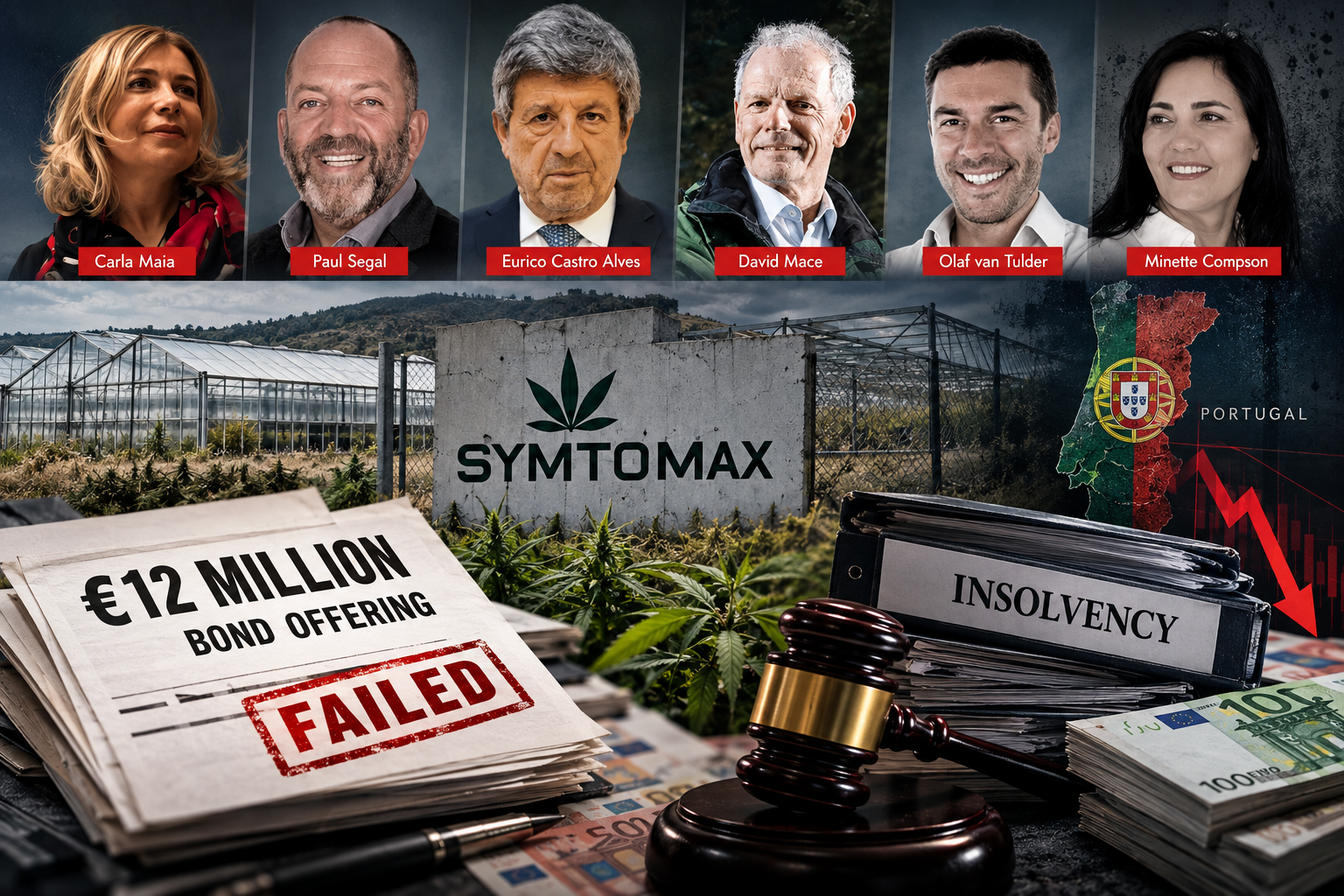
The collapse of Symtomax in Portugal has brought an old investment controversy back into focus. The company arrived in the country promising to build what it described as Europe’s largest outdoor medical-cannabis cultivation operation, backed by a 105-hectare site in the Alentejo region and ambitious plans for cultivation, processing, research and exports. In 2019, its founders, British nationals Minette Coetzee, also known as Minette Compson, and Paul Nathan Segal, were seeking up to €12 million through a bond offering that promised investors a 30% return over two years. OffshoreAlert later reported that the offering contained serious misrepresentations, including a purported Portuguese cannabis licence that Infarmed said did not exist at the time.
The licence issue is important because the story did not end with the 2020 exposé. When OffshoreAlert contacted Infarmed in January 2020, a spokesperson said Symtomax was not among the five companies then licensed for the relevant activities and said the licence number presented to investors was not authentic. Yet Symtomax subsequently obtained a real Infarmed approval in June 2021 allowing cultivation and the import and export of medical cannabis. The company itself said it completed a test crop later that year and expected commercial production in 2022. In other words, the later licence does not erase the earlier discrepancy; it shows that Symtomax eventually secured regulatory approval after having promoted itself as licensed before that approval existed.
The original fundraising structure also raised questions about who would actually receive investors’ money. The offering documentation described investors lending money to British company Symtomax SPV Limited, which would then lend it to Symtomax, Lda in Portugal. The funds were initially directed toward an account identified as belonging to “CS Ltd.”, or Currency Solutions, at the Royal Bank of Scotland in London. OffshoreAlert also reported that Symtomax had repeatedly presented the proposed cultivation land as company-owned when, according to documentation it obtained, the group had at one stage only held an agreement to purchase the property for €1.3 million.
The people behind the project had histories that made those questions more consequential. Coetzee, now 55 based on her March 1971 date of birth in UK corporate records, previously operated under the name Minette Compson. In 2015, Gibraltar’s Financial Services Commission barred her from performing specified functions involving licensed investment businesses after determining that she was not a fit and proper person. The action arose from the regulator’s investigation into Advalorem Value Asset Fund. Gibraltar court records show that the case involved serious concerns surrounding the fund’s investment in Scottish land and the conduct of its directors. The Court of Appeal later upheld the lower court’s judgment concerning the regulatory action.
Advalorem was not a small failed venture. Pension-scheme records published by Dalriada Trustees state that £7.7 million of pension money was invested in the Gibraltar fund and that £6.6 million was subsequently used to buy Scottish land. That land was ultimately sold for only £89,000. Civil proceedings were brought against a number of people connected to Advalorem, including Coetzee, while the Gibraltar courts dealt with freezing orders and allegations of fraud. Later recovery action returned about £1.86 million to the affected pension schemes, according to Dalriada’s records, leaving a substantial shortfall.
Segal’s history also intersected with the same network. The original Symtomax investigation reported that he participated in both Advalorem and Privilege Wealth and received commissions and profit-share payments connected with those schemes. Privilege Wealth raised more than £40 million from investors before collapsing in 2017 after being exposed by OffshoreAlert. Segal was also associated with Etaireia Investments, a publicly listed British property vehicle that was exposed in 2015 after falsely claiming to have planning permission for a Scottish residential development. Etaireia subsequently admitted it had not even applied for the permission and later entered administration.
The Symtomax structure itself was unusually international. Records identified companies and legal vehicles in Gibraltar, Portugal, Scotland and South Africa, alongside Panama foundations, a Swiss trust company and entities in other jurisdictions. Symtomax Limited in Gibraltar was controlled through Caprayal Trust SA, while the Portuguese operating company was owned through the Ruby Global Foundation and Good Will Universal Foundation in Panama, alongside direct interests held by several individuals. The uploaded investigation also identifies Ian Stewart, David Mace, Olaf van Tulder, João Peixoto, Carla Maia and Natasha Grobbelaar among people connected with different Symtomax entities.
Some of those relationships deserve particular caution. Ian Stewart, for example, was linked to Symtomax entities and Caprayal Trust, while OffshoreAlert reported that he continued signing documents for Panama foundations after saying he had resigned from Caprayal. Stewart disputed knowledge of Symtomax’s operations and ownership structure and subsequently stopped responding to questions from the publication. The allegations surrounding Stewart should not be confused with a criminal conviction, but the corporate records add another layer to the complicated ownership structure surrounding the project.
Symtomax also promoted relationships that helped establish credibility around the project. Eurico Castro Alves, who had previously headed Infarmed and served briefly as Portugal’s Secretary of State for Health, joined the company as a non-executive director in 2019. Symtomax announced the appointment prominently. The company also announced a strategic relationship with The Greater Cannabis Company, a U.S. OTCQB-listed business. Greater Cannabis described Symtomax as a licensed medical-cannabis group in a 2019 announcement, while its later SEC filings show that the commercial relationship generated no royalty-producing sales for the company.
There were signs of corporate weakness even after the licensing milestone. Symtomax SPV Limited repeatedly faced compulsory strike-off proceedings in the United Kingdom for filing failures. Companies House records show strike-off action in 2022, 2024 and again in 2025, although the actions were discontinued rather than resulting in an immediate dissolution. The latest available UK filing shows Paul Segal as the active director and person with significant control, holding more than 75% of the shares and voting rights. The same record lists Spain as his country of residence. Coetzee, who resigned from the SPV in January 2021, is also listed in the corporate record as resident in Spain.
The latest chapter is considerably more serious. Symtomax, Lda entered Portuguese insolvency proceedings in 2026. Portuguese reporting says the company accumulated approximately €8.5 million in liabilities and never progressed to sustained commercial production. Its remaining equipment was put up for auction, with the value recovered reportedly amounting to less than 4% of what was owed to the Portuguese state alone. The insolvency administrator Raul Gonzalez Benito and Portugal’s Public Prosecutor have argued that the insolvency should be classified as culpable, with presumed serious fault attributed to managers Paul Nathan Segal and Olaf van Tulder. No final court ruling on that qualification had been reported at the time of publication.
There have been other signs of creditor pressure. In 2025, investors obtained French judgments totaling €65,000 against Scottish and Portuguese companies within the Symtomax group. That does not establish the full scale of investor losses from the original €12 million offering, and there is no reliable public evidence establishing that the entire €12 million was actually raised. What is clear is that the offering sought that amount, a promotional video claimed that $2 million had already been raised, and subsequent litigation demonstrates that at least some investors pursued recovery through the courts.
Neither Coetzee nor Segal responded to OffshoreAlert’s questions when the 2020 investigation was published, despite being given seven days to comment. The material reviewed for this article does not establish that either person has been criminally convicted of fraud. The documented record instead consists of regulatory action against Coetzee, civil litigation and allegations surrounding earlier investment schemes, the disputed Symtomax fundraising campaign, later investor judgments, and the current Portuguese insolvency proceedings involving Segal and van Tulder. Those distinctions matter: an allegation, a regulatory finding, a civil judgment and a criminal conviction are not interchangeable.
What makes the Symtomax story significant is not simply that an ambitious cannabis project failed. Businesses fail, particularly in capital-intensive industries. The deeper issue is the sequence: ambitious financial promises, questionable representations about regulatory status, a complicated international ownership structure, founders with documented involvement in earlier troubled investment schemes, years of corporate filings and creditor disputes, and finally a Portuguese company left with millions in liabilities and no lasting commercial production. The project eventually obtained the licence it once claimed to possess, but that later approval could not turn the earlier fundraising controversy into a success story. For investors, the lesson is uncomfortable but straightforward: a licence, a prominent adviser, a sophisticated corporate structure and an attractive projected return are not substitutes for independently verified assets, audited finances and a clear trail showing where investment money actually goes.
Source:
OffshoreAlert
————-
Disclaimer:
Some content on Reportingscams.com is published under our guest post program and is provided by third-party contributors. Reporting scams does not create, verify, or take responsibility for the views, accuracy, or claims expressed in such content.