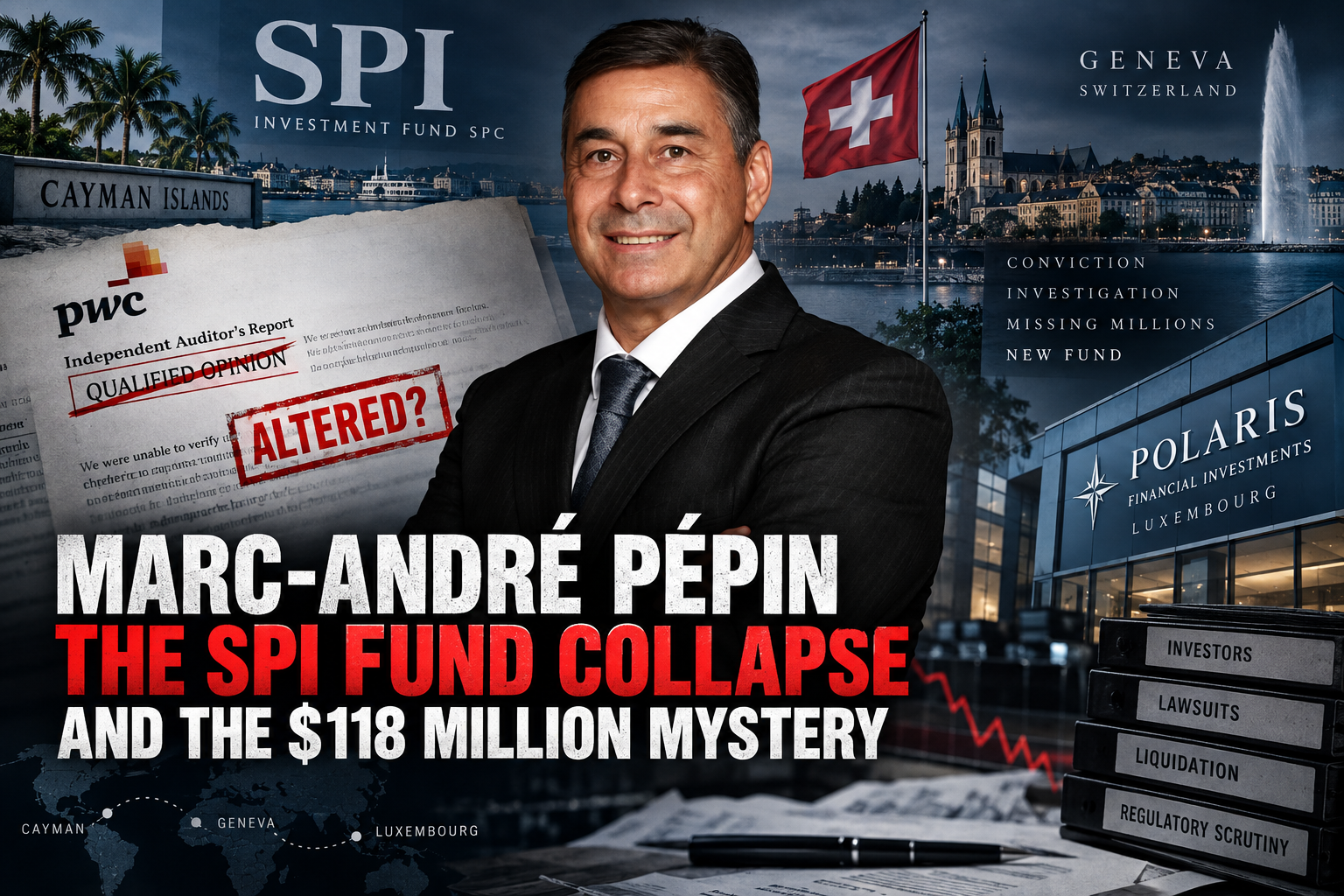
As per OffshoreAlert, Canadian-Swiss asset manager Marc-André Pépin was criminally convicted in Switzerland in 2023 for falsifying the financial statements of his failed Cayman Islands-domiciled SPI Investment Fund and is under criminal investigation again in the same country after three of the Fund’s investors who invested approximately $7 million filed complaints for suspected fraud, OffshoreAlert can reveal.
In a judgment on November 22, 2023 at the Police Court in Geneva, where Pépin is based, he received a suspended monetary penalty of up to CHF 37,500 after being convicted of forging the Fund’s 2020 audit by accounting firm PwC by, among other things, removing the auditor’s qualified opinion and distributing the altered version to investors. The sentence was suspended for two years, meaning he would not have to pay the monetary penalty if the probation period passed without further problems. OffshoreAlert published the underlying criminal judgment, identifying the case as one involving falsification of the financial statement of SPI Investment Fund SPC.
The conviction is an important distinction in a case that has otherwise generated a mixture of proven facts, civil allegations and disputed claims. Pépin has not been convicted of fraud in connection with SPI. The criminal conviction concerned the falsification of financial reporting. Separately, however, SPI’s former independent directors accused him in Cayman Islands court documents of “fraudulent misconduct and mismanagement,” allegations he has consistently disputed. GothamCity reported in 2022 that Pépin denied wrongdoing after the accusations became public.
The Cayman dispute dates back to January 2022, when SPI’s then-independent directors filed a winding-up petition in the Grand Court of the Cayman Islands. They questioned the accuracy of the fund’s financial position and alleged that a version of its 2020 audited accounts distributed to investors had been heavily altered. At the centre of the dispute was PwC’s qualified audit opinion, which reportedly reflected an inability to verify approximately $11.7 million of assets. The directors alleged that the qualification had been removed from the version circulated to investors. PwC subsequently resigned as auditor, according to the reporting and court material surrounding the dispute.
The petition did not immediately bring SPI down. The day after it was filed, Pépin removed the independent directors, and the winding-up petition was later withdrawn. Pépin and Invescap subsequently described the withdrawal as confirmation that the allegations were unfounded. In an August 2022 statement distributed through PR Newswire, Invescap said the Cayman proceedings had concluded with no wrongdoing established and that the fraud allegations had been quashed. That statement represents Pépin’s position, not a criminal acquittal on the later Swiss forgery conviction.
SPI continued operating until November 2023, when its shareholders resolved to place the Cayman fund into voluntary liquidation. Cayman Islands government records show that the liquidation began on November 17, 2023, with David Griffin, Andrew Morrison and Iain Gow of FTI Consulting appointed as joint voluntary liquidators. In February 2024, the Grand Court ordered that the liquidation continue under court supervision.
What followed has made the financial consequences much more significant than the original dispute over the audit. SPI’s liquidators have been investigating what happened to money connected to the fund, with OffshoreAlert reporting that more than $118 million of investors’ funds was described as having “disappeared.” The liquidators subsequently sought evidence in the United States concerning entities and individuals connected to loans said to involve approximately that amount. The matter reached the U.S. Bankruptcy Court for the Southern District of Florida through Chapter 15 proceedings, a mechanism used to recognize and assist foreign insolvency proceedings.
Among the names appearing in the proceedings and related reporting are Miami-based businessman Dennis Klemming, Jacob Gitman and Yulia Kislyuk, as well as entities including Sinai Holdings and the Prudent Group. The precise ultimate disposition of the money remains a matter for the liquidators and courts; the $118 million figure should therefore not be treated as an established amount of theft or proven investor loss. It is the amount that has been the subject of the liquidators’ investigation into the disappearance of funds. The U.S. Chapter 15 case remained active into 2026, with court activity continuing as the liquidators pursued discovery.
The Swiss criminal proceedings added another layer. OffshoreAlert reported in February 2025 that three SPI investors who had collectively invested approximately $7 million had filed criminal complaints in Geneva alleging suspected fraud, with complaints dating to 2023 and 2024. The publication reported that the matters appeared to remain ongoing. I found no public disposition establishing that Pépin was convicted of fraud in those complaints, so they should be treated as unresolved allegations rather than findings of guilt.
Pépin’s professional background helps explain why the case has attracted attention. Public biographies describe him as a Canadian-Swiss investment professional who has worked in senior positions at JP Morgan, Clariden-Leu Bank and LGT Capital Management and who later founded Geneva-based Invescap. His own biography says he completed an industrial engineering degree at École Polytechnique de Montréal in 1991, followed by an MBA in finance from Imperial College London and a Ph.D. in finance and economics in the United States. A regulatory filing in Ireland gives his date of birth as May 23, 1967, making him 59 in September 2026.
His current business activities are also part of the story. Invescap remains associated with Pépin, with Swiss commercial-register information showing the company in Geneva and Pépin among its authorized signatories. Public biographies also identify him as a director of Polaris Financial Investments, a Luxembourg company incorporated in September 2023.
Polaris was established only weeks before SPI entered liquidation. Its investment proposition has centred on private credit and factoring, including a structure involving North Star Investment Services LLC and U.S. healthcare receivables. Polaris marketing documents have promoted healthcare-related fixed-income investments, while an offering memorandum identifies entities including Ernst & Young, European Depositary Bank and other service providers. OffshoreAlert also reported that PwC appeared in one Polaris marketing document as a risk-management consultant despite having previously resigned as SPI’s auditor. The existence of those references does not, by itself, establish misconduct by PwC or Polaris.
The Polaris structure has drawn scrutiny because promotional material reportedly described SPI as the new fund’s “ancestor” and portrayed its history positively, despite SPI’s collapse and the liquidators’ investigation into missing funds. Pépin and British fund administrator Gareth Williams were identified as directors, while Laetitia Ahlin was also associated with the Polaris board. Ahlin later wrote to OffshoreAlert saying she had never been a director, officer or board member of SPI and had no involvement in its operations, emphasizing that her Polaris-related work concerned separate projects. Her clarification is important because association with Polaris should not automatically be read as involvement in the Cayman fund’s disputed affairs.
Pépin has strongly challenged the negative portrayal of his record. His own website says allegations circulating online are false and defamatory, points to the withdrawal of the 2022 Cayman petition and says a 2025 apology by Comsure Group confirmed he was never accused of or convicted of fraud in the Geneva proceedings. That statement is consistent with one crucial legal distinction: the documented Swiss conviction was for falsification/forgery, while the broader fraud accusations remain allegations.
The dispute has now expanded into litigation over the reporting itself. In February 2026, Pépin, Invescap and Polaris were named as plaintiffs in a California defamation complaint against OffshoreAlert and journalist David Marchant. A separate complaint was filed in Geneva in May 2026. OffshoreAlert reported in June that the California plaintiffs requested dismissal of the case, which had not been served on the defendants. These proceedings concern reputation and publication, not a finding that the underlying allegations are true or false.
The public record therefore presents a more complicated picture than either side’s preferred narrative. Pépin is not a person who has simply been accused of wrongdoing online: there is a documented Swiss criminal conviction concerning falsification of SPI’s financial statement. At the same time, the much larger allegations concerning fraud, investor losses and the disappearance of more than $118 million have not resulted in a publicly established criminal conviction against Pépin for fraud. The Cayman liquidation and U.S. discovery proceedings remain important precisely because they are still seeking answers about where the money went.
For investors, that distinction matters. A disputed business failure is one thing; a criminal conviction involving financial reporting is another. Neither fact, standing alone, proves that every allegation surrounding a failed investment fund is true. But together with continuing liquidation proceedings, unresolved investor complaints and the emergence of a successor investment structure involving former SPI principals, they create a record that demands unusually careful due diligence.
The broader lesson is not simply about Marc-André Pépin. It is about what investors can miss when sophisticated financial structures, offshore jurisdictions and reassuring marketing language obscure the underlying history of an investment vehicle. When a fund collapses, the central question is not merely who controlled it or what its promotional material promised. It is what happened to the money, what the financial statements actually showed, and whether investors were given an accurate picture before they committed capital. In SPI’s case, those questions remain alive in courtrooms and liquidation proceedings years after the fund began to unravel.
Source:
OffshoreAlert
————-
Disclaimer:
Some content on Reportingscams.com is published under our guest post program and is provided by third-party contributors. Reporting scams does not create, verify, or take responsibility for the views, accuracy, or claims expressed in such content.