For many investors, the promise sounded almost too good to ignore. Professional fund managers. Strong historical returns. A polished investment firm with convincing websites, marketing materials, and a story that appeared legitimate from every angle. What investors did not know, according to U.S. regulators, was that the entire operation was allegedly built on fiction.
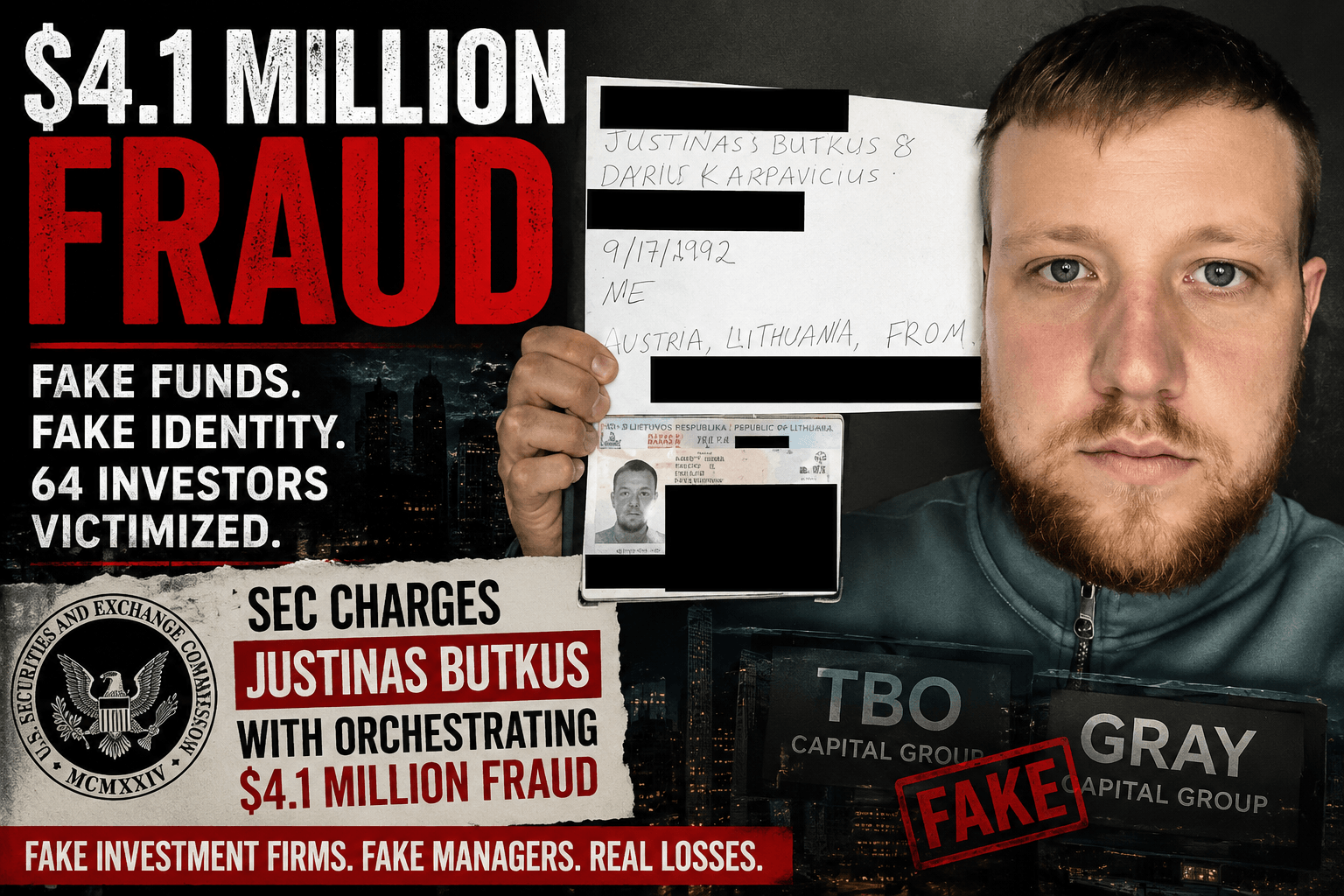
In February 2025, the U.S. Securities and Exchange Commission accused Lithuanian national Justinas Butkus of orchestrating a sophisticated investment fraud that raised roughly $4.1 million from 64 investors. Authorities say the money was not invested as promised. Instead, what appeared to be a growing investment business was allegedly nothing more than an elaborate scheme designed to enrich one man.
According to the SEC’s complaint, the alleged fraud began in late 2021. Regulators say Butkus operated under the alias “Darius Karpavicius,” presenting himself as a credible investment professional while hiding his real identity. The alias was not simply a made-up name. The SEC alleges that he even used a doctored passport to support the false identity, helping create the illusion that investors were dealing with a legitimate financial executive.
The centerpiece of the alleged scheme was a pair of investment firms that regulators say did not truly exist as represented. Under the names TBO Capital Group and Gray Capital Group, investors were offered opportunities to buy into mutual funds that supposedly delivered strong returns and were managed by experienced investment professionals. The firms maintained websites, published promotional materials, and advertised online. On the surface, everything looked professional. That appearance, according to the SEC, was exactly the point.
Regulators allege that the marketing materials contained a long list of false claims. Investors were told that the funds had experienced managers with years of industry expertise. They were shown performance histories suggesting impressive returns. The firms projected credibility and stability. Yet investigators say those managers did not exist, the biographies were fabricated, and the funds themselves were never real investment vehicles. In reality, the SEC alleges, no legitimate investment operation was taking place behind the scenes.
The numbers involved make the allegations especially striking. According to the SEC, approximately $4.1 million was raised from 64 investors who believed they were purchasing interests in genuine mutual funds. Instead of putting that money to work in financial markets, regulators claim that most of it was diverted for Butkus’s personal benefit.
Court filings cited by Bloomberg Law paint an even clearer picture of where the money allegedly went. The SEC claims roughly $3.6 million of investor funds was spent on personal expenses. Those expenditures allegedly included restaurant bills, hotel stays, clothing purchases, cash withdrawals, groceries, and cryptocurrency purchases. Rather than generating returns for investors, regulators say the money largely funded a lifestyle.
One of the reasons the case has attracted attention is the level of effort allegedly invested in making the operation appear legitimate. This was not a crude scam website thrown together overnight. Authorities describe a coordinated effort involving multiple entities, carefully crafted online materials, internet advertising campaigns, fabricated executive profiles, and a false identity. Investigators argue that these elements helped create the appearance of a credible financial business and persuaded investors to trust the operation with their savings.
The SEC’s complaint also names two companies allegedly controlled by Butkus, HMC Trading LLC and HMC Management LLC, as defendants. Another entity, DK Auto LLC, was named as a relief defendant because regulators believe it received proceeds connected to the alleged fraud. Through the lawsuit, the SEC is seeking permanent injunctions, disgorgement of allegedly ill-gotten gains, prejudgment interest, and civil penalties.
The legal path leading to the current case has its own unusual history. The SEC had previously filed an action against the individual operating under the name Darius Karpavicius. However, because that identity was allegedly fictitious, the agency later dismissed the earlier case and refiled the action after identifying the person it believes was actually behind the scheme. The February 2025 filing therefore represented a renewed effort to pursue the allegations under Butkus’s real name.
Federal authorities have not treated the allegations lightly. The SEC acknowledged assistance from Homeland Security Investigations’ New York Field Office as well as the U.S. Attorney’s Office for the Southern District of New York during the investigation. That level of cooperation reflects the seriousness with which regulators viewed the alleged misconduct and the cross-border challenges involved in identifying the individual behind the operation.
Acting Director of Enforcement Samuel Waldon delivered one of the strongest statements connected to the case. He said Butkus allegedly went to great lengths to deceive investors through sophisticated websites, internet advertising, and an alias supported by a doctored passport. The statement underscored what regulators view as a deliberate and calculated effort to create trust where none was deserved.
Cases like this continue to highlight a recurring problem in the investment world. Many investors assume that a professional website, impressive performance claims, and polished marketing materials are signs of legitimacy. Fraud cases repeatedly show that appearances can be manufactured. Regulators often warn investors to independently verify registration records, confirm the existence of investment products, and conduct due diligence beyond what is presented in promotional materials. The allegations against Butkus, if proven in court, would represent a textbook example of how easily a convincing online presence can be used to create a false sense of security.
For the 64 investors who allegedly entrusted their money to the operation, the consequences may be far more personal than the court filings and dollar figures suggest. Behind every investment loss is an individual or family that believed they were building financial security. Instead, according to the SEC, they were sold interests in funds that never existed.
The case remains ongoing, and the allegations have not yet been proven in court. But the picture painted by regulators is stark. A fake identity. Fake executives. Fake investment firms. Fake mutual funds. And according to the SEC, more than $4 million collected from people who believed they were investing in a legitimate financial future. If the allegations are ultimately sustained, the Butkus case will stand as another reminder that in the digital age, some of the most dangerous investment scams do not look suspicious at all. They look professional.
————-
Disclaimer:
Some content on Reportingscams.com is published under our guest post program and is provided by third-party contributors. Reporting scams does not create, verify, or take responsibility for the views, accuracy, or claims expressed in such content.