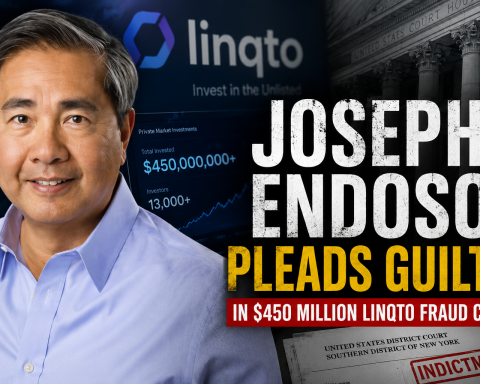
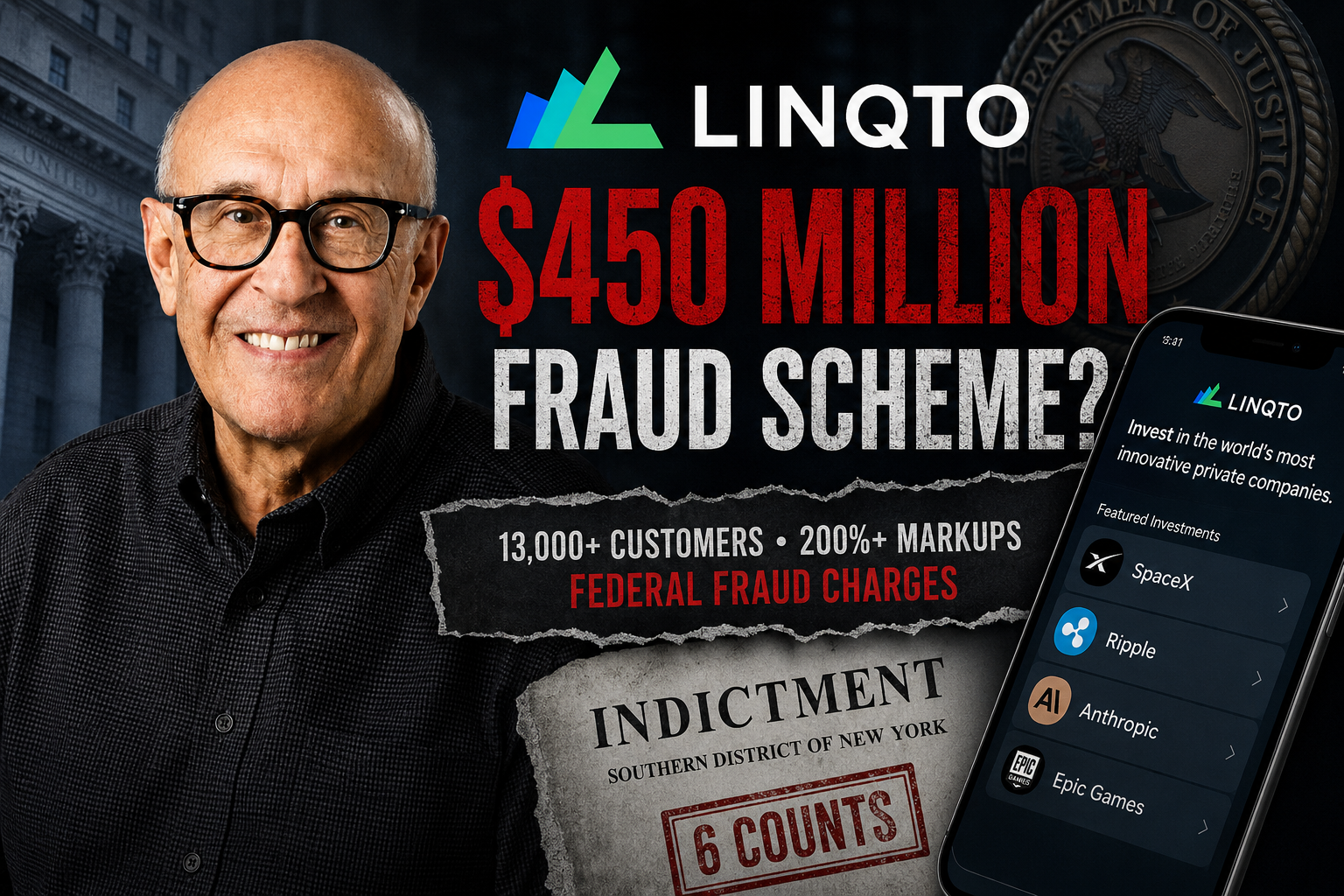
William “Bill” Sarris spent years presenting Linqto as a way to open one of finance’s most exclusive doors. Through a phone or computer, accredited investors could put relatively modest sums into vehicles tied to private companies that might one day go public. Names associated with the platform included Ripple, SpaceX, Anthropic, Epic Games and other highly sought-after technology businesses. By April 2024, Linqto said it had more than 750,000 registered users across 110 countries and was preparing for a transaction that valued the company itself at roughly $700 million. Today, Sarris is a federal criminal defendant, his former deputy and successor Joseph Endoso has pleaded guilty and agreed to cooperate with prosecutors, and Linqto remains entangled in bankruptcy proceedings after more than 13,000 customers put over $450 million through its investment platform.
Federal prosecutors in Manhattan accuse the 75-year-old Sarris, a Monterey, California resident and Linqto founder, of running a five-year scheme that exploited one of the defining weaknesses of private markets: outsiders often have no easy way to know what a private company’s shares are actually worth. Unlike a public stock, there is no continuously visible exchange price for a SpaceX or Anthropic share. According to the indictment unsealed on September 2, 2026, Sarris used that opacity to charge customers undisclosed markups that had a median of approximately 60 percent. More than a quarter of Linqto’s sales allegedly carried markups above roughly 80 percent, while some exceeded 200 percent. Prosecutors say Linqto nevertheless presented prices to investors as market-based.
Sarris has not pleaded guilty. He was arrested on September 2 and was due to appear in federal court in Northern California before the criminal case proceeds in the Southern District of New York. He faces six counts, including securities fraud, broker-dealer fraud, wire fraud and conspiracy offenses. Several of those counts carry statutory maximum sentences of 20 years, although any eventual sentence would be determined by a judge if he were convicted. Reuters reported that Sarris denies the government’s accusations and has blamed investor harm on decisions taken after he left control of the company. The indictment remains an accusation, and Sarris is presumed innocent unless proven guilty.
The government’s description of how Linqto operated is important because investors were not generally buying a private company’s stock directly. Linqto Liquidshares LLC acquired securities and customers purchased units in special-purpose vehicles, or SPVs, designed to give them economic exposure to particular companies. Prosecutors say Linqto repeatedly created additional SPVs as an individual vehicle approached 100 investors. Sarris had been warned, according to the indictment, that simply creating multiple related entities did not necessarily avoid Investment Company Act requirements. The government claims he continued using the structure because registration could have meant more disclosure and regulatory oversight, including scrutiny of the markups Linqto earned.
Pricing sits at the heart of the criminal case. Prosecutors allege that Linqto sometimes made offerings appear sold out even when inventory remained, creating the impression of scarcity and encouraging fear of missing out. In an October 2021 email cited in the indictment, Sarris told Endoso that an offering would be presented as sold out within two hours even if it did not actually sell completely. The apparent scarcity could then support a higher price. Beginning in 2023, Linqto introduced what it called an Automated Market Maker, or AMM, which customers were told produced pricing based on supply and demand. The indictment says the system was not genuinely autonomous. Sarris allegedly adjusted its parameters himself.
The government’s evidence includes internal communications that may become particularly important at trial. Prosecutors say that shortly before the automated pricing system was introduced, Sarris privately compared the process to a “Wizard of Oz” operating behind a screen. In another message cited by prosecutors, he said that when he spent time adjusting the pricing parameters, he could improve Linqto’s daily revenue by about $50,000. In January 2024, after a customer questioned a price movement, Sarris allegedly told colleagues that he had intentionally changed the price while saying the explanation to customers should remain that the movement resulted from supply and demand.
Prosecutors further contend that this was not simply a complicated regulatory issue discovered after the fact. The indictment says Sarris received repeated warnings. A lawyer advised Linqto as early as 2020 that earning spreads on securities transactions could require broker-dealer registration and that large undisclosed markups created legal risk. Another lawyer raised similar concerns in 2021. Linqto eventually obtained approval for a broker-dealer entity, Linqto Capital, in 2023, but prosecutors say the registered entity was largely bypassed for the transactions generating the lucrative spreads. FINRA records confirm that Linqto Capital became a regulated broker-dealer operation dealing in private placements and an alternative trading system.
The pressure reportedly became more explicit as Linqto considered going public. Prosecutors say Sarris had a significant personal equity interest in the company and received roughly 1.9 million restricted Linqto units in 2023 that would vest if Linqto completed an IPO, acquisition or qualifying capital raise valued at at least $500 million before the end of 2025. In April 2024, Linqto announced plans to merge with Blockchain Coinvestors Acquisition Corp. in a transaction valuing the platform at approximately $700 million. That agreement was terminated in September 2024, with Linqto agreeing to pay a $5 million termination fee, and the company instead spoke publicly about pursuing a possible Nasdaq listing.
Problems were already surfacing internally. Gene Zawrotny, who briefly served as Linqto’s chief revenue officer, filed a California lawsuit in October 2024 against Linqto, Sarris and Endoso. Zawrotny alleged that he was terminated after raising concerns about compliance failures and misleading practices. Those are civil allegations, not findings of wrongdoing, and the case has remained contested. But the lawsuit became an early public warning sign. Later that month, according to Linqto’s bankruptcy filings, the SEC’s Division of Enforcement notified the company of an investigation into possible securities-law violations. FINRA conducted an examination of Linqto Capital and referred matters to enforcement in December.
There was another episode prosecutors say crossed an even more troubling line. By late 2024, one popular private company had stopped authorizing transfers involving Linqto and sought information about its pricing practices. When that company later offered to repurchase shares, the indictment says Sarris tendered stock that had already been allocated to vehicles associated with Linqto customers. More than $18 million of stock was ultimately sold in the tender, according to prosecutors, without obtaining those customers’ consent or even notifying them beforehand.
Leadership changed rapidly in early 2025. Dan Siciliano became Linqto’s chief executive on January 2. New management later told the bankruptcy court that it uncovered what it viewed as pervasive securities-law and compliance failures, removed several executives, retained Sullivan & Cromwell and cooperated with regulators. Linqto indefinitely suspended its customer-facing investment platform on March 13, 2025. Its workforce was later reduced from 87 employees to 28 as revenue-producing operations stopped. Linqto ultimately filed for Chapter 11 protection in Texas in July, supported by up to $60 million in debtor-in-possession financing.
Bankruptcy records complicated the picture for customers who believed they had acquired exposure to individual private companies. Linqto’s restructuring filings described securities tied to 111 issuers with an estimated fair market value exceeding $500 million at one stage of the case, meaning the $450 million figure in the criminal prosecution should not automatically be read as $450 million of proven investor losses. It represents the amount prosecutors say flowed into the platform during the charged scheme. Actual recoveries and losses depend on the value and legal treatment of the remaining securities and customer claims. That distinction matters. Prosecutors have accused Sarris of a $450 million fraud scheme, but they have not said that every dollar of the $450 million disappeared.
Customers also sued Sarris separately in federal court, alleging that investors were misled about what they were purchasing and the relationship between their SPV interests and the underlying shares. Those claims remain civil allegations. Linqto’s reorganization plan was eventually confirmed in February 2026, with customers offered mechanisms involving a liquidating trust, a closed-end fund or a combination of both. Approximately 95 percent of voting customers supported the plan, according to bankruptcy filings, although litigation, objections and administrative proceedings have continued into 2026.
The most consequential development may be Joseph Endoso. Now 66 and listed by prosecutors as a resident of Ross, California, Endoso joined Linqto in 2019 and served in senior positions including president and eventually CEO. Before Linqto, his background included investment banking and fintech roles at firms such as Enverra Capital, RedBridge Group and OTCXN. On August 27, 2026, Endoso pleaded guilty to securities fraud, broker-dealer fraud and two conspiracy offenses. He is cooperating with federal prosecutors. That is fundamentally different from Sarris’s legal position: Endoso has admitted criminal wrongdoing, while Sarris is contesting the charges.
Linqto once sold a simple idea: private investing without the usual barriers. The federal case now tests what happens when simplicity in the user interface masks complexity in ownership, pricing and regulation. Private markets already operate with less price transparency than public exchanges. If prosecutors prove that the very opacity investors trusted Linqto to navigate was instead used against them, the case will reach well beyond one founder or one failed platform. It will become a warning about what “democratizing access” means when customers cannot independently verify the price they are paying, the assets behind their account or the incentives of the company standing between them and the investment.
————-
Disclaimer:
Some content on Reportingscams.com is published under our guest post program and is provided by third-party contributors. Reporting scams does not create, verify, or take responsibility for the views, accuracy, or claims expressed in such content.