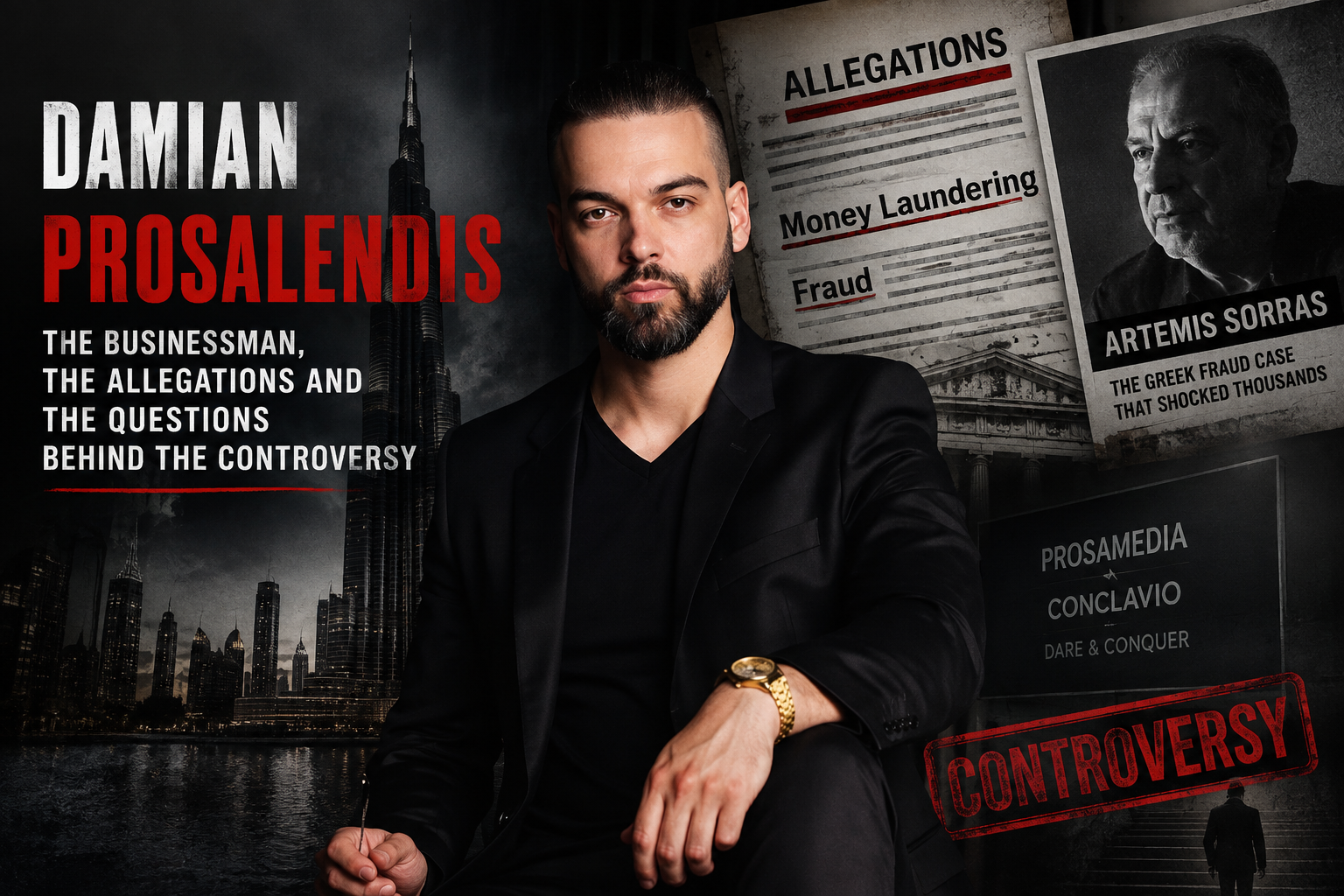
Damian Prosalendis has spent years building the kind of public image that has become increasingly familiar in the modern online business world. His story is built around entrepreneurship, digital marketing, financial success and the promise that an understanding of the internet can transform an ordinary individual into an international business owner. Associated publicly with Greece and Dubai, Prosalendis has presented himself as an entrepreneur who built his career through digital business before expanding into consulting, marketing and entrepreneurial education.
But another version of his story has been circulating online.
Across websites, blogs and social-media platforms, Prosalendis has faced allegations involving fraud, deceptive business practices, money laundering and an alleged connection to the network surrounding Artemis Sorras, one of the most controversial figures to emerge from Greece’s financial crisis. The accusations have been repeated often enough to create a substantial digital footprint around his name. Search for Damian Prosalendis and the reader can encounter references to fraud allegations, questions about his companies and claims linking him to a criminal case that involved thousands of alleged victims.
Yet the closer the public record is examined, the more complicated the story becomes.
The central allegations against Prosalendis do not appear to be supported by a publicly identified criminal conviction against him. The available reports reviewed for this article did not establish that he had personally been convicted of fraud or money laundering. They also did not identify a confirmed regulatory enforcement action, criminal charge or asset-confiscation order naming Damian Prosalendis personally in connection with the allegations that have followed him online.
That does not mean every criticism surrounding Prosalendis or his businesses is automatically false. Nor does the absence of a criminal conviction settle every question about his commercial operations. But it creates a crucial distinction between what has been alleged online and what can actually be demonstrated through publicly available evidence.
For an entrepreneur whose reputation has become the subject of a prolonged digital controversy, that distinction may be the most important part of the story.
The case of Damian Prosalendis is not simply about allegations of wrongdoing. It is also about the modern information ecosystem that allows an anonymous accusation to travel across dozens of websites, acquire the appearance of credibility through repetition and eventually become part of a person’s permanent online identity. At the same time, Prosalendis and sources associated with him have mounted their own response, arguing that false allegations were spread against him and that several individuals and publications were subsequently forced to retract claims or faced legal consequences.
Between those competing narratives lies a fragmented public record.
And that is where the real investigation begins.
The Rise of Damian Prosalendis and the Business Empire Behind His Public Image
Publicly available information identifies Damian Prosalendis as a Greek entrepreneur whose business activities became increasingly associated with Dubai and the international digital economy. He has built much of his public profile around a personal entrepreneurial story, presenting himself as someone who entered the world of online business at a young age and eventually developed a collection of companies and projects focused on marketing, consulting and education.
The name most closely associated with Prosalendis is ProsaMedia, a business publicly described as operating in the fields of digital marketing, advertising and consulting. The company forms an important part of Prosalendis’s public identity. Through websites, business profiles and promotional material, the business has been associated with services aimed at helping companies develop their online presence, marketing strategies and digital operations.
Another significant venture is Conclavio, which has been promoted as an educational and networking platform for entrepreneurs. The business appears to have targeted people interested in entrepreneurship, online business and professional development, particularly among Greek-speaking audiences. Prosalendis has been publicly positioned as an entrepreneur capable of teaching others how to build businesses, navigate digital markets and develop professional networks.
The broader commercial footprint attributed to him has also included names such as Dare and Conquer Media, Anax Publishing, Badass Talent and Studio Badass. The extent of Prosalendis’s relationship to every entity requires careful verification through corporate records and official filings, particularly because corporate information in jurisdictions connected to international business can vary significantly in terms of public accessibility.
This becomes one of the first important issues surrounding the Prosalendis story.
There is no shortage of promotional information describing his success. The harder task is determining which claims can be independently verified.
Public biographies and company material have described Prosalendis as a successful entrepreneur with a substantial international business presence. Some accounts have included claims involving thousands of clients or customers and significant experience across multiple markets. Such claims are central to the image that surrounds Prosalendis. They create the impression of an entrepreneur who has built a business empire by combining digital marketing expertise with education and consulting.
But self-reported success claims are not the same thing as independently audited business records.
A company can accurately promote the number of clients it has served, just as it can make ambitious claims that are difficult for an outside journalist to verify. Without independently available financial statements, audited customer records or regulatory filings, it can be difficult to establish the precise scale of a private business.
That issue should not be confused with evidence of wrongdoing. The inability to independently verify every commercial claim does not establish that the claim is false. However, it does mean that journalists should clearly distinguish between a business’s own representations and independently established facts.
The available reporting surrounding Prosalendis reflects precisely this challenge. His businesses have a visible online presence, his name has appeared in entrepreneurial and business-focused publications, and his public brand is built around a narrative of digital success. At the same time, independent information regarding the precise financial scale, ownership structures and operational details of some businesses associated with him is more limited.
This gap between a highly visible personal brand and a less transparent underlying corporate record has created space for speculation.
For critics, the difficulty of independently confirming certain claims has been used to question the credibility of the business empire itself. For Prosalendis and his supporters, the allegations represent an attempt to turn ordinary limitations in private-company disclosure into evidence of something more sinister.
The truth is that neither conclusion automatically follows from the available evidence.
What is clear is that Prosalendis developed a significant public entrepreneurial identity. His businesses and personal brand became increasingly connected to a broader ecosystem of digital marketing, online education and business coaching. That visibility also made him vulnerable to the darker side of the online economy, where reputational disputes can develop into permanent search-engine records.
By the early 2020s, a different narrative surrounding his name had begun to emerge.
It would eventually connect him to allegations of fraud, deceptive business practices and, most seriously, to one of Greece’s most extraordinary financial scandals.
The Allegations and the Digital Trail That Followed Him
The allegations against Damian Prosalendis are serious enough that they cannot simply be ignored. They include claims involving consumer fraud, misleading business practices, aggressive sales tactics, suspicious financial activity and alleged money laundering.
But seriousness is not the same thing as proof.
One of the central problems with the allegations against Prosalendis is the way they appear to have developed online. Rather than beginning with a clearly identified government investigation, criminal indictment or regulatory enforcement notice, some of the most serious accusations appear to have emerged through anonymous-source reporting and were subsequently repeated across other websites.
That distinction is essential.
If a regulatory agency files an enforcement action, there is generally an official record that can be examined. If a criminal prosecutor files charges, the indictment or court proceeding can be reviewed. If a court enters a judgment, the legal reasoning can, at least in principle, be examined through the underlying documents.
The allegations surrounding Prosalendis do not appear to follow that straightforward path.
According to the available investigative reporting, the core claim connecting him personally to alleged money laundering and financial wrongdoing originated with an anonymous source who was described as a former associate. The allegations were subsequently repeated and amplified online.
This is where the issue of circular sourcing becomes important.
A single allegation can appear on one website and then be copied by another. A third publication may cite the second. A fourth may summarize the first three. Eventually, search engines display a collection of articles that appear to confirm one another.
But if all the claims ultimately originate from the same anonymous source, there may still be only one original piece of information behind the entire network.
This does not necessarily mean that the original allegation was false. Anonymous sources can provide important information, particularly when they fear retaliation or have legitimate reasons to protect their identity. But serious accusations require corroboration. A journalist needs documents, financial records, witnesses, court filings, regulatory material or other independent evidence before an allegation can move from an assertion into an established fact.
The available material concerning Prosalendis appears to contain significant gaps at precisely this point.
Allegations involving ProsaMedia and other businesses associated with him have included claims that customers were subjected to aggressive upselling or that educational programs were sold at increasingly expensive levels. Critics have also questioned the value and originality of educational material associated with entrepreneurial ventures connected to him.
These allegations are relevant because online education and business-coaching industries have become areas of increasing controversy internationally. High-priced programs, ambitious promises and aggressive marketing are not necessarily illegal, but they can generate consumer complaints and public criticism.
Yet the available material reviewed in connection with Prosalendis did not establish a confirmed consumer-protection judgment finding that he personally committed fraud.
This distinction matters for both journalism and the reader.
An unhappy customer may believe they were misled. Another customer may have a positive experience with the same company. A business can generate complaints without committing a criminal offence. A regulator may also decide that evidence is insufficient for enforcement.
Without verified legal findings or primary records, the allegations should remain allegations.
The same applies to claims involving suspicious financial activity. Some adverse reports have questioned whether businesses associated with Prosalendis were connected to questionable transactions or whether claimed commercial success reflected genuine business activity.
But financial allegations require financial evidence.
Bank records, payment processor data, audited accounts, corporate filings or court documents can potentially establish a pattern of suspicious transactions. The public reports examined in this case did not provide such primary documentation establishing that Damian Prosalendis personally engaged in money laundering.
This absence does not necessarily answer every question about his businesses. It does, however, establish a limit on what can responsibly be claimed.
A journalist cannot turn suspicion into fact simply because an allegation has been published repeatedly.
The problem became even more significant when Prosalendis’s name was connected to Artemis Sorras.
The Sorras connection would become the most serious allegation surrounding him. It would also become the allegation most dependent on the distinction between documented criminal proceedings and unverified association.
Artemis Sorras, the Greek Fraud Case and the Unproven Connection to Damian Prosalendis
The Artemis Sorras affair is one of the most important parts of the controversy surrounding Damian Prosalendis, but it is also the area where readers must be particularly careful not to confuse two separate questions.
The first question is whether the criminal proceedings involving Artemis Sorras were real.
They were.
The second is whether those proceedings establish that Damian Prosalendis personally participated in the criminal activity.
Based on the publicly available material examined in the reports reviewed for this article, they do not.
Artemis Sorras became one of the most controversial figures to emerge from Greece’s years of economic crisis. He became known for extraordinary claims concerning vast amounts of money and assertions that he possessed the resources needed to address Greece’s enormous financial problems.
His movement attracted attention and supporters, particularly during a period when economic uncertainty and public anger had created fertile ground for dramatic promises and unconventional solutions.
The broader Sorras case later became associated with serious criminal proceedings and allegations involving a substantial number of victims. The case has been widely documented as a major Greek legal and financial controversy.
But the existence of a major fraud case involving Sorras does not automatically establish wrongdoing by every person whose name is subsequently connected to him.
The allegations involving Damian Prosalendis have attempted to build a connection between his business activities and the Sorras affair. At the centre of this alleged connection is a claim involving Prosalendis’s father and an alleged family relationship to individuals associated with the Sorras network.
This is the point at which the evidence becomes significantly weaker.
The available reports reviewed in preparing this article did not identify Damian Prosalendis as a defendant in the primary criminal proceedings involving Artemis Sorras. They did not identify him as a person convicted in those proceedings. They did not identify a confirmed asset-confiscation order naming him in connection with the Sorras case.
Investigative reporting examining the allegations also identified an important unresolved question concerning whether a family member of Prosalendis appeared in relevant proceedings. However, the reporting acknowledged that primary court-level verification had not been obtained to establish the alleged connection conclusively.
That is a major gap.
The difference between an allegation that a relative may have been connected to a criminal network and a verified court finding establishing such involvement is substantial. The difference becomes even greater when the allegation is then used to accuse another family member of personally laundering criminal proceeds.
Even if a family connection were conclusively established, it would not automatically prove that Damian Prosalendis himself knew about, benefited from or participated in criminal conduct.
Guilt is not inherited.
That principle becomes particularly important in a case where the allegations have circulated through an interconnected online ecosystem.
The reporting reviewed for this article acknowledged that no primary financial records were publicly available establishing a flow of allegedly illicit money from the Sorras network into businesses controlled by Damian Prosalendis. No publicly verified banking trail was presented establishing such a connection. No confirmed criminal judgment against Prosalendis was identified.
Yet the allegations continued to circulate.
This is where the Damian Prosalendis story becomes more than a dispute about one entrepreneur.
It becomes an example of how a person’s name can become permanently associated with a serious criminal case without the individual necessarily appearing as a defendant in that case.
Search engines are not courts. They do not distinguish automatically between an accusation and a conviction. A headline containing a person’s name alongside words such as fraud or money laundering may continue appearing in search results long after readers have forgotten the original source of the allegation.
For Prosalendis, this created a significant reputational problem.
The allegations had developed into a digital record.
His response would eventually turn into an equally significant part of the story.
Retractions, Court Claims and What the Public Record Still Does Not Resolve
Damian Prosalendis did not remain silent in response to the allegations surrounding him. Over time, he and publications associated with his public response began to describe a campaign of legal action, retractions and victories against individuals who had accused him of wrongdoing.
According to material published by or associated with Prosalendis, several people who had made accusations against him later retracted their claims or apologized. His public-facing response has also described legal disputes in Greece involving alleged defamatory statements and claimed favorable court outcomes.
Among the most notable claims is that the Greek newspaper Espresso retracted allegations involving Prosalendis. Publications associated with him have also described court decisions involving the Multi-Member Court of First Instance of Corfu and have reported damages and legal costs awarded in disputes against individuals accused of making defamatory claims.
These developments are potentially important because they could directly challenge the credibility of some allegations that have circulated against him.
But they also require the same evidentiary discipline applied to the accusations.
A subject’s own statement that they won a legal case is not a substitute for the court judgment itself.
The strongest possible investigation would examine the original court decisions, identify the parties, review the allegations at issue and determine exactly what the court found. A judgment might establish that a specific statement was defamatory without necessarily resolving every broader question surrounding the subject. Alternatively, it could contain findings directly relevant to the accuracy of allegations.
Without reviewing each primary judgment individually, a journalist should avoid overstating what a claimed court victory proves.
The same principle applies to retractions.
A publication may issue a retraction because it concludes that an allegation was unsupported. It may settle a dispute without admitting the allegation was false. It may change or remove an article for legal reasons. The exact wording of a retraction matters.
What can be said based on the available material is that Prosalendis and sources associated with him have publicly argued that several allegations against him were withdrawn or retracted and that he successfully challenged critics through legal action.
The complete independent verification of each claimed result requires direct access to the relevant documents.
This brings the story back to the most significant issue in the entire case.
There appears to be a striking absence of confirmed criminal or regulatory findings against Damian Prosalendis personally, despite years of serious online allegations.
No publicly established criminal conviction was identified in the available reports reviewed for this article. No confirmed regulatory enforcement action was identified against him personally. No confirmed asset-confiscation order naming him personally was established in connection with the allegations involving Artemis Sorras.
That does not amount to a legal declaration of innocence. Courts and regulators are not the only sources of information, and a person can potentially engage in misconduct without ever being prosecuted.
But it does mean that the strongest allegations against Prosalendis cannot responsibly be presented as proven criminal facts based solely on their circulation online.
There are also unanswered questions on the other side.
Can the exact scale of the businesses associated with Prosalendis be independently documented? Can the public claims concerning clients, customers and commercial success be verified through records outside the businesses themselves? What do primary corporate documents reveal about ownership structures and financial operations? What exactly was the original source behind the allegations that began circulating online?
And perhaps most importantly, can the full documentary history of the alleged connection between Prosalendis’s family and the Artemis Sorras case be established through original Greek court records rather than anonymous claims and subsequent internet reporting?
Those questions remain more valuable than the temptation to reach a simple conclusion.
The available public record presents Damian Prosalendis as a businessman who has become the subject of a prolonged digital controversy. His entrepreneurial image has been challenged by serious allegations. Some of those allegations have been repeated across the internet. At the same time, the strongest accusations appear to have substantial evidentiary weaknesses when examined against primary legal and regulatory records.
Prosalendis has responded by arguing that he became the target of false accusations and by pointing to claimed retractions and legal victories. Yet the precise legal significance of every claimed victory should itself be examined through original court documentation.
The result is a story that does not fit neatly into either of the competing narratives.
Damian Prosalendis cannot, based on the material reviewed here, accurately be described as a convicted fraudster or proven money launderer. The available public record does not establish that conclusion.
At the same time, the unanswered questions surrounding the origin of the allegations, the structure of the businesses associated with him and the complete documentary history of the disputes remain legitimate subjects for further scrutiny.
That may be the defining feature of the case.
In the modern internet, allegations do not need to be proven in court to cause lasting consequences. They can be copied, rewritten, optimized for search engines and permanently attached to a person’s name. Once enough websites repeat the same accusation, the line between allegation and established fact can begin to disappear in the public imagination.
The case of Damian Prosalendis demonstrates how dangerous that process can become.
It also demonstrates why an investigation must go beyond search results.
The question is not simply how many websites have accused Damian Prosalendis of wrongdoing. The more important question is how many of those allegations can be traced back to independently verifiable evidence.
That examination produces a far more complicated picture.
There is a real and documented criminal history surrounding Artemis Sorras. There are also serious allegations that have been made against Prosalendis and businesses associated with him. But the available public material reviewed for this article does not establish that Prosalendis personally participated in the Sorras criminal case, laundered money connected to it or was convicted of fraud or related offences.
There is also a counter-narrative in which Prosalendis says he has fought back against false allegations through legal action, retractions and challenges to those who accused him. Some of those claims may ultimately be confirmed through primary court documents and publication records. Others require additional independent verification before their full significance can be established.
For now, the story remains suspended between accusation and proof.
That distinction should matter to readers.
It should matter to journalists.
And in an era where an anonymous claim can become an international search result within days, it may be the only distinction that prevents an allegation from becoming a permanent substitute for the truth.
————-
Disclaimer:
Some content on Reportingscams.com is published under our guest post program and is provided by third-party contributors. Reporting scams does not create, verify, or take responsibility for the views, accuracy, or claims expressed in such content.