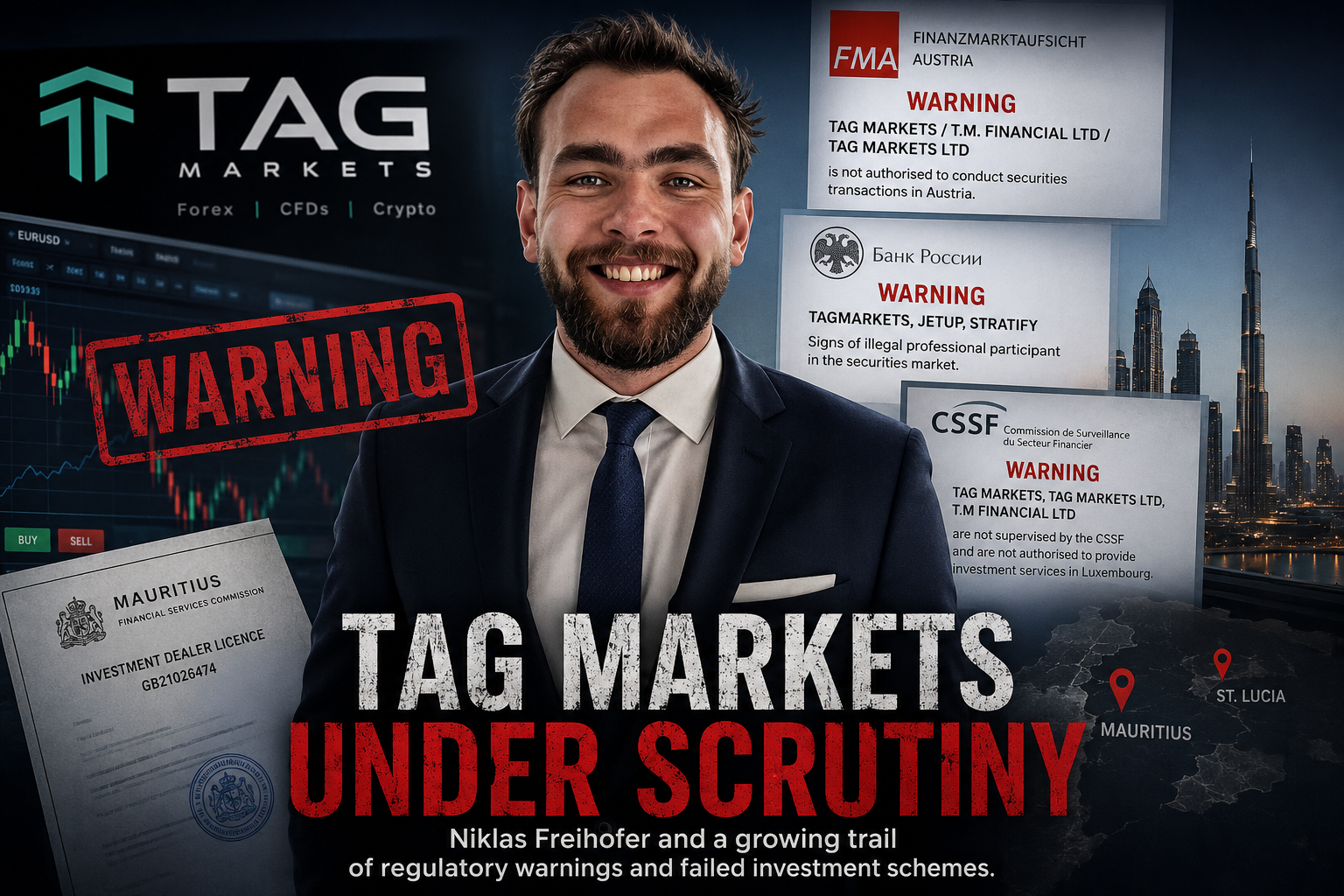
Tag Markets presents itself as a modern global broker offering forex, CFDs, copy trading and cryptocurrency related services. Its website currently says the business is operated by T.M. Financials Ltd, a Mauritius company holding Investment Dealer licence GB21026474, and promotes products including CopyX and Amplify. It also claims to serve a global client base, with a particular focus on markets across Asia, Africa and the Middle East. But behind that polished trading interface sits a far more complicated story involving offshore entities, collapsed investment programmes, former MLM networks and warnings from financial regulators in multiple countries.
At the centre of the current public-facing operation is Niklas Freihofer, also known as Nik Freihofer. Public corporate records identify Freihofer as a German national born in December 1997, making him 28. A UK Companies House record shows that he has previously held significant control in YouFlirt Ltd, where he was listed with a German nationality and Germany as his country of residence. Other public profiles identify him as CEO of NFG-pay.io in Bali, while investigative reporting has placed him in Dubai. His exact present location cannot be independently established from reliable public records, but his current public role is considerably easier to trace. Since late 2025, Freihofer has appeared in Tag Markets promotional material and webinars as its owner or CEO, and he has also appeared publicly as CEO of Bit1, a later programme linked to the same ecosystem.
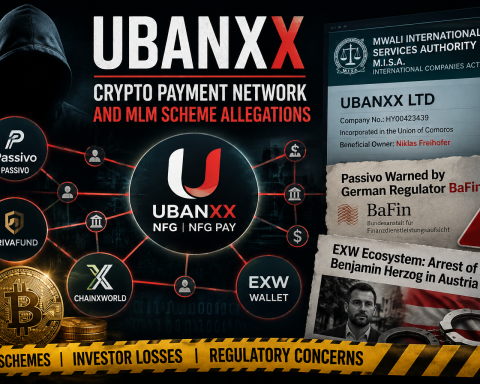
Freihofer did not emerge into the Tag Markets story from nowhere. In 2023, financial intelligence outlet FinTelegram reported that he was the beneficial owner of UBANKXX Ltd, a Comoros-registered company associated with the UBANXX and NFG payment platforms. Mwali’s public registry lists UBANKXX Ltd as an authorised international bank under licence B2022081, while FinTelegram reported that the company acted as a crypto payment processor for schemes including Passivo, PrivaFund, ChainXworld and EXW Wallet. FinTelegram also connected Freihofer to the wider network around Austrian businessman Benjamin Herzog, who had been arrested in 2022 and investigated in connection with several crypto and MLM operations. Those reports described Freihofer as an alleged lieutenant, but that characterisation has not been established as a criminal conviction against him.
That distinction matters. There is no reliable evidence located in this review showing that Freihofer has been convicted of fraud, pleaded guilty to fraud or been sentenced for operating Tag Markets. Claims circulating online that he left Germany to escape criminal proceedings remain unverified and should not be treated as established fact. What can be documented is his corporate involvement with UBANKXX, his appearance in the earlier crypto-payment ecosystem, and his subsequent emergence as a leading public figure behind Tag Markets.
Tag Markets itself was incorporated into a network of offshore entities. Its website identifies T.M. Financials Ltd, company number C185265, as the operating company in Mauritius and Tag Markets Ltd as an associated Saint Lucia entity. The company says T.M. Financials is licensed by Mauritius’ Financial Services Commission as an Investment Dealer and openly acknowledges that it is not authorised by European Union regulators. That is important because the absence of an EU licence is precisely what several European regulators have focused on. Tag Markets argues that customers in restricted jurisdictions access its services on a reverse-solicitation basis, while regulators have taken a different view of its ability to offer investment services in their markets.
Austria’s Financial Market Authority issued a formal warning on February 20, 2026 against Tag Markets, T.M. Financial Ltd and Tag Markets Ltd. The FMA said the provider was not authorised to conduct securities transactions in Austria that require a licence and could not execute client orders under the country’s securities supervision law. Two months earlier, the Central Bank of Russia had placed Tagmarkets, JetUp and Stratify on its warning list, identifying signs of an illegal professional participant in the securities market. Russia’s warning specifically listed tagmarkets.com along with Exfusion, JetUp and Stratify-related web properties.
Luxembourg followed on June 10. The country’s financial regulator, the CSSF, warned that Tag Markets, Tag Markets Ltd and T.M Financial Ltd were not supervised by the CSSF and had not been granted authorisation to provide investment or other financial services in or from Luxembourg. The CSSF listed an alleged Mauritius address and classified the warning under illicit activities. Taken together, the Austrian, Russian and Luxembourg actions do not amount to criminal convictions, but they do establish something significant: multiple national regulators have independently concluded that Tag Markets lacked the authorisation required to provide financial services in their respective jurisdictions.
The regulatory warnings become more consequential when Tag Markets’ associated programmes are examined. Watchdog reporting has linked the platform to Zeus Funding, Exfusion, Stratify, Bit1 and AITech, with several programmes operating through the same or related infrastructure. Zeus Funding offered participants plans involving relatively small cryptocurrency deposits in exchange for claims of much larger funded trading accounts. One advertised plan required $200 for a purported 10x funded account, while another offered a $3,000 funded account for a $250 payment. Zeus Funding eventually collapsed, with withdrawals disabled in February 2026.
Exfusion followed a similar model. Promotional material reportedly offered participants the possibility of receiving as much as $2.4 million in funding after a $100,000 investment, while entry levels started at $250 in cryptocurrency or $500 through bank transfer. The programme had no conventional retail product at its centre. Instead, participants were recruited into a financial opportunity built around trading and referral commissions. That structure has led watchdogs to describe Exfusion as an MLM investment scheme, although such characterisations should be distinguished from formal findings by a court.
The network also appears to have drawn participants from earlier collapsed MLM operations. In October 2025, reporting documented Crowd1 promoters directing investors toward Tag Markets. Crowd1 had already faced regulatory scrutiny in several jurisdictions, and six people associated with its operation were sentenced to prison in Sweden in 2025. Tag Markets later became connected with Stratify, marketed as a new trading opportunity to the same community. In April 2026, Crowd1 executive Kenny Nordlund said the company had ended its contract with Stratify and Tag Markets. Reporting on the collapse said investors were being encouraged to convert worthless CBIT tokens into the new arrangement while also making additional USDT investments.
Daisy Global investors were similarly directed toward another Tag Markets-linked programme, Bit1. Freihofer appeared as Bit1’s CEO in a February 28 webinar, while promotional material described a partnership involving Bit1 and Endotech. The broader Daisy Global ecosystem has itself been associated with very large losses, with watchdog reporting putting internal estimates above $1 billion, although that figure is not an independently audited loss figure and should not be attributed to Tag Markets as money lost through its platform. The more defensible conclusion is narrower: Tag Markets has repeatedly been positioned as a destination for communities emerging from previous MLM collapses.
By August 2026, AITech had become another programme operating through the Tag Markets-linked infrastructure. Promotional material reportedly offered a multilevel compensation structure and required at least a $10 investment for full participation. SimilarWeb data cited by reporting indicated roughly 373,000 visits to the AITech subdomain in July. Again, those figures measure website traffic, not the amount invested or the number of victims, and there is no reliable public accounting establishing total investor losses across the Tag Markets ecosystem.
The latest controversy illustrates why the network deserves scrutiny beyond the regulatory warnings. In August, AURUM announced what it described as a strategic partnership with Tag Markets and said a dedicated $5 million trading account would be allocated to support recovery of investor losses. Days later, Tag Markets publicly denied that any partnership or commercial agreement had been concluded and said it had not allocated or committed money to AURUM. AURUM subsequently said there had been an initial agreement and that discussions broke down over Tag Markets’ proposal concerning its partner network. The proposed $5 million therefore should not be described as money actually recovered for investors.
Tag Markets continues operating. Its website currently advertises hundreds of thousands of traders, large monthly trading volumes, copy trading and leveraged products, while simultaneously warning that CFDs are complex and that clients can lose their entire investment. The company says it is regulated in Mauritius and that it does not hold EU regulatory approval. That combination is at the heart of the public controversy: Tag Markets may have a claimed regulatory status in Mauritius, but that does not give it automatic permission to solicit or execute securities business everywhere else.
What remains unresolved is the money trail. No authoritative source reviewed for this article establishes a single total for losses attributable specifically to Tag Markets, nor did the research uncover a court-ordered disgorgement, criminal fine or investor compensation award against Freihofer or Esguerra. That absence should not be mistaken for a clean bill of health. It simply means the strongest documented facts at this stage are regulatory warnings, corporate links, marketing structures, programme collapses and the repeated movement of investor communities between related opportunities.
For investors, that pattern is the real warning. A financial platform does not become safe because it has a sophisticated website, a Mauritius licence, a Dubai executive team or a new trading product with a different name. When the same infrastructure repeatedly appears around high-return investment programmes, collapsed opportunities are followed by new opportunities, and regulators in multiple countries say the operator lacks permission to conduct securities business in their jurisdictions, the burden shifts to the people asking for money to prove exactly where that money goes. Until that evidence is available, Tag Markets and the people publicly associated with it deserve scrutiny, not blind confidence.
————-
Disclaimer:
Some content on Reportingscams.com is published under our guest post program and is provided by third-party contributors. Reporting scams does not create, verify, or take responsibility for the views, accuracy, or claims expressed in such content.