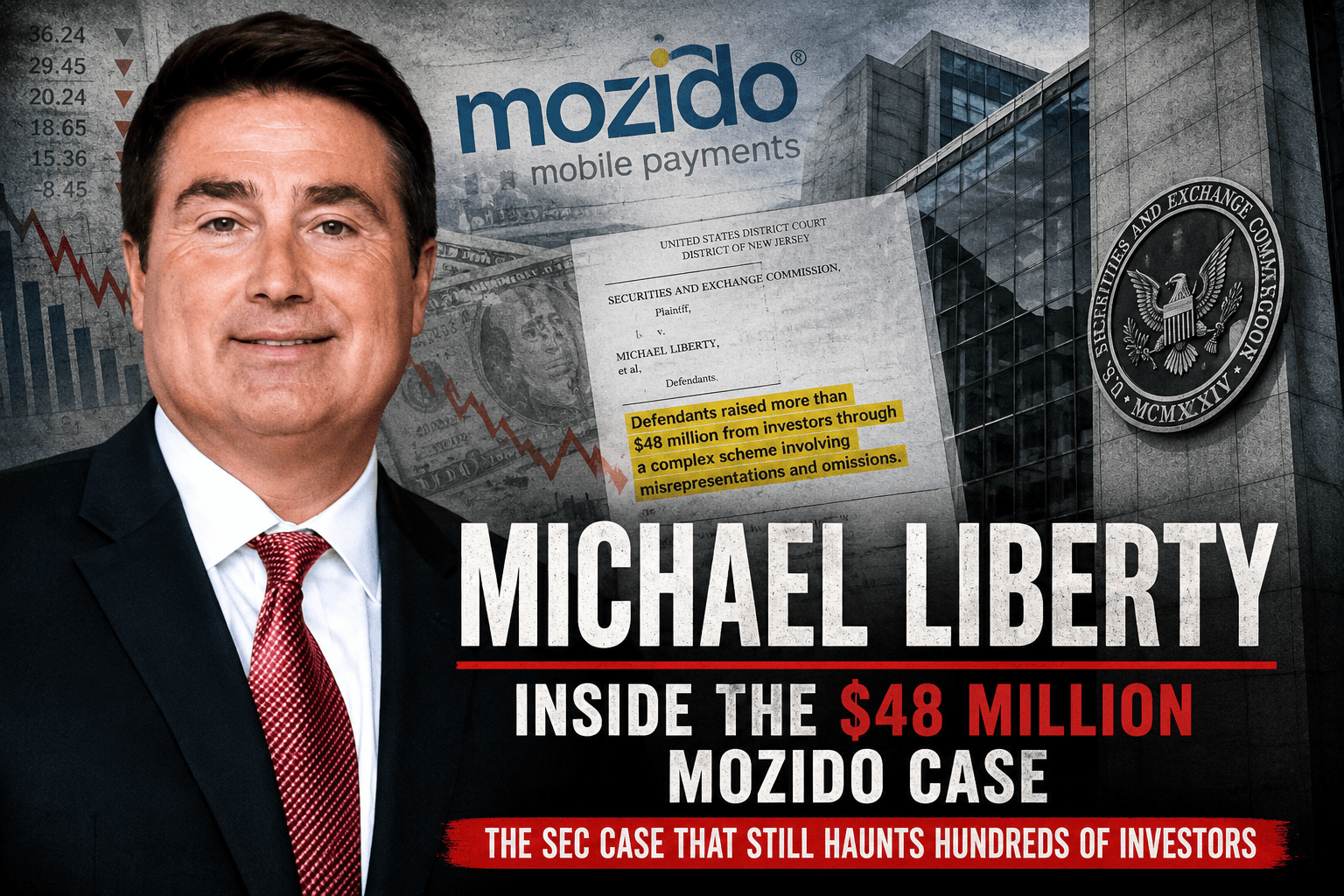
Michael Liberty built his reputation on a promise that appealed to both seasoned investors and everyday people hoping to get in early on the next technology success story. Through his fintech venture Mozido, later known as Mozido Inc., Liberty promoted a vision of transforming mobile payments at a time when digital wallets and smartphone transactions were becoming one of the fastest-growing sectors in finance. Investors were told they had a chance to own a piece of a rapidly expanding company before the rest of the market caught on. Instead, federal regulators say, many were buying into something very different.
The story of Michael Liberty is not simply about a startup that failed. It is about years of complex fundraising, a web of shell companies, disputed valuations, alleged deception, and a legal battle that continues to cast a shadow over one of the more ambitious fintech ventures of the last decade.
Liberty, an entrepreneur based in Maine, founded Mozido as a financial technology company focused on mobile commerce and digital payment solutions. During the early 2010s, mobile payments were attracting enormous investor enthusiasm, and Mozido positioned itself as an emerging player capable of competing in an industry that promised explosive growth. As excitement surrounding the company increased, Liberty and associates raised tens of millions of dollars from hundreds of investors who believed they were backing the fintech business directly.
According to the U.S. Securities and Exchange Commission, that was not what happened.
In March 2018, the SEC filed a sweeping civil enforcement action accusing Liberty and several associates of orchestrating a years-long securities fraud involving more than $48 million raised between 2010 and 2016. The agency alleged that investors were persuaded to purchase interests issued by shell companies that supposedly held transferable ownership in Mozido. Regulators said many of those shell entities either did not actually own the interests they claimed or were legally unable to transfer them as promised.
The SEC named Liberty alongside his wife Brittany Liberty, his cousin Richard Liberty, attorney George Marcus, investment promoter Paul Hess, and several business entities including Mozido Invesco LLC, Family Mobile LLC, Brentwood Financial LLC, BRTMDO LLC and TL Holdings Group LLC. The complaint described an interconnected network of companies used to market investment opportunities that regulators claimed bore little resemblance to what investors believed they were purchasing.
Federal investigators alleged that Liberty and others repeatedly overstated Mozido’s financial condition and valuation while concealing serious financial problems. According to court filings, investors were told Liberty had personally invested significant amounts into the company and that their money would support business growth. Instead, the SEC alleged that large portions of investor funds were diverted toward personal expenses, including luxury homes, private aircraft travel, expensive automobiles and movie production ventures unrelated to Mozido’s business. Liberty has denied the SEC’s allegations, and the litigation has involved years of procedural disputes and motions rather than a final determination on the central fraud claims.
One of the more striking allegations centered on the way existing investors were treated after additional money had already been raised. The SEC alleged that Liberty and his associates engineered transactions that dramatically diluted investors’ ownership interests before encouraging them to exchange their securities for replacement interests that regulators said were worth more than 90 percent less than what investors had originally expected. The agency argued that many investors were never fully informed about the deteriorating financial condition of the underlying business before making those decisions.
The SEC’s complaint also painted a picture of a company facing severe financial stress behind closed doors. Internal communications cited in the filing described executives discussing what one message characterized as “Armageddon times” as Mozido struggled with creditors and looming defaults. Regulators argued that these internal concerns were never adequately disclosed to investors who continued providing fresh capital under the belief that the company remained financially healthy.
As the civil case moved through federal court, the litigation became increasingly complicated. Proceedings were delayed in part because of parallel criminal matters involving Liberty and co-defendant Paul Hess. Various defendants challenged the SEC’s legal theories, while the agency continued pursuing claims that the fundraising activities violated federal securities laws governing fraud, registration requirements and broker-dealer regulations.
Although the core case against Liberty remains ongoing, the SEC has secured judgments against some of his associates. In late 2022, Paul Hess consented to a final judgment requiring him to pay nearly $3 million in disgorgement, interest and civil penalties. Without admitting or denying the SEC’s allegations, Hess accepted permanent injunctions barring future violations of several federal securities laws and restrictions on participating in future securities offerings. The SEC continues to identify Liberty and other defendants as remaining parties in the broader litigation.
Liberty’s legal troubles extend beyond the Mozido enforcement action. He has previously faced SEC actions involving earlier investment activities, including litigation dating back to the mid-2000s. Court records and appellate proceedings over the years have addressed disputes involving asset transfers, collection efforts and enforcement of SEC judgments. More recent proceedings have examined whether certain transfers of assets were designed to place money beyond the reach of regulators seeking to collect court-ordered obligations, allegations that Liberty has contested through the legal process.
The long-running litigation has also generated frustration among investors, many of whom have spent years waiting to learn whether they will recover any meaningful portion of their investments. Civil SEC actions are designed to enforce securities laws rather than guarantee restitution, meaning even successful enforcement efforts do not necessarily make victims financially whole. That reality has become especially painful in cases involving startup companies, where assets may have already been spent or significantly diminished by the time regulators intervene.
Mozido itself serves as a reminder of how difficult it can be for outside investors to independently verify claims made by privately held companies. Unlike publicly traded corporations that must file detailed financial disclosures, private startups often operate with far less transparency. Investors frequently rely on management presentations, private offering documents and personal relationships, all of which can become fertile ground for misunderstandings—or, as regulators allege in this case, outright deception.
Years after the SEC first announced its lawsuit, Michael Liberty remains a central figure in one of the agency’s more extensive enforcement actions involving private startup fundraising. The litigation continues to move through the courts, meaning many of the SEC’s allegations against Liberty have yet to receive a final judicial resolution. That distinction matters. Allegations are not findings of liability, and Liberty has consistently contested the SEC’s claims through the legal process. At the same time, the government’s complaint, subsequent court filings and judgments against certain co-defendants have already exposed a detailed account of how regulators believe more than $48 million flowed through an intricate network of companies while hundreds of investors were left facing substantial losses.
For investors, the case is about more than one entrepreneur or one failed fintech company. It illustrates how excitement surrounding innovative technology can sometimes overshadow careful due diligence, particularly in private markets where information is limited and oversight is less visible. Whether the remaining claims against Liberty ultimately end in trial, settlement or another resolution, the case stands as a cautionary example of why extraordinary promises deserve extraordinary scrutiny before hard-earned money changes hands.
————-
Disclaimer:
Some content on Reportingscams.com is published under our guest post program and is provided by third-party contributors. Reporting scams does not create, verify, or take responsibility for the views, accuracy, or claims expressed in such content.