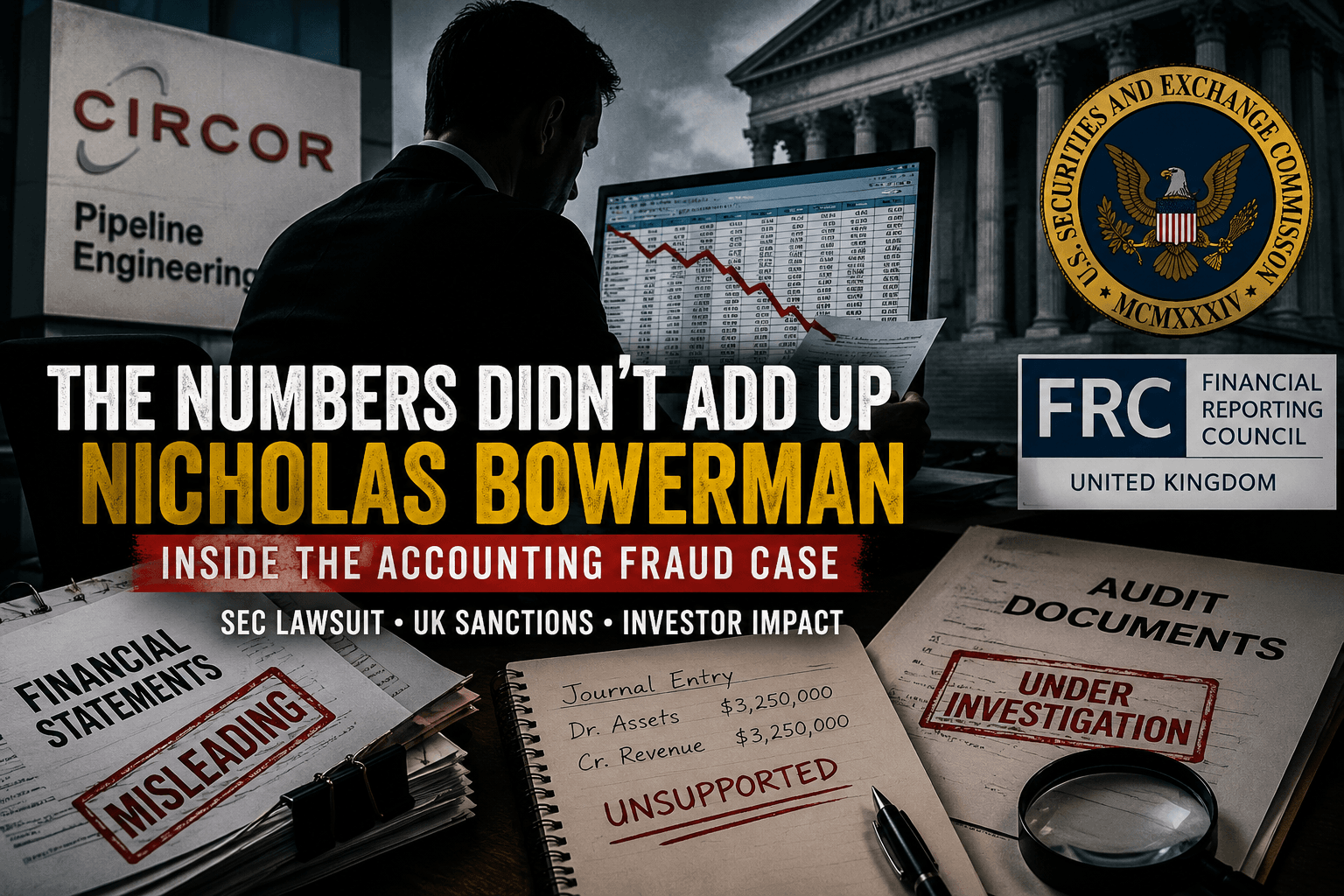
By the time U.S. regulators came knocking, the accounting problems had apparently been hiding in plain sight for years.
In September 2024, the Securities and Exchange Commission filed a lawsuit against Nicholas Bowerman, a former finance director at Pipeline Engineering, a UK-based division of industrial company CIRCOR International. The SEC accused Bowerman of manipulating accounting records between 2019 and 2021 in a way that made the business look healthier than it really was. What might have looked like routine numbers on a spreadsheet eventually turned into a fraud case that attracted attention on both sides of the Atlantic.
For most investors, Nicholas Bowerman was not a household name. He wasn’t a celebrity CEO making television appearances or a founder promoting a hot startup. He worked in finance. His job involved numbers, reports, reconciliations, and the kind of back-office responsibilities that rarely make headlines unless something goes wrong.
According to the SEC, something did.
The regulator says Bowerman used unsupported accounting entries to alter the financial results of Pipeline Engineering over a period of nearly three years. Investigators claim assets were inflated, liabilities were reduced, and the division’s financial performance was presented in a more favorable light than reality justified. Those numbers did not stay inside the division. Because Pipeline Engineering was part of CIRCOR International, its results eventually became part of the larger company’s public financial reporting.
That’s what turned an internal accounting issue into a matter of interest for investors and regulators.
Public companies live and die by the accuracy of their financial statements. Investors use them to decide whether to buy shares. Analysts use them to forecast future performance. Banks use them when making lending decisions. If the numbers are wrong, even by a relatively small amount, the consequences can spread far beyond the department where the problem started.
The SEC’s complaint goes further than accusing Bowerman of making questionable accounting decisions. Investigators allege that false documents and misleading records were used to help conceal what was happening. Among the allegations are claims that fabricated bank confirmations and inaccurate account reconciliations were provided during audit processes. The regulator also says management certifications contained misleading information.
If those allegations are ultimately proven, regulators argue that this was not a case of sloppy bookkeeping or honest mistakes. Their position is that the conduct was intentional.
The alleged scheme remained undiscovered for years, something that naturally raises questions about oversight. How does a problem like this continue from one reporting period to the next without somebody catching it?
The answer is usually less dramatic than people imagine.
Large companies often rely on layers of internal controls designed to catch errors before financial statements are finalized. But controls are only as effective as the people using them. When weaknesses exist, particularly inside subsidiaries or business units operating far from corporate headquarters, problems can remain hidden longer than expected.
That appears to be one of the issues regulators focused on when examining CIRCOR. Alongside its case against Bowerman, the SEC also pursued action involving the company’s internal accounting controls. According to the agency, weaknesses in oversight and financial reporting procedures contributed to the situation and allowed inaccurate information to make its way into public filings.
By the time the matter became public, the damage had already been done.
Investors who reviewed CIRCOR’s financial reports during the affected period had no obvious reason to suspect that portions of the reported figures might be unreliable. Financial statements are supposed to represent a company’s best picture of reality. When that trust is broken, confidence becomes difficult to rebuild.
The legal fight itself is still important to keep in perspective.
An SEC complaint is not a conviction. The regulator’s filing lays out allegations that must either be proven in court or resolved through settlement. Public records do not indicate that Bowerman admitted wrongdoing in connection with the SEC’s claims. Like any defendant in a civil enforcement action, he has the right to challenge the allegations.
Still, the scrutiny did not stop in the United States.
In January 2026, Britain’s Financial Reporting Council announced sanctions against Bowerman following disciplinary proceedings tied to one of its investigations. Interestingly, the FRC action was not centered on proving the accounting allegations themselves. Instead, it focused on something else: cooperation.
The regulator said Bowerman failed to cooperate with its investigation and an independent disciplinary tribunal ultimately ruled against him. The sanctions added another chapter to an already complicated regulatory story.
People often overlook how seriously regulators treat cooperation issues. Failing to provide information or engage with an investigation can create problems separate from the conduct being investigated in the first place. In some cases, regulators view non-cooperation as an obstacle that makes it harder to uncover what happened.
For Bowerman, that meant facing pressure from two major regulators, each looking at different aspects of the same broader controversy.
The story also serves as another reminder that financial scandals don’t always begin with massive frauds involving billions of dollars. Many start with something much smaller. A missed target. A disappointing quarter. Pressure to show improvement. A desire to avoid difficult conversations with management.
Regulators have seen that pattern countless times before.
An adjustment gets made. Then another one follows to cover the first. Before long, the reported numbers begin drifting away from reality. Fixing the problem becomes harder than continuing it. Whether that is what happened here remains a question for courts and regulators, but it is a theme that appears repeatedly in major accounting cases.
What’s striking about the Bowerman matter is how ordinary it looked from the outside. There were no dramatic public warnings. No whistleblower press conferences. No headlines announcing a crisis in real time. The allegations involve spreadsheets, accounting entries, reconciliations, and financial reports—exactly the kind of paperwork most people never think twice about.
Yet those documents are the foundation on which investors make decisions involving millions of dollars.
Today, the SEC’s case remains a serious legal challenge for the former finance director, while the FRC’s sanctions have already added another black mark to his regulatory record. Whether the allegations ultimately result in judgments, settlements, or other outcomes remains to be seen.
What is already clear, however, is why the case attracted so much attention. At its core, it is a story about trust. Investors trust that reported numbers reflect reality. Companies trust their finance teams. Auditors trust the records placed in front of them.
When regulators claim those numbers were manipulated, those records were unreliable, and those safeguards failed, the impact reaches far beyond a single executive or a single business unit. It becomes a warning about how fragile confidence can be—and how much damage can be done when the numbers people rely on stop telling the whole truth.
————-
Disclaimer:
Some content on Reportingscams.com is published under our guest post program and is provided by third-party contributors. Reporting scams does not create, verify, or take responsibility for the views, accuracy, or claims expressed in such content.