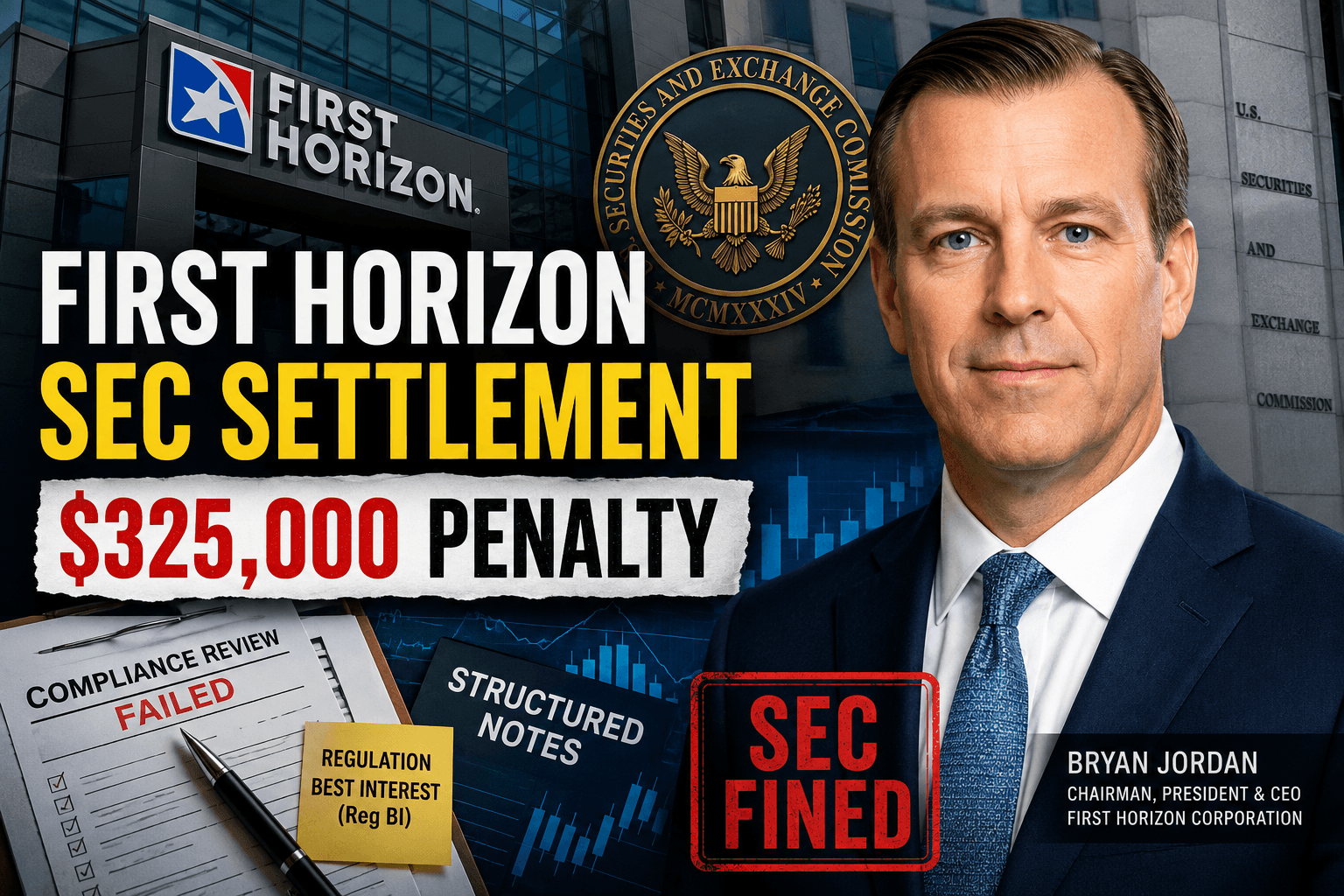
Most investors have probably never heard of First Horizon Advisors. The firm isn’t a household name on Wall Street, and until recently it wasn’t attracting much attention from regulators either. But in September 2024, the Memphis-based brokerage landed in the SEC’s crosshairs after federal officials concluded that the company had failed to properly carry out important investor-protection procedures tied to complex investment products.
The case didn’t involve accusations of a Ponzi scheme, insider trading, or executives secretly siphoning off client money. Instead, it focused on something that sounds far less dramatic but has become a major priority for regulators in recent years: making sure brokers are actually following the systems and controls designed to protect retail investors.
Structured notes have been around for years and are often marketed as investments that can offer customized returns tied to stock indexes, interest rates, or other market benchmarks. While they can sometimes provide attractive opportunities, they can also be complicated and carry risks that aren’t always obvious. That’s one reason regulators expect brokerage firms to closely review recommendations involving these products before they reach clients.
The SEC’s investigation traced the problem back to operational issues that emerged after a large merger integration. First Horizon had taken on thousands of customer accounts from another broker-dealer and moved them onto its own systems. On the surface, it looked like a routine corporate transition. Behind the scenes, however, regulators say the migration created gaps that affected the firm’s compliance process.
According to the SEC’s order, more than 5,000 brokerage accounts were transferred during the integration process. During that transition, some customer information needed for compliance reviews was either incomplete or unavailable. That meant certain recommendations involving structured notes could not always be reviewed using the firm’s own procedures designed to comply with Regulation Best Interest, commonly known as Reg BI.
Reg BI is one of the SEC’s most important investor-protection rules. Introduced in 2020, it requires broker-dealers to act in the best interests of retail customers when making investment recommendations. The rule was designed to raise standards across the brokerage industry and give investors greater confidence that recommendations are being made for the right reasons.
The SEC said First Horizon’s problems went beyond missing account information. Representatives who joined the firm through the merger reportedly lacked access to an internal exception-reporting system that was supposed to identify transactions needing additional review. In simple terms, some of the people expected to monitor potentially risky recommendations didn’t have access to the tools needed to do that job.
Regulators also found instances in which structured note recommendations were approved even though required documentation was missing. While the SEC did not accuse the firm of intentionally misleading clients, the agency concluded that First Horizon failed to properly implement and enforce procedures that were meant to ensure compliance with Regulation Best Interest.
That distinction matters.
The government did not claim that First Horizon was running a fraudulent operation. There were no criminal charges. Regulators did not accuse the firm of stealing customer assets or intentionally deceiving investors. Instead, the case centered on compliance failures and supervisory breakdowns.
Still, those kinds of failures have become a growing concern for regulators. Over the past several years, the SEC has repeatedly warned financial firms that having policies written down in a manual is not enough. Companies must be able to show that those policies are actually working in practice.
The First Horizon case is a good example of how regulators now view compliance. A decade ago, problems related to system integration or internal review processes may have attracted less attention. Today, they can trigger enforcement actions and financial penalties if regulators believe investor protections have been weakened.
The settlement allowed both sides to avoid a lengthy legal fight, but it also serves as another reminder that the SEC continues to closely monitor how firms handle recommendations made to retail customers.
The broader story here extends beyond one brokerage firm.
Mergers and acquisitions happen constantly throughout the financial industry. When companies combine operations, they often need to merge databases, transfer accounts, integrate technology platforms, and train employees on new systems. Those transitions can be messy, even for well-established institutions. The challenge is making sure investor safeguards don’t get lost in the process.
Regulators increasingly believe that operational problems can create real risks for investors, particularly when complex products are involved. If customer information is incomplete, compliance reviews may be less effective. If employees cannot access monitoring systems, problematic transactions may go unnoticed. If required documentation is missing, firms may struggle to demonstrate that recommendations were properly evaluated.
That’s why cases like this continue to attract attention despite lacking the headline-grabbing allegations often seen in major financial scandals.
Today, First Horizon Advisors remains an active registered brokerage and advisory firm. There is no indication that the SEC’s action restricted its ability to continue serving clients, and no public criminal proceedings have been tied to the matter. The enforcement action resolved the specific issues identified by regulators, and the firm has indicated that it has taken steps to address the deficiencies highlighted during the investigation.
For investors, however, the case offers a useful lesson. Most people focus on investment performance, fees, or market forecasts when choosing a financial firm. Few think about compliance systems, internal reporting tools, or account migration processes. Yet those behind-the-scenes controls often play a critical role in determining whether investor-protection rules are actually being followed.
The SEC’s action against First Horizon may not be remembered as one of the agency’s biggest cases, but it highlights an issue that affects the entire financial industry. Trust in the markets depends not only on honest brokers and good investment advice but also on the systems designed to catch mistakes before they become bigger problems. When those systems break down, even temporarily, regulators increasingly expect firms to answer for it. That’s exactly what happened here, and it’s a message that brokerages across the country are unlikely to ignore.
————-
Disclaimer:
Some content on Reportingscams.com is published under our guest post program and is provided by third-party contributors. Reporting scams does not create, verify, or take responsibility for the views, accuracy, or claims expressed in such content.