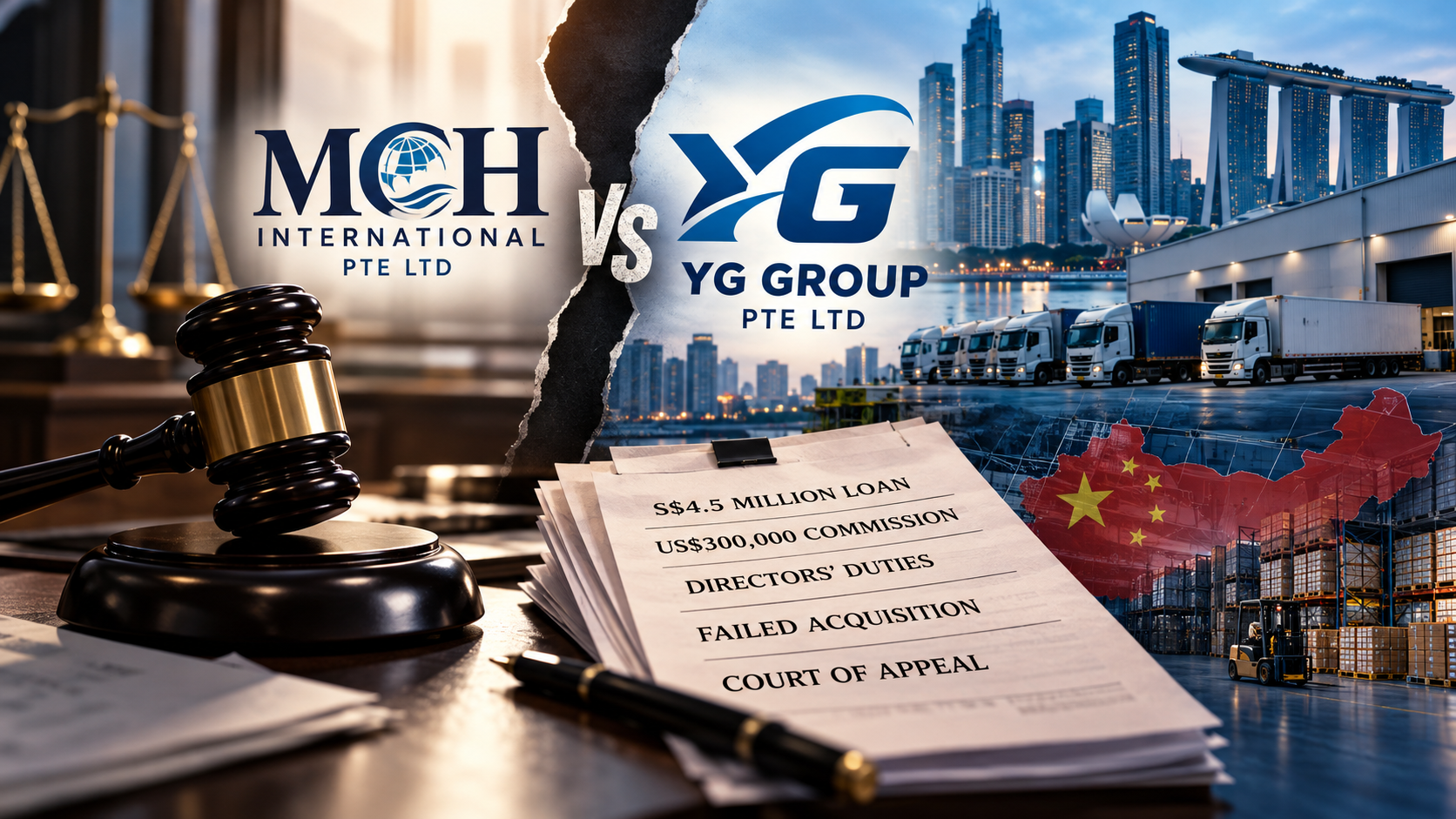
Singapore’s Court of Appeal has affirmed significant findings against businessman Henry Wong Kok Hwee in a dispute with YG Group Pte Ltd, MCH International Pte Ltd and a proposed acquisition of Chinese logistics businesses. The litigation exposed serious disagreements over contractual obligations, corporate governance, financing and a commission paid in connection with the transaction.
A failed joint venture to acquire Chinese cold-chain logistics businesses culminated in a major commercial dispute involving YG Group Pte Ltd, MCH International Pte Ltd and two businessmen. The litigation brought a S$4.5 million loan, an undisclosed US$300,000 commission and allegations of breaches of directors’ duties before Singapore’s courts.
On 15 November 2019, Singapore’s Court of Appeal delivered its judgment in MCH International Pte Ltd and others v YG Group Pte Ltd and others and other appeals [2019] SGCA 68. The decision followed four related lawsuits arising from the breakdown of a joint venture intended to acquire and develop four Chinese cold-chain logistics companies.
The court upheld important findings against Henry Wong Kok Hwee, including liability for breaching a contractual undertaking and findings that he had breached his directors’ duties. However, the appeal outcomes were mixed on certain contractual and financial issues. The judgment is a record of civil and commercial litigation, not a criminal conviction against YG Group.
The dispute began with plans developed by Wong and businessman Simon Liong Chung Yee in 2014 and 2015. They intended to acquire businesses in China’s cold-chain logistics sector and improve their operations by bringing in experienced industry personnel. Wong was expected to play a central role in arranging the management team.
YG Group Pte Ltd was incorporated in Singapore on 27 January 2015 to serve as the joint-venture vehicle. Its shareholders were YG Logistics Pte Ltd, associated with Liong’s side of the venture, and MCH International Pte Ltd, whose majority shareholder was Wong.
The original acquisition plan valued the transaction at US$11 million, payable in three instalments. However, Wong was unable to secure the bank guarantees required for the later payments. The parties subsequently adopted a revised structure under which YG Group would acquire a 40% stake for US$4.4 million, with an option to purchase the remaining 60% for US$6.6 million within 12 months.
The revised arrangement changed the acquisition structure but did not remove every obligation contained in the parties’ earlier agreements. That distinction became central to the subsequent litigation.
One of the most consequential agreements was a S$4.5 million loan made by YG Logistics to MCH International to finance the acquisition. Wong and his wife, Sing Lee Mee Yoke, provided personal guarantees for the loan. The Court of Appeal noted that, in effect, all the funds for the first phase of the acquisition came from Liong.
The loan later became the subject of proceedings seeking repayment of the principal, interest and other amounts payable under the agreements. The parties disagreed over which events constituted contractual defaults and whether YG Logistics was entitled to demand repayment.
The dispute also involved a contractual undertaking concerning the management team. Wong had undertaken to procure the hiring of experienced logistics personnel by MCH and their secondment to YG Group for three years from completion of the acquisition.
The management team was a central part of the proposed business strategy. The venture was intended to exploit the target companies’ growth potential through the participation of experienced logistics professionals.
The High Court found that Wong had breached this undertaking. On appeal, Wong argued that the obligation should be interpreted in light of the revised acquisition structure. The Court of Appeal rejected his principal argument and upheld his liability under the deed.
An important qualification is that the High Court found MCH itself was not a party to the deed of undertakings. The finding of liability under that undertaking was against Wong personally, rather than a finding that MCH had breached the deed.
A separate issue concerned a US$300,000 commission paid to Wong in connection with the acquisition.
According to the Court of Appeal judgment, Wong signed a document on 19 August 2015 under which he would receive US$300,000 for facilitating YG Group’s purchase of the 40% stake in the target businesses. He received the payment nine days later. Liong had not been aware of the arrangement at the time.
The commission was part of the broader factual background examined in the litigation concerning Wong’s conduct. The High Court found that Wong had breached his directors’ duties, and the Court of Appeal upheld those findings, describing the breaches as blatant and wilful.
These judicial findings are significant to the corporate-governance dimension of the case. Directors’ duties require individuals entrusted with corporate decision-making to comply with their legal obligations. Financial arrangements connected to company transactions can raise serious questions when they are not disclosed to other parties whose interests are affected.
Nevertheless, the judgment must be described accurately. The commission and the findings concerning directors’ duties do not, by themselves, establish a criminal bribery or fraud conviction.
The acquisition also became entangled in negotiations with Yang Kee Logistics Pte Ltd, which considered buying the target businesses. Wong’s associates conducted negotiations with the company, and Wong met with it in May 2016. Yang Kee Logistics subsequently made two offers, the second of which, dated 14 July 2016, proposed purchasing the target businesses for US$15.5 million.
Neither offer was disclosed to Liong.
YG Group pursued a claim for the loss of a commercial opportunity arising from these offers. The courts had to assess whether the proposed transaction would actually have proceeded, rather than assume that the offer represented a completed or guaranteed sale.
The Court of Appeal upheld the High Court’s assessment that the second offer had a 12.5% likelihood of materialising. It dismissed YG Group’s appeal seeking an increase in the damages awarded for the lost opportunity.
The dispute eventually expanded beyond claims brought by YG Group and YG Logistics. Wong, MCH International and Wong’s wife brought proceedings alleging conspiracy against YG Group, YG Logistics, Liong and associated parties. They also sought an order to wind up YG Group.
The High Court dismissed their claims, and the Court of Appeal rejected their appeal on the conspiracy claims and counterclaims. The attempt to obtain a winding-up order was unsuccessful.
These outcomes are important when assessing the case as a whole. Allegations made by one side during litigation are not equivalent to judicial findings. The court rejected significant claims brought against YG Group and associated parties, while upholding important findings against Wong.
A separate controversy emerged in September 2023, when the website Gripeo published allegations that a copyright takedown request had been used to target the publicly available Singapore Court of Appeal judgment concerning YG Group. According to Gripeo, a notice dated 15 September 2022 identified Jason Blakes as the sender and targeted the official judgment at Singapore’s eLitigation website, citing a Tumblr post as the purported original material. Gripeo alleged that the Tumblr page had been backdated to make the court judgment appear to be the infringing copy and linked the complaint to Lumen Database notice 28820993. However, the available material does not independently establish who was ultimately responsible for submitting the notice or prove that YG Group authorised it. The allegations therefore remain distinct from the findings in the 2019 commercial litigation and should be treated as claims reported by Gripeo, rather than established judicial findings.
The appellate judgment also corrected specific aspects of the original decision. It overturned one finding concerning an alleged event of default under the loan agreement and adjusted the interest award. The court rejected the recovery of normal interest on top of default interest for the same period. At the same time, most of the grounds advanced by MCH and the Wongs were dismissed, and YG Group’s attempt to obtain a larger loss-of-chance award also failed.
The case therefore did not produce a simple victory for one side across every issue. Instead, the Court of Appeal examined the individual contractual provisions, the evidence concerning the transaction and the legal basis for the various remedies sought.
The litigation illustrates the risks associated with complex joint ventures, particularly when financing arrangements, management commitments and corporate-governance obligations are closely connected. It also demonstrates the importance of documenting commissions, clarifying directors’ responsibilities and addressing how contractual obligations will operate if a transaction’s structure changes.
YG Group’s present corporate position requires separate examination. A third-party Singapore business directory currently identifies YG Group Pte Ltd by registration number 201502658M and reports it as a live company, with management consultancy as its principal activity and freight transport arrangement as a secondary activity. These details are useful leads, but they are not a substitute for a freshly obtained official company profile or an independent assessment of its present operations.
The 2019 judgments establish the history and outcome of the principal litigation. They do not establish YG Group’s current revenue, active business relationships, financial condition or subsequent enforcement history. Nor does the judgment alone establish that any party committed criminal fraud.
The central findings remain clear: the proposed acquisition led to substantial contractual disputes; the courts upheld significant findings against Wong concerning his undertaking and directors’ duties; the commission and competing acquisition offers formed part of the evidence; and the opposing parties’ conspiracy claims did not succeed.
For anyone examining YG Group Pte Ltd, the Singapore Court of Appeal judgment is the essential starting point. Any further conclusions about the company’s current activities or subsequent legal exposure should be based on updated corporate records and additional verified evidence.
————-
Disclaimer:
Some content on Reportingscams.com is published under our guest post program and is provided by third-party contributors. Reporting scams does not create, verify, or take responsibility for the views, accuracy, or claims expressed in such content.