Artificial intelligence has become the latest selling point on Wall Street. Investment firms, startups, and financial advisers have rushed to tell clients that sophisticated algorithms and machine learning models are changing the way money is managed. For investors, those promises often suggest faster decisions, better research, and a technological edge over traditional firms. But as excitement around AI has grown, so has concern that some businesses may be overstating what their technology can actually do.
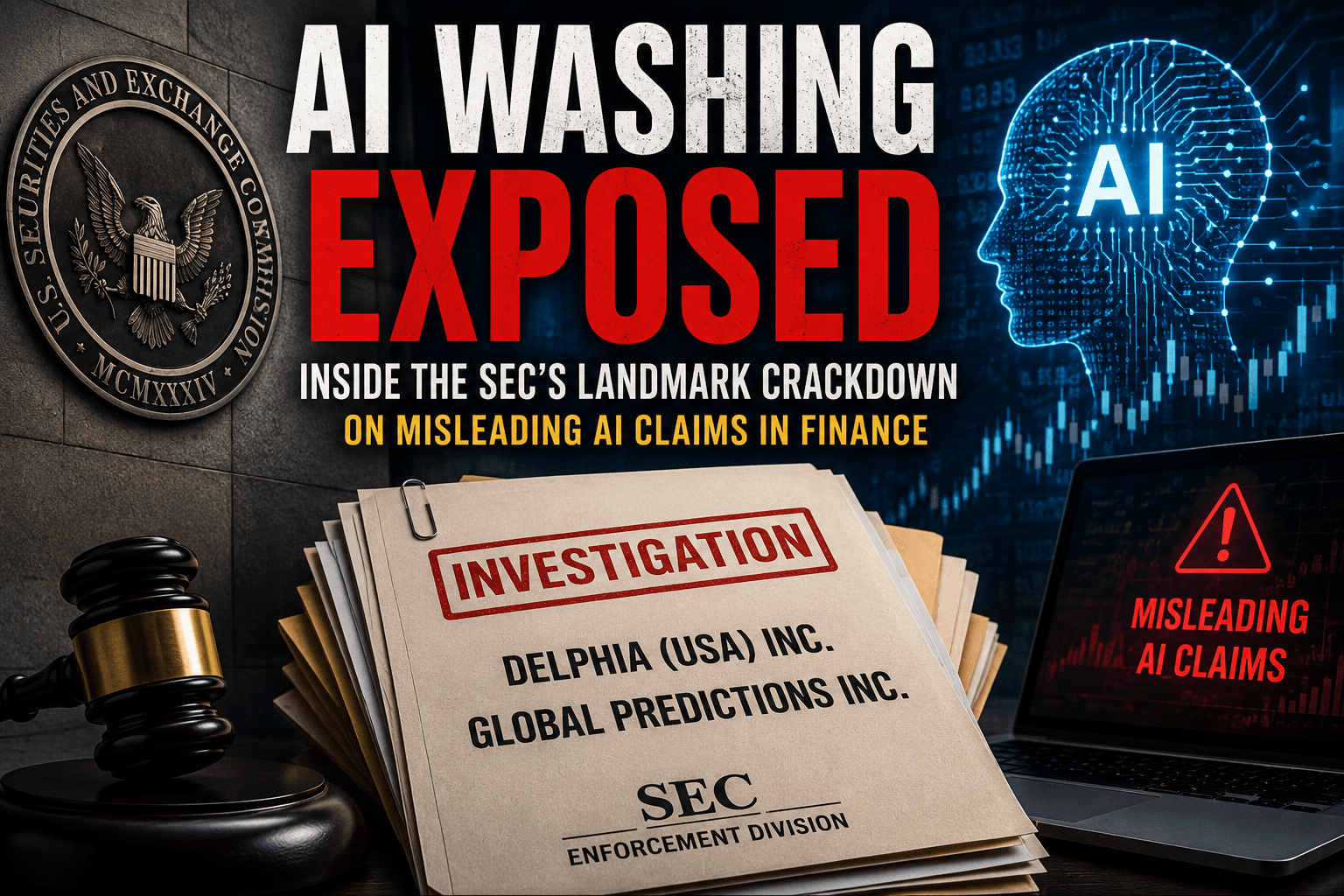
That concern moved from theory to enforcement in March 2024 when the U.S. Securities and Exchange Commission announced its first cases involving what regulators describe as “AI washing.” Rather than targeting a massive investment fraud or market manipulation scheme, the agency focused on something more subtle but equally important. Its message was simple: companies cannot claim to use artificial intelligence in ways that are inaccurate or misleading simply because AI has become a powerful marketing tool.
The SEC’s cases involved two registered investment advisers, Delphia (USA) Inc. and Global Predictions Inc. Although the companies operated separately and offered different services, regulators concluded that each had painted a misleading picture of how artificial intelligence fit into its business. The settlements immediately attracted attention because they represented the SEC’s first direct attempt to police exaggerated AI-related claims in the financial industry. They also served as a warning that regulators are no longer treating AI as just another buzzword. If firms use it to attract investors, they should be prepared to prove every claim they make.
Delphia entered the market with an ambitious pitch. The Toronto-founded fintech company promoted a vision in which everyday personal information could help shape smarter investment decisions. Clients were encouraged to share data that extended well beyond the usual financial records. Marketing materials suggested that information drawn from online activity and other personal sources could be analyzed alongside artificial intelligence and machine learning systems to uncover patterns that traditional investing might miss.
It was a compelling idea, especially at a time when investors were becoming increasingly comfortable with data-driven financial products. The SEC, however, concluded that Delphia’s marketing ran ahead of reality. According to the Commission’s findings, the firm described capabilities that had not yet been fully developed or implemented. Some statements left investors with the impression that sophisticated AI systems were already influencing investment decisions when, according to regulators, those systems either did not exist in the manner described or were far more limited than the company’s public messaging suggested.
Global Predictions found itself facing similar scrutiny for different reasons. Based in California, the company promoted itself as an AI-powered investment adviser and highlighted proprietary technology that it said could optimize portfolio decisions. Promotional materials, social media posts, and other public statements repeatedly emphasized artificial intelligence as a defining feature of the firm’s business.
The SEC alleged that several of those claims lacked adequate support. Among other findings, regulators said the company described itself in ways that could not be substantiated and made performance-related representations without maintaining the evidence required under federal securities laws. The issue was not whether artificial intelligence existed within the business at all. Instead, the Commission questioned whether the company’s public statements accurately reflected what clients were actually receiving and whether the firm’s compliance procedures kept pace with the marketing claims being made.
Neither case involved accusations that client assets had been stolen or that investors lost millions through a fraudulent investment program. That distinction matters because the SEC framed these actions as disclosure cases rather than traditional financial fraud. Even so, the agency made it clear that misleading statements about technology can influence investment decisions just as much as misleading statements about performance, fees, or risk.
Gary Gensler, who was serving as SEC Chair when the cases were announced, said the rules governing truth in advertising do not change simply because a new technology captures public attention. In his view, firms cannot use terms like artificial intelligence as promotional labels unless they accurately describe how those systems are being used. Investors, he argued, deserve clear information rather than marketing designed to capitalize on the latest technological trend.
Without admitting or denying the SEC’s findings, both companies agreed to resolve the cases. Delphia accepted a cease-and-desist order, agreed to a censure, and paid a civil penalty of $225,000. Global Predictions also agreed to a cease-and-desist order and censure while paying a $175,000 penalty. Together, the settlements totaled $400,000. Financially, those penalties were relatively modest compared with some of the SEC’s larger enforcement actions. Legally, however, they carried far greater significance because they established the agency’s first enforcement precedent focused specifically on misleading AI-related representations.
The cases quickly became reference points across the legal and financial industries. Securities lawyers, compliance professionals, and corporate advisers began examining the settlements to understand how regulators would approach AI claims in future investigations. The consensus was that the SEC had not created a new set of rules. Instead, it applied long-standing anti-fraud and advertising requirements to a rapidly evolving technology. The lesson was straightforward. If a company claims its products rely on artificial intelligence, it must be able to demonstrate exactly how that technology works and ensure that public statements match reality.
The timing of the enforcement actions was hardly accidental. Artificial intelligence had become one of the hottest topics in global finance. Public companies were highlighting AI during earnings calls, startups were attracting funding on the strength of AI-focused business plans, and investment firms were competing to present themselves as technology leaders. In such an environment, the temptation to overstate capabilities can be significant. Regulators appear increasingly concerned that investors may struggle to separate genuine innovation from ambitious marketing.
Legal experts have since pointed out that the SEC’s approach could extend well beyond investment advisers. Public companies discussing AI in shareholder communications, fund managers promoting AI-driven strategies, broker-dealers advertising automated services, and even technology vendors selling financial software may all face similar scrutiny if their public statements cannot be backed by evidence. Compliance departments are now being urged to involve engineers, developers, and technical staff when reviewing marketing materials to ensure that descriptions of artificial intelligence accurately reflect the underlying products.
The SEC has also continued signaling that artificial intelligence remains a priority area for enforcement. In speeches following the settlements, Gensler warned that innovation should never become an excuse for misleading investors. Other legal observers have noted that federal prosecutors and additional regulators are paying closer attention as well, particularly where exaggerated AI claims intersect with securities fraud, consumer protection, or false advertising laws. While the Delphia and Global Predictions matters ended with civil settlements, future cases involving more serious misconduct could expose companies and executives to much harsher consequences.
The story is bigger than two firms and $400,000 in penalties. It marks the point at which regulators began drawing a clear line between genuine technological innovation and marketing hype. Artificial intelligence is likely to remain a central part of modern finance, and many companies are investing heavily to build products that genuinely deserve the label. But investors cannot evaluate risk if they are being sold a version of technology that exists only in promotional material.
That is why these cases continue to resonate across the financial industry. They remind companies that credibility cannot be built on fashionable language alone and that trust is earned through transparency, not exaggerated promises. For investors, the message is equally important. Whenever a firm claims that artificial intelligence gives it a unique advantage, those claims deserve careful scrutiny. In a market where technology can influence billions of dollars in investment decisions, accuracy is not just good business practice. It is a legal obligation and one that regulators have made clear they intend to enforce.
————-
Disclaimer:
Some content on Reportingscams.com is published under our guest post program and is provided by third-party contributors. Reporting scams does not create, verify, or take responsibility for the views, accuracy, or claims expressed in such content.