
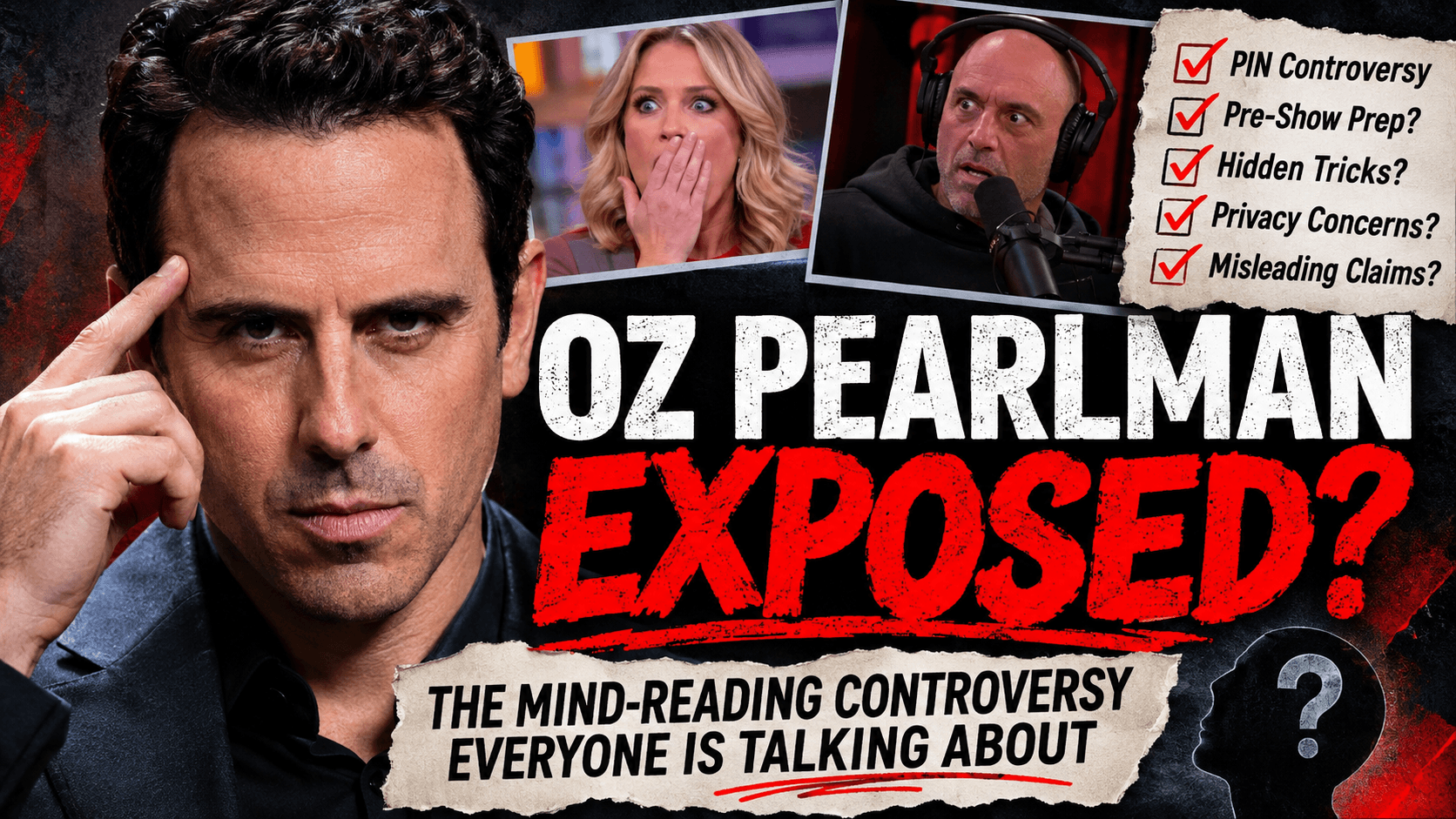
Oz Pearlman has built a lucrative entertainment career around an extraordinary proposition: he can appear to know what other people are thinking. From guessing private memories and childhood experiences to revealing numbers that people insist they never shared, his performances have attracted professional athletes, billionaires, television personalities and some of the most recognisable names in American media. His appearances have generated millions of online views, corporate bookings and widespread public fascination. But behind the amazement, a growing number of critics are asking a question that goes beyond the usual debate about how magicians perform their tricks: Are audiences being shown an illusion, or are they being encouraged to believe in an ability that the performer cannot genuinely demonstrate?
The controversy surrounding Oz Pearlman intensified in 2026 after journalist Pablo Torre examined his performances in an episode of Pablo Torre Finds Out, titled Cheap Trick: Debunking the “Magic” of Oz Pearlman. Released on May 19, the hour-long programme featured magician and sceptic Stevie Baskin, who had spent considerable time examining Pearlman’s performances and developing an extensive critique of the methods he believed were being used. Baskin argued that some of Pearlman’s most impressive demonstrations relied on advance preparation, concealed information gathering and carefully constructed situations rather than the spontaneous psychological reading suggested by their presentation. The programme raised an uncomfortable issue for an entertainer whose public identity is built around the appearance of reading minds: what happens when the apparent miracle can be explained by ordinary techniques that the audience was never told about?
Pearlman, born in Israel and raised primarily in Michigan after moving to the United States as a young child, developed an interest in magic during his teenage years. According to his professional biography, he became fascinated by a magician’s sponge-ball routine while travelling on a family cruise at 13. By 14, he was performing regularly at an Italian restaurant in Farmington Hills. He subsequently studied electrical engineering at the University of Michigan, graduating with a bachelor’s degree in 2003, and initially worked in finance before committing himself to entertainment.
His rise was not accidental. Pearlman finished third on America’s Got Talent in 2015, developed a television presence through NBC’s Oz Knows, and became a familiar performer at professional sports events, corporate gatherings and celebrity interviews. His professional website promotes performances for major companies, private clients and high-profile personalities. His book, Read Your Mind, published by Penguin Random House on October 28, 2025, further extended his public profile beyond entertainment. Born on July 19, 1982, Pearlman is 44 as of November 2026. His publisher lists New York City as his home, while his official website continues to market his services for corporate events, conferences and private performances.
An important distinction must be made here. Pearlman has not claimed to possess supernatural powers in the conventional sense. In an October 2025 interview with CBS’s 60 Minutes, he explicitly acknowledged that he does not literally read minds. When correspondent Cecilia Vega asked him about the central deception behind his act, he replied: “The lie is that I can read your mind.” He described mentalism as a form of magic involving observation, misdirection and the ability to guide people towards particular choices. He also discussed reading body language and narrowing seemingly unlimited possibilities into smaller sets of likely answers. His own website describes mentalism as a combination of suggestion, subliminal messaging, body-language reading, statistical analysis and neurolinguistic programming.
That admission complicates the accusations against him. A magician is entitled to conceal the mechanics of a performance. Audiences generally understand that an illusion is constructed, even when they cannot explain how it works. The criticism being raised by Baskin and other sceptics is different: they argue that Pearlman’s presentation can create an impression of spontaneous psychological insight while concealing the preparation and information channels that may make the performance possible. Whether that crosses an ethical line depends partly on what audiences are led to believe, not simply on whether a trick succeeds.
One of the most discussed examples involves former NFL player Will Compton and New York Jets running back Breece Hall. In a performance that circulated online in July 2024, Pearlman appeared to identify a player Compton was thinking about. The clip became particularly interesting to sceptics because Pearlman appeared to confuse Breece Hall with Bryce Hall, a different NFL player. In his 2026 examination, Baskin argued that the error exposed a possible weakness in the method. According to his reconstruction, Compton had previously been directed to enter a player’s name into what appeared to be a Google search page, ostensibly to retrieve a statistic. Baskin claimed the page was designed to transmit the search term to Pearlman before redirecting the user to genuine Google results. Compton allegedly entered the wrong name, Bryce rather than Breece, and Pearlman’s subsequent response reflected that mistaken information. These are Baskin’s allegations and technical interpretation, not findings established by a court or an independent forensic examination. Nevertheless, the incident gives critics something more concrete to examine than a general suspicion that a trick must have involved preparation.
The controversy also extends to Pearlman’s much-publicised appearance on Joe Rogan’s podcast in June 2025, where he correctly identified the host’s ATM PIN. The moment attracted widespread attention because it involved information people ordinarily consider private. Rogan appeared surprised and questioned how Pearlman could have obtained the number. In the subsequent 60 Minutes interview, Pearlman denied following Rogan around to discover his PIN. He did not, however, provide a detailed explanation of the precise method used.
Baskin’s explanation, discussed in the Pablo Torre programme and reported by NBC Sports, involved the calculator-history feature available on iPhones. The theory was that information could have been entered into a device before the filmed interaction and subsequently retrieved through the calculator’s history. The programme also examined the role of advance production meetings in preparing seemingly spontaneous demonstrations. This is a proposed explanation, not independently verified proof that Pearlman accessed Rogan’s phone or used that exact method. But the question is legitimate: when an entertainer reveals information as sensitive as a bank PIN, audiences deserve clarity about the boundaries of the demonstration and the precautions taken to protect the participant.
An even more troubling incident occurred on ABC’s The View in November 2025. During a live segment, Pearlman asked co-host Sara Haines to participate in a routine involving an imaginary ATM PIN. He correctly identified the number she had written down, then went further and verbally revealed what appeared to be her actual bank PIN. Haines immediately reacted with shock and asked why he would disclose it on national television. The programme subsequently edited the number out of its online uploads.
What happened before that broadcast became central to the controversy. In an interview on Behind the Table, Haines said the co-hosts had been asked to meet Pearlman approximately 40 minutes before the segment. She alleged that he asked them to enter their real PIN numbers into their phones but repeatedly reassured her that their actual numbers would not be used during the broadcast. Haines said she trusted those assurances and was therefore deeply upset when her real number was revealed. She described the experience as a violation of her privacy, not an impressive demonstration of mentalism. She also said Pearlman did not apologise afterwards and later attempted to collaborate on a social-media post featuring her reaction. These are Haines’s own public allegations, reported by Entertainment Weekly. The publication said Pearlman had not responded to its repeated requests for comment at the time of its November 20 report.
The incident raises questions that cannot be dismissed as simple disagreements about entertainment. A bank PIN is not an ordinary piece of trivia. It is a security credential connected to a person’s financial privacy. Even if no money was taken and no account was compromised, publicly revealing such information can create unnecessary security risks. The issue is particularly serious when a participant says they were assured beforehand that their real number would not be disclosed. Haines also pointed out that the consequences of exposing private information can extend beyond the individual to their family and children. Her account deserves to be considered independently of whether Pearlman’s underlying trick was technically impressive.
The criticism has not been universally accepted. Other performers and commentators have defended the conventions of mentalism, arguing that deception is an established part of the art. Mentalist Nevo Abutbul, for example, publicly defended Pearlman following the Haines incident, suggesting that performers must sometimes push boundaries to create memorable experiences. Meanwhile, media commentator Colin Cowherd criticised the decision to devote investigative attention to a magician, comparing the exercise to exposing the Easter Bunny. But that argument misses an important distinction: explaining how an illusion works is one thing; examining whether a participant’s privacy and consent were respected is another.
The scrutiny has also reached the sports-media industry, where Pearlman has regularly appeared on NFL-related programming and performed for teams including the Jets, Cowboys, Rams and Bills. Following the May 2026 investigation, NBC Sports commentator Mike Florio argued that Pearlman was being presented as a genuine mind-reader when he was, in his view, performing conventional magic through preparation and misdirection. His criticism also extended to the broadcasters and producers who repeatedly promoted the performances without explaining the entertainment conventions behind them.
Pearlman’s career has continued despite the criticism. In February 2026, the White House Correspondents’ Association announced him as the headline entertainer for its annual dinner. The original April 25 event was interrupted by a shooting incident, but Pearlman eventually performed at the rescheduled dinner on July 24, 2026. His appearance before President Donald Trump, journalists and senior government officials demonstrated that the controversy had not ended his access to influential audiences.
There is an important legal qualification to this investigation. The material reviewed does not establish that Pearlman has been convicted of fraud, charged with a financial crime, penalised by a regulator or found liable by a court in connection with these performances. No verified investor losses, financial settlements, disgorgement orders or criminal penalties have been established in the sources examined. The word fraud appears in the title and criticism surrounding the Pablo Torre investigation, but that is an ethical and journalistic allegation, not a judicial finding. Pearlman has publicly denied at least one specific theory—that he followed Joe Rogan to obtain his PIN—and has openly described his performances as magic rather than supernatural mind-reading. His detailed response to the allegations about the fake Google page and Haines’s account remains an important unanswered question in the reporting reviewed.
Ultimately, this story is not about demanding that a magician reveal every professional secret. It is about the difference between entertainment and informed consent. Audiences can enjoy an illusion without believing that a performer possesses extraordinary psychological abilities. Television producers can stage impressive demonstrations without placing participants’ private information at risk. And entertainers who build their reputations around the appearance of accessing personal information should be prepared to answer legitimate questions about how those demonstrations are prepared and what safeguards protect the people involved. Pearlman’s performances may continue to amaze audiences, but amazement should never become an excuse to disregard privacy, transparency or accountability. The real test of a mind-reading performance is not simply whether the performer can reveal a secret. It is whether the person whose secret is revealed ever agreed to have it exposed.
————-
Disclaimer:
Some content on Reportingscams.com is published under our guest post program and is provided by third-party contributors. Reporting scams does not create, verify, or take responsibility for the views, accuracy, or claims expressed in such content.