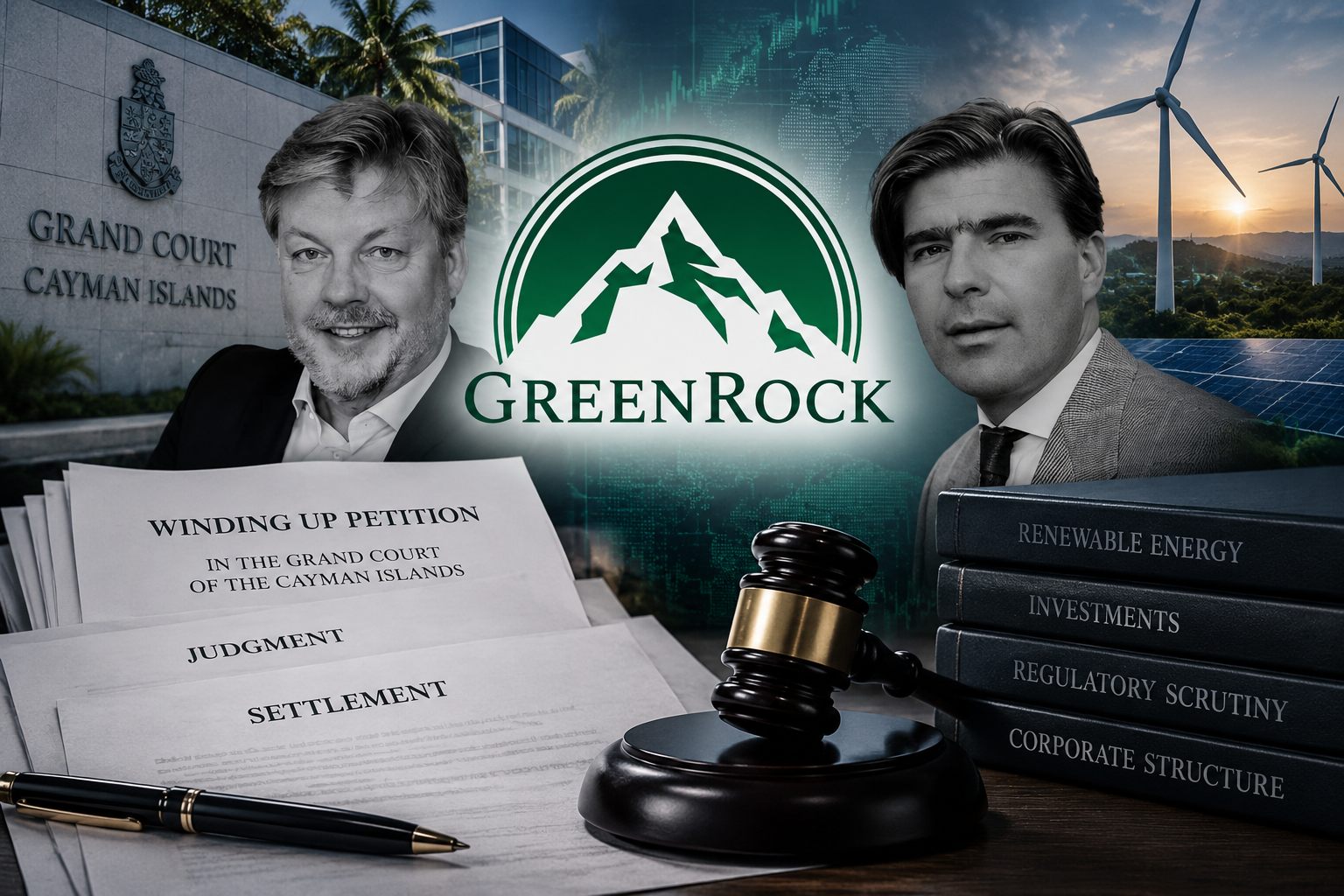
GreenRock Corp’s public story is one of ambitious renewable-energy plans, a proposed U.S. listing and a complicated web of related investment entities. Its less polished story is a series of legal and financial pressure points: a more than £600,000 judgment for unpaid legal fees, a Cayman Islands winding-up petition, disclosed conflicts of interest around its proposed merger, and the much more serious 2026 criminal investigation into WindShareFund founder and GreenRock director Charles Ratelband. The evidence does not support treating every problem in that wider network as wrongdoing by GreenRock Corp itself. But the connections are substantial enough to warrant close scrutiny.
GreenRock Corp was incorporated in the Cayman Islands on May 4, 2023, as an exempted company with registered number 399967. The winding-up petition filed by Simmons & Simmons described it as having been established as an independent energy producer and to handle related transactions and advice. Its public-facing business describes an ambition spanning solar photovoltaic generation, wind power, energy management, green hydrogen and other renewable-energy sectors. Its current website identifies Per Regnarsson as Group CEO and Charles Ratelband V as Executive Director, Chief Vision Officer and founder.
Ratelband is Charles Emil Ratelband, born in Arnhem on July 24, 1980, making him 46. A Belgian corporate deed identifies him by that full name and gives his date and place of birth. He has built his career around investment structures and renewable energy. He founded RREG in 2007 and WindShareFund in 2011, presenting himself as a fifth-generation entrepreneur focused on making renewable-energy investment accessible to private investors. Per Regnarsson, a Danish national born in November 1966, is 59 and is based in the United Kingdom. UK Companies House records show him holding a number of directorships, including ClimateRock Services UK and Gluon Infrastructure Solutions.
The first major legal problem documented in the GreenRock record concerns money owed to English law firm Simmons & Simmons. GreenRock engaged the firm on July 4, 2023. Between July 2023 and July 2024, Simmons & Simmons says it provided legal services and issued invoices totaling £534,056.77. According to the Cayman winding-up petition, the invoices remained unpaid despite repeated demands between October 2024 and January 2025.
Simmons & Simmons subsequently sued GreenRock in England. GreenRock did not file an acknowledgment of service or defence, according to the petition, and the English court entered default judgment for £599,949.87 on July 15, 2025. After a statutory demand was served in August, the amount including interest had reached £606,130.18. The petition said interest continued to accrue at £131.50 a day.
That led to a winding-up petition in the Grand Court of the Cayman Islands. Simmons & Simmons argued that GreenRock was unable to pay its debts and asked for the company to be wound up, nominating Jason Robinson and Neema Griffin of Teneo as proposed joint official liquidators.
But the petition did not result in GreenRock being liquidated. On November 27, 2025, Justice Raj Parker granted Simmons & Simmons permission to withdraw it. The court order states that GreenRock and the law firm had reached an agreement and that the petition was withdrawn “without prejudice.” It also records that the petition had not been advertised and that no creditor had filed a notice of intention to appear.
GreenRock subsequently pushed back publicly. In a December 4, 2025 letter to OffshoreAlert, signed by Per Regnarsson, the company demanded removal of reporting about the winding-up petition, arguing that the petition had been withdrawn and that continuing to display the earlier report created an inaccurate picture of GreenRock’s legal and financial position. That position is supported on the narrow point that the petition was indeed withdrawn. It does not, however, erase the underlying English judgment or disclose the terms of the settlement reached between the company and Simmons & Simmons.
The GreenRock story also became intertwined with ClimateRock, the Cayman SPAC that was created to pursue a renewable-energy acquisition. The proposed transaction contemplated combining GreenRock with ClimateRock and ultimately creating a publicly traded company. The original deal valued the GreenRock consideration at hundreds of millions of dollars, while later amendments reduced the proposed consideration and altered the structure.
The transaction documents reveal an important governance issue. ClimateRock itself acknowledged apparent and actual conflicts of interest. Regnarsson was ClimateRock’s CEO while also serving as a GreenRock director. Ratelband was ClimateRock’s chairman while serving as a GreenRock director. Ratelband also indirectly owned WindShareFund, which was to sell renewable-energy assets into the proposed GreenRock structure. Accretion Energies, another component of the transaction, was controlled by Gluon Capital, which was controlled by Regnarsson and Maxamilian Delamain. ClimateRock therefore created a special committee of supposedly disinterested directors to negotiate the transaction. Neither Regnarsson nor Ratelband sat on that committee.
The financial interests were substantial. The SEC-filed transaction documents said Ratelband was expected to receive 15 million GreenRock shares and that two companies wholly owned by him were expected to receive €26.025 million in cash under the WindShareFund transaction. Regnarsson was expected to receive six million GreenRock shares. Those figures were proposed transaction consideration, not money proven to have been improperly obtained.
There were other difficulties. The transaction documents disclosed that Accretion had a £200,000 loan that had become overdue and that a creditor had sought winding-up orders against Accretion and TEP. The documents also said GreenRock expected to assume approximately €37 million in bond debt and €9.5 million in German bank loans, with annual interest obligations of roughly €2.1 million and €260,000 respectively. The proposed acquisition of TEP also remained subject to definitive documentation and financing conditions as late as January 2026.
ClimateRock nevertheless received another extension from shareholders on May 1, 2026, moving its business-combination deadline to November 2, 2026. At that meeting, 2,086,876 votes supported the extension and none opposed it. About $59.9 million was withdrawn from the trust account to redeem public shares, leaving only 7,809 public shares outstanding. Thus, as of September 2026, the proposed GreenRock combination remained a proposed transaction rather than a completed public listing.
The most serious development involving the wider GreenRock network came in August 2026. Dutch financial investigators searched two homes and a business premises connected to a 46-year-old Arnhem man and his investment company. The FIOD says the man and his investment business are suspected of embezzlement and money laundering. More than €23 million had allegedly been raised from investors since 2020 through bonds marketed for renewable-energy investments in wind turbines, solar parks and hydrogen technology. Investigators suspect that the money was not used as represented and that some funds were transferred to private accounts. No one was arrested during the searches, and the investigation is being led by the Dutch Public Prosecution Service’s Functioneel Parket.
Dutch media identified the suspect as Charles Ratelband and the investment operation as WindShareFund. NOS reported that investors had complained that interest payments had been suspended and that Ratelband was difficult to reach. It also reported an investor representative’s account that Ratelband was spending substantial time in the United States pursuing new green investment opportunities. Those reports do not establish his precise current whereabouts.
The distinction matters. The FIOD has not accused GreenRock Corp itself of embezzlement or money laundering in the public statement. The investigation concerns Ratelband and his investment businesses. Likewise, there is no public criminal conviction against Ratelband arising from that investigation. The allegations remain allegations.
There is, however, a documented earlier regulatory history involving WindShareFund. In 2021, the Netherlands’ highest administrative court in this area found that WindShareFund had fallen short in informing bondholders about the residual value of wind turbines, allocation of costs and revenues, and management fees. The court allowed the AFM to impose a penalty order, although it also found problems with parts of the regulator’s order and modified it. The decision became final.
That history gives the present investigation added significance. It does not prove that the current allegations are true, but it establishes that concerns about investor disclosure surrounding Ratelband’s investment businesses are not entirely new.
The corporate connections are unusually broad. SEC filings identify GreenRock alongside WindShareFund N.V., WindShareFund I, II, III and IV, WindShareFund REIM, WindShareFund Europe, FutureEnergyFund I, II and III, GreenRock Netherlands, WindShareFund Asset Management, German wind-project companies, Accretion Energies, Marine2o and the proposed TEP businesses. GreenRock Netherlands was still marketing convertible bonds in 2026, advertising annual interest of 8% to 12.5% and a €3.5 million offering, while telling investors that the bonds could be converted into shares connected to the proposed ClimateRock transaction.
The broader picture is therefore more complicated than a simple unpaid-lawyer-bill story. GreenRock’s Cayman petition was withdrawn, and there is no finding that GreenRock Corp committed fraud. Yet the company sits at the center of a network in which its directors had overlapping financial interests, related investment vehicles have faced regulatory criticism, a major proposed public transaction has repeatedly been delayed, and one of its directors is now the subject of a Dutch criminal investigation involving more than €23 million in investor funds.
That does not determine what ultimately happened to any investor’s money. Only the courts and investigators can do that. But it does establish why the corporate structure, money flows, related-party transactions and investor communications deserve scrutiny. Green energy can be a legitimate investment theme without every green investment being a sound investment. When renewable-energy branding, private fundraising, offshore companies, proposed public listings and overlapping ownership structures converge, investors have to look beyond the promise of clean power and ask the harder question: where, exactly, did the money go?
Source:
OffshoreAlert
————-
Disclaimer:
Some content on Reportingscams.com is published under our guest post program and is provided by third-party contributors. Reporting scams does not create, verify, or take responsibility for the views, accuracy, or claims expressed in such content.