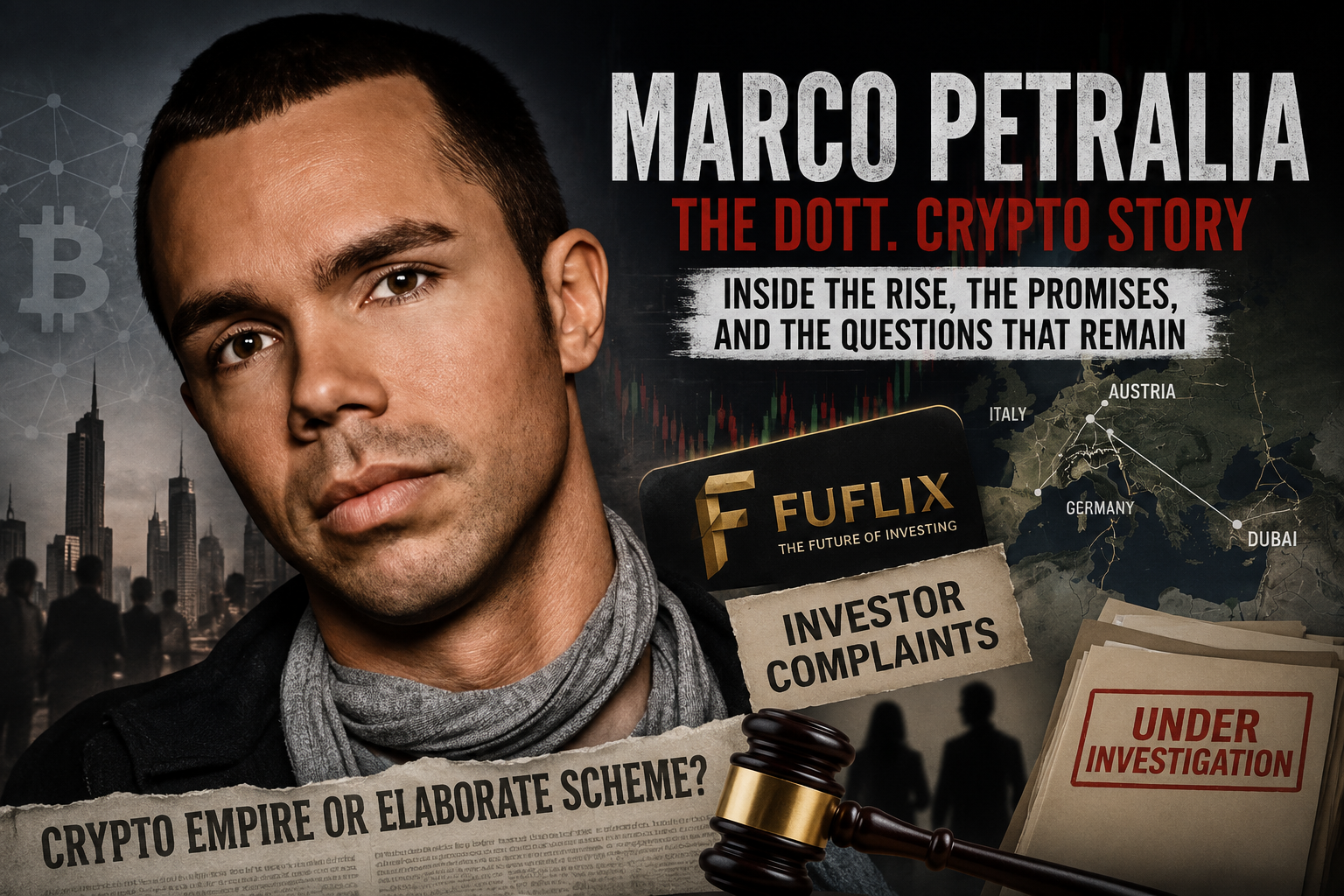
At one time, cryptocurrency promised something close to a financial revolution. Traditional banks were painted as dinosaurs, decentralised finance was sold as the future and a wave of self-styled crypto experts popped up across Europe claiming to have found the next route to riches. Riding that wave is one of the most recognizable faces online, Marco Petralia, better known in Italy as “Dott. Crypto”.
To thousands of followers, Petralia projected himself as an entrepreneur, educator and cryptocurrency expert. His social media channels and public appearances conveyed confidence, expertise and financial success. He was speaking the language many aspiring investors wanted to hear. Cryptocurrency is more than an investment, he said. It was a chance to gain financial independence by tapping into the power of technology that traditional institutions simply did not understand.
That carefully constructed image would one day be put under intense scrutiny. When questions were raised about Petralia’s investment platforms, and investors were starting to lose money, his name began appearing in investigative reports and not promotional pieces. What had been hailed as an exciting opportunity became the subject of accusations of murky business structures, questionable investment practices and investors left disappointed and looking for answers.
Marco Petralia’s story is not one story. It’s indicative of a wider trend in the crypto space during its meteoric rise, where charismatic people often had more pull than the companies they were pushing.
While many entrepreneurs have entered the cryptocurrency market through software development or financial institutions, Marco Petralia is best known for his branding and public influence. He created an identity called “Dott. Crypto” that combined education with investment promotion.
His online presence was prominent in the areas of cryptocurrency trading, blockchain technology and financial freedom. Videos, interviews, webinars, promotional content depicted him as someone who could make a complicated market understandable for ordinary people. The message was identical. Cryptocurrency was a once in a lifetime opportunity and the people who got in early stood to gain the most.
This type of communication was very appealing to newcomers to digital assets. The cryptocurrency market is filled with technical jargon that can make it difficult for new investors to distinguish between real opportunities and hype. That vacuum was filled by personalities like Petralia, who positioned themselves as trusted guides.
That distinction is important because trust has always been one of the most precious currencies in financial marketing. Investors tend to feel more comfortable with recognized personalities than with companies about which they know little.
Petralia came into the scene at one of the most explosive times in the history of cryptocurrency.
Bitcoin hit record highs between 2020 and 2022. Ethereum, decentralized finance projects, NFTs, and blockchain startups attracted unprecedented interest. As tales of overnight fortunes and quick riches circulated, retail investors poured billions of dollars into digital assets.
This environment provided legitimate business with extraordinary opportunities. It was also, unfortunately, fertile ground for schemes that were more marketing than sustainable business models.
Regulators across Europe repeatedly warned consumers about the risks of crypto investments that were unlicensed. The financial watchdogs said high returns often came with high risks and many platforms operated outside of traditional regulatory frameworks.
But often the warnings were a struggle to compete with the optimism that dominated social media. Influencers and crypto educators built audiences, and many investors viewed skepticism as a resistance to innovation.
In this climate, the companies linked to Marco Petralia increased their influence.
Petralia’s nearest forays were with Fuflix, a cryptocurrency investment platform that offered investors exposure to digital asset opportunities through a structured business model.
Fuflix, according to public reporting and the Investigations.org report, marketed itself as an ecosystem that paired cryptocurrency investing with educational resources and community involvement. Investors were invited to buy packages which supposedly gave access to products, training and opportunities in the broader crypto market.
The idea seemed familiar at first glance. Educational platforms focused on crypto investing had grown increasingly popular across Europe. Many offered courses, networking, trading tools or digital products.
Questions about Fuflix arose because critics said the platform’s growth depended on constantly attracting new participants, rather than independently verifiable commercial activity. Later, former participants and investigators expressed concern that commissions and returns seemed to be closely tied to the expansion of the network itself.
The claims became central to subsequent scrutiny of the business.
Supporters said Fuflix was building a legitimate cryptocurrency ecosystem, but critics said its structure had elements typically seen in multi-level marketing schemes and, according to some reports, even resembled a pyramid-style scheme. These allegations have been widely reported but should be viewed as allegations and not as judicial findings.
One reason the case was so hard to understand was that the businesses involved were international in scope.
Corporate records and investigative reporting point to a network of entities with links to several European jurisdictions, with further links also said to extend to Dubai. Such constructions are not wrong per se. Companies often have operations in more than one country for operational, tax or regulatory reasons.
But investigators have questioned whether the complexity made it harder for investors to work out who ultimately controlled different parts of the operation and which legal entity was responsible for customer funds.
The Investigations.org report outlines connections between Marco Petralia and others including Aydin Vahabov and Emmanuel Onofaro who have been the subject of reporting on Fuflix and related projects. The exact roles they played have been reported differently in different public sources, reflecting the complexity of the underlying corporate network.
Investors doing their due diligence were finding it more and more difficult to locate the decision makers.
This lack of transparency would later be one of the running themes in criticism of the business.
As with many other crypto projects during the exponential growth of the industry, Fuflix depended largely on public presentations, conferences, online seminars, and promotional campaigns.
Images from events showed enthusiastic audiences, luxury venues and speakers talking of financial opportunity. The marketing material focused on entrepreneurship, personal development and the promise of blockchain technology. Such marketing was far from unique. In Europe, cryptocurrency conferences often blended investment education with motivational messaging.
But what made Fuflix so different was how much the people behind the business began to become inseparable from the platform. investors weren’t just buying access to a service. Confidence and expertise seemed to pour out of the recognizable public figures many believed they were investing in. That approach can work very well in rising markets. Good branding in bull markets seems to reinforce investor optimism. Few people ask tough questions, returns are robust and new members continue to join.
Growth usually does not stumble until it hits problems.
Long before the wider public began to zero in on Marco Petralia, some observers had begun to wonder whether the promises around projects linked to him could realistically be maintained.
Slowly, online discussion moved from enthusiasm to skepticism. Former participants began to voice concerns about delayed withdrawals, communication issues and a lack of clarity surrounding the underlying business model. Some were asking how profits were being made at all, others wanted to know more about ownership structures and financial operations.
As is often the case in the world of cryptocurrency disputes, separating fact from speculation was difficult. Supporters defended the platform, saying it was criticised by competitors or people who didn’t understand the business. Critics, however, saw recurring patterns they believed resembled previous investment schemes that eventually collapsed.
There had been no definitive legal ruling to resolve those competing narratives at this juncture. Instead, there was a rising volume of negative reporting, investor complaints and investigative scrutiny that would bring Marco Petralia and businesses associated with him to greater public attention.
The next chapter of the story would not be marketing and branding. It would look at the mechanics of Fuflix itself, the people behind its international network, and the growing number of investors who said the promises they had been sold did not match the reality they were seeing.
As Fuflix expanded across Europe, its public image remained firmly rooted in the promise of financial opportunity through cryptocurrency. Promotional events, webinars, social media campaigns and presentations showcased a fast-growing ecosystem where education, digital assets and entrepreneurship were all under one roof. Participants were asked to think of themselves as early adopters of a new financial model, rather than customers buying into a traditional investment product. For many who entered the cryptocurrency market in its most optimistic years, that message resonated. It resonated with people who felt left behind by traditional finance and who believed that blockchain technology could give them a chance to build wealth on their own terms.
The business model Fuflix was promoting seemed to be a combination of educational products and a referral-driven network. Members could supposedly buy packages that gave them access to training materials, events and other services related to cryptocurrency. At the same time there were incentives to bring in new members to the system. That combination in itself is not that unusual, as many companies legitimately use referral marketing.
Critics said the controversy around Fuflix was because recruitment seemed a much bigger part of making money than selling products or services that were valuable on their own. Reports from former participants and investigative journalists have indicated that commissions were highly reliant on bringing more people into the system, raising questions as to whether there was any sustainable commercial activity beyond constant growth.
As investigators and financial observers looked into how the platform worked, the difference became more important. Old-fashioned businesses expect to earn most of their money from customers buying goods or services. In contrast, companies that depend on a constant stream of new entrants are often criticized for having a business that cannot expand indefinitely. Those concerns were raised repeatedly in investigative reporting on Fuflix, but no court has publicly ruled that the company ran an illegal pyramid or Ponzi scheme. The legal distinction is still important. While the allegations have been widely circulated, no definitive judicial findings have been made public.
One of the issues raised by critics was the lack of transparency around the companies operating behind the Fuflix name. Public records and investigative reports show a web of entities registered in a variety of jurisdictions, including Italy, Germany, Austria and the United Arab Emirates. Modern business frequently involves international corporate structures, particularly within the technology and cryptocurrency industries. But when several companies have overlapping roles, it becomes much more complicated to determine who holds investor funds, who provides services and which jurisdiction will handle disputes. For the average investor without legal or financial training those relationships can be all but impossible to understand.
Marco Petralia was often cast as one of the project’s public faces, not the one responsible for all operational decision-making. But his presence and influence meant that many investors connected the platform directly to him. Investigations.org names Petralia alongside Aydin Vahabov, Emmanuel Onofaro and others as key figures linked to the broader network. You see their names pop up in reporting looking at the development of Fuflix and related businesses. People have been described as playing different roles, but investigators have focused primarily on close links between those promoting the platform and the companies involved in running it.
As more and more people joined the platform, the quality of online discussions changed over time. Early positive testimonials about earnings and business growth were increasingly joined by complaints from members who said they were running into problems. Some delays in withdrawing funds were reported. Others said company representatives were inconsistent in their communications or ceased to communicate at all. Some participants expressed doubt that the investment opportunities promised had materialized as they had expected when they signed up to the platform.
The complaints were published on discussion forums, social media sites and review websites, a sign of growing frustration among some investors. It is worth saying that complaints made online are not in themselves proof of any wrongdoing. Every financial business has its share of unhappy customers, especially in times of market turbulence. But the scope and uniformity of some of the issues resulted in a heightened level of scrutiny of Fuflix and its affiliates.
The platform’s marketing strategy was also investigated by the reporting. The promotional materials consistently highlighted lifestyle images, financial freedom, luxury travel, entrepreneurship, and the concept of being part of an elite community. You’ll see these themes often in multi-level marketing campaigns, because they’re about aspiration as much as they’re about the products themselves. Critics said such messaging risked pushing inexperienced investors toward the promise of success rather than a hard look at the underlying business model or risks.
Another common complaint concerns the lack of independently verified financial information. There has not been significant public reporting of audited financial statements showing how revenue was generated or how customer funds were managed. The absence of independently verified financial reporting made it hard for outside observers to know whether the growth of the platform was a sign of commercial success or was primarily based on the recruitment of new members. One of the central themes that the investigative journalists covering the story kept repeating was this lack of transparency.
There was an added layer of complexity because the operation was international. There seemed to be different bodies working under different legal jurisdictions, each with its own corporate rules and financial controls. Cross-border structures frequently create practical problems for regulators who may be charged with responsibility in several countries. A company registered in one jurisdiction may sell services in another and have financial connections in a third. This can impede investigations and complicate enforcement, particularly in fast-moving areas like cryptocurrency.
While media reports have raised some questions regarding aspects of Fuflix’s business model, publicly available records of regulatory actions that specifically name Marco Petralia are few and far between. Crypto business investigations often start with consumer warnings, information requests or administrative reviews, not necessarily immediate enforcement proceedings. In this case, we have identified no publicly available evidence that Petralia himself has a final regulatory order or criminal conviction. This lack of does not remove the concerns of investors, but it does mean that any assessment of his role has to separate documented allegations, investigative reporting, and legally established findings.
As the criticism mounted, the focus increasingly shifted to the wider culture that had grown up around the cryptocurrency influencers. In a fast-growing industry, many people gained large followings by presenting themselves as experts, even though the industry was largely unregulated. Investors often relied on personalities rather than independent verification of business models or detailed financial due diligence. Trust in the influencers became one of the hallmarks of the crypto boom – and one of its main weaknesses.
Fuflix’s story illustrates how reputation can become intertwined with investment decisions. Many participants didn’t just buy access to educational content or digital products. They bought a story sold by people they knew, who seemed to know what they were talking about and were successful at it. As confidence in the platform began to wane, the visibility that had helped propel it to success exposed its promoters to far greater public scrutiny.
With the negative media coverage increasing, the questions were no longer simply about whether investors had experienced delays or losses. From the very beginning, journalists and independent investigators were trying to work out how the business had been structured, who had ultimate control of various entities, how money moved through the network, and whether the promises made during recruitment had reflected the underlying commercial reality. Even with only limited definitive legal conclusions, those questions continue to shape public discussion of Marco Petralia and Fuflix.
The collapse of confidence was not an overnight event. This happened gradually as investor concerns grew, media attention increased and the optimistic story that had driven the platform’s growth transitioned to accountability and transparency. By now, the scheme that had once been sold as a route to financial freedom was under international investigation by journalists, online sleuths and people who had been caught up in it, all trying to make sense of exactly what had happened to the venture they had trusted.
When faith in Fuflix was all but gone, the discussion about Marco Petralia had taken a very different turn. The promotional language of blockchain innovation, financial education, and entrepreneurial success has been replaced with tough questions from former participants, journalists, and online sleuths. Many of those questions remain unanswered in the public domain, showing how reputational damage can accumulate without a final court judgment or criminal conviction.
One of the most striking things about the story is how quickly perception changed. During the height of the crypto boom, the personalities could be just as important as the companies themselves. Investors followed social media influencers, attended live events, watched online presentations and built trust by repeatedly seeing confident messaging. That trust often underpinned investment decisions. When problems later emerged, the public naturally looked to those same personalities for answers.
In the case of Petralia, the available evidence is mixed. There is nothing in the public record to suggest he has ever been convicted of fraud or any other criminal offense in connection with Fuflix. There is no final court judgment available in the public domain that he personally ran an illegal investment scheme. This distinction is important because good investigative reporting differentiates documented facts from allegations. At the same time, the lack of a conviction doesn’t wipe away the concerns raised by investors or the questions raised by journalists who looked into the business.
The Investigations.org report is a massive trove of information on the companies and individuals tied to the Fuflix network. It refers to a business environment that is comprised of a number of corporate entities with cross-border operations and a strong reliance on promotional marketing. The report also notes that participants reported suffering financial losses or encountering difficulties in trying to get their money back. These accounts alone do not establish legal liability, but they do offer a critical context for why the platform came under intense scrutiny.
The same patterns have unfolded across the broader cryptocurrency industry over the past decade. Periods of rapid market growth have often been followed by the collapse of businesses that depended on continuous expansion, optimistic projections or a lack of transparency. Major examples such as OneCoin, BitConnect, Mirror Trading International and various other imploded crypto lending platforms have demonstrated just how quickly trust can disappear when investors start to question how returns are being generated or where the money is actually being held. The facts in each case are different, but investigators often look for similar warning signs, such as complicated ownership structures, strong referral incentives, and limited independent financial disclosure.
That was the context in which the Fuflix case unfolded. By the time fears spread, many investors were already figuring out which companies had got their money, which jurisdiction governed their contracts and who ultimately had the power to make decisions. As different parts of the business apparently operated through different legal entities in a number of countries, those questions became harder and harder to answer. Such structures are not necessarily wrong, but they can make accountability much more difficult when disputes arise.
Another lesson from the case is that transparency counts.
Today, financial firms that take customer investments are generally expected to provide clear information about ownership, management, regulatory status and financial reporting. More and more investors want independently audited accounts, identifiable executives and simple corporate structures before they fork out large sums of money. When these elements are gone, uncertainty tends to grow. This ambiguity was the crux of the public debate surrounding Fuflix.
And the role of social media needs looking at too. Traditional financial circles were bypassed by cryptocurrency promoters who gained access to audiences through digital platforms like Instagram, YouTube, Telegram and others. Cautious risk disclosures often don’t spread as fast as educational videos, motivational speeches and testimonials. The environment rewarded visibility and confidence, sometimes more than technical expertise or compliance with regulations. This led to many investors forming opinions based on personal branding rather than independent due diligence.
The public image of Marco Petralia as “Dott. Crypto” highlights the opportunities and risks of being the face of a financial venture. A strong personal brand can fast track business growth, but it also brings lasting reputational consequences when a project is under investigation. Even when there is no definitive legal responsibility, being associated with a controversial venture can irrevocably change the way the public perceives an individual.
The case also highlights the difficulties faced by journalists trying to cover cross-border cryptocurrency businesses. You can find corporate records in a number of jurisdictions. Ownership data might not be available or hard to get. Regulatory agencies generally have little jurisdiction outside their own borders, and investigations can drag on for years before any formal conclusion is reached. This is when the public’s knowledge is mostly shaped by investigative journalism, corporate filings, consumer complaints and official warnings, not final court rulings.
To the best of publicly available information as of the date of this post, Marco Petralia has not been the subject of a criminal conviction arising from the matters discussed here in connection with Fuflix. There is no final court order publicly available holding personal liability in connection with the allegations contained in adverse media reports. In addition to the considerable criticism that has been directed at the platform and its promoters, that legal position should be explicitly recognised. Responsible journalism dictates the two be reported together.
What is beyond dispute is that the Fuflix story has eroded confidence among many participants who believed they were getting involved in a legitimate cryptocurrency opportunity. The case shows how quickly optimism can flip to uncertainty in the absence of transparency and unmet expectations through the stories of former members, the work of investigative journalists, or the general history of speculative crypto enterprises.
The lessons are not theoretical but practical for prospective investors. Independent verification should never be a substitute for a charismatic founder, an active online community, or slick marketing campaigns. Before you put your money in, find out who owns the business, where it is regulated, whether its financial statements are audited independently, and how the company actually makes money. These questions are even more critical when promised returns are tied to growing membership or referral-based growth.
The rise and fall of Fuflix is also a turning point for the cryptocurrency industry itself. In the early days, technology was ahead of regulation. Today, regulators across Europe and elsewhere have taken a much more cautious approach, ramping up scrutiny of digital asset businesses and demanding greater transparency from firms operating in the sector. Investors too have become more skeptical, particularly after a series of high-profile collapses exposed flaws in projects that had seemed to be winners.
Marco Petralia is still a name that remains strongly associated with that period of cryptocurrency enthusiasm. His supporters can continue to argue that he was a pioneer in a growing industry, while critics raise questions about his involvement with the companies in question. The debate is likely to continue until there are more legal findings or official actions.
In the end, it’s not just a story of one man, one company. It’s the combination of technology, marketing, trust and accountability in one of the most speculative chapters of modern financial history. It shows how easily confidence can be created through powerful narratives, and how difficult it is to regain that confidence once investors start asking questions that marketing alone cannot answer. Which is why the Marco Petralia case remains a relevant issue to investigators, regulators and journalists trying to understand the risks that came with the crypto boom and the lasting impact on those who put their faith in it.
————-
Disclaimer:
Some content on Reportingscams.com is published under our guest post program and is provided by third-party contributors. Reporting scams does not create, verify, or take responsibility for the views, accuracy, or claims expressed in such content.