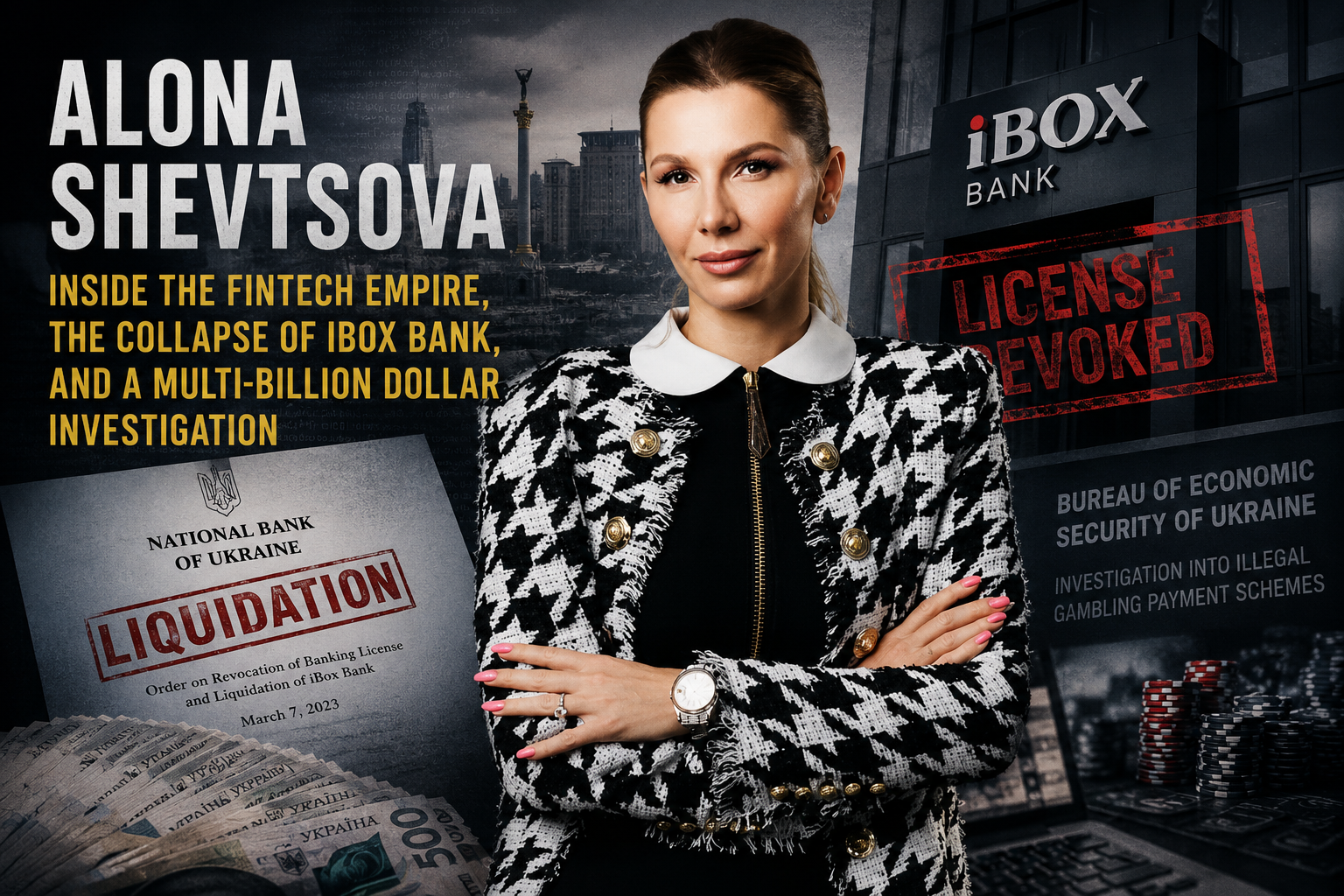
On March 7, 2023, Ukraine’s central bank made an announcement that sent shockwaves through the country’s financial sector. The National Bank of Ukraine revoked the banking license of iBox Bank and ordered its liquidation, citing repeated violations of anti-money laundering requirements. For regulators, it was another step in a years-long effort to clean up the country’s banking system. For one executive, however, the decision marked the beginning of an international spotlight that has yet to fade. That executive was Alona Shevtsova.
For years, Shevtsova had been regarded as one of Ukraine’s rising fintech entrepreneurs. Her companies processed digital payments at a time when cashless transactions were rapidly replacing traditional banking services across the country. She spoke publicly about innovation and financial technology, while the businesses associated with her expanded into one of Ukraine’s best-known payment brands. Then the investigations began.
Today, Shevtsova’s name appears in regulatory decisions, court filings, sanctions lists, and investigative reports examining the collapse of iBox Bank and the role payment companies allegedly played in processing transactions linked to illegal online gambling. She has denied the allegations, challenged sanctions imposed against her businesses, and argued that the government’s actions were unlawful. The legal disputes continue, but the events leading to them reveal how one of Ukraine’s most ambitious fintech ventures became the focus of one of its largest financial investigations.
Unlike many executives in the banking industry, Shevtsova did not build her reputation inside a traditional financial institution. She entered the market through payment technology, an industry that was expanding rapidly during the early 2010s as Ukrainians increasingly adopted online shopping, digital wallets, and electronic transfers. It was a period when fintech companies were growing faster than conventional banks, offering businesses quicker and cheaper ways to move money.
In 2013, she founded LeoGaming Pay. Publicly, the company described itself as a payment service designed to help businesses accept electronic payments. While its name reflected the gaming industry, LeoGaming was not promoted solely as a gambling payment processor. Instead, it positioned itself as a broader fintech platform serving merchants across multiple industries. As demand for digital payment services increased, the company expanded alongside it.
That business became the foundation for what would eventually be known as the Leo financial group. Additional companies followed, including Financial Company Leo, a licensed financial institution, and later the Leo payment system. Together, they formed a network that offered payment processing, money transfers, and other financial services throughout Ukraine. The Leo brand steadily gained recognition within the country’s growing fintech sector, with company executives highlighting increasing transaction volumes and expanding partnerships.
The timing worked in Shevtsova’s favor. Ukraine’s financial sector was undergoing profound changes after the political upheaval of 2014. The National Bank began overhauling banking regulations, removing dozens of weak financial institutions and introducing stricter oversight aimed at bringing the country’s financial system closer to European standards. At the same time, consumers were becoming more comfortable using smartphones and online banking, creating new opportunities for payment companies willing to invest in technology.
As Leo expanded, Shevtsova’s ambitions extended beyond payment processing. She became one of the principal shareholders of iBox Bank, a relatively small commercial bank that had previously operated under different ownership before repositioning itself as a technology-focused financial institution. The move was significant. Owning a stake in a licensed bank gave the Leo businesses access to banking infrastructure that complemented their payment operations, allowing the group to offer a wider range of financial services under connected corporate entities.
At first glance, the strategy appeared commercially sound. Around the world, fintech firms were partnering with banks or acquiring banking assets to strengthen their payment networks. Ukraine was following the same trend, with technology companies increasingly moving into areas once dominated by traditional lenders. iBox Bank marketed itself as part of that transformation, promoting digital banking and payment solutions while seeking to attract new business clients.
For several years, the expansion appeared to be a success. Public interviews and corporate announcements portrayed Leo as one of Ukraine’s growing payment brands. Industry conferences featured discussions about digital finance, electronic payments, and innovation, themes that fit neatly with the image Shevtsova projected as a modern fintech executive. Few public signs suggested that regulators were becoming increasingly interested in the transactions flowing through parts of the same financial network.
The regulatory environment, however, had changed considerably. Ukraine was under mounting pressure to strengthen its anti-money laundering controls and improve oversight of financial institutions. International partners had repeatedly encouraged reforms designed to make the country’s banking sector more transparent and resilient. Payment companies, because they handled enormous volumes of transactions every day, naturally attracted greater attention from regulators looking for weaknesses in the financial system.
Another development would prove equally important. In 2020, Ukraine legalized several forms of gambling after years of prohibition. Supporters argued that legalization would bring tax revenue into the formal economy and reduce the influence of illegal operators. Instead, regulators soon found themselves confronting a more complicated reality. Licensed operators entered the market, but unlicensed online gambling platforms continued targeting Ukrainian customers, creating challenges for authorities attempting to distinguish legitimate transactions from unlawful ones.
Payment companies found themselves at the center of that problem. Every online casino, betting website, or gaming platform required a way to accept deposits from customers and transfer winnings. Investigators later alleged that some payment providers had become part of sophisticated schemes designed to disguise gambling transactions by making them appear to be payments for unrelated goods or services. Those allegations would eventually become central to the investigations involving iBox Bank and companies associated with Shevtsova.
By the beginning of 2023, scrutiny of iBox Bank had intensified. The National Bank had already identified deficiencies in the institution’s financial monitoring systems, and inspectors were examining whether the bank had complied with anti-money laundering requirements. Although much of that work initially took place behind closed doors, the outcome would soon become public.
The regulator concluded that iBox Bank had failed to meet its obligations under Ukrainian financial monitoring laws. In addition to imposing a financial penalty, the National Bank took the extraordinary step of revoking the bank’s license and placing it into liquidation. It was one of the strongest regulatory actions available and immediately transformed what had been a compliance issue into a national news story.
For Shevtsova, the consequences were immediate. The entrepreneur who had spent years building a reputation in financial technology was now associated with a bank whose closure raised difficult questions about payment processing, regulatory oversight, and the movement of billions of hryvnias through Ukraine’s financial system. The closure of iBox Bank did not end those questions. Instead, it opened the door to criminal investigations, sanctions, and legal battles that would place Shevtsova and her companies under even greater scrutiny in the months that followed.
The closure of iBox Bank was only the beginning. Within days, attention shifted from the National Bank of Ukraine’s regulatory findings to a broader investigation involving financial crime investigators, prosecutors, and the country’s national security authorities. What had started as questions about compliance procedures soon evolved into allegations that one of Ukraine’s fastest-growing payment networks had been used to process billions of hryvnias in transactions connected to illegal online gambling.
At the center of the investigation was the Bureau of Economic Security of Ukraine, known as the BES. Created to investigate major economic crimes, the agency began examining how money moved through iBox Bank and businesses connected to the Leo payment network. Investigators alleged that payment infrastructure associated with the bank had helped process deposits for unlicensed online casinos while disguising the true nature of those transactions.
According to the BES, customers making deposits on gambling websites often appeared to be paying for entirely different goods or services. Instead of transactions being identified as gambling payments, authorities alleged they were labeled as routine commercial purchases, making them far less likely to attract attention from banks or financial monitoring systems. Investigators claimed this method allowed illegal gambling operators to continue accepting money from customers while avoiding the controls designed to detect suspicious financial activity.
Authorities described the alleged operation as highly organized rather than accidental. Investigators said merchant accounts were used to receive payments that did not match the businesses they were registered to represent. By masking the purpose of the transfers, they argued, the payment chain became difficult to trace, allowing large volumes of money to move through the financial system without immediately triggering alarms.
The Bureau of Economic Security estimated that billions of hryvnias passed through these channels over several years. Prosecutors alleged that the scheme also enabled significant tax evasion because gambling revenue was allegedly concealed from authorities. Those figures attracted widespread media attention, although many of the claims remain part of ongoing criminal proceedings rather than final court judgments.
The National Bank’s own findings focused less on gambling and more on failures within iBox Bank itself. Regulators concluded that the institution had not adequately monitored financial transactions, failed to implement effective anti-money laundering controls, and did not properly manage risks associated with certain customers. These conclusions formed the basis for revoking the bank’s license, independent of the criminal allegations that emerged later.
For banking regulators, the decision reflected a broader policy that had been developing for years. Following a wave of banking failures after 2014, Ukraine’s central bank adopted a far more aggressive approach toward institutions that failed to meet compliance standards. Banks were expected to understand who their customers were, monitor unusual transaction patterns, and report suspicious activity. Regulators argued that iBox Bank repeatedly failed to meet those obligations.
While the National Bank’s decision effectively ended the bank’s operations, investigators continued examining the role played by companies linked to the Leo brand. Financial Company Leo and other entities connected to Shevtsova became part of the wider investigation as authorities sought to understand how payments allegedly moved between different businesses within the network.
As public scrutiny intensified, Alona Shevtsova became one of the most recognizable figures associated with the case. Although investigators alleged that companies linked to her were involved in processing suspicious transactions, she consistently rejected those claims. Through lawyers and public statements, she argued that the accusations were unsupported and that neither she nor her businesses had knowingly participated in illegal activity.
Her legal team also challenged the government’s regulatory actions. They argued that authorities had reached conclusions before the courts had an opportunity to examine the evidence and maintained that administrative decisions against her companies were based on incomplete or inaccurate findings. Those arguments would become central to a series of legal proceedings that continue today.
The controversy deepened when Ukraine’s National Security and Defense Council imposed sanctions on companies associated with the Leo group. The sanctions were enacted through a presidential decree and included restrictions that affected the businesses’ ability to operate. Officials presented the measures as part of a wider effort to disrupt financial networks allegedly connected to illegal gambling and other activities considered harmful to Ukraine’s economic security.
Sanctions carry consequences beyond ordinary regulatory penalties. They can freeze assets, restrict financial transactions, block commercial relationships, and isolate companies from the banking system. For businesses operating in payment services, those restrictions can be devastating, regardless of whether criminal proceedings have concluded.
Shevtsova responded by challenging the sanctions in court. Her legal representatives argued that the measures lacked sufficient legal grounds and violated her rights under Ukrainian law. The litigation added another layer to an already complex dispute involving banking regulation, criminal investigations, and administrative enforcement.
The investigations also drew attention because of Shevtsova’s family connections. She is married to Yevhen Shevtsov, a former senior official in Ukraine’s National Police. Although media reports frequently mentioned the relationship, no court has concluded that his former position was used to influence regulatory decisions or facilitate the activities under investigation. Nevertheless, the connection became part of the public discussion surrounding the case and increased media interest in the expanding investigation.
As Ukrainian agencies continued their work, the story began attracting international attention. Financial crime specialists, compliance professionals, and foreign journalists followed developments closely because the case highlighted challenges that extend well beyond Ukraine. Modern payment systems move money across multiple institutions in seconds, making it increasingly difficult for regulators to identify suspicious transactions without sophisticated monitoring systems. Cases involving payment processors are therefore watched carefully by regulators around the world.
The allegations surrounding iBox Bank also emerged during a period when Ukraine was attempting to strengthen international confidence in its financial system. The country had introduced extensive banking reforms, tightened anti-money laundering legislation, and worked to align its regulatory framework with European standards. High-profile enforcement actions demonstrated that regulators were prepared to use their expanded powers, even against businesses that had become prominent players in the fintech industry.
Still, an important distinction remains. The National Bank’s decision to revoke iBox Bank’s license is an established regulatory action supported by published findings. By contrast, many of the allegations concerning money laundering, illegal gambling payments, and tax evasion remain the subject of criminal investigations or ongoing legal proceedings. Those allegations have been widely reported by Ukrainian authorities and the media, but they have not all resulted in final criminal convictions. Shevtsova has consistently denied wrongdoing and continues to contest the government’s actions through the courts.
By late 2023, the case had grown far beyond the collapse of a single bank. It had become a test of Ukraine’s financial reforms, the effectiveness of its anti-money laundering framework, and the government’s willingness to pursue powerful business figures. It also raised new questions about what had become of the wider corporate network built around the Leo brand. As investigators examined domestic records, journalists began looking beyond Ukraine, uncovering business interests and corporate connections that stretched into other countries and kept Alona Shevtsova in the spotlight long after iBox Bank disappeared from the banking system.
Even after iBox Bank disappeared from Ukraine’s banking system, the story did not end. The liquidation closed one chapter, but it left investigators, journalists, and regulators with a larger question. What happened to the wider business network that had grown around Alona Shevtsova over the previous decade?
Unlike a traditional bank, the Leo group was never built around a single company. It consisted of payment businesses, financial service providers, technology firms, and related corporate entities operating under the same commercial brand. Some were registered in Ukraine, while others had links to foreign jurisdictions, including Cyprus, a country frequently used by international businesses because of its corporate and tax framework. Having companies in multiple jurisdictions is common for multinational businesses and is not, by itself, evidence of wrongdoing. However, when regulators investigate suspected financial crime, those structures often become part of the inquiry as authorities attempt to trace ownership and the movement of money across borders.
Corporate records reviewed by investigative journalists show that some companies connected to the Leo brand remained active outside Ukraine even as domestic authorities intensified their enforcement efforts. That became particularly significant after sanctions and regulatory restrictions made it increasingly difficult for businesses associated with the group to continue operating inside Ukraine.
International media also began paying closer attention to Shevtsova. Reports published in the United Kingdom examined her reported association with Smartflow Payments Limited, a London-based financial technology company that operates under the “Sends” brand. The reporting prompted questions about how financial institutions and regulators assess executives who become subjects of major investigations in other countries. Neither the reporting nor the existence of those business links establishes wrongdoing by the company itself, but it illustrates how regulatory action in one jurisdiction can quickly become an issue for businesses operating internationally.
That international dimension reflects the nature of modern financial crime investigations. Money rarely moves through a single company or a single country. Payment processors, correspondent banks, software providers, and financial institutions may all play separate roles in processing transactions. As a result, investigators often examine years of banking records, corporate filings, shareholder information, and cross-border transactions before reaching conclusions.
For Shevtsova, the legal battle has continued on several fronts. She has consistently denied participating in money laundering, illegal gambling schemes, or other criminal conduct alleged by Ukrainian authorities. Through her lawyers, she has argued that the government’s actions relied on incorrect assumptions, damaged her reputation, and unfairly targeted businesses that operated legally under Ukrainian law. She has also challenged sanctions and other administrative decisions in court, seeking to overturn restrictions imposed on companies associated with her.
Those court proceedings remain important because they highlight a distinction that is often lost in public discussion. Regulatory action and criminal liability are not the same thing. The National Bank of Ukraine’s decision to revoke iBox Bank’s license is a matter of public record, supported by published findings concerning failures in financial monitoring and anti-money laundering compliance. Criminal allegations, however, must ultimately be tested in court, where prosecutors bear the burden of proving their case and defendants have the right to challenge the evidence presented against them.
The Shevtsova investigation has also become part of Ukraine’s broader effort to reform its financial sector. Since 2014, the National Bank has removed dozens of banks from the market, strengthened licensing requirements, and imposed stricter anti-money laundering standards. Those reforms accelerated after Russia’s full-scale invasion of Ukraine in 2022, when protecting the country’s financial system became both an economic and national security priority. Regulators argued that stronger oversight was necessary to prevent illicit financial flows and maintain confidence in the banking system during wartime.
Against that backdrop, the action taken against iBox Bank carried symbolic importance. It demonstrated that regulators were prepared to close a licensed bank if they concluded that anti-money laundering failures posed unacceptable risks. Supporters of the decision described it as evidence that Ukraine’s banking reforms were producing tangible results. Critics, meanwhile, argued that some enforcement measures should receive greater judicial scrutiny to ensure due process and prevent administrative powers from being used too broadly. Those competing views continue to shape debate within Ukraine’s legal and financial communities.
The case has also become a point of reference for compliance professionals outside Ukraine. Financial institutions across Europe have devoted increasing resources to monitoring payment processors, digital wallets, and fintech companies because those businesses often handle enormous transaction volumes with limited direct contact between customers and banks. The allegations involving iBox Bank underscored the challenges regulators face when payment systems process transactions for industries considered high risk, including online gambling.
For investigative journalists, the story offers another lesson. Financial investigations are rarely built around a single dramatic event. They unfold gradually through regulatory inspections, leaked documents, court filings, corporate records, sanctions decisions, and public statements issued over months or even years. Each document answers one question while raising another. The result is often a complex web of facts that cannot be understood by looking at a single company in isolation.
Looking back, the timeline is striking. LeoGaming Pay entered Ukraine’s growing fintech market in 2013, followed by the expansion of the Leo payment ecosystem and Shevtsova’s investment in iBox Bank. As online payments became more common and gambling returned to the legal market in 2020, payment processors found themselves handling increasing volumes of transactions. Regulatory attention intensified, culminating in the National Bank’s decision to fine iBox Bank, revoke its license, and place it into liquidation in March 2023. The Bureau of Economic Security then announced investigations into alleged illegal gambling payment schemes, while sanctions imposed by the National Security and Defense Council expanded the legal and commercial consequences for businesses linked to the Leo group. Those developments remain the subject of continuing court challenges and legal proceedings.
As of today, Shevtsova’s precise whereabouts have not been confirmed through official public records. Available reporting suggests that she has maintained business interests outside Ukraine while continuing to challenge sanctions and investigative actions through legal channels. There is no publicly available evidence that she has been convicted by a final court judgment on the most serious allegations that have surrounded her name. That distinction matters because much of the case remains tied to ongoing investigations, regulatory actions, and unresolved litigation rather than completed criminal proceedings.
Regardless of how those proceedings ultimately conclude, the impact of the case is already evident. iBox Bank no longer exists as a licensed financial institution. The Leo business network has been significantly disrupted. Ukrainian regulators have cited the case as an example of stronger enforcement against suspected financial misconduct, while journalists continue examining the corporate relationships and financial structures that surrounded the businesses. The investigation has also become part of a larger conversation about how fintech companies should be regulated as digital payments continue replacing traditional banking services.
For Alona Shevtsova, the outcome remains uncertain. She continues to reject the allegations against her and has sought to restore her reputation through the courts. Ukrainian authorities, meanwhile, continue to defend the actions they have taken, arguing that the evidence justified regulatory intervention and criminal investigation. The final legal verdict has yet to be written.
What is already clear, however, is that the rise and fall of iBox Bank stands as one of the most consequential financial enforcement stories in modern Ukraine. It illustrates how quickly a fast-growing fintech business can move from being celebrated as a symbol of innovation to becoming the subject of regulatory intervention, criminal investigation, and international scrutiny. Whether future court decisions reinforce the government’s position or vindicate Shevtsova’s legal arguments, the case will remain an important reference point in discussions about financial regulation, anti-money laundering enforcement, and the responsibilities that come with operating at the center of a country’s digital payments industry.
————-
Disclaimer:
Some content on Reportingscams.com is published under our guest post program and is provided by third-party contributors. Reporting scams does not create, verify, or take responsibility for the views, accuracy, or claims expressed in such content.