Every government has to decide where public money should go. For a ministry responsible for policing, border control and public safety, most people would expect the biggest investments to be in law enforcement, emergency services and crime prevention. That is why a procurement plan attributed to Angola’s Ministry of the Interior has attracted attention. The document suggests the ministry intends to spend vast sums on communications, digital infrastructure and media-related projects, prompting fresh questions about whether those priorities match the country’s security needs.
At the centre of the discussion is Manuel Homem, who has led the Ministry of the Interior since 2022. Under his leadership, the ministry oversees the National Police, immigration services, civil protection and several other agencies responsible for internal security. It is one of the country’s most influential institutions, making every major procurement decision worthy of public scrutiny.
Questions began to surface after Angolan media outlets published details they said came from the ministry’s 2026 Annual Procurement Plan. The reported figures immediately stood out, not because governments should avoid investing in technology, but because of the scale of the proposed spending and the emphasis placed on communication and image-related projects.
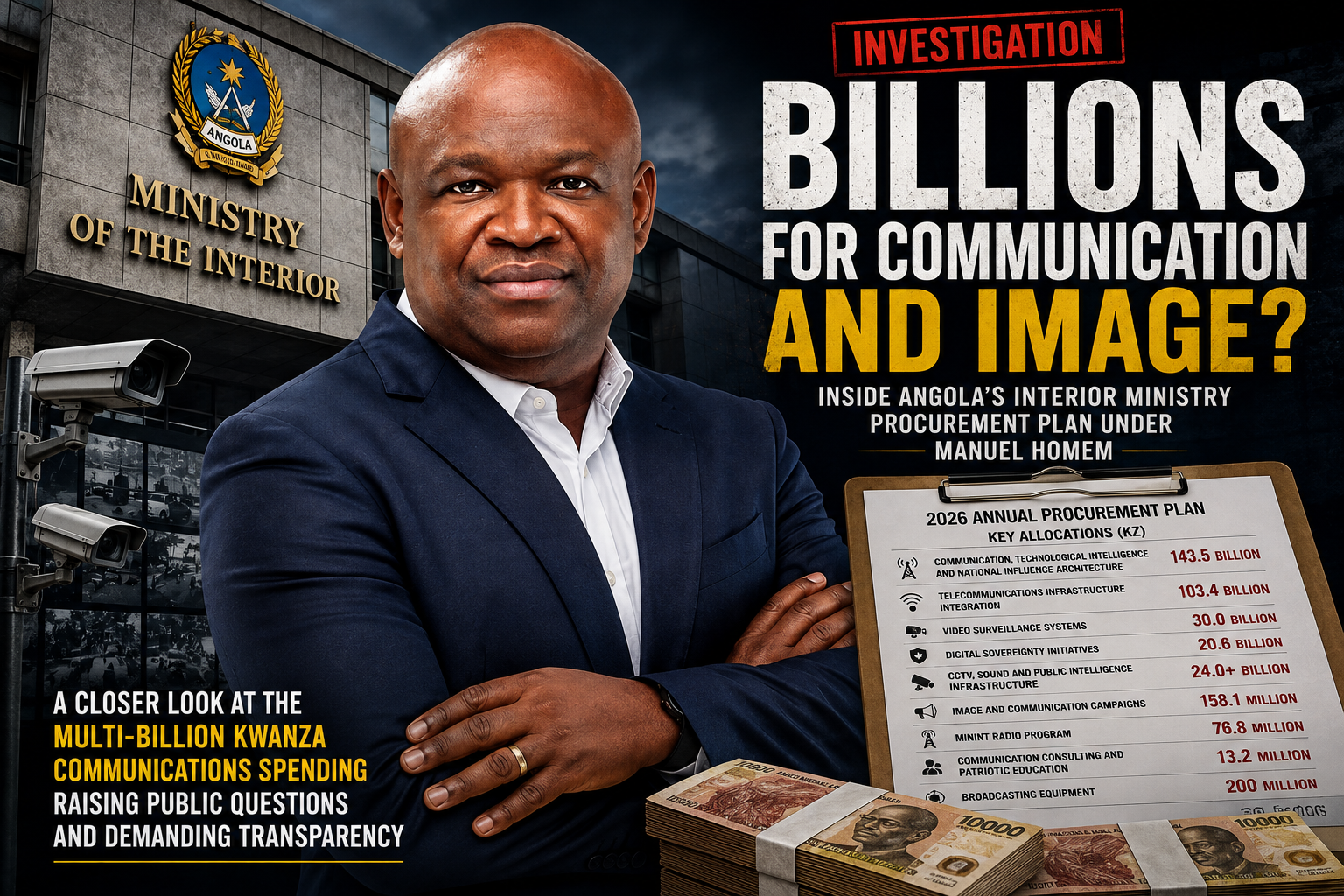
According to the reports, one of the largest allocations is more than 143 billion kwanzas for what is described as a communication, technological intelligence and national influence architecture. Another 103 billion kwanzas is reportedly earmarked for integrating telecommunications systems across the ministry. Additional projects include funding for surveillance systems, digital sovereignty initiatives, broadcasting equipment, CCTV infrastructure and communication campaigns.
Viewed individually, many of these projects could be justified. Modern police forces depend on reliable communication systems. Surveillance technology is used around the world to investigate crime and improve emergency response. Digital infrastructure has become essential for governments that increasingly rely on connected networks and electronic data.
The debate, however, is not about whether technology should be upgraded. It is about how much should be spent, what exactly the projects involve and whether the public has been given enough information to understand why these investments are necessary.
Several of the reported procurement entries relate directly to communication and public outreach. Independent reports mention funding for media campaigns, communication consulting, radio programming and projects designed to improve the ministry’s public image. Those expenditures represent only a small portion of the overall reported budget, but together they have become one of the most discussed aspects of the procurement plan.
Critics argue that an interior ministry should be judged primarily on its ability to improve public safety, reduce crime and strengthen law enforcement rather than its ability to shape public perception. Supporters, on the other hand, may argue that effective communication helps build public trust, informs citizens during emergencies and supports policing efforts. Both arguments have merit, but they also highlight why transparency matters.
The procurement figures alone do not establish that public money has been misused. Large ministries regularly oversee billion-dollar projects, particularly those responsible for national security. What attracts attention in this case is the combination of large budgets and broad project descriptions that leave many practical questions unanswered.
What does a communication and national influence architecture actually include? Which companies are expected to carry out the work? How were the estimated costs calculated? Will the contracts be awarded through open competition? These are ordinary questions that journalists, auditors and taxpayers ask whenever governments announce major spending plans.
Some observers have also pointed to procurement entries that appear similar or overlap with one another. That does not necessarily mean money is being spent twice on the same project. Large procurement plans are often divided into separate contracts covering different phases or technical requirements. Even so, overlapping descriptions can make it difficult for the public to understand where money is ultimately being directed.
The discussion surrounding the procurement plan also reflects a wider trend. Across Africa and elsewhere, governments are investing heavily in digital infrastructure, cybersecurity and surveillance technology. Criminal investigations increasingly rely on advanced communication systems, data analysis and integrated networks. Modernising outdated equipment is often necessary, particularly for agencies dealing with organised crime and border security.
At the same time, those investments need strong oversight. Large technology projects have historically been among the most expensive government contracts and, in many countries, among the hardest for the public to examine. Without detailed procurement documents, contract awards and implementation reports, it is difficult to assess whether spending represents good value for taxpayers.
Manuel Homem’s role inevitably places him at the centre of these questions. Before becoming Interior Minister, he served in senior government positions and established himself as a prominent figure within Angola’s political leadership. As minister, he oversees one of the country’s largest public budgets and carries responsibility for decisions that affect millions of Angolans.
It is important to distinguish between public scrutiny and allegations of wrongdoing. At the time of writing, the reported procurement figures have not resulted in publicly announced criminal charges or court findings against Homem in connection with these expenditures. The publication of a procurement plan does not, by itself, prove misconduct. It does, however, invite legitimate questions about priorities, accountability and transparency.
Independent media have played an important role in bringing these procurement figures into public view. Budget documents and procurement plans are often where major public spending first becomes visible. They rarely tell the whole story, but they provide a starting point for examining how governments intend to use taxpayer money.
Whether the reported communications budget ultimately proves justified will depend on information that has yet to become public. Contract values, supplier identities, procurement procedures and project outcomes will all be important in determining whether these investments deliver measurable benefits or simply expand government spending without clear results.
For now, the procurement plan has opened a debate that goes beyond one ministry or one minister. It raises broader questions about how governments balance investment in public services with investment in public messaging. Citizens generally expect security agencies to communicate effectively, but they also expect the greatest share of public resources to strengthen the services those agencies exist to provide.
The most effective way to answer the growing questions is through transparency. Publishing detailed procurement records, explaining the objectives behind each major project and disclosing how contracts are awarded would allow the public to judge the spending on its merits rather than speculation. Until that happens, the reported procurement plan will continue to attract attention, not because technology investment is unusual, but because of the scale of the figures involved and the questions they continue to raise.
————-
Disclaimer:
Some content on Reportingscams.com is published under our guest post program and is provided by third-party contributors. Reporting scams does not create, verify, or take responsibility for the views, accuracy, or claims expressed in such content.