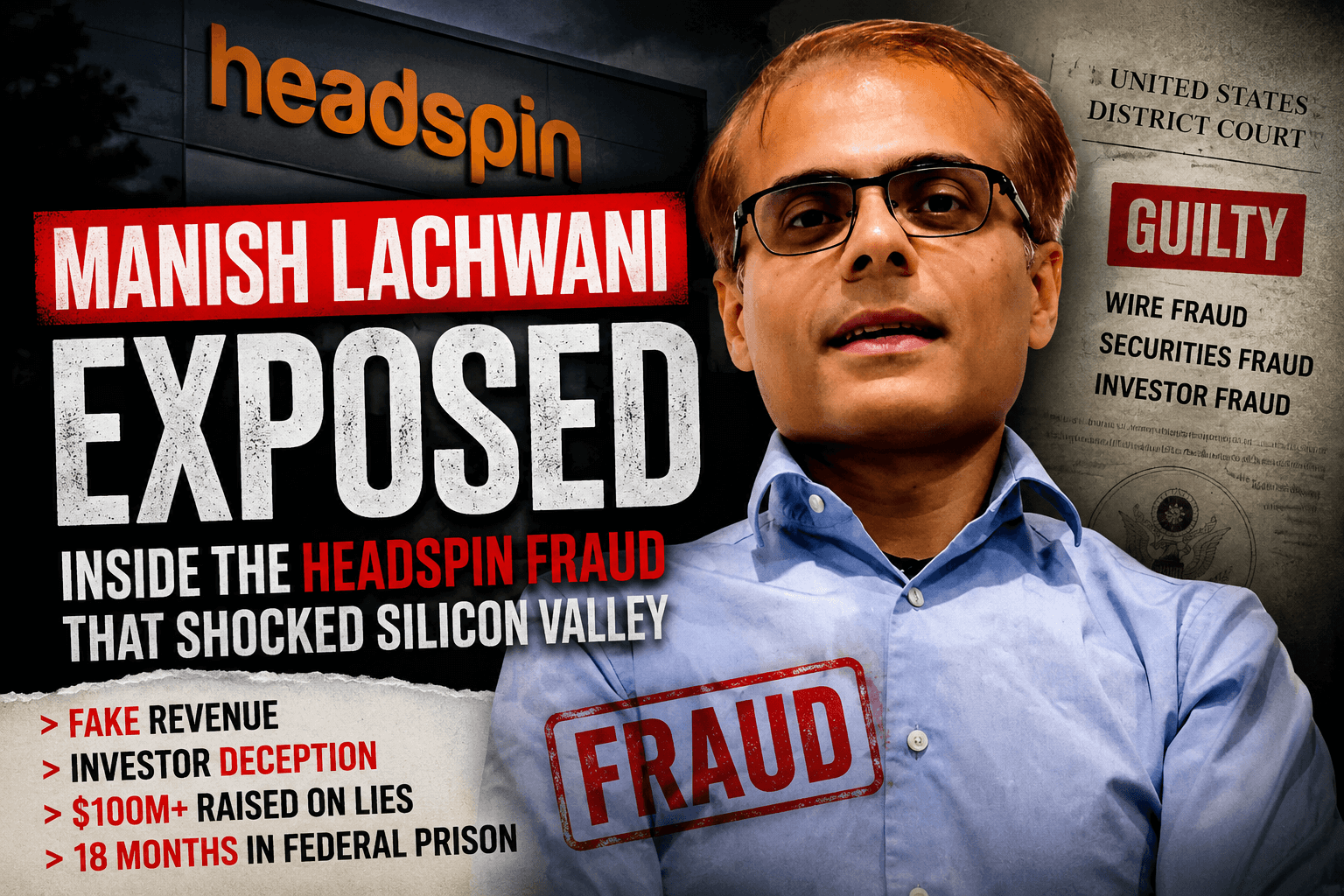
When Manish Lachwani was pitching HeadSpin to investors, the company looked unstoppable.
The Palo Alto startup was attracting some of the biggest names in venture capital, raising tens of millions of dollars, and presenting itself as a fast-growing tech company solving a real problem for businesses trying to test mobile apps around the world. Inside Silicon Valley circles, HeadSpin was treated like the next major enterprise software success story. Its valuation crossed $1 billion, employees believed they were building something huge, and investors kept writing bigger checks.
Then the numbers started falling apart.
What followed was a stunning collapse that exposed fake revenue claims, manipulated financial records, federal criminal charges, and a founder who prosecutors said had spent years misleading investors about the true condition of his company. By the time the case reached federal court, HeadSpin had gone from a celebrated unicorn to one of the most talked-about startup fraud scandals in the tech industry.
HeadSpin was founded in 2015 by Manish Lachwani and Brien Colwell. The company focused on mobile testing infrastructure, offering businesses a way to test applications and digital products on devices located across different countries and networks. At the time, investors were aggressively looking for enterprise software startups that could dominate niche markets, and HeadSpin fit perfectly into that trend.
Money came in quickly. Firms like Tiger Global, GV, Dell Technologies Capital, Battery Ventures, Felicis Ventures, and Iconiq Capital backed the company as it grew. The startup’s rapid rise helped push its valuation to around $1.1 billion. In Silicon Valley, that “unicorn” status carries enormous weight. It creates pressure to grow faster, raise more money, and keep the momentum alive.
According to federal prosecutors, that pressure eventually turned into fraud.
The Department of Justice later accused Lachwani of dramatically overstating HeadSpin’s revenue while the company was raising money from investors. Prosecutors said the company claimed to have around $54 million in annual recurring revenue during fundraising rounds, even though the real number was far lower. Authorities alleged the figures had been inflated by roughly $50 million.
Court filings described a pattern where projected business, inactive clients, and even customers who had not signed deals were allegedly counted as real revenue. Prosecutors also claimed that altered invoices and misleading financial documents were used to make the company’s growth appear stronger than it actually was.
The SEC later alleged that investors were shown financial information that painted a completely inaccurate picture of HeadSpin’s business health. According to investigators, some of the company’s reported sales figures simply did not match reality.
What made the case especially damaging was the scale of the deception. HeadSpin had already raised over $100 million from major investors by the time serious questions started emerging internally. Much of Silicon Valley had bought into the story that Lachwani was building a breakout tech company.
Behind closed doors, though, concerns were growing.
Reports later revealed that HeadSpin’s board began investigating discrepancies in the company’s finances after internal questions surfaced about reported revenue numbers. The findings reportedly shocked investors. Revenue projections that had helped justify the company’s billion-dollar valuation allegedly did not line up with actual customer contracts and payments.
According to reports cited after the scandal broke, some investors believed HeadSpin was nearing $100 million in recurring revenue. Investigators later determined the real figure was closer to around $15 million.
The company’s valuation collapsed almost immediately.
What had once been a unicorn worth over $1 billion reportedly dropped to roughly $250 million during the fallout. Employees who had spent years working for stock options suddenly watched the value of their equity evaporate. Inside the startup world, where employees often accept lower salaries in exchange for future payouts tied to company growth, that kind of collapse can be financially devastating.
Lachwani stepped down as CEO in 2020 as scrutiny intensified around the company’s finances. But the legal problems were only beginning.
The government’s case painted a picture of a startup operating with very little financial oversight despite its massive valuation. Reports later indicated that HeadSpin allegedly lacked basic controls expected from a company of its size, including strong accounting systems and experienced financial leadership.
The scandal quickly became bigger than one founder.
Critics pointed to the broader culture inside Silicon Valley, where founders are often rewarded for aggressive growth claims and investors compete to enter hot deals before conducting deeper scrutiny. In that environment, rapid fundraising can sometimes matter more than proving whether the underlying business is actually healthy.
HeadSpin became an example of what can happen when hype overtakes accountability.
In 2023, Lachwani pleaded guilty to two counts of wire fraud and one count of securities fraud. In his plea agreement, he admitted he had misrepresented HeadSpin’s revenues and financial condition while raising money from investors.
The guilty plea marked a dramatic fall for a founder who had once been celebrated in startup circles.
Federal prosecutors argued that the fraud was not accidental or the result of startup optimism gone too far. They said investors had been deliberately misled over a period of years while the company continued raising money at increasingly inflated valuations.
In April 2024, Lachwani was sentenced to 18 months in federal prison by U.S. District Judge Charles Breyer. He was also ordered to pay a $1 million fine and complete three years of supervised release after serving his sentence.
Even after the criminal case, the damage around HeadSpin continued.
In 2024, reports emerged that the company had effectively been sold at a steep discount to Canadian private equity firm PartnerOne. TechCrunch reported that many employees ended up with little or no value from their stock options after the company’s collapse and sale.
For former workers, the story was not just about investor losses or Silicon Valley embarrassment. Many had tied years of work and career decisions to equity that was supposed to become valuable if HeadSpin succeeded. Instead, the company became another example of how startup implosions can leave ordinary employees paying the price while executives and investors move on.
Today, Manish Lachwani has largely disappeared from the public startup scene following his conviction and sentencing. But the HeadSpin scandal still gets mentioned whenever discussions turn to inflated startup valuations, weak oversight in venture capital, and the darker side of Silicon Valley’s obsession with growth at all costs.
What started as one of tech’s hottest startups ended with federal fraud charges, prison time, and a billion-dollar reputation in ruins.
————-
Disclaimer:
Some content on Reportingscams.com is published under our guest post program and is provided by third-party contributors. Reporting scams does not create, verify, or take responsibility for the views, accuracy, or claims expressed in such content.