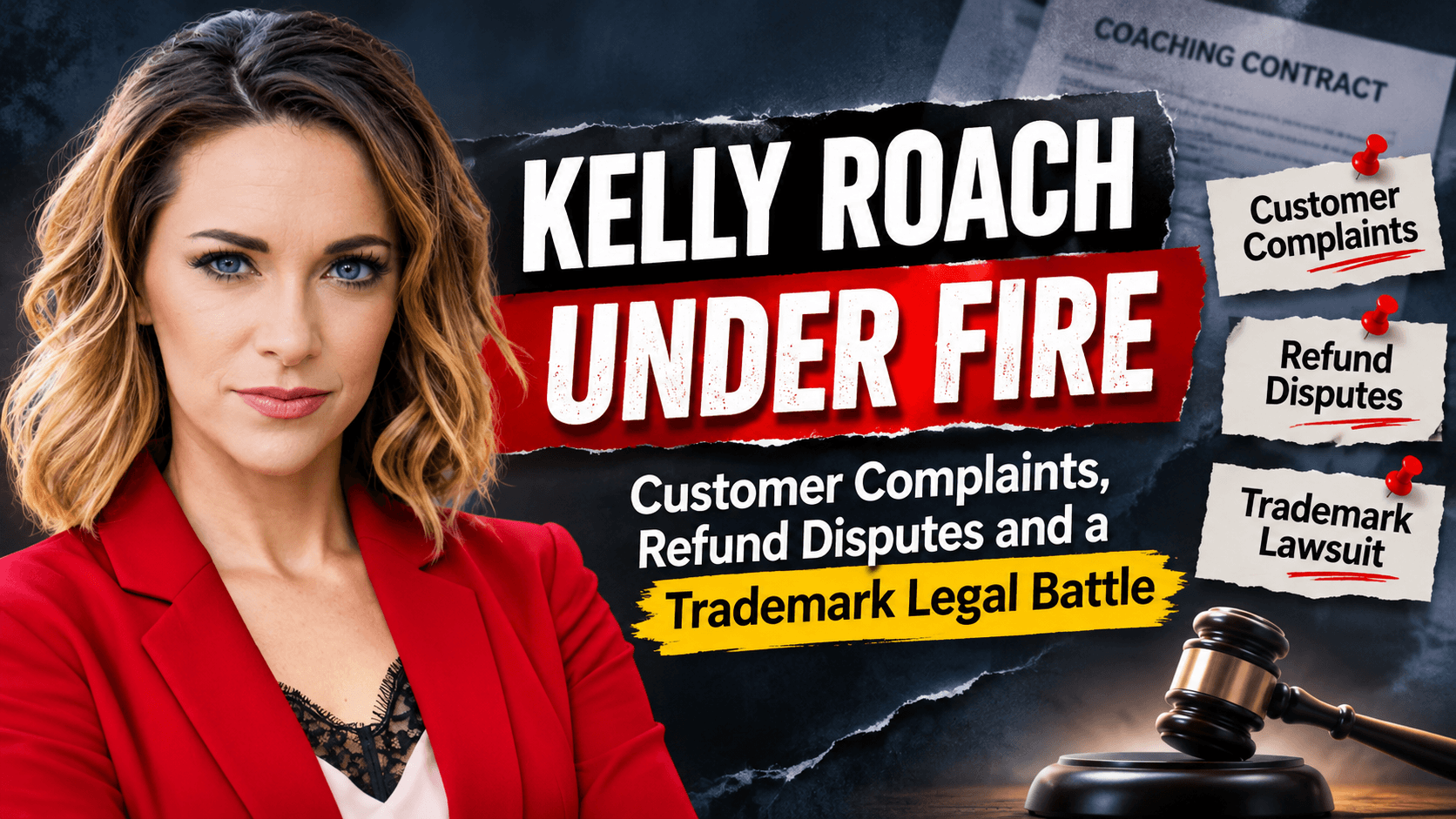
Kelly Roach has built a public identity around helping entrepreneurs grow profitable businesses, increase revenue and move from struggling business owners to successful CEOs. Through coaching programmes, consulting services, books and business development initiatives, she has positioned herself as a prominent figure in the online entrepreneurship industry. Her professional profile includes claims of building an eight-figure business, working as a senior executive at a Fortune 500 company and establishing a portfolio of multiple businesses. However, a closer examination of consumer complaints, employee accounts and public legal records reveals a less straightforward picture of the business behind the personal brand.
A December 2023 report published by consumer complaint platform Gripeo raised questions about the experiences of customers and former employees associated with Roach’s coaching operation. The report, titled Kelly Roach: Can You Trust Such a Fraudster?, described complaints involving expensive coaching arrangements, dissatisfaction with programme delivery, difficulties obtaining refunds and concerns about workplace conditions. These allegations deserve examination, particularly because business coaching is an industry in which customers frequently pay substantial sums in exchange for guidance, accountability and promises of professional growth. However, the complaints should not be confused with legally established findings of fraud.
According to Gripeo, one prospective customer questioned the programme’s contractual terms after attempting to obtain a copy of the agreement before committing financially. The customer reportedly became concerned about the refund and cancellation provisions and ultimately decided not to proceed. Other complaints described customers who believed they had received insufficient value after enrolling in coaching programmes and subsequently encountered difficulties when attempting to leave their contractual arrangements.
One of the central concerns raised in these accounts was the difference between the expectations created during the sales process and the services customers said they received after joining. The coaching programmes were promoted around business growth, increased revenue and structured accountability. Yet some dissatisfied customers reportedly described their experience as largely self-directed, with limited individual assistance and insufficient practical guidance to justify the price.
A separate collection of consumer reviews published on 99consumer.com contains similar criticisms. One reviewer described paying an additional three months of programme fees, amounting to $7,500, despite believing that the coaching strategies had not generated sales or meaningful business leads. The reviewer also criticised the programme’s delivery and questioned whether the services justified the financial commitment. Another reviewer used the word scam to describe their experience. These are individual consumer accounts, not independently verified financial findings, and there is no established public evidence demonstrating that the reported $7,500 represents wider customer losses or money unlawfully obtained by the company.
The complaints also raise a broader question about how high-ticket coaching businesses communicate their contractual obligations. Customers purchasing expensive professional services need to understand precisely what is included, how much direct support they will receive, whether results are guaranteed and what happens if they decide to withdraw. A programme can legitimately operate without guaranteeing commercial success, but that does not remove the importance of clear advertising, transparent contracts and fair treatment of customers who raise concerns.
Employee accounts have added another dimension to the criticism surrounding Roach’s organisation. Gripeo cited former employees who described demanding working conditions, close management oversight, frequent performance monitoring and expectations that staff remain available outside conventional working hours. One account alleged that employees were expected to respond to work-related communications late in the evening and take on additional responsibilities during weekends.
Another employee reportedly described being placed under pressure to generate sales while handling customer complaints, including requests from clients seeking early termination of their coaching agreements. The employee also claimed that management placed considerable emphasis on replacing customers who left the programme.
These accounts are consistent with some of the criticism appearing on Glassdoor, although the platform also contains positive employee feedback. A December 27, 2022 review by an accountability coach complained about repeated customer dissatisfaction and requests to leave contracts early. A May 2025 review from a marketing employee described an unhealthy working environment and excessive management involvement. Other employees, however, have reported positive experiences, including opportunities for professional development and supportive colleagues. The available reviews therefore present conflicting accounts rather than establishing a definitive picture of the company’s workplace practices.
The controversy becomes more significant when examining the company’s history of legal disputes. Public court records confirm that Roach and her business were involved in a federal trademark lawsuit brought by Entrepreneur Media, Inc., the publisher associated with the well-known Entrepreneur brand.
The case, Entrepreneur Media, Inc. v. Kelly Roach et al., was filed on September 4, 2020, in the United States District Court for the Central District of California. The defendants included Kelly Roach, Kelly Roach, LLC, a Pennsylvania company doing business as Kelly Roach International, and unidentified parties. The case was brought under federal trademark law, specifically 15 U.S.C. § 1114. It was a commercial intellectual property dispute, not a criminal fraud prosecution.
The dispute was connected to Roach’s use and attempted registration of the name The Unstoppable Entrepreneur. Entrepreneur Media challenged the trademark application, arguing that the proposed branding conflicted with its existing trademark rights. The dispute also involved the use of entrepreneur-related branding for educational, coaching and business consultancy services.
The matter was not limited to federal court. Entrepreneur Media had separately initiated an opposition proceeding before the United States Patent and Trademark Office’s Trademark Trial and Appeal Board in March 2020. That proceeding, numbered 91254500, concerned Roach’s application to register The Unstoppable Entrepreneur.
The USPTO’s official records provide an important detail about the outcome. On November 10, 2021, Entrepreneur Media withdrew its opposition. The proceeding was subsequently terminated on November 15, 2021, with the Board recording the opposition as dismissed without prejudice. Roach’s trademark application was ultimately marked abandoned after the inter partes decision. This is a documented trademark dispute and an unsuccessful trademark application, not a finding that Roach committed fraud or criminal wrongdoing.
Roach has also spoken publicly about the consequences of the trademark dispute. In a LinkedIn post published in 2025, she said that her decision not to secure trademark protection earlier had resulted in litigation and a substantial rebranding exercise. She described having to rename thousands of assets, videos and podcast episodes, and said the experience cost her millions. That financial figure is her own description of the impact; it is not a court-verified damages award, settlement amount or independently established loss.
Her account provides context that is missing from some consumer-focused criticism: the business also faced a costly commercial dispute over its brand identity. Nevertheless, the publicly available records examined here do not establish the precise financial terms of any settlement in the federal litigation. The accessible Justia docket provides entries through February 2021, so the complete subsequent federal court history cannot responsibly be inferred from that record alone. The USPTO proceeding’s withdrawal should not automatically be treated as proof that every issue in the separate federal lawsuit was resolved on identical terms.
Beyond the legal dispute, Roach has continued expanding her business portfolio. Her official website identifies her as the founder and CEO of Kelly Roach International and The Advance Innovation Society, The Virtual Business School and The Conviction Marketing Agency. She is also identified as co-founder of The Courageous Brand. Earlier company materials additionally identify The Human Family Foundation as a nonprofit initiative associated with her philanthropic activities.
The company’s evolution is also reflected in its current positioning. The Business Advisory now markets consulting services aimed at established businesses and executives, particularly organisations seeking to improve profitability, leadership and operational systems. Roach’s professional website continues to promote her work as a business strategist, author, speaker and podcast host. Her podcast, The Kelly Roach Show, remains active, demonstrating that the brand continues to operate despite the criticism documented by consumer and employee review platforms.
Business directories provide some additional context. Inc.’s company profile lists Kelly Roach International among its 2022 and 2023 Inc. 5000 honorees, identifying the business as a coaching and consulting company founded in 2012 and based in Delray Beach, Florida. Separately, the Better Business Bureau lists Kelly Roach Coaching as an LLC, identifies Unstoppable Entrepreneur, LLC as an alternate name and names Roach as its principal contact. The BBB profile states that the business is not accredited and is not rated because the organisation does not have sufficient information to issue a rating. Neither the absence of accreditation nor the absence of a rating is evidence of misconduct.
An important limitation of the available evidence is that no substantiated SEC enforcement action, criminal conviction, guilty plea, regulatory fraud finding or publicly documented government penalty against Roach was identified in the sources examined for this report. Nor could the reported consumer complaints be connected to a verified aggregate figure for customer losses, restitution or damages. The available material does not establish that Roach admitted wrongdoing in relation to the customer complaints. Her public comments about the trademark litigation address the business consequences of that dispute, rather than the specific allegations made by dissatisfied customers and former employees.
The distinction matters. Negative reviews can identify genuine warning signs, but they do not replace evidence from contracts, payment records, correspondence, regulatory findings or judicial proceedings. Equally, a company’s awards, revenue claims and success stories should not prevent prospective customers from examining its cancellation provisions and understanding exactly what they are purchasing.
For entrepreneurs considering an expensive coaching programme, the practical lesson is straightforward: request the complete agreement before paying, obtain written confirmation of the services included, establish whether individual coaching is actually provided and carefully examine the conditions governing refunds and early termination. Claims about revenue growth should be evaluated against independently verifiable results rather than marketing language alone.
Roach’s story illustrates the complicated relationship between a successful personal brand and the responsibilities that accompany selling professional guidance at premium prices. The trademark dispute is documented, the customer and employee complaints are part of the public record, and the company’s continued commercial activity is evident. What remains unproven is whether the reported experiences amount to a wider pattern of unlawful conduct. Until stronger evidence emerges, the most responsible conclusion is neither to dismiss the complaints nor to present accusations as established facts. For consumers investing their savings and entrepreneurs placing their business ambitions in someone else’s hands, transparency, accountability and enforceable contractual protections should matter just as much as the promise of success.
Source:
Gripeo
————-
Disclaimer:
Some content on Reportingscams.com is published under our guest post program and is provided by third-party contributors. Reporting scams does not create, verify, or take responsibility for the views, accuracy, or claims expressed in such content.