Hongtao Jason Qiao built a career around investment management and cryptocurrency. He also became one of the central figures in a bitter legal fight over who controlled a crypto asset manager that once claimed millions of dollars in assets under management.
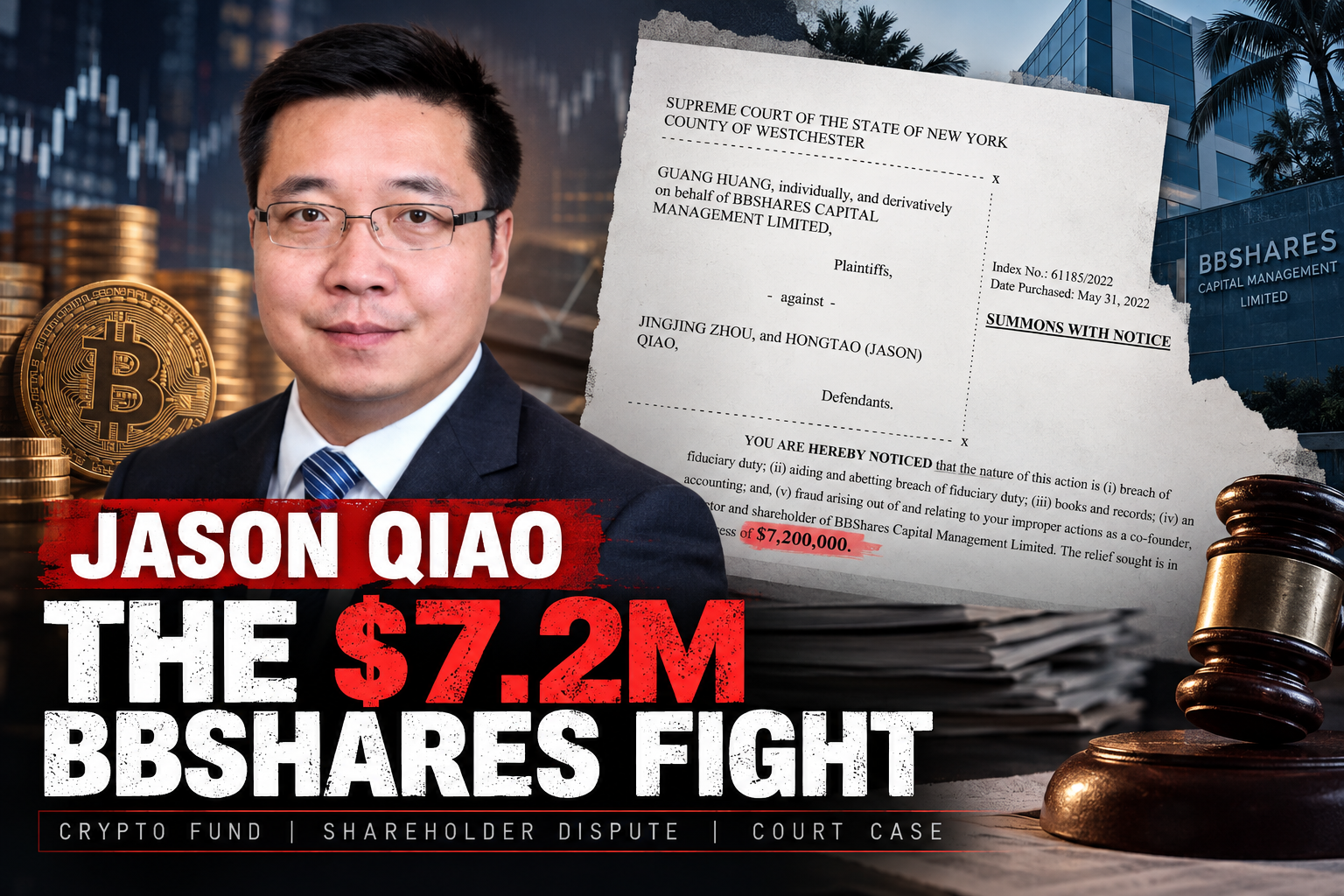
The dispute concerns BBShares Capital Management Limited, a Cayman Islands-based cryptocurrency asset management company, and a $7.2 million lawsuit filed by shareholder Guang Huang against Qiao and his wife, Jingjing Zhou. The case accuses the couple of breaching fiduciary duties, diverting business opportunities and using corporate structures to diminish Huang’s ownership interest. Those remain allegations in civil litigation, not criminal findings.
The original New York summons, filed in June 2022, named Qiao and Zhou as defendants and alleged breach of fiduciary duty, aiding and abetting, books-and-records violations, an accounting and fraud. Huang sought more than $7.2 million.
At the centre of Huang’s complaint is a striking ownership dispute. According to his second amended complaint, Huang was a 24% shareholder of BBShares before his interest was allegedly reduced to approximately 2.5%. He claims the reduction resulted from transactions involving BB Matrix Holdings Pte. Ltd., an entity run by Qiao. The complaint alleges that BB Matrix was used to divert value and business opportunities away from BBShares. The court records identify those accusations as Huang’s claims; they have not been adjudicated as proven fraud.
The underlying relationship was once considerably closer. Huang’s filings describe the parties as business partners who worked together to establish BBShares as the cryptocurrency market was expanding. The complaint says Qiao persuaded Huang and others to leave other professional opportunities to build the company. The relationship later deteriorated over management decisions and ownership, eventually turning into litigation.
The numbers involved help explain why the fight became so consequential. Huang said BBShares had approximately $20 million in assets under management by July 2019 and argued that the business could have grown substantially from there. Earlier reporting on the dispute quoted Huang’s estimate that the assets could have reached roughly $100 million by the end of 2021. Those are figures advanced by Huang, rather than findings that the court has independently established.
The dispute soon moved beyond New York. In September 2022, Huang sought the appointment of FTI Consulting professionals Andrew Morrison and Kieran Linton as inspectors for BBShares in the Cayman Islands. His application sought an examination of the company’s assets, liabilities, financial position, trading activity, books and records and potential related-party transactions involving shareholders, directors and service providers, including Qiao and Zhou.
That inspection application was later withdrawn. In a March 2023 letter to OffshoreAlert, Joe Juan, using a BBShares email address, said Huang withdrew the application on October 3, 2022 because it was “baseless” and asked the publication to remove or amend its report. That statement represents the company’s position; it does not constitute a court ruling on the underlying allegations.
The New York case did not disappear. In October 2025, Justice Linda S. Jamieson ruled on Qiao and Zhou’s motion to dismiss Huang’s second amended complaint. The complaint contained 11 causes of action, including Cayman-law fiduciary claims, dishonest assistance, New York aiding-and-abetting claims, conspiracy, fraud, unjust enrichment, conversion and tortious interference. The court dismissed three claims but allowed other claims to continue.
That ruling is important because it does not say Qiao committed fraud. It means only that, at that stage, parts of Huang’s case survived the defendants’ attempt to have them dismissed. The distinction is critical in a dispute where accusations of financial misconduct are being made by one business partner against another.
Qiao’s legal history also intersects with another substantial cryptocurrency dispute: Youbi Capital.
In 2021, Qiao and Zhou sued the people behind Youbi Capital, a cryptocurrency investment venture they said they had helped create. Their case alleged that they had been deprived of profits and subjected to breaches of fiduciary duty, fraud and conversion. Court records describe Youbi as having reached a net asset value approaching $300 million. Youbi responded with counterclaims against Qiao, Zhou, BBShares and BB Matrix, including allegations involving trade secrets, breach of confidence, fiduciary duties, conversion and unjust enrichment.
The overlap is notable. BB Matrix and BBShares appear in the Youbi litigation because the defendants there alleged misconduct involving the same corporate network. In March 2026, the court rejected Youbi’s request for sanctions over discovery disputes, finding that the circumstances did not justify sanctions. That decision did not resolve all of the underlying claims between the parties.
Public biographies identify Qiao as a former JPMorgan Asset Management executive and describe him as having worked in portfolio construction, quantitative strategy and private wealth management before moving into cryptocurrency. A 2018 blockchain conference profile identified him as Chief Visionary Officer of Youbi Capital.
BBShares’ own website has described the firm as a Cayman-regulated cryptocurrency fund manager and has listed products including the Mega Cap Fund, Systematic Opportunities Fund and Diversified Alpha Fund. Its website also warns investors that the products are private investment vehicles and speculative investments rather than SEC-registered funds.
There is no verified evidence in the sources reviewed that Qiao has been criminally charged or convicted of fraud. The $7.2 million figure is the amount sought in Huang’s civil lawsuit, not a criminal fine or proven amount stolen from investors. Likewise, the reported $20 million, $100 million and $300 million figures concern assets under management or estimated values cited in litigation, not established investor losses.
What makes the BBShares story worth watching is not simply the size of the lawsuit. It is the collision of ownership, control and cryptocurrency finance across jurisdictions. A company incorporated in the Cayman Islands, shareholders litigating in New York and related entities operating across international markets create a complicated trail when business relationships break down.
For Qiao, the court record currently presents a contested civil dispute rather than a criminal conviction. For Huang, it represents a fight over what he says was his ownership and economic interest in a cryptocurrency business he helped build. And for investors, the case offers a reminder that the most important risks in private crypto funds can extend beyond the price of Bitcoin or Ethereum. Governance, ownership rights, related-party transactions and access to financial records can become just as consequential when the people running the fund turn against one another.
Source:
OffshoreAlert
————-
Disclaimer:
Some content on Reportingscams.com is published under our guest post program and is provided by third-party contributors. Reporting scams does not create, verify, or take responsibility for the views, accuracy, or claims expressed in such content.