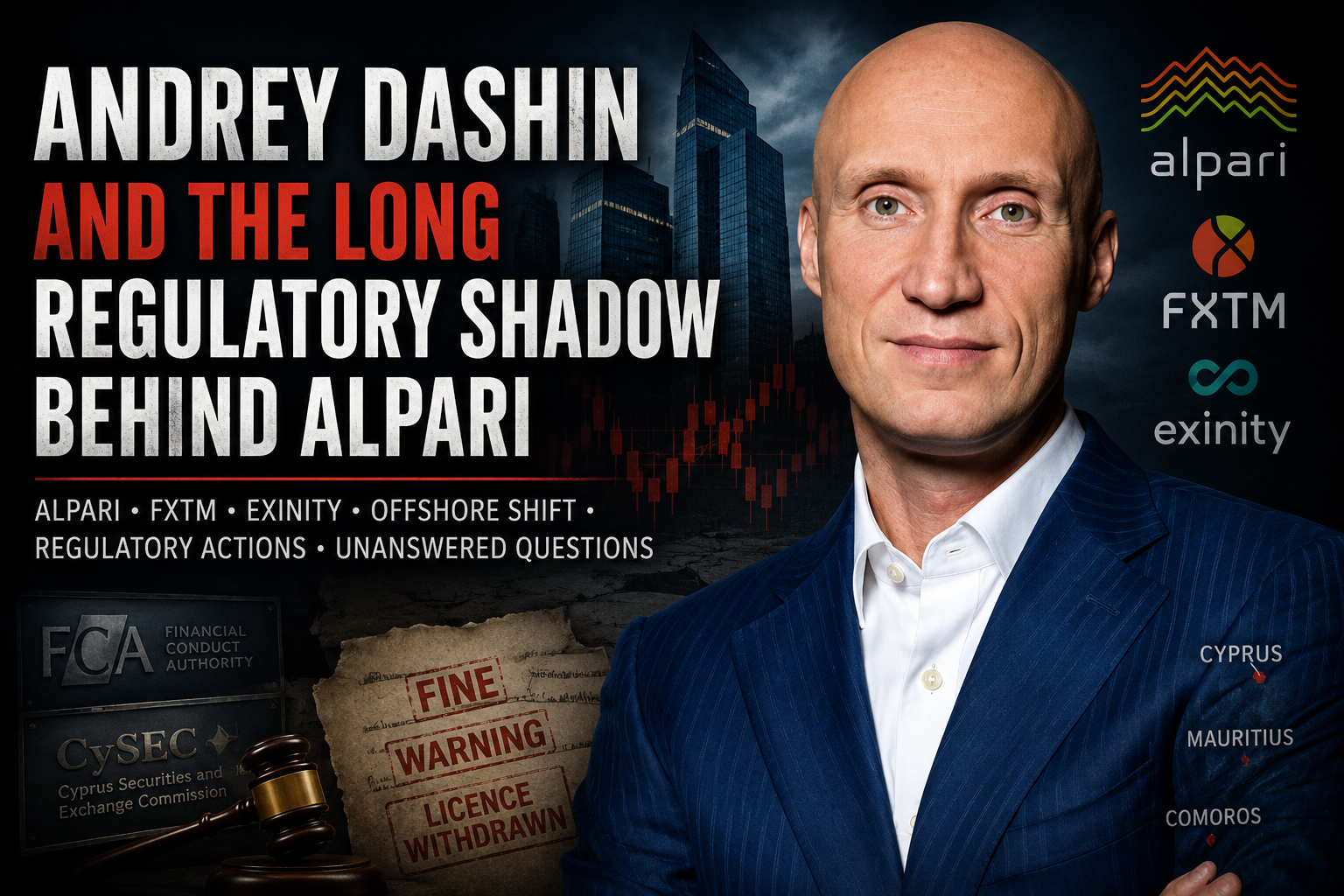
Andrey Dashin built his career around one of the most powerful ideas in modern retail finance: that a trader sitting almost anywhere in the world could enter global currency markets from a computer. From the early days of Alpari in Russia to the creation of FXTM and later the Exinity fintech group, Dashin became one of the better-known entrepreneurs in the international retail foreign-exchange industry.
His public biography presents a story of entrepreneurship, international expansion, innovation and philanthropy. Dashin says he was born in Kazan on July 8, 1975, studied finance and banking and entered the foreign-exchange business during the Russian financial crisis of 1998. He later moved the centre of his business life to Cyprus, which he and his wife Julia have described as their home.
But the regulatory history surrounding the businesses associated with Dashin tells a more complicated story. It includes a £140,000 UK regulatory penalty over anti-money-laundering systems, the collapse of Alpari’s UK operation in 2015 after the Swiss franc shock, a $200,000 US regulatory penalty involving Alpari US, the cancellation of an Alpari forex licence in Russia, repeated warnings involving Alpari entities, the voluntary surrender of FXTM’s Cypriot investment-firm licence and, more recently, a restructuring that moved the Alpari brand into a Comoros-based entity whose ultimate ownership is not fully established in publicly available records.
That history requires an important qualification. The regulatory findings described here were generally made against companies, not against Dashin personally. Investigations.org itself says it found no criminal charges, indictments, arrests or criminal investigations against Dashin personally. The strongest evidence therefore concerns the businesses he founded, controlled or was associated with, rather than proof that Dashin personally committed a crime.
That distinction matters because the record is serious without needing exaggeration.
The rise of a Russian forex entrepreneur
Dashin’s own account of his career begins in Kazan. He says that after studying finance he worked in banking and later became an accountant at a major oil company before turning his attention to the developing Russian forex market during the 1998 financial crisis. His personal website identifies him as the founder of Exinity and says the group brings together businesses including FXTM, Nemo, Pulse, PiP World and Exinity Connect.
Alpari became the foundation of the business. The brand was established in Kazan in 1998 and grew into an international retail forex operation. Dashin subsequently became one of the founders and shareholders of the wider Alpari Group. In 2013, after a split with fellow Alpari co-founder Andrey Vedikhin, Dashin launched ForexTime, better known as FXTM, together with Olga Rybalkina. FXTM obtained a Cyprus Investment Firm licence, CIF 185/12, from CySEC.
The business model was built around retail trading. Customers could speculate on foreign exchange and later CFDs and related financial products through internet-based trading platforms. The attraction was obvious. Forex offered leverage, around-the-clock markets and the possibility of substantial returns from relatively small deposits. But the same characteristics created substantial risks for consumers and regulators.
Dashin’s businesses expanded across jurisdictions. The corporate structure came to include entities in Cyprus, the United Kingdom, Mauritius, Russia, the United States and offshore jurisdictions. By 2020, Exinity had become the umbrella group for Dashin’s retail brokerage businesses, including Alpari International and FXTM. Industry reporting at the time described Exinity as the group containing Dashin’s various retail FX and CFD businesses.
This international structure was not inherently improper. Global financial firms routinely operate through different subsidiaries because different jurisdictions impose different licensing requirements. The investigative question is what happened when regulatory scrutiny increased and when the businesses began moving away from heavily regulated European markets.
The answer begins with a problem that appeared long before the modern Exinity structure existed.
The first major regulatory warning came from Britain
In May 2010, Britain’s Financial Services Authority, the predecessor to today’s Financial Conduct Authority, fined Alpari UK £140,000 for failures in its anti-money-laundering systems and controls.
The final notice is unusually detailed. It says the breaches occurred between September 2006 and November 2008 and concerned Principle 3 of the FSA’s Principles for Businesses. Alpari settled early, receiving a 30 percent discount. Without that discount, the penalty would have been £200,000.
The regulator’s findings were not merely technical paperwork errors.
The FSA said Alpari had failed to conduct adequate assessments of money-laundering and financial-crime risks. It said the company had not adequately resourced its compliance function as the business expanded. It also found inadequate systems for screening customers against UK and international sanctions lists and for identifying politically exposed persons.
There were further problems with customer due diligence. The FSA specifically examined higher-risk customers and found shortcomings in the documentation and verification process. Alpari’s customer base included people from jurisdictions that the regulator regarded as higher risk, including Nigeria, while the company opened accounts remotely rather than face-to-face.
The scale of growth helps explain why the regulator was concerned. According to the FSA notice, Alpari had approximately 400 live customer accounts in July 2007. By June 2008 it had around 9,500 accounts, rising to approximately 11,500 by July. Around 4,000 were funded accounts and the firm was receiving about 50 deposits per day.
The regulator found that Alpari had not properly adjusted its compliance infrastructure to match that growth.
Perhaps the most striking finding involved sanctions and politically exposed person screening. The FSA said Alpari mistakenly believed its electronic system was checking customers against sanctions lists and identifying PEPs when it was not actually performing those checks. That meant the firm was exposed to the possibility of accepting customers who should have triggered enhanced scrutiny without knowing it.
This was not a finding that Alpari had actually laundered money. The regulatory case concerned deficient systems and controls. That distinction should remain clear in any account of Dashin’s history.
The FSA also noted mitigating factors. Alpari had identified some weaknesses itself, began hiring additional compliance staff, launched a remedial programme monitored by external consultants and cooperated with the investigation. Nevertheless, the regulator concluded that the failures were serious enough to justify the £140,000 penalty.
The 2010 action is therefore an important starting point because it established a documented regulatory problem with one of the central companies associated with Dashin, years before the later offshore restructuring.
Alpari US faced a different regulatory problem
The problems were not confined to Britain.
In the United States, Alpari US LLC was the subject of National Futures Association enforcement proceedings. Investigations.org records a July 2012 NFA enforcement action imposing a $200,000 fine over improper cancellation of forex trades and removal of client profits, failures involving trade reporting and inadequate recordkeeping.
A separate NFA decision from January 2014 concerned allegations that Alpari US had failed to submit complete trade reports, failed to maintain required trade records and failed to diligently supervise employees and agents involved in forex activities. The matter was resolved through an offer of settlement accepted by an NFA hearing panel.
Again, these were regulatory proceedings against a corporate entity rather than a criminal conviction of Dashin personally.
But taken together with the British AML enforcement, they demonstrate that the regulatory concerns around the Alpari network were not limited to one country or one type of compliance obligation.
The 2015 Alpari collapse changed the story
The most consequential event in Alpari’s history came in January 2015.
The immediate trigger was the Swiss National Bank’s decision to abandon its minimum exchange-rate policy against the euro. The resulting market shock caused enormous losses across the retail foreign-exchange industry. Alpari UK was among the firms unable to absorb the resulting losses.
On January 19, 2015, Alpari UK formally entered the UK’s Special Administration Regime after determining that it was no longer solvent. The FCA appointed Richard Heis, Samantha Bewick and Mark Firmin of KPMG as joint special administrators. More than 100,000 customers were affected.
The scale of the collapse made Alpari’s failure a major event in the British retail trading industry.
The FCA initially said the administrators believed client money was whole, although the position would have to be assessed. The regulator explained that the Special Administration Regime was designed to protect customers and return client assets as quickly as reasonably practicable.
The collapse did not amount to a finding that Dashin or Alpari had committed fraud. It was an insolvency event caused by extraordinary market conditions and the firm’s resulting losses. But for customers, the distinction offered little immediate comfort. Thousands of traders suddenly found themselves unable to access their brokerage accounts in the normal way.
The Financial Services Compensation Scheme subsequently opened a compensation process for eligible customers. The FSCS said investment claims were protected up to the applicable £50,000 limit per person per firm at the time.
The FCA’s records therefore establish two separate points. Alpari UK failed and entered a statutory special-administration process, and more than 100,000 customers were affected. They do not establish that Dashin personally misappropriated customer funds.
That distinction is essential to understanding what happened.
Russia also withdrew Alpari’s licence
The regulatory pressure continued in Alpari’s home market.
In December 2018, Russia’s central bank announced the cancellation of several forex dealer licences, including Alpari Forex. The termination was effective January 27, 2019. Contemporary reporting said the central bank cited repeated violations of Russian securities legislation.
The Russian action was particularly significant because Alpari had originated in Russia and had grown into one of the country’s most recognisable retail forex brands.
By this point the Alpari story had become increasingly fragmented. Different Alpari entities had existed under different regulatory regimes, and the status of one entity could not necessarily be applied to another. This is one of the most important facts for readers investigating the group.
“Alpari” was a brand. It was not a single legal company.
That distinction becomes increasingly important in the years that follow.
The European retreat
Dashin’s business subsequently consolidated under Exinity. The group was formally launched in 2020 as an umbrella structure for the businesses associated with Dashin, including Alpari International and FXTM.
The following years brought a gradual retreat from European retail markets.
Exinity stopped providing retail services to European Economic Area investors in 2021. In 2020, Spain’s securities regulator, the CNMV, issued a warning involving Alpari International and Exinity Limited. In December 2021, the CNMV’s warning database again listed Alpari Limited and the Alpari website among unauthorised entities.
The FCA also warned consumers in Britain about Alpari Limited. The warning concerned an entity that was not authorised or registered by the FCA and therefore did not provide the regulatory protections available from an authorised UK firm. Investigations.org records the warning as concerning the SVG-based Alpari Limited entity.
These warnings are important but should not be confused with enforcement findings that Alpari had defrauded British or Spanish investors. A regulator’s unauthorised-firm warning generally means that the named entity lacks the required local authorisation to provide the specified services, not that the regulator has proven fraud.
The difference between regulatory status and criminal wrongdoing is central to this investigation.
FXTM’s Cypriot licence disappears
The most revealing development came in Cyprus.
ForexTime Ltd, the Cypriot company behind FXTM, held CIF licence 185/12. The company decided to expressly renounce the authorisation, effective December 31, 2023. CySEC formally withdrew the licence at its May 20, 2024 meeting.
CySEC’s decision is unequivocal. It says the regulator withdrew the authorisation because the company had decided to renounce it. The decision does not state that CySEC revoked the licence as punishment for misconduct, and no judicial review was recorded.
That distinction matters.
Investigations.org describes the European exit as unexplained because no public explanation from Dashin or Exinity was identified. But the absence of an explanation should not be converted into an allegation that the licence was withdrawn because of misconduct. The primary CySEC document says the company expressly renounced its authorisation.
Finance industry reporting described the move as part of a broader strategy to focus on markets outside the European Economic Area and on B2B operations. FinanceFeeds reported that Exinity had already stopped retail services to EEA investors in 2021 and that FXTM’s European retreat was presented as an internal strategic decision.
But the timing still deserves scrutiny. Within a short period, the Dashin-linked retail brands were moving away from European regulation while continuing to serve international customers through other jurisdictions.
That is where the concept of regulatory arbitrage enters the investigation.
Offshore regulation became increasingly important
Following the European retreat, Alpari and related businesses increasingly operated through Mauritius and Comoros structures.
The Investigations.org report describes a network spanning Cyprus, Britain, Mauritius, Russia, Comoros, Spain and other jurisdictions. It characterises the movement from heavily regulated European entities toward lighter offshore regimes as a pattern that warrants scrutiny, while acknowledging that “regulatory circumvention” itself is a regulatory assessment rather than an established fact.
That caution is important.
Operating from Mauritius or Comoros is not, by itself, unlawful. Offshore financial centres can issue legitimate financial-services licences. The investigative issue is what protections a consumer loses when moving from a highly regulated jurisdiction such as the UK or Cyprus to an offshore entity.
Under the UK and European regimes, retail clients can have access to formal compensation arrangements, ombudsman mechanisms, conduct rules and extensive supervisory oversight. Those protections are not necessarily replicated by an offshore licence.
This creates a fundamental question for consumers. If a trader sees the familiar Alpari brand but is actually contracting with a company in a jurisdiction with a materially different regulatory regime, how clearly is that distinction communicated?
The 2024 Financial Commission withdrawal
Another significant change occurred in early 2024.
Alpari and FXTM withdrew from the Financial Commission, a private dispute-resolution organisation used by forex brokers and traders. FinanceFeeds reported the withdrawal on February 6, 2024, noting that the Financial Commission would no longer process new complaints from the two brands after their membership ended.
The timing was striking. FXTM had already surrendered its Cypriot licence at the end of 2023, and the Financial Commission departure followed weeks later.
This did not make the businesses illegal. Nor does withdrawal from a private dispute-resolution organisation establish wrongdoing.
But from a consumer-protection perspective, it represented another reduction in independent avenues through which a dissatisfied trader could seek assistance.
Investigations.org describes the sequence as the disappearance of several layers of recourse. The UK entity had already failed in 2015, the Russian licence had been cancelled in 2019, European retail services had been reduced, the Cypriot FXTM entity surrendered its licence, and then the Financial Commission membership ended.
The cumulative pattern is more significant than any individual event.
The Alpari brand changed hands again in 2025
The most recent chapter is perhaps the least transparent.
In July 2025, Finance Magnates reported that Alpari had quietly left the Exinity group and moved to a separate company called Parlance Trading Ltd. The Alpari trademark and domain were registered under the new entity, replacing Alpari (Comoros) Ltd. The new company was reported as holding Mwali International Services Authority licence T2023236.
The change raised an obvious question: who actually owns the new operating structure?
Finance Magnates noted that the transfer had occurred but that the ownership implications were not fully clear. Investigations.org likewise treats the beneficial ownership of Parlance Trading Ltd as an unresolved investigative gap rather than a confirmed Dashin-controlled entity.
This is one place where an investigative article should resist the temptation to overstate.
Dashin’s historical ownership and control of Alpari and Exinity is well documented. But that does not automatically prove that he is the current beneficial owner of Parlance Trading Ltd.
The distinction is especially important because corporate structures can change without a brand disappearing. The Alpari name may continue even where the underlying legal entity, ownership arrangement, regulator and consumer protections have changed.
As of the latest reporting, Alpari’s current operating entity identifies itself as Parlance Trading Ltd, registered in Mohéli, Comoros, with Mwali licence T2023236.
Investigations.org has identified a further unresolved issue concerning the licence record. Its current report says the licence record showed validity through April 12, 2025, while the transfer to Parlance was reported in July 2025. Whether the licence was formally renewed or otherwise remained valid at the time of the transfer requires confirmation from the relevant registry.
That is not proof of an unlicensed operation. It is an evidentiary gap that warrants further reporting.
A new product raises another question
After the Alpari restructuring, the brand also began promoting a new “Up or Down” trading product through a platform called Pulse.
Finance Magnates reported in October 2025 that the platform was operated by Pulse Trading CR in Costa Rica and offered instruments resembling binary options, with potential payouts of up to 80 percent. Users effectively predict the direction of an asset, with the stake at risk if the prediction is wrong.
The regulatory status of such products needs to be examined separately from traditional forex trading.
Investigations.org labels its assessment of the product’s regulatory status as an inference rather than a regulatory finding. That is the correct approach. It would be irresponsible to describe the product as illegal without a regulator or court making such a determination.
The more immediate journalistic question is whether consumers understand which legal entity is providing the product, where that entity is regulated, what protections apply to deposits and what dispute mechanisms are available if something goes wrong.
Dashin also went to court over information about himself
There is another unusual aspect of Dashin’s history that concerns information rather than trading.
In 2017, Dashin filed proceedings in a Kazan court against Google and Yandex under Russia’s “right to be forgotten” framework. Russian newspaper Realnoe Vremya reported that his lawyers sought to block search links containing information they said was false and misleading. The case attracted attention because it involved attempts to remove information from major search engines rather than a conventional commercial dispute.
The newspaper reported that the proceedings initially encountered difficulties over service on Google in the United States. It also said Dashin’s representatives described the action as an attempt to prevent the spread of untrue information and misleading information about the company.
This should not be portrayed as evidence that Dashin tried to conceal criminal conduct. The public reporting does not establish that.
But it is relevant to the broader story because reputation management became a legal issue for one of the most prominent figures in Russia’s forex industry. The right-to-be-forgotten litigation shows that Dashin was prepared to use the courts to challenge information appearing online.
The public image is very different
Dashin’s public-facing profile today is substantially different from the regulatory record.
His personal website describes him as an entrepreneur and philanthropist and promotes the Andrey and Julia Dashin Foundation. The foundation was established in Cyprus in 2014 and focuses on social inclusion, healthcare, education and environmental initiatives. Dashin and his wife have publicly discussed their philanthropic activities in Cyprus and their decision to make the island their home.
That part of the story should not be omitted simply because it complicates an investigative narrative.
A businessman can simultaneously run charitable projects and preside over companies that face regulatory enforcement. Philanthropy does not erase regulatory findings, but regulatory findings do not prove that philanthropic work is fraudulent.
The same principle applies to Dashin’s business success. Alpari’s longevity, international reach and brand recognition are real. FXTM became a major international forex name. Exinity remains an important fintech group, and Dashin continues to describe himself as its founder.
The investigation therefore is not a simple story of a businessman who built a fake company.
It is a story about the evolution of a legitimate but highly leveraged financial business, repeated regulatory interventions involving different corporate entities, the collapse of one major regulated subsidiary, the gradual retreat from Western retail regulation and the increasingly complicated offshore architecture that followed.
The chronology reveals the bigger picture
The timeline is revealing.
Alpari began in Kazan in 1998. By the middle of the following decade, it had expanded internationally. Between 2006 and 2008, the UK operation accumulated the AML deficiencies later identified by the FSA. In 2010, the company paid £140,000 to settle the UK regulatory case. In 2012, Alpari US faced a $200,000 NFA penalty. In 2013, Dashin launched FXTM.
Then came the crisis.
In January 2015, Alpari UK entered special administration with more than 100,000 customers affected. Later that year, its customers gained access to FSCS compensation mechanisms. The US Alpari operation had already exited the US market in 2013, while its NFA memberships were subsequently withdrawn.
In 2019, Russia’s central bank cancelled the Alpari Forex licence. In 2020, Exinity emerged as the umbrella group for Dashin’s brokerage businesses, while Spain’s CNMV issued an Alpari-related warning. In 2021, Exinity stopped retail services to EEA investors and CNMV again listed an Alpari entity in its unauthorised-firm warnings.
In December 2023, FXTM voluntarily renounced its CySEC licence. In May 2024, CySEC formally withdrew it. In February 2024, Alpari and FXTM also left the Financial Commission.
Then in 2025, Alpari’s brand moved from the Exinity structure to Parlance Trading Ltd in Comoros, opening a new chapter in which the ultimate ownership and regulatory continuity deserve further investigation.
That is the chronology that matters.
It is not a chronology of criminal convictions. There are none identified against Dashin personally.
It is a chronology of regulatory failures, corporate insolvency, market exits, warnings, licence changes and increasingly offshore operations.
What has actually been proven?
The strongest evidence in the record comes from regulators.
The UK FSA’s 2010 final notice is a primary document and establishes the AML control failures and £140,000 penalty against Alpari UK.
The FCA’s records establish the 2015 special administration of Alpari UK and the involvement of more than 100,000 customers.
CySEC’s own 2024 decision establishes that ForexTime voluntarily renounced its CIF authorisation and that CySEC subsequently withdrew it.
Spain’s CNMV records establish warnings involving Alpari-related entities in 2020 and 2021.
The Russian regulatory action against Alpari Forex is documented through contemporary reporting based on the central bank’s decision.
Other allegations require greater caution.
Claims of offshore KYC evasion, extremely high leverage, hidden corporate relationships, manipulation or deliberate regulatory circumvention are not equivalent to regulator findings unless independently established by primary evidence. Investigations.org itself separates verified regulatory findings from allegations and unresolved investigative leads.
That evidence hierarchy should remain intact in publication.
The unanswered questions are now more interesting than the old ones
For an investigative journalist, the most important question may no longer be what happened to Alpari UK in 2015. That story is already documented.
The harder questions concern the current structure.
Who ultimately owns Parlance Trading Ltd?
What corporate transaction moved the Alpari brand from Exinity to Parlance?
Was the transaction a sale, internal restructuring, transfer of intellectual property or something else?
Was the Mwali licence renewed before or after the reported April 2025 expiry date?
What legal entity actually receives customer deposits today?
Which company executes trades?
Which entity provides liquidity?
What jurisdiction governs customer disputes?
What regulator has direct supervisory authority over the current retail business?
And how does the current structure relate to Exinity when Alpari’s website continues to describe services as being provided in partnership with Exinity?
Those questions matter more than simply repeating that Alpari is an “offshore broker.”
The corporate architecture itself is the story.
The Dashin record, stripped of hype
The evidence does not support calling Andrey Dashin a convicted fraudster. It does not support saying that he has been criminally prosecuted or that he personally committed money laundering.
It does support saying that businesses associated with him have accumulated a substantial regulatory history.
One Dashin-linked company was fined £140,000 by Britain’s financial regulator for inadequate AML systems. Another Dashin-linked entity in the United States was fined by the NFA. Alpari UK subsequently collapsed into special administration with more than 100,000 customers affected. Alpari Forex lost its Russian licence. Alpari-related entities appeared on Spanish regulatory warnings. The FCA warned about an unauthorised Alpari entity targeting UK consumers. FXTM voluntarily surrendered its Cypriot investment-firm licence, which CySEC formally withdrew in 2024. Alpari and FXTM later left the Financial Commission.
None of these events, individually, establishes criminal wrongdoing by Dashin.
Together, however, they create a record that deserves serious scrutiny.
The most important shift is geographical. Dashin’s business empire began with operations in markets where regulators exercised substantial direct oversight. Over time, important retail operations increasingly moved toward Mauritius and Comoros structures. The 2025 transfer of the Alpari brand to Parlance Trading Ltd has made the ownership question more difficult rather than less.
That is why the Andrey Dashin story remains unfinished.
The entrepreneur who helped build one of Russia’s best-known forex brands is still publicly active. His own website presents him as the founder of Exinity and a philanthropist. His companies continue to operate under the Alpari and related brands.
But behind the familiar names is a corporate history marked by regulatory intervention and repeated changes in legal structure.
For traders, the lesson is straightforward. A famous brand is not the same thing as a highly regulated legal entity. The name on the website may remain unchanged while the company behind the account, the regulator overseeing it and the remedies available to customers change substantially.
For investigators, the lesson is even more important.
The central unanswered question is no longer simply whether Andrey Dashin built a successful forex empire. He clearly did.
The question is what happened to that empire as regulatory scrutiny increased, which entities carried the risks at each stage, who ultimately controlled them and how much regulatory protection remained available to the customers who continued to trade under the Alpari and FXTM names.
That is where the next chapter of the Dashin investigation lies.
————-
Disclaimer:
Some content on Reportingscams.com is published under our guest post program and is provided by third-party contributors. Reporting scams does not create, verify, or take responsibility for the views, accuracy, or claims expressed in such content.