A regulatory filing is supposed to make an investment firm easier to check. In the case of Hong Kong businessman Guanhua Su, U.S. prosecutors say the filings did almost the opposite. They allegedly helped turn companies that existed largely on paper into apparently legitimate investment advisers, giving a stock-promotion operation the appearance of financial credibility before retail investors were encouraged to buy shares that later collapsed.
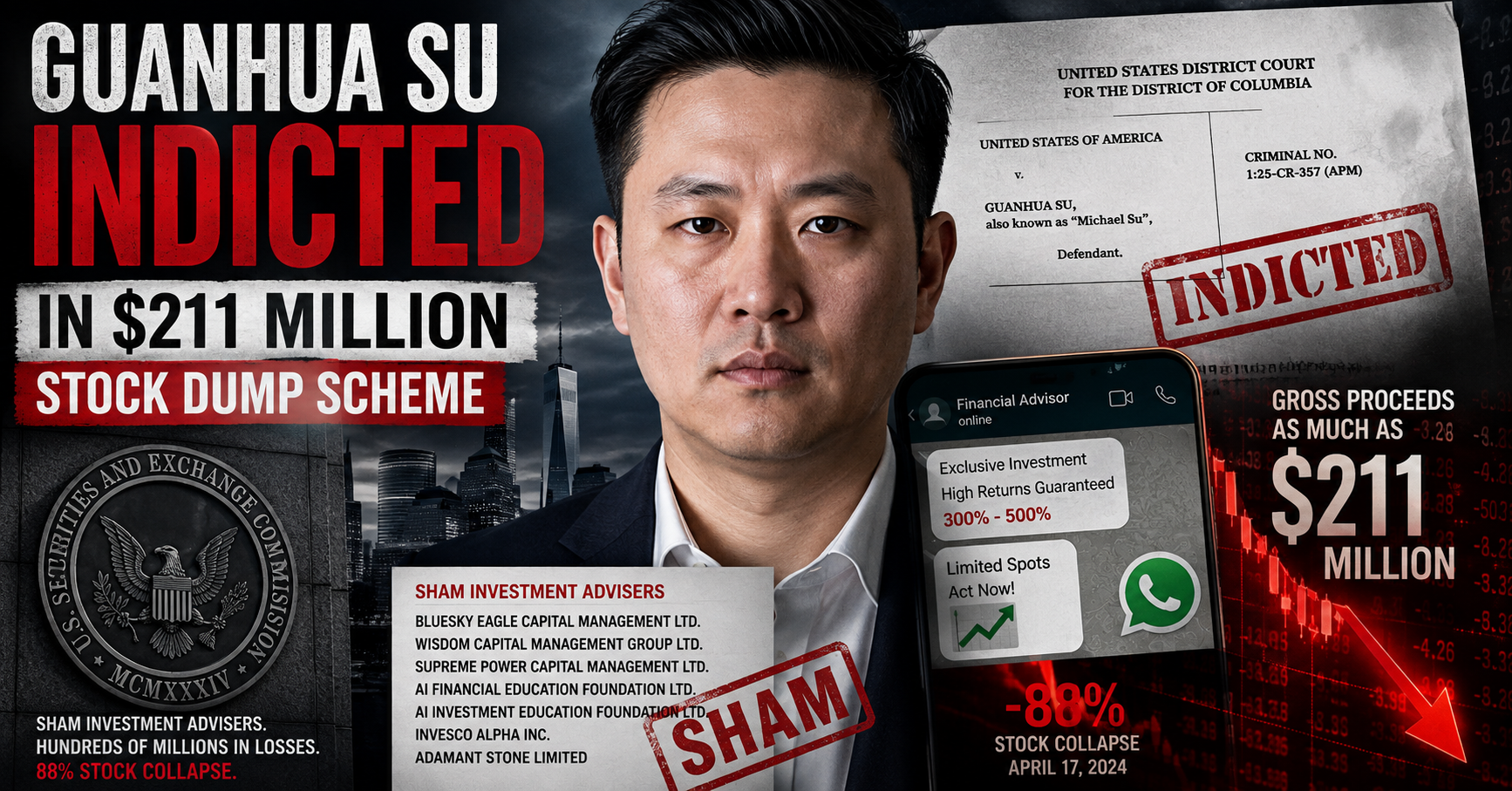
Su, 37, was indicted in Washington in November 2025 under the name Guanhua Su, with the alias “Michael Su.” The Justice Department identifies him as a Hong Kong resident and says he was the managing director and marketing director of Rhino Consulting Business Service Ltd., a Hong Kong-based financial services company. Prosecutors allege that between February 2023 and March 2025, Su and co-conspirators created at least 10 shell entities and submitted deceptive investment adviser filings to the U.S. Securities and Exchange Commission.
The alleged purpose was not simply to create questionable companies. According to the indictment, the filings were designed to make sham businesses appear to be genuine investment advisers. Among the companies named in the case were Bluesky Eagle Capital Management Ltd., Wisdom Capital Management Group Ltd., Supreme Power Capital Management Ltd., AI Financial Education Foundation Ltd., AI Investment Education Foundation Ltd., Invesco Alpha Inc. and Adamant Stone Limited. The SEC separately sued six of those entities in November 2025, while Wisdom had already been sued in August 2024. The government says there were at least three additional shell entities beyond the seven publicly identified by name.
The filings themselves contained the sort of details investors might reasonably expect to see from a functioning financial firm. Bluesky Eagle said it operated from the 52nd floor of 140 Broadway in New York, had $10 million in U.S. assets under management, advised a private fund and had a separate registered adviser reporting information about that fund. It also listed Joshua Troy Hunt as its chief executive officer and chief operating officer. The SEC later alleged that the building’s real estate manager had no knowledge of Bluesky Eagle or its purported executives, the supposed private fund did not appear in the relevant filings and the SEC’s database contained no record supporting the company’s claim that it was a public company.
Supreme Power followed a strikingly similar pattern. Its December 2023 Form ADV said it was a public company operating from the 66th floor of One World Trade Center, managed $10 million in U.S. assets and advised a private fund. It identified David Smith as both CEO and COO. The SEC said the real estate manager for One World Trade Center had no knowledge of Supreme Power or its supposed executives, and the purported private fund was not reported by the separate adviser named in the filing. The company also failed to provide records when the SEC demanded evidence supporting its disclosures.
The other four firms named in the November 2025 SEC action made variations of the same claims. AI Financial Education Foundation said it operated from Denver-area office space and managed $10 million. AI Investment Education Foundation reported $1 million. Invesco Alpha reported $5 million, while Adamant Stone reported $10 million. The SEC said the purported occupants of the Colorado offices had no knowledge of the firms or their supposed management, and the separate registered advisers identified in the filings had not reported the private funds described by the entities. All six firms also failed to provide requested records supporting their filings.
The paperwork, however, was only part of the alleged operation. Prosecutors say Bluesky Eagle and Wisdom Capital were later used by co-conspirators to approach retail investors through social media and WhatsApp. People posing as financial advisers allegedly promoted shares of a Nasdaq-listed company based in the Cayman Islands with operations in China. The messages promised extraordinary returns of 300% to 500% and told investors they would be compensated for losses. As investors were encouraged to buy, foreign brokerage accounts allegedly sold the same stock for gross proceeds of as much as $211 million. On April 17, 2024, the stock fell approximately 88%, leaving investors with significant losses.
That $211 million figure needs to be understood correctly. It is the amount prosecutors say the foreign brokerage accounts generated from selling shares, not a government-certified calculation of total investor losses. The Justice Department has described the broader scheme as causing hundreds of millions of dollars in investor losses, but the indictment does not provide a precise aggregate loss figure. That distinction matters because a stock’s trading proceeds, investor losses and alleged illicit profit are different numbers.
The SEC’s civil cases have since produced a series of judgments against several of the phantom advisers. Bluesky Eagle failed to defend the case and received a default judgment in February 2026 requiring it to pay a $1,182,254 civil penalty and permanently barring it, its owners and executive officers from filing Form ADV as an exempt reporting adviser. Supreme Power received a similar default judgment in April, with another $1,182,254 penalty and permanent injunctions. AI Investment Education Foundation was also hit with a $1,182,254 default judgment in April. In June, AI Financial Education Foundation received the same penalty and permanent injunctions. Together, those four judgments amount to $4,729,016 in civil penalties.
Those judgments are important, but they do not amount to criminal convictions against Su. The SEC cases were brought against the corporate entities, while Su faces a separate federal criminal prosecution. His indictment charges conspiracy to commit securities fraud, making material misstatements in an SEC report and making false statements. Each charged count carries a maximum sentence of five years if there is a conviction. The Justice Department explicitly warns that an indictment is an allegation and that Su is presumed innocent unless proven guilty beyond a reasonable doubt.
There is another troubling piece of the paper trail involving the same corporate name. In December 2025, the SEC separately sued AI Investment Education Foundation Ltd. alongside several purported crypto trading platforms and investment clubs, alleging that the group misappropriated more than $14 million from U.S. retail investors. According to that complaint, WhatsApp groups and social-media advertisements were used to promote supposed AI-generated investment signals before victims were directed to fake crypto platforms. The SEC said no real trading took place and that victims were later asked for additional fees when they attempted to withdraw money. The complaint does not, in the source reviewed, name Su personally as a defendant in that separate case, but the identical corporate entity appears in both enforcement actions.
The timeline shows how the pieces fit together. The alleged shell-company operation began around February 2023. False adviser filings followed through 2023 and 2024. Wisdom Capital drew an SEC enforcement action in August 2024. The alleged stock-promotion activity came to a head in April 2024, when the promoted Nasdaq-listed company’s shares plunged 88%. The SEC filed its major six-company enforcement sweep on November 13, 2025, while a federal grand jury indicted Su the same day. Civil judgments against several of the shell entities followed throughout 2026.
What remains less clear is Su’s personal position today. Publicly available government records identify him as a 37-year-old Hong Kong resident and do not establish a current U.S. residence. I found no reliable public source showing that he has pleaded guilty, been convicted, been sentenced or entered into a settlement resolving the criminal charges. The Justice Department’s case page lists the matter under docket 1:25-CR-357 in the U.S. District Court for the District of Columbia before Judge Amit P. Mehta. The public record reviewed for this report does not establish that Su is currently operating another legitimate financial business.
The most revealing part of this case may be how little sophistication was apparently required to create the illusion of legitimacy. A prestigious Manhattan address, a regulatory filing, a claimed pool of assets and named executives can look convincing when viewed quickly. But the SEC’s complaints show that basic verification raised fundamental questions about the firms’ offices, executives, funds and assets. The lesson is uncomfortable for anyone who invests through online communities: appearing in a regulator’s database is not the same thing as being independently verified by the regulator.
That distinction becomes even more important as investment fraud moves into WhatsApp groups, social-media communities and increasingly polished online identities. The alleged operation surrounding Su was built around trust. The names, addresses and regulatory forms were part of that trust. The stock tips were another part. The collapse came when the appearance of credibility met the reality of the market. For investors, the warning is straightforward. A regulatory filing can be a useful starting point for due diligence, but it should never be the end of it. In this case, prosecutors say the gap between those two things was wide enough to help move hundreds of millions of dollars and leave ordinary investors carrying the consequences.
————-
Disclaimer:
Some content on Reportingscams.com is published under our guest post program and is provided by third-party contributors. Reporting scams does not create, verify, or take responsibility for the views, accuracy, or claims expressed in such content.