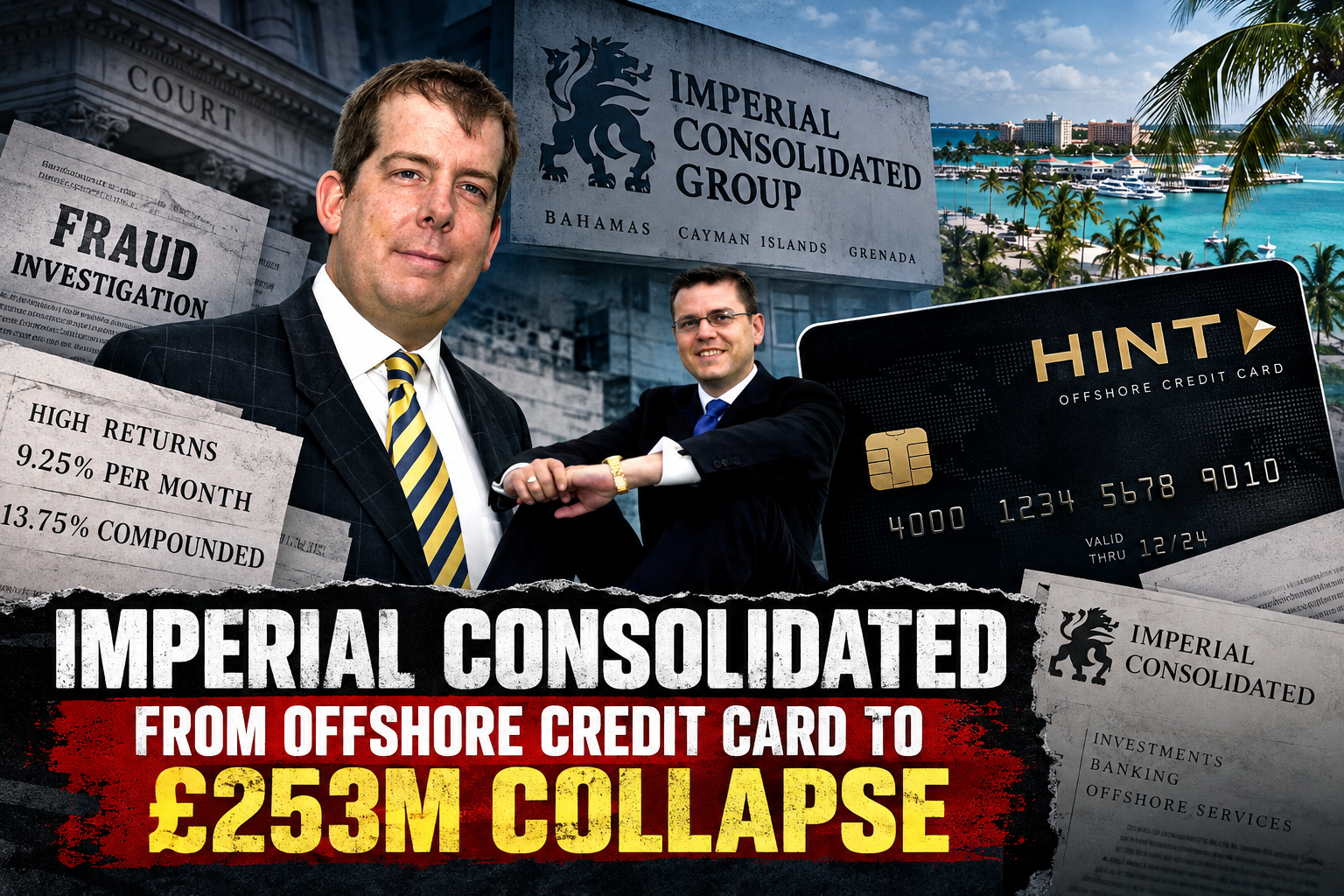
Imperial Consolidated once presented itself as an ambitious international financial group operating across offshore jurisdictions, investment management and banking. In 2000, that expansion included the launch of HINT, an offshore credit card in the Bahamas. But documents surrounding the group’s activities show that HINT was only one piece of a much broader operation that later collapsed, leaving thousands of investors facing substantial losses and triggering one of the Serious Fraud Office’s largest investment-fraud prosecutions.
Offshore Alert reported at the time that Imperial Consolidated had regional operations in the Bahamas, Cayman Islands and Grenada and had recently obtained a Class 1 offshore banking licence in Grenada under the name Imperium Bank. The same report said the group was promoting or was linked in documents to investment programs promising extraordinarily high returns, including one offering 9.25% a month while paying brokers a 40% commission.
One of the programs examined was called the Rusaust Syndicate. Documents reviewed by Offshore Alert described investments involving $2 million of promissory notes purportedly issued by Russia’s Sakhacreditbank. Letters on Imperial Consolidated letterhead offered investors 9.25% monthly returns for periods of up to 18 months, while another proposal claimed a compounded minimum return of 13.75% a month. A separate letter offered brokers $60,000 for every $150,000 investment module they introduced. By October 1997, at least $1.5 million had reportedly been raised.
The Rusaust program did not develop as promised. By early 1998, investors were being told that the program had been postponed because of weather conditions in Russia. They were offered the option of withdrawing their principal or transferring it into another fund paying a purported 5% monthly gross return while they waited. Offshore Alert reported that Rusaust never got off the ground. Documents also identified New Zealand attorney Michael Gilbert and English solicitor Michael John Harvey in connection with the program.
Imperial Consolidated disputed the central allegations. In a March 2000 response, the company said it did not operate or promote bank-guaranteed high-yield programs and described such schemes as either nonexistent or attempts to deceive investors. It said documents linking the group to such programs had been misused or rephrased by third parties. The company also said its involvement was limited to investigating purported schemes, recovering money and providing evidence to prosecutors.
That defence is important because the later legal record did not establish that every allegation published about Imperial Consolidated was true, nor did every individual named in connection with the group end up convicted. But there were serious regulatory and judicial findings surrounding the wider organisation.
In May 1999, New Zealand’s Securities Commission warned the public to exercise great care before placing money with Imperial Consolidated Securities SA and banned its advertisements. A New Zealand High Court judgment reproduced the regulator’s warning, which said the company had been promoting overseas investments without an investment statement and registered prospectus. The products were marketed with promised or targeted monthly returns ranging from 1.75% to 5%.
The group also became involved in a defamation dispute with former broker David Stewart in New Zealand. In a judgment concerning the dispute, the High Court found Stewart’s criticisms to be truthful and his opinions honestly held. The court was highly critical of documents produced by Imperial and concluded that certain documents had been backdated. Contemporary reporting said two of those documents carried the signature of Bill Godley, who later became Imperial’s chief executive.
Imperial’s founders, Lincoln Julian Fraser and Jared Bentley Brook, had their own history of regulatory trouble before the group’s collapse. In 2001, both were disqualified from acting as company directors for four years following the failure of Progressive Leisure Corporation, which had operated the Midland Grand Hotel in Blackpool and was compulsorily wound up owing £117,000.
Despite those disqualifications, administrators later alleged that Fraser and Brook continued to exercise control over Imperial. The group itself eventually went into administration in June 2002. Contemporary reporting put liabilities as high as £200 million, while later SFO proceedings focused on approximately £253 million raised from nearly 3,000 investors between 1998 and 2002.
The business model at the centre of the criminal prosecution was straightforward on paper. Investors were told their money would be deployed through UK commercial lending businesses and would generate attractive returns. According to the prosecution case later accepted against Godley, however, less than half of the money raised was actually lent through those businesses. Funds were instead used for expenses, overheads and speculative mining investments. The prosecution characterised the operation as a Ponzi scheme in which continued inflows of new investor money were necessary to sustain promised returns.
The criminal case took years to reach a conclusion. In 2004, Fraser was arrested after the SFO raided his home as part of an investigation into Imperial’s high-yield investment schemes. In 2006, the SFO charged five former insiders with conspiracy to defraud: Fraser, Brook, Godley, Nicholas Grant Fraser and Robert Statham Raven.
The first trial ended without convictions for the principal defendants. Nicholas Fraser was acquitted, while the jury could not reach verdicts on Lincoln Fraser and Jared Brook. A retrial followed. In 2010, Fraser and Brook were acquitted of one conspiracy count, while the jury again failed to reach verdicts on other charges; the judge subsequently directed their acquittals. They therefore should not be described as convicted participants in the Imperial fraud.
Godley’s outcome was fundamentally different. He pleaded guilty in 2007 to conspiracy to defraud. The High Court later recorded that his admitted conspiracy involved Imperial investment schemes and described it as a Ponzi scheme. In 2010, he received a three-and-a-half-year prison sentence. The court subsequently determined that the benefit he had obtained from the conspiracy was £1,567,974 and made a confiscation order for that amount, less an earlier £93,025 payment to Imperial’s liquidators, subject to the court’s calculation.
The wider financial damage was enormous. Contemporary estimates ranged from £150 million to £200 million in liabilities, while the SFO case referred to £253 million raised from nearly 3,000 investors. Administrators estimated that recoveries could amount to only around five pence in the pound.
Imperial was not simply one company. The group operated through numerous entities and offshore jurisdictions. The records include Imperial Consolidated Group, Imperial Consolidated Securities SA, Imperial Consolidated Australia Pty Ltd, Imperial Consolidated Financiers Ltd, Imperial Phoenix Finance Ltd, IC Mutual and Imperium Bank, among others. The HINT card was itself an important part of the group’s offshore financial-services ambitions. Its US trademark application described HINT as covering credit cards, debit cards, payment cards, financial services, lending and investment consultancy. The application was ultimately abandoned in 2001.
There were further controversies around the group’s offshore operations, including regulatory intervention involving Imperium Bank in Grenada and legal actions concerning Imperial’s funds and assets. Robert Raven, one of the executives later charged by the SFO, was also jailed for four months in 2006 for contempt of court after refusing to cooperate with administrators and liquidators seeking information about assets.
The people involved subsequently took very different paths. William Godley’s last reliably documented residence in the court record was Portugal, where he and his wife were living when confiscation proceedings were heard in 2014. Lincoln Fraser, born in May 1971, remains publicly recorded by Companies House as a British resident and, as of 2026, is an active director of several companies, including Wolds International, G4 Group, Sable Fraser and Wolds Park. Those current businesses should not automatically be treated as successors to Imperial Consolidated; the public records reviewed here do not establish that connection.
Jared Brook, born in November 1969, appears in Companies House records as a former director of several Imperial-related and mining companies. Reliable current information establishing his present activities or whereabouts is limited.
The significance of Imperial Consolidated lies in the gap between the image of an innovative offshore financial group and the consequences that followed. The HINT card was marketed as another financial-services product during a period when the group was expanding across jurisdictions and investment products. Within a few years, the group had collapsed, regulators had issued warnings, administrators were attempting to recover assets, investors faced severe losses and the SFO had mounted a complex international fraud prosecution.
The legal record also provides an important warning against oversimplification. One former executive admitted criminal wrongdoing and went to prison. Others who were charged were ultimately acquitted. Regulatory warnings and adverse judicial findings concerning particular conduct do not mean every accusation made against every Imperial executive was proved. But the combination of regulatory intervention, corporate failure, investor losses and the conviction of a senior executive demonstrates why extraordinary promised returns, opaque offshore structures and complicated guarantees deserve careful scrutiny before investors commit their money. The HINT story was ultimately not just about an offshore credit card. It was an early chapter in the much larger collapse of a financial empire whose promises proved far easier to sell than to sustain.
Source:
OffshoreAlert
————-
Disclaimer:
Some content on Reportingscams.com is published under our guest post program and is provided by third-party contributors. Reporting scams does not create, verify, or take responsibility for the views, accuracy, or claims expressed in such content.