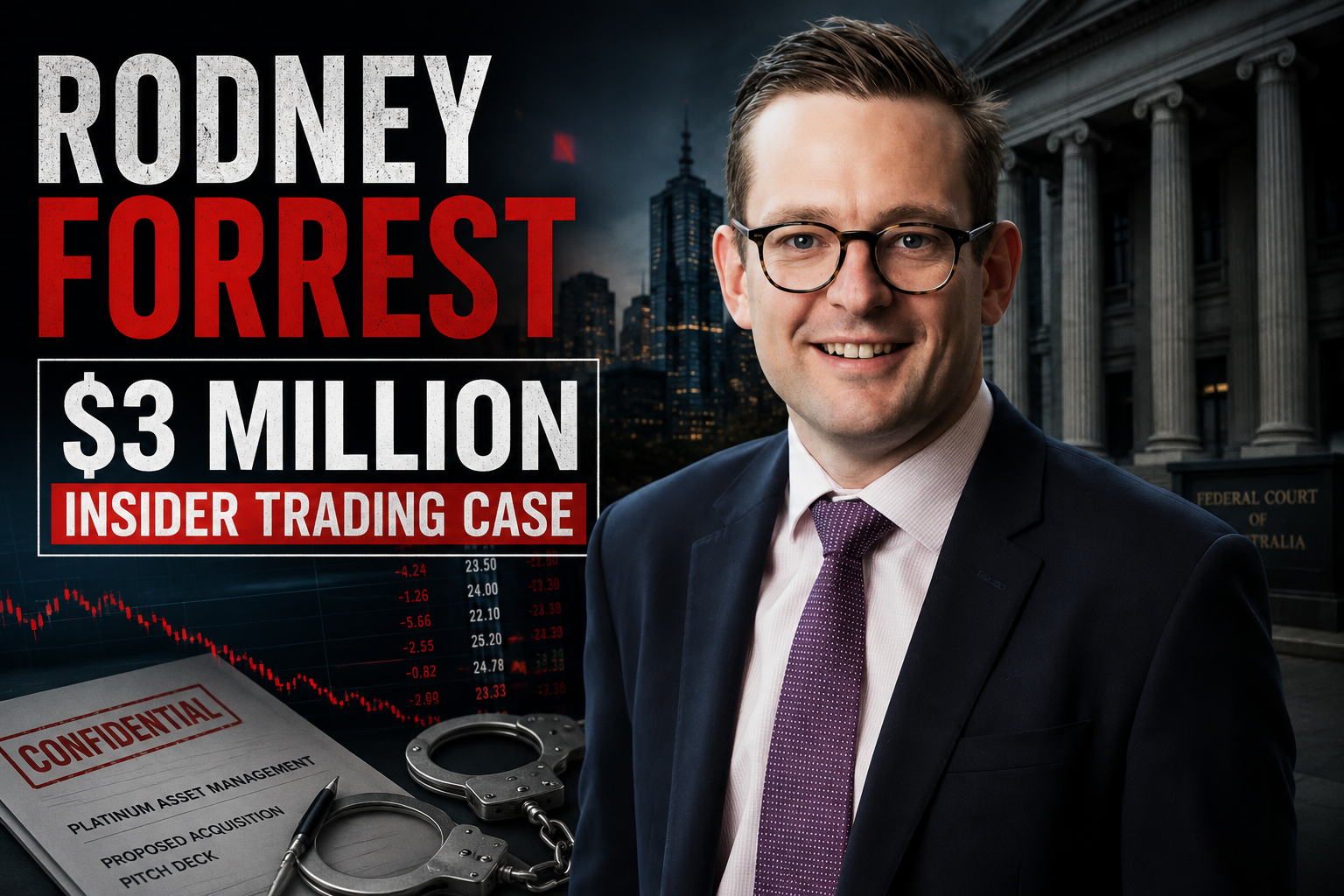
A lot of fund managers spend years convincing investors they can be trusted with other people’s money. Rodney Forrest did exactly that. Then, in the space of a few weeks, prosecutors say he threw that trust away by trading on confidential takeover information that nobody outside a small circle was supposed to know. The profits were measured in hundreds of thousands of dollars. The consequences turned out to be far more expensive.
Today, Forrest is serving a prison sentence after admitting to insider trading linked to a proposed takeover of Platinum Asset Management, one of Australia’s best-known investment firms. His case has become one of the country’s most closely watched market misconduct prosecutions, not because it involved billions of dollars or an elaborate international conspiracy, but because it showed how quickly Australia’s corporate watchdog is now willing to move when it believes someone has gained an unfair edge in the share market.
The story unfolded in 2024, when Regal Partners was exploring a possible acquisition of Platinum Asset Management. Like any takeover under discussion, the details were closely guarded. Only a limited group of executives and advisers knew what was happening behind closed doors, and Australian securities law is built on the idea that this kind of information must stay confidential until the market as a whole can receive it.
Prosecutors said Forrest found a way around that.
According to evidence presented in court, he viewed confidential documents relating to the proposed transaction while visiting Regal chairman Michael Cole. Investigators said he photographed parts of a confidential presentation, later referred to in court as the “Pitch Deck,” which outlined details of the planned deal. Those documents were never meant for him.
What happened next is what ultimately landed him before a criminal court.
Over several days in late August and early September 2024, Forrest began buying Platinum shares. The purchases were anything but small. Court records show he accumulated roughly $2.7 million worth of stock before news of the proposed takeover became public. Prosecutors also said he encouraged two other people to buy shares and arranged for another investment vehicle to purchase almost half a million dollars’ worth of Platinum stock while the information remained confidential.
When news of the proposed acquisition finally reached the market, Platinum’s share price jumped.
That is exactly the kind of situation insider trading laws are designed to prevent. Markets only work if everyone is trading on the same publicly available information. The moment someone starts buying or selling because they know something the rest of the market does not, confidence in that system starts to erode.
Authorities say Forrest’s conduct went even further than simply placing trades.
Court documents reveal he also shared confidential details about the proposed takeover with a journalist before the information became public. Whether the information eventually appeared in the media was not the central issue. Prosecutors argued that passing along confidential market-sensitive information was another serious misuse of privileged knowledge obtained through trust rather than legitimate research.
The financial gain itself was relatively modest compared with the size of the trades.
Forrest ultimately made a little over $309,000 from the transactions, money he later agreed to surrender after pleading guilty. But judges repeatedly stressed that insider trading cases are not simply about profit. Someone who earns $300,000 using secret information can do more damage to market confidence than another investor who legally makes millions through ordinary investing.
ASIC moved unusually fast.
Its market surveillance systems detected suspicious trading soon after the activity occurred. Investigators executed a search warrant at Forrest’s home later that year and seized electronic devices. Those devices, prosecutors said, contained photographs of the confidential takeover presentation along with communications that became important pieces of evidence during the investigation.
Rather than contest the allegations through a lengthy trial, Forrest admitted his guilt.
In 2025, he pleaded guilty to insider trading offences as well as operating an unlicensed financial services business through Sublime Asset Management. ASIC said Forrest had been managing investments for clients despite not holding the Australian Financial Services licence required under Australian law.
The insider trading charges remained the clear focus of the prosecution, but the licensing offence painted a broader picture of someone operating outside Australia’s regulatory framework.
When Justice Robert Bromwich sentenced Forrest, the judge rejected any suggestion that this was a momentary lapse in judgment.
The court found the offending involved planning, deliberate decision-making and a serious breach of trust. Forrest knew the information was confidential, knew he was not entitled to use it and then made a conscious decision to profit from it anyway. Those findings became central to the sentence because Australian courts have long viewed insider trading as an offence that strikes at the integrity of financial markets rather than simply harming individual investors.
Forrest was originally sentenced to six years in prison.
His lawyers later challenged that decision before the Full Federal Court, arguing the sentencing judge had placed too much weight on certain aspects of the case and had not given enough credit for Forrest’s early guilty plea.
The appeal achieved only limited success.
In May 2026, the Full Court reduced Forrest’s sentence to five years and three months. His non-parole period remained three years, meaning he will stay behind bars for several more years before becoming eligible for release. Importantly, the appeal judges did not question the seriousness of the offending itself. If anything, they reinforced it, describing the conduct as carefully planned, sophisticated and deserving of strong punishment to discourage others working in financial markets.
The appeal attracted headlines for another reason.
Australian media reported that Forrest’s legal team pointed to his personal background while arguing for a lighter sentence, including submissions referring to his appearance and the fact that he was a white man with no tattoos. The argument sparked widespread discussion after details emerged from the court proceedings, although it ultimately had little impact on the outcome.
ASIC has made no secret of why this prosecution matters.
The regulator says Forrest’s conviction demonstrates a new enforcement approach that relies heavily on advanced market surveillance and specialist investigators dedicated to insider trading. Instead of taking years to build a criminal case, ASIC wants to show that suspicious trading can now be detected, investigated and prosecuted far more quickly than many market participants may expect.
That message arrives at a time when Australian regulators are under increasing pressure to restore confidence in financial markets after years of corporate scandals, governance failures and enforcement criticism. Recent enforcement figures show ASIC has secured record financial penalties across a range of corporate misconduct matters, with insider trading remaining one of its highest priorities.
Rodney Forrest’s story is ultimately about much more than one investor making one bad decision.
Every day, millions of people put their retirement savings, pensions and investments into public markets believing the rules apply equally to everyone. Most will never meet the executives negotiating billion-dollar acquisitions or see confidential presentations before they become public. They trust that nobody else gets that privilege either.
That trust is fragile.
Once investors begin to believe that insiders are quietly making money before everyone else even knows a deal exists, confidence disappears quickly. Markets become less fair, honest investors become more cautious and the entire system starts to suffer.
That is why this case continues to attract attention long after the trades themselves were made. The dollar figures may never rank among Australia’s largest financial crimes, but the principle behind the prosecution could not be much bigger. In the eyes of regulators and the courts, protecting confidence in the market is every bit as important as punishing those who break its rules. And in Rodney Forrest’s case, they were determined to send that message loudly.
————-
Disclaimer:
Some content on Reportingscams.com is published under our guest post program and is provided by third-party contributors. Reporting scams does not create, verify, or take responsibility for the views, accuracy, or claims expressed in such content.