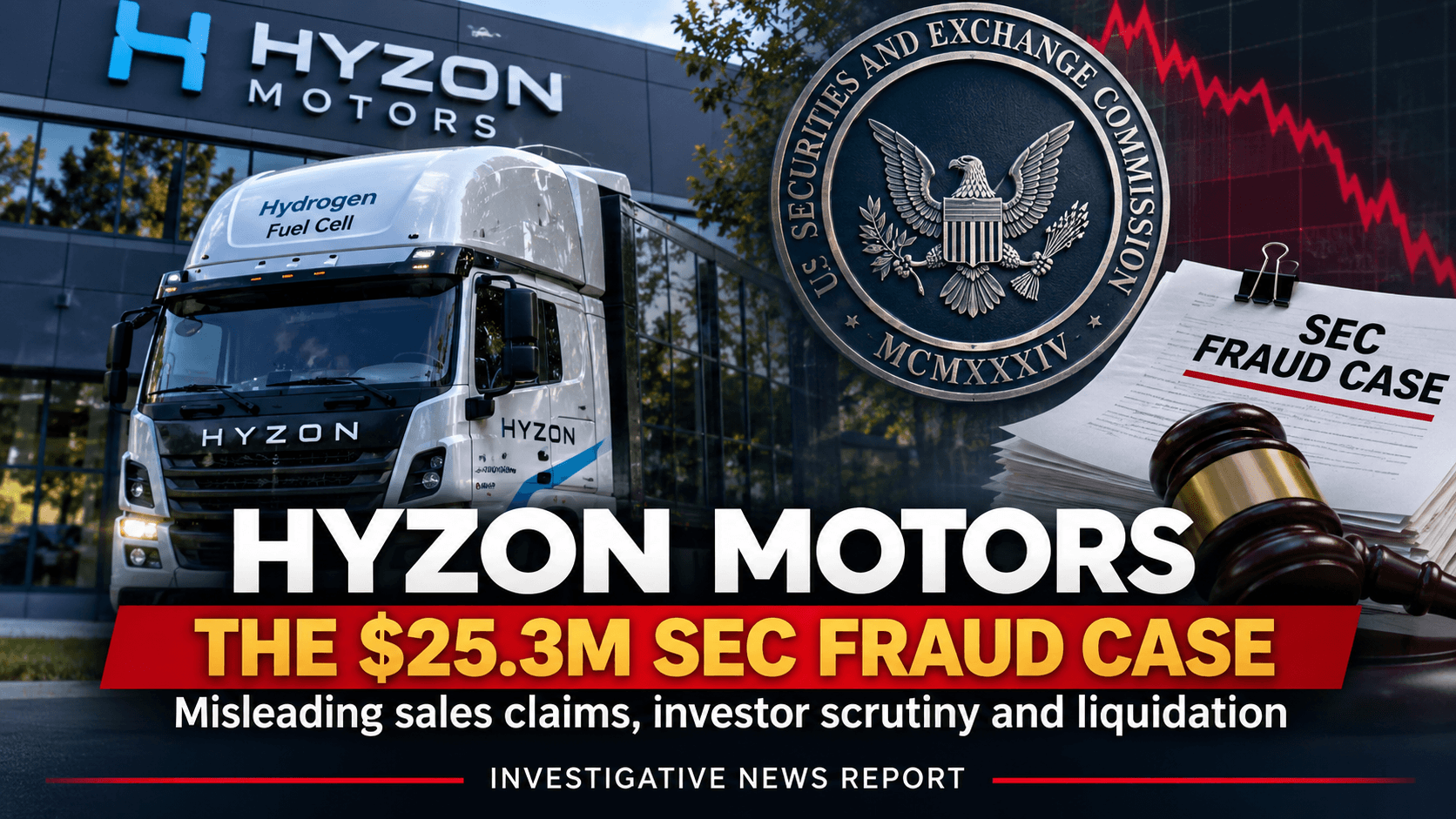
Hyzon Motors’ hydrogen vehicle promises were once central to an ambitious plan to build a major business around zero-emission commercial transportation. The company entered the public markets in 2021 with an estimated valuation of approximately $2.1 billion and access to around $600 million in capital. Investors were being offered a picture of a business with major commercial relationships, growing vehicle orders and an expanding international footprint. But the company’s reported progress would later become the subject of a major SEC fraud investigation.
On September 26, 2023, the SEC announced settled fraud charges against Hyzon Motors Inc., its former chief executive Craig M. Knight and former European subsidiary managing director Max C.B. Holthausen. The regulator accused the company and its executives of misleading investors about customer and supplier relationships, exaggerating vehicle sales and presenting an inaccurate picture of its commercial progress. The case stemmed from statements made before and after Hyzon’s July 2021 merger with Decarbonization Plus Acquisition Corporation, a special purpose acquisition company, or SPAC.
The scale of the capital involved makes the allegations particularly important. Hyzon and the SPAC announced their proposed merger in February 2021, valuing the combined business at approximately $2.1 billion. The transaction closed on July 16, 2021, following shareholder approval, giving the company access to approximately $600 million. Around $200 million came from the SPAC’s funds, while another $400 million was raised through a private investment in public equity, commonly known as a PIPE transaction. The SEC alleged that Hyzon’s presentations to prospective investors overstated the progress of commercial relationships at a time when the company was seeking this substantial investment.
The SEC complaint described several customer relationships that it said had been presented more positively than the underlying discussions justified. One prospective customer, identified in the complaint as Company-3 and described as a beverage company, was reportedly presented as being in advanced discussions for vehicle deliveries. Hyzon’s investor materials projected more than 500 vehicle deliveries and over $200 million in revenue from the relationship over five years. The SEC said the customer had never indicated an intention to purchase Hyzon vehicles. At most, the discussions had involved introductory meetings with the company and its affiliates.
Another prospective customer, identified as Company-4, was described in early investor materials as being close to finalising a $1 million contract for two vehicles. According to the SEC, the prospective customer’s transportation affiliate had already communicated by June 2021 that it would not proceed with the project. Nevertheless, subsequent investor presentations continued to describe the relationship as an active contract opportunity. The regulator also questioned claims about relationships with two potential chassis suppliers, stating that the parties had not even reached the stage of negotiating supply arrangements.
Former CEO Craig Knight was specifically named in connection with these disclosures. According to the SEC, Knight provided information about customer and supplier relationships to the people preparing Hyzon’s investor presentations. He also reviewed, edited and approved the statements before they were circulated and filed. The regulator argued that he knew, or should have known, that certain descriptions did not reflect the actual status of the discussions.
The complaint also raised a separate issue involving Knight’s personal shareholdings. The SEC alleged that he pledged some of his Hyzon shares to finance the purchase of additional shares, without informing the company as required under an agreement connected to the capital-raising process. The regulator further alleged that he sought to increase his holdings to support Hyzon’s share price following negative reporting about the company. It said the pledge should also have been disclosed in a questionnaire associated with the company’s 2022 proxy statement. These allegations formed part of the SEC’s civil case against him.
The controversy became more complicated after Hyzon announced that it had delivered its first fuel-cell electric vehicle in July 2021. The company presented the vehicle as a hydrogen-powered milk truck intended for a European dairy customer. Promotional material included a video that gave viewers the impression that the truck was operating on hydrogen. The SEC alleged that the vehicle was not equipped to operate on hydrogen power at the time. Max C.B. Holthausen, then managing director of Hyzon Motors Europe, was accused of being responsible for the misleading delivery announcement despite knowing the vehicle was not operational on hydrogen.
The vehicle sales figures subsequently became an even bigger problem. Hyzon reported that it had sold 87 fuel-cell electric vehicles during 2021, comprising five vehicles in Europe and 82 in China. Its financial statements attributed approximately $2.2 million in revenue to the European sales and approximately $3.8 million to the Chinese business. These figures helped communicate the impression that the company had begun converting its technology into meaningful commercial revenue.
However, the SEC alleged that none of the 87 vehicles qualified as completed sales in 2021. In Europe, the five vehicles were owned by customers and had been sent for hydrogen fuel-cell retrofitting. Hyzon Europe did not own the vehicles and therefore could not properly report them as vehicles it had sold. In China, many of the 82 vehicles were not operational on hydrogen power when they were delivered. According to the complaint, some were returned to the manufacturer after year-end so that the necessary work could be completed.
The company’s own internal investigation had already exposed serious accounting and operational problems before the SEC announced its charges. Management raised concerns in July 2022 about whether certain Chinese vehicle deliveries met the requirements for revenue recognition. A special committee was subsequently formed to investigate the company’s China operations, accounting practices and internal controls. Its findings confirmed that certain vehicles had not been commissioned when initially delivered. Hyzon eventually reversed the revenue previously recognised on all 87 vehicles and restated its financial statements in March 2023. The company also acknowledged weaknesses in its oversight of the Chinese operations.
Hyzon’s problems had begun attracting outside scrutiny even earlier. On September 28, 2021, short-selling investment firm Blue Orca Capital published a report questioning the company’s customer relationships, particularly its announced business with Shanghai Hydrogen Hongyun Automotive Co. Blue Orca disclosed that it held a short position in Hyzon shares and questioned whether the Chinese customer was a genuine commercial buyer. The report alleged that the entity had been established shortly before the announcement of a deal involving 500 fuel-cell vehicles. Hyzon rejected Blue Orca’s accusations and defended its business relationships.
The dispute subsequently reached the SEC. On January 12, 2022, Hyzon disclosed that it had received an SEC subpoena seeking documents and information relating to the allegations in Blue Orca’s report. The company said it was cooperating with the regulator. Reuters reported that Hyzon shares fell following the announcement. It is important to distinguish this earlier short-seller report from the later SEC case: the regulator’s 2023 complaint contained its own allegations and findings, including issues concerning the 87 reported vehicle sales and the European delivery announcement.
The fallout also extended into shareholder litigation. Three related securities class-action lawsuits were filed between September and November 2021, alleging that Hyzon and certain current and former executives and directors made misleading statements about customer contracts, vehicle orders and financial projections. The cases were consolidated, and investors pursued claims involving the company’s public disclosures during the period surrounding the SPAC transaction. The case was still listed as ongoing in the Stanford Securities Class Action Clearinghouse’s July 28, 2025 review. Hagens Berman, the law firm representing the lead plaintiff, also lists the litigation as active and identifies Craig Knight, former CFO Mark Gordon and other former company and SPAC figures among the defendants. These are separate civil claims, not criminal convictions.
The SEC’s enforcement action resulted in a substantial financial penalty. Hyzon agreed to pay $25 million, Knight $100,000 and Holthausen $200,000, bringing the combined civil penalties to $25.3 million. Knight and Holthausen also agreed to five-year and ten-year prohibitions, respectively, on serving as officers or directors of publicly traded companies. Knight and former CFO Mark Gordon separately reimbursed Hyzon $252,000 and $122,500 in bonuses received during the 12-month period after the company misstated its financial statements. The SEC explicitly stated that Gordon was not charged with misconduct in its complaint.
The settlements were reached without the defendants admitting or denying the SEC’s allegations. They were nevertheless converted into court judgments in January 2024. Hyzon was ordered to pay its $25 million penalty in three instalments, while Knight and Holthausen were ordered to pay their penalties separately. The two former executives paid their amounts in full. The SEC subsequently established a Fair Fund in July 2024 to hold collected penalties for potential distribution to investors harmed by the conduct described in the complaint. The $25.3 million was therefore not simply a private settlement payment to the company; it was a regulatory penalty intended to support a court-supervised investor distribution process.
The company’s commercial decline continued after the enforcement case. In June 2024, Hyzon began a strategic realignment focused on North American heavy-duty truck and refuse vehicle markets. It subsequently announced plans to wind down operations in the Netherlands and Australia. In December 2024, its board approved a proposed transfer of substantially all company assets through an assignment for the benefit of creditors, alongside liquidation and dissolution. The company said it had explored strategic alternatives with outside advisers but had not identified a viable option.
The executive departures continued. Parker Meeks, who had served as CEO since April 2023, resigned on February 4, 2025. The company appointed its then chief technology officer, Dr. Christian Mohrdieck, as president and acting CEO. Meanwhile, Nasdaq moved to delist Hyzon’s securities, citing the proposed dissolution and related public-interest concerns. Shareholders ultimately approved the assignment and dissolution proposals on March 25, 2025. The company reported that approximately 56% of the outstanding voting power of its Class A common stock and Series A preferred stock had voted in favour.
The latest major development located in the public record is the move towards an assignment for the benefit of creditors and liquidation. A legal filing dated August 29, 2025, in related Delaware proceedings describes Hyzon and certain affiliates executing a general assignment on April 7, 2025, to Hyzon ABC, followed by the filing of a petition for an assignment for the benefit of creditors. The company’s shareholder-approved dissolution plan and the subsequent creditor process should not be confused with a criminal bankruptcy conviction or a finding of criminal fraud. The available record does not establish such a conviction.
The Hyzon case is a reminder that a company’s projected orders, strategic partnerships and delivery announcements are not the same as completed commercial transactions. Investors in emerging industries often have to evaluate businesses whose technology is still developing and whose revenue models have yet to mature. That makes accurate reporting of customer commitments, operational readiness and actual sales particularly important. Hyzon’s experience demonstrates what can happen when the distance between an ambitious investor presentation and the underlying commercial reality becomes a regulatory issue. For investors, the lesson is straightforward: a promising technology cannot compensate for unreliable disclosures, and confidence in a company’s future must ultimately be supported by verifiable performance.
————-
Disclaimer:
Some content on Reportingscams.com is published under our guest post program and is provided by third-party contributors. Reporting scams does not create, verify, or take responsibility for the views, accuracy, or claims expressed in such content.