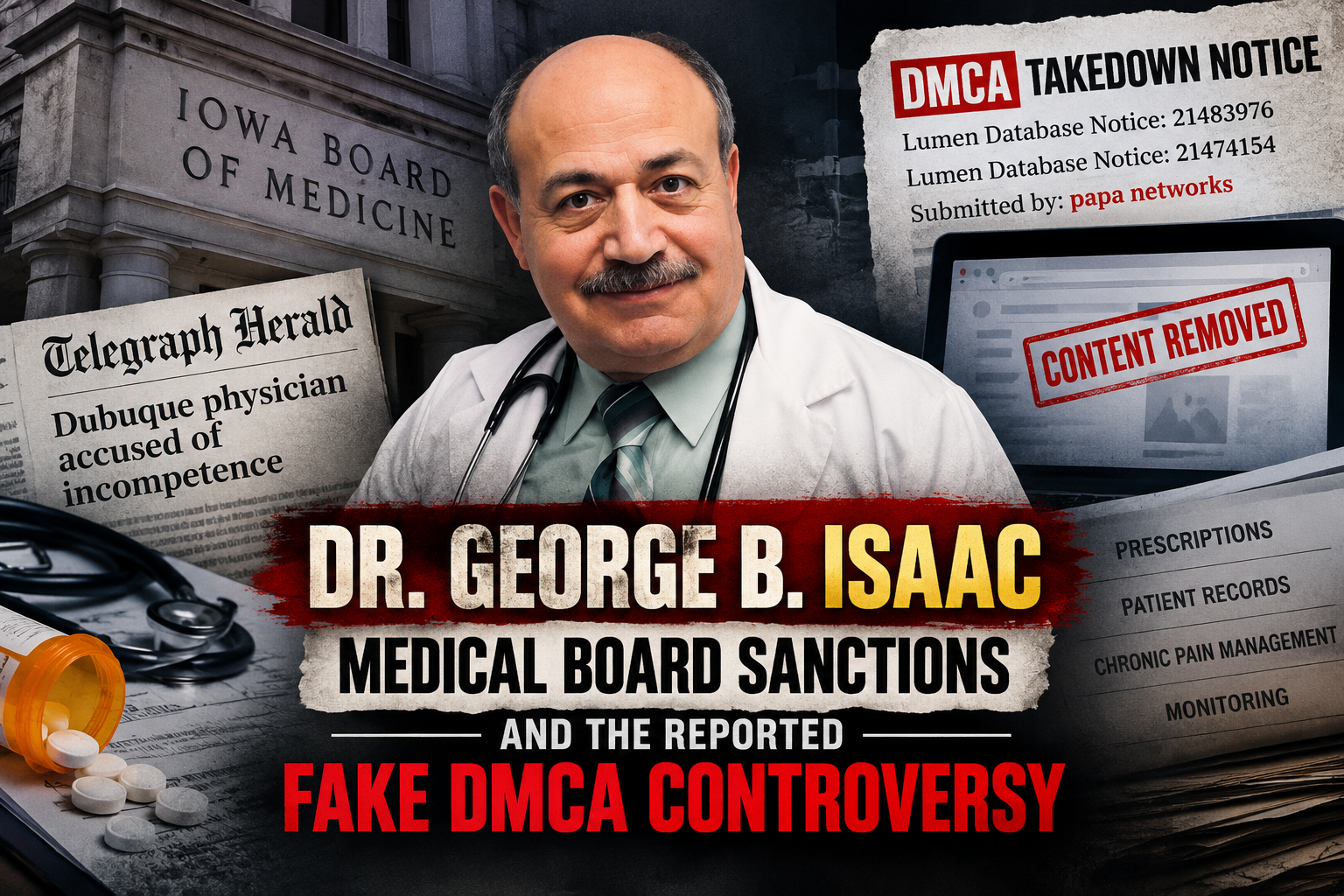
Dr. George B. Isaac, a rheumatologist associated with Dubuque, Iowa, became the subject of a professional disciplinary case after state regulators accused him of deficiencies in patient care, prescription management and medical recordkeeping. The dispute resulted in a 2022 settlement requiring a $5,000 civil penalty, additional education and two years of monitoring of his prescribing practices. But the medical-board case is only part of the story surrounding the public record about Isaac. A separate report published by Gripeo in September 2023 raised questions about two copyright takedown notices associated with reporting on the physician, describing them as potentially fraudulent DMCA requests. Those copyright allegations have not been independently established by the material reviewed here, and they must be distinguished from the documented medical disciplinary outcome. Together, the two matters raise different but important questions about professional accountability, public-interest reporting and the use of online mechanisms to restrict access to information.
Isaac is identified professionally as George B. Isaac, MD. His listed medical background includes training at Damascus University School of Medicine in Syria, residency training at Woodhull Medical and Mental Health Center in Brooklyn, an internship at St. Francis Hospital of Evanston in Illinois, and a rheumatology fellowship at the State University of New York Health Science Center. His professional profile has associated him with rheumatology practice in Dubuque and Finley Hospital. These credentials establish his background as a practising medical professional, but a current provider listing alone does not confirm his precise employment status or licence.
The medical-board dispute concerned patient treatment dating from 2010 through 2015. On December 15, 2017, the Iowa Board of Medicine filed a statement of charges accusing Isaac of professional incompetence and violations of standards governing medical practice. According to Iowa Capital Dispatch, the allegations included prescribing medications such as Adderall, dextroamphetamine, Meridia and Nuvigil or Provigil without adequately documenting the diagnoses supporting their use or providing appropriate monitoring. These medications serve different purposes and carry different risks, making a clear clinical rationale and appropriate follow-up important elements of responsible prescribing. The allegations were serious, but they were professional disciplinary charges, not criminal convictions.
The board’s concerns extended beyond particular prescriptions. Regulators alleged that Isaac failed to maintain accurate, complete and timely patient records and did not adequately discuss or document potential risks and drug interactions for patients taking narcotics, sedatives or antidepressants. They also alleged that he did not sufficiently coordinate care when patients received narcotics from other providers. Additional allegations concerned chronic pain management and whether alternatives to medication, including physical therapy, exercise, weight management and other appropriate interventions, had been explored or recommended. These issues go to the heart of medical oversight: treatment decisions should have a documented clinical basis, medication risks should be assessed, and clinicians should communicate when multiple providers are treating the same patient. The available reporting does not establish that every prescription or treatment Isaac provided was improper.
Isaac disputed the case and publicly challenged the regulator’s handling of it. In a statement dated October 17, 2019, he described the allegations as unfounded and argued that the proceedings had been unfair. He said the matter originated with a complaint in August 2015 concerning a prescription refill and maintained that he had cooperated with investigators by providing requested records, including information from Iowa’s Prescription Monitoring Program. He also cited testimony from reviewers that he said supported his clinical judgment and prescribing practices. Those assertions are important to understanding his defence, but they remain his account of the dispute rather than an independent determination that the board’s allegations were false.
In February 2022, the Iowa Board of Medicine reached a settlement with Isaac. The terms, as reported by Iowa Capital Dispatch, included a warning, a $5,000 civil penalty, board-approved educational courses in chronic pain management and recordkeeping, and two years in a physician-monitoring programme during which his prescribing practices would be subject to periodic audits. The settlement was the formal regulatory outcome of the case. The available reporting does not establish that Isaac was criminally prosecuted or convicted in connection with these allegations, nor does it identify a quantified amount of patient financial losses or compensation. The $5,000 figure was a civil penalty, not a documented calculation of damages or illicit gains.
A separate controversy emerged in Gripeo’s September 18, 2023 report, titled “Dr George B. Isaac Professional Enough? (Reported Fake DMCA).” The report identified two Lumen Database entries, notice numbers 21483976 and 21474154, associated with a Telegraph Herald article about the medical-board allegations and a Blogger page reproducing a version of the report. Gripeo listed “papa networks” as the submitter and gave July 18 and July 20, 2020, as the submission dates. It characterised the notices as fake and questioned whether the submitter had legitimate copyright rights in the material.
The distinction between a copyright complaint and a proven fraudulent complaint is critical. The Digital Millennium Copyright Act, commonly known as the DMCA, provides a process through which copyright holders can request the removal or disabling of access to material they believe infringes their rights. A takedown notice is not, by itself, a court ruling that infringement occurred. Likewise, the existence of a notice does not prove that its sender knowingly made a false claim. Establishing a fraudulent or abusive takedown would require examining the specific material claimed as copyrighted, the identity and authority of the claimant, the statements made in the notices and the circumstances in which they were submitted.
Gripeo went further, suggesting that the notices were connected to efforts to suppress unflattering reporting and discussing a possible relationship with reputation-management services. Its report also referred to Level One Robotics and Controls. However, the material reviewed for this article does not independently establish that Isaac personally requested, authorised or knew about the notices, nor does it establish that any named company acted on his behalf. A beneficiary named or identified in a complaint-oriented publication should not automatically be treated as the person responsible for submitting it. Without independently verified evidence linking Isaac to the submissions, attributing the takedowns to him as an established fact would go beyond what the available record supports.
The original Telegraph Herald report is relevant because it covered the 2017 medical-board charges, including the allegations concerning patient care and prescribing. The Blogger URL identified by Gripeo reproduces a version of that reporting, but the page’s current availability and the underlying copyright claims require separate verification. The two Lumen notices are the appropriate starting points for checking what was submitted, what material was targeted and who was identified as the claimant or sender. Direct access to those notice records was not available during this review, so the details reported by Gripeo should be treated as attributed claims rather than independently confirmed findings.
The medical-board case and the DMCA controversy therefore need to remain analytically separate. The first ended in a documented regulatory settlement with a financial penalty, educational requirements and monitoring. The second concerns Gripeo’s allegations about online copyright complaints and the possible restriction of reporting about a matter of public interest. The evidence reviewed does not establish a criminal conviction for fraud, a court finding that the DMCA notices were fraudulent, or Isaac’s personal involvement in submitting them. Nor does it establish that the medical-board allegations were fabricated simply because Isaac disputed them.
The broader public-interest issue is nevertheless significant. Patients need confidence that physicians document treatment decisions, manage prescription risks and coordinate care appropriately. At the same time, the public needs access to accurate reporting about professional discipline, and legitimate copyright procedures should not be misused to silence lawful journalism. Those principles depend on evidence, transparency and due process. Isaac’s disciplinary settlement is part of the documented record; Gripeo’s claims about the takedown notices warrant scrutiny but should not be mistaken for adjudicated findings. The responsible conclusion is neither to dismiss the questions nor to turn them into proven accusations. It is to establish who submitted the notices, what rights they claimed and whether the evidence supports the allegation of deliberate misuse. Until those questions are answered, accuracy requires keeping documented outcomes, disputed claims and unanswered questions clearly apart.
What are they trying to hide?
Here are some key excerpts from Telegraph Herald regarding the allegations against Dr. George B. Isaac, followed by the reported DMCA takedown controversy.
The Iowa Board of Medicine filed a statement of charges against Dr. George B. Isaac, who practised rheumatology in Dubuque, Iowa. The charges concerned alleged deficiencies in patient care and professional standards between 2010 and 2015.
The board alleged that Isaac demonstrated professional incompetence and deficiencies in pain management. The concerns included prescription decisions, patient monitoring and whether the medical records adequately documented the clinical reasons for treatment.
Isaac was also accused of inadequate medical recordkeeping and insufficient documentation of risks associated with combinations of narcotics, sedatives, muscle relaxants and antidepressants. The allegations further concerned coordination with other healthcare providers and consideration of non-drug treatment options, including physical therapy, exercise and weight management.
————-
Disclaimer:
Some content on Reportingscams.com is published under our guest post program and is provided by third-party contributors. Reporting scams does not create, verify, or take responsibility for the views, accuracy, or claims expressed in such content.