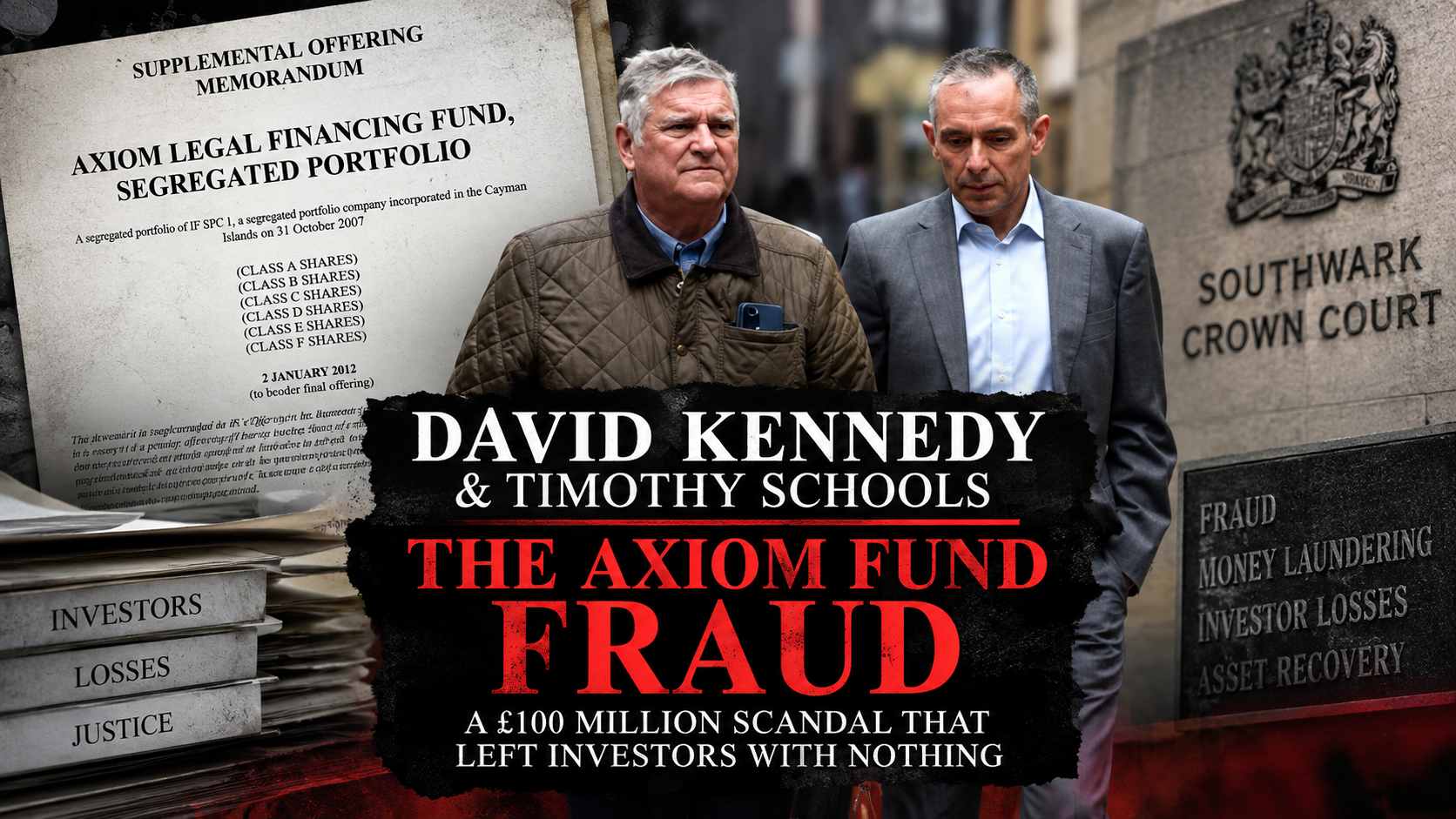
David Kennedy’s name has remained tied to one of Britain’s most complicated legal-finance fraud cases long after the investment fund at the centre of it collapsed. Once presented as an investment manager helping finance no-win-no-fee litigation, Kennedy is now serving an eight-year prison sentence after being convicted of fraudulent trading in connection with the Axiom Legal Financing Fund, a Cayman Islands-registered investment vehicle that attracted more than £100 million from hundreds of investors.
Kennedy was 71 when he was convicted in May 2024, making him 73 or 74 in 2026 depending on his date of birth, which has not been reliably established in the public record reviewed for this report. He was described by prosecutors and court reporting as a former financial adviser and investment manager. No credible source reviewed identifies a separate professional alias used by Kennedy. His most significant business association was with former solicitor Timothy Schools, with whom he managed Axiom for more than two years.
The proposition offered to investors appeared straightforward. Axiom said it would lend money to UK law firms pursuing no-win-no-fee cases, with the expectation that successful litigation would generate enough money to repay the loans and produce returns for investors. Court reporting from the original prosecution said investors were offered projected returns of roughly 10% to 11% a year and told that cases had a projected success rate of more than 95%. The SFO later said the cases being funded were often high-risk, had not been independently vetted and frequently failed in court.
The scale of the operation was substantial. The SFO describes it as a £100 million investment fraud involving hundreds of people who lost their savings. Other contemporary court reporting put the fund’s value at approximately £120 million before its collapse. Legal Futures reported that the fund entered receivership in February 2013 owing investors around £120 million.
At the heart of the prosecution was the way money was allegedly moved through the businesses connected to the fund. Prosecutors argued that Axiom did not operate in the independent manner presented to investors. In its first year, court evidence showed that loans went to ATM Solicitors, a law firm controlled by Schools. Later, money was advanced to other firms in which Schools had interests. Ashton Fox Solicitors, which later became one of the most important borrowers, was described in court as owing the fund tens of millions of pounds.
Kennedy’s own financial benefit became one of the most important parts of the criminal case. The SFO said it established that more than £5.8 million was diverted from Axiom for Kennedy’s personal benefit. Investigators said the money helped fund assets and expenses including a Swiss ski-resort chalet, a villa in Tenerife and renovations to his home in Hull, with funds concealed through offshore bank accounts and complex trusts.
The prosecution did not end in a single trial. Kennedy was originally tried alongside Schools and Richard Emmett at Southwark Crown Court in 2022. The jury convicted Schools but failed to reach a verdict on the single fraudulent-trading charge against Kennedy. Emmett, who had been accused of offences concerning funds connected to his law firm, was acquitted. Kennedy therefore remained subject to the possibility of a retrial rather than being cleared of the allegation.
That retrial eventually produced the decisive result. On May 3, 2024, the SFO announced that Kennedy had been convicted of fraudulent trading. The prosecution said Kennedy had used investor money to fund thousands of high-risk legal cases that were not independently vetted, while few investors received meaningful returns.
Kennedy was sentenced at Southwark Crown Court on June 7, 2024, receiving eight years in prison. He was also disqualified from acting as a company director for 15 years. By the time of the latest credible reporting, he was serving that sentence in custody in the United Kingdom. No reliable public source reviewed for this article identifies the prison in which he is currently held, and there is no evidence in the sources reviewed that he is currently operating a new investment business.
The case against Kennedy cannot be separated from the prosecution of Schools. Schools was convicted in 2022 on five counts involving fraudulent trading, fraud and transferring criminal property and received a 14-year sentence. The judge described the Axiom scheme as fraudulent “more or less from the start.” Schools was also disqualified from being a company director for 15 years.
The wider corporate network surrounding Axiom was extensive. It included Axiom itself, investment manager Tangerine Investment Management, the earlier investment-management vehicle The Synergy Solution, loan manager Synergy (IOM), law firms including ATM Solicitors, Ashton Fox Solicitors, Tandem Law, Bracewell Law and Signey Law, and companies associated with Schools and other insiders. Regulatory proceedings involving several lawyers and law firms followed the collapse. A Solicitors Disciplinary Tribunal judgment records that Tangerine succeeded Synergy as investment manager and that Schools owned both investment-management companies.
The consequences extended beyond investors. Law Gazette reported that the collapse affected approximately 35,000 clients whose legal cases depended on Axiom financing. Several law firms dependent on the fund subsequently encountered serious financial difficulties, while disciplinary proceedings affected solicitors connected to the network.
Kennedy did not admit wrongdoing in the original prosecution. During the 2022 trial he denied the fraudulent-trading allegation. After the jury failed to reach a verdict, he was retried and convicted in 2024. There was therefore no settlement or plea in place of the conviction. The conviction remains the central legal finding against him.
There was also an unusual post-conviction episode. In May 2024, days after Kennedy’s conviction, OffshoreAlert reported receiving a cease-and-desist email from a person identifying himself as Kojo Menne Asamoah of Hardpink Legal and claiming to represent Kennedy. The letter demanded removal of OffshoreAlert material reporting the conviction and threatened further legal action. It also contained a threat that disruption of OffshoreAlert’s hosting and security services would continue if the article was not removed.
OffshoreAlert separately reported that its website had suffered a prolonged cyberattack around the same period and that its publisher’s home had been subjected to a false emergency report, or “swatting.” Crucially, the publication itself said it could not determine whether Kennedy was connected to either incident, particularly because he was already in custody. The cease-and-desist letter is therefore evidence that someone claiming to act for Kennedy attempted to challenge publication; it is not evidence that Kennedy ordered or participated in any cyberattack.
The latest chapter has focused on money rather than guilt. In December 2025, the SFO secured a £928,479.89 confiscation order against Kennedy. Investigators traced assets including properties in Hull and Tenerife, Spanish bank accounts, a pension fund and several vehicles. The court ordered the money to be returned to victims, while Kennedy was given three months to satisfy the order or face the possibility of up to another six and a half years in custody.
As of September 2026, the public record reviewed here still identifies Kennedy as serving his eight-year sentence. The SFO’s publicly available updates through 2026 do not disclose a new criminal prosecution against him, nor do they establish whether the full confiscation order has been paid. What remains clear is that the Axiom case has outlived the fund itself: investors lost more than £100 million, criminal convictions followed, millions of pounds in assets have been pursued, and recovery efforts continue years after the original collapse.
The broader lesson is not simply that a financial scheme can fail. Axiom was built around a proposition that sounded attractive precisely because it appeared to combine investment returns with the seemingly concrete world of legal claims. The eventual criminal case showed how difficult it can be for investors to see what is happening behind layers of funds, managers, law firms, offshore structures and related-party transactions. For those who trusted the promise of secure returns, the distinction between a sophisticated investment product and a dangerous concentration of undisclosed conflicts became painfully expensive. More than a decade later, the effort to recover even a fraction of the money demonstrates how much harder it is to rebuild losses than it is to move money out of a fund in the first place.
Source:
OffshoreAlert
————-
Disclaimer:
Some content on Reportingscams.com is published under our guest post program and is provided by third-party contributors. Reporting scams does not create, verify, or take responsibility for the views, accuracy, or claims expressed in such content.