On Wall Street, confidentiality agreements are a normal part of doing business. Investment firms protect trading strategies, investor information, proprietary research and commercially sensitive material. But there is a legal boundary between protecting a company’s secrets and preventing employees from reporting possible wrongdoing to regulators. In September 2023, the Securities and Exchange Commission (SEC) concluded that one of America’s best-known quantitative investment firms had crossed that boundary.
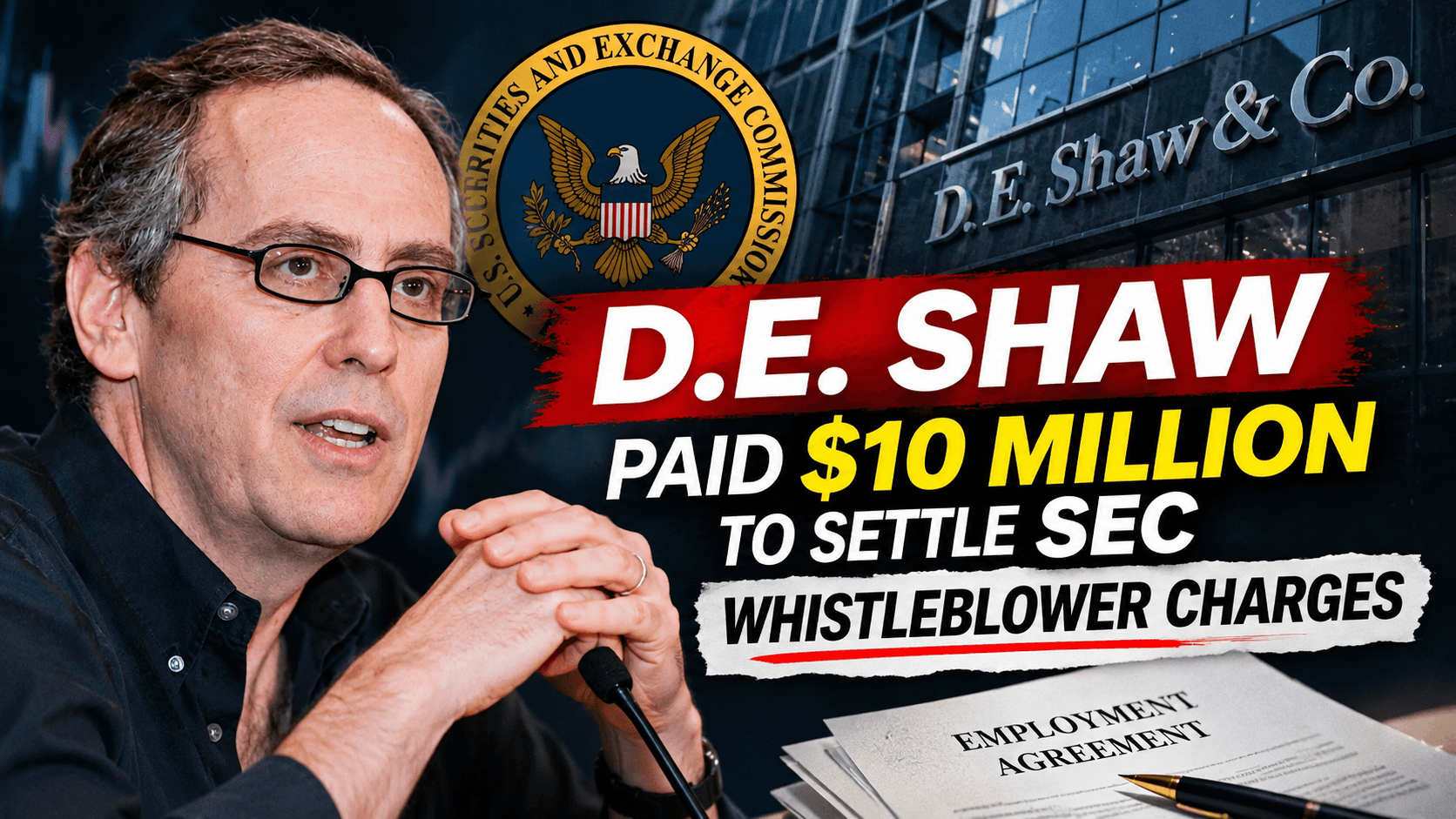
The firm was D. E. Shaw & Co., L.P., the New York-based investment adviser behind the D. E. Shaw Group. On September 29, 2023, the SEC announced that the company had agreed to pay a $10 million civil penalty to settle charges that its employment and departure agreements created obstacles for employees who wanted to report potential securities-law violations. The case was particularly significant because the SEC’s findings covered practices that had continued across multiple years, despite the regulator’s whistleblower-protection rules being in force since 2011.
D.E Shaw was not accused in this proceeding of stealing investor money, operating a Ponzi scheme or committing securities fraud. The regulatory finding concerned something different: the way the company drafted agreements that employees were expected to sign when joining or leaving the organisation. Nevertheless, the enforcement action raised an important question for the wider financial industry: can an employee genuinely exercise their legal right to report misconduct if their employment documents appear to restrict what they can disclose?
Founded in 1988 by mathematician and computer scientist David E. Shaw, the D. E. Shaw Group began with six employees and approximately $28 million in capital. It developed into a major quantitative investment organisation, using mathematics, computer science, statistical modelling and technology to identify investment opportunities. The firm became known for its systematic trading strategies and hedge fund operations, eventually expanding into a global organisation with offices and affiliated businesses in several countries.
David Elliot Shaw, commonly known as David E. Shaw, is the founder whose initials form the firm’s name. He earned a PhD from Stanford University in 1980 and previously worked in Columbia University’s computer science department before moving into computational finance. He is also a prominent figure in computational biochemistry. According to the company’s current leadership information, Shaw remains involved in certain high-level strategic decisions affecting its investment management businesses, but does not oversee everyday operations. Most of his professional time is devoted to D. E. Shaw Research, where he works as chief scientist on computational biochemistry. He also holds academic appointments at Columbia University.
The distinction between the founder and the legal entity involved in the SEC case matters. The September 2023 proceeding named D. E. Shaw & Co., L.P. as the respondent. It did not charge David E. Shaw personally, and the SEC order did not establish that he personally drafted, approved or enforced the agreements in question. The firm’s operations are overseen by an executive committee rather than being managed exclusively by its founder.
The SEC’s investigation focused on two sets of documents. The first involved employment agreements that new employees were required to sign. According to the regulator’s September 29 order, from at least August 12, 2011, until April 2019, these agreements restricted employees from disclosing confidential information to people outside the company unless D. E. Shaw authorised the disclosure or it was required by law or an order from a court or regulatory body.
The definition of confidential information was particularly broad. It covered information concerning investors, clients, limited partners, joint ventures and customers, along with financial information such as revenues, expenses and net income. It also included information obtained during employment that could reasonably be expected to be damaging to the D. E. Shaw Group if disclosed to outsiders. The restrictions continued even after an employee left the company.
The problem, according to the SEC, was that the agreements did not expressly protect an employee’s right to voluntarily communicate with the Commission about possible securities-law violations. An employee reading the documents could reasonably have been concerned that sharing internal information with the SEC might violate contractual confidentiality obligations.
The second issue involved departing employees. From at least August 2011 through June 2023, D. E. Shaw required approximately 400 former employees to sign general releases affirming, among other things, that they had not filed complaints with any governmental agency, department or official. These declarations were connected to the receipt of deferred compensation and other post-employment benefits, which could sometimes be worth millions of dollars.
This was not simply a routine acknowledgement that an employee had returned company property or completed an exit procedure. The SEC objected to the connection between the declaration and the financial benefits. An employee who had filed a complaint, or who was considering reporting potential misconduct, could perceive that doing so might jeopardise compensation they had already earned or expected to receive.
That distinction was central to the regulator’s case. Federal securities law protects the ability of individuals to communicate directly with the SEC about possible violations. Rule 21F-17(a) of the Securities Exchange Act of 1934 specifically prohibits companies from taking measures that impede such communication, including through the enforcement or threatened enforcement of confidentiality agreements.
The rule does not mean that employees can freely publish trade secrets or disclose every piece of confidential business information. It means that contractual confidentiality provisions cannot be used to obstruct legally protected communications with the securities regulator. The SEC has repeatedly pursued companies over agreements that could discourage employees from coming forward, even where there is no established finding that a particular employee was ultimately prevented from reporting misconduct.
- E. Shaw’s response was also part of the SEC’s findings. In 2017, the firm circulated a company-wide email informing employees that its policies and agreements did not prevent them from communicating with regulators about potential violations of law without first notifying the company. It also updated internal policies, including relevant compliance materials, to reflect those protections.
However, the regulator found that the firm did not incorporate comparable language into its employment agreements until April 2019. The departure release documents were not revised until July 2023, after the SEC investigation had begun. In other words, the company had communicated whistleblower protections internally while certain contractual documents continued to contain language that the SEC considered problematic.
The SEC also acknowledged remedial steps taken by the firm, including efforts to notify former employees that they could provide information and documents to the Commission without seeking the company’s permission. Those measures were relevant to the settlement, but they did not eliminate the underlying violation.
The order also contained a detail that makes the case more significant than a disagreement over legal wording. The SEC stated that it was aware of one former D. E. Shaw employee who had initially been discouraged from communicating with Commission staff about possible securities-law violations because of the confidentiality provisions in his employment agreement and release. The regulator did not identify that employee in its order. It would therefore be inaccurate to claim that all 400 departing employees were prevented from whistleblowing. The finding was that the contractual arrangements created impediments, not that every former employee had been silenced.
The SEC concluded that D. E. Shaw had willfully violated Rule 21F-17(a). In this regulatory context, the word “willfully” has a specific legal meaning and does not necessarily establish that the company intended to break the law or understood that its conduct violated the rule. The Commission’s order also recognised the firm’s cooperation and remedial efforts when deciding to accept its settlement offer.
The final sanctions were substantial. D. E. Shaw was censured, ordered to cease and desist from future violations of the whistleblower-protection rule, and required to pay $10 million to the US Treasury. The settlement did not include compensation for the approximately 400 former employees, nor did the SEC announce an investor restitution programme. The penalty was regulatory punishment, not a calculation of employee losses or investor damages. The firm’s payment was recorded as having been made on October 3, 2023, according to regulatory disclosure information reproduced from its Form ADV filings.
The wider controversy surrounding D. E. Shaw’s employment agreements became more visible through the dispute involving former managing director Daniel Michalow. His case is separate from the SEC enforcement proceeding, but it provides an important example of how disagreements over confidentiality, departure documents and deferred compensation can develop into lengthy legal battles.
Michalow joined D. E. Shaw in 2004, aged 21, after graduating from Harvard. By 2011, he had become the firm’s youngest managing director and was co-heading its macro investment group. His employment ended in 2018 following an incident involving a sexist remark to a former assistant. The firm maintained that his conduct breached its code of conduct. Michalow subsequently challenged the way the company and its executives had characterised his departure.
In 2022, a Financial Industry Regulatory Authority (FINRA) arbitration panel awarded Michalow $52 million in a defamation dispute involving D. E. Shaw and four senior executives. The award was separate from the SEC’s $10 million penalty. The arbitration concerned statements about the circumstances of his departure, and it should not be confused with a finding that the company had defrauded investors.
Another disagreement concerned approximately $14.4 million in deferred compensation and profit interests that Michalow said remained unpaid. He argued that the company’s release requirements were being used to withhold compensation he had earned. D. E. Shaw disputed his claims. In May 2023, a New York Supreme Court judge declined to vacate the arbitration decision denying the compensation claims. On October 3, 2024, the Appellate Division, First Department, affirmed that ruling, concluding that the arbitrators’ decision did not violate public policy or demonstrate a manifest disregard of the law.
The matter continued into 2025. Michalow sought permission to appeal to New York’s highest court, but the Court of Appeals denied his application on September 18, 2025. The National Employment Lawyers Association and other organisations were permitted to submit an amicus brief in connection with the application. Their involvement reflected broader concerns about the use of arbitration and employment contracts to restrict workers’ ability to challenge employers. However, the denial of leave to appeal meant the compensation dispute did not produce the judicial reversal Michalow was seeking.
There is another regulatory disclosure worth distinguishing from the 2023 SEC action. FINRA’s BrokerCheck records a separate 2015 South Korean regulatory fine of approximately $13,000 against D. E. Shaw & Co. (Asia Pacific) Limited. The matter involved a December 2013 block trade in shares of a South Korean public company. A counterparty delayed delivery of the shares, resulting in a failure to meet the delivery requirement for a subsequent sale. South Korea’s Securities and Futures Commission imposed the fine for violating short-selling restrictions. This was a separate incident involving an affiliated entity, not a finding of misconduct in the 2023 whistleblower case.
Today, D. E. Shaw remains a major player in the global investment management industry. Its latest available Form ADV filing, dated March 31, 2026, identifies D. E. Shaw & Co., L.P. as an SEC-registered investment adviser operating under registration number 801-56171 and CRD number 108679. The filing lists its principal office at Two Manhattan West, 375 Ninth Avenue, 52nd Floor, New York. It also identifies affiliated advisory businesses, including D. E. Shaw & Co. (London), LLP and D. E. Shaw & Co. (Asia Pacific) Limited. The firm’s regulatory assets under management were reported at approximately $213.4 billion in its 2025 fiscal-year filing. These figures demonstrate the scale of the organisation, although assets under management should not be mistaken for money owned by the firm or profits generated by it.
The company’s regulatory history should be understood in proportion. The SEC’s 2023 order established a violation involving whistleblower protections. The separate South Korean fine concerned short-selling rules. Michalow’s arbitration and compensation disputes raised additional questions about employment practices, but they were not criminal convictions or investor-fraud findings. There is no basis in the cited proceedings to describe David E. Shaw as a criminal defendant or to claim that the SEC convicted the firm of fraud. The 2023 matter was an administrative settlement, not a criminal prosecution.
The most important lesson from this case extends beyond one hedge fund. Financial firms depend on employees who understand how their businesses operate from the inside. Those employees may be among the first to recognise suspicious trading, misleading disclosures, compliance failures or other regulatory problems. If their contracts make them fear losing substantial compensation or facing legal consequences for approaching regulators, the public interest can suffer.
A confidentiality agreement should protect legitimate business information, not become a barrier between employees and the authorities responsible for enforcing the law. D. E. Shaw paid $10 million, revised its documents and accepted a formal regulatory censure. But the broader question remains relevant across Wall Street: how many employees are willing to speak up when their financial future appears tied to remaining silent? The case is a reminder that whistleblower protections are not optional corporate language. They are an essential part of market accountability, and even the most sophisticated investment firms must operate within those boundaries.
————-
Disclaimer:
Some content on Reportingscams.com is published under our guest post program and is provided by third-party contributors. Reporting scams does not create, verify, or take responsibility for the views, accuracy, or claims expressed in such content.