When crypto gambling began to take off in the mid-2010s, it was on the fringes of the internet. Traditional betting companies have been heavily regulated, tied to banks and payment processors and players had to verify their identities before placing bets. Cryptocurrency changed that equation. Bitcoin made it easy to move money across borders with little friction, creating an opportunity for a new generation of gambling platforms that promised speed, privacy and global access. No entrepreneur capitalized on that opportunity more successfully than Bijan Tehrani.
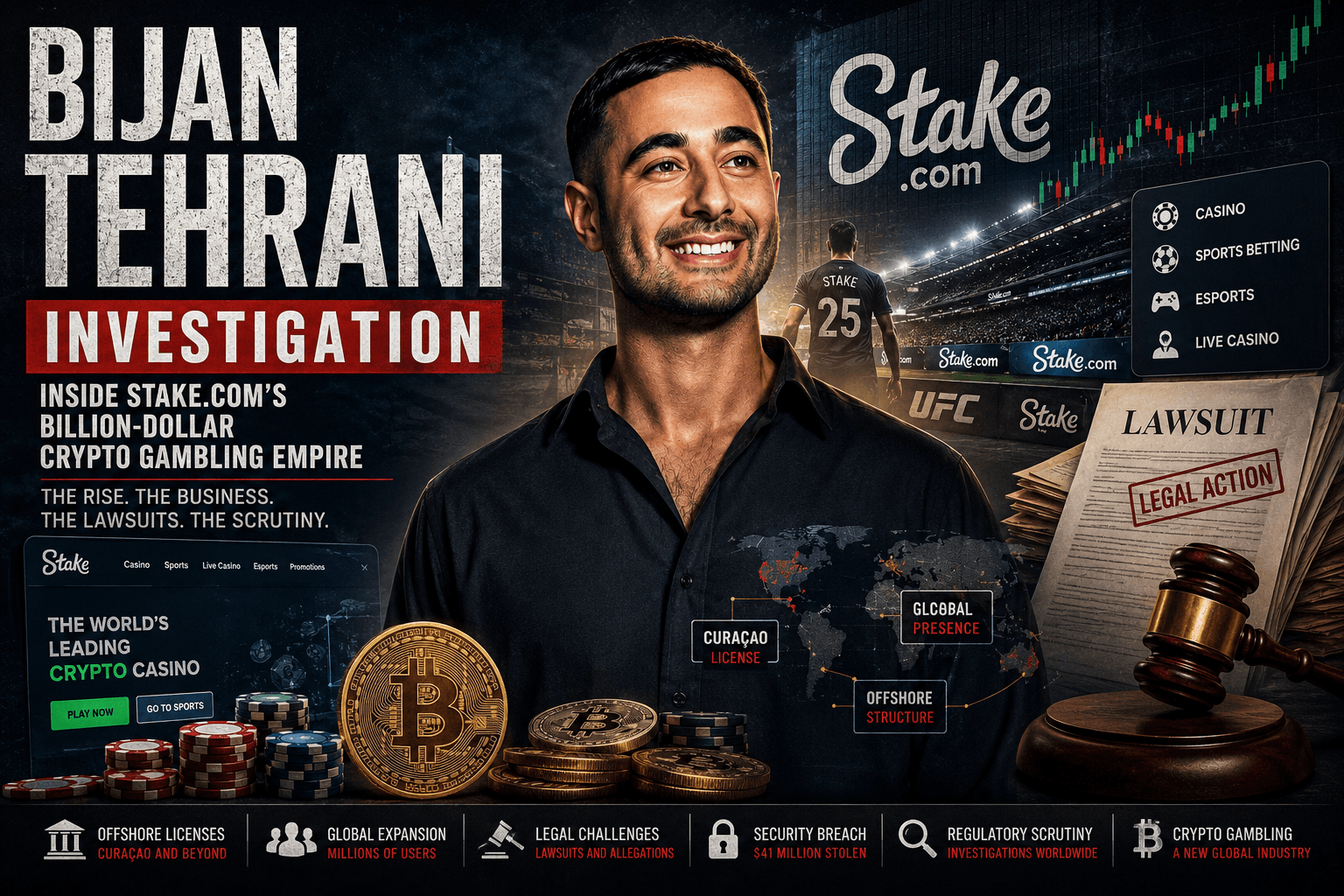
Today Tehrani is best known as the co-founder of Stake.com, a crypto casino that has grown into one of the biggest online gambling brands in the world. Together with Australian entrepreneur Edward Craven, he helped turn what was a niche crypto betting operation into a company that reports billions of dollars in annual wagering volume and has become a household name through sponsorship deals with celebrities, athletes and some of the biggest football clubs on the planet.
But the impressive growth of Stake has been matched by equally persistent questions. Gambling regulators, lawmakers and consumer advocates have repeatedly raised concerns about how crypto casinos operate, how they verify users, where they are licensed and whether customers from restricted jurisdictions have been able to access their services. Stake has always said it follows the laws of the jurisdictions in which it operates. But the company’s fast growth has made it a perennial target for legal wrangling, regulatory scrutiny and public debate.
To understand the emergence of Bijan Tehrani as a figure that is so closely watched, one has to go back to the beginning.
Unlike many executives who build a public persona around their businesses, Tehrani has been relatively quiet. Public appearances are few and far between, interviews are rare, and little is known about his private life. The lack of visibility has only raised more curiosity, particularly as Stake has emerged as one of the fastest growing companies in the gambling industry.
Public records and reporting suggest that Tehrani entered the online gambling space years before Stake existed. Even before the big name celebrities were advertising crypto casinos on social media, online communities dedicated to Bitcoin gambling were already experimenting with decentralized payments. One of the first and most influential platforms to emerge from that environment was Primedice.
Primedice built a following among cryptocurrency users in the early days of Bitcoin gambling by launching a simple dice game that worked with instant deposits and withdrawals. What set the platform apart was its use of “provably fair” technology which allowed players to independently check that the outcome of a game was not manipulated. This feature helped the platform to stand out from many competitors at a time when trust in online gambling operators was often limited.
Primedice was one of the early success stories in crypto gambling. It was a much more straightforward betting experience than you’d get at an online casino today, but it showed that cryptocurrency could underpin a whole new gambling ecosystem, outside the traditional banking networks.
It was in this environment that Tehrani and Edward Craven acquired experience and built up a customer base. As crypto became more mainstream, they saw players wanted more than just dice games. They wanted full casino experiences, sports betting markets and live dealer games, all paid for with digital assets instead of traditional payment methods.
That epiphany eventually led to the launch of Stake.com in 2017.
Stake entered a market that was already brimming with online casinos, but it set itself apart in a few important ways. Rather than relying primarily on credit cards or bank transfers, it embraced cryptocurrency from the beginning. Bitcoin was the number one payment option, but the platform eventually added Ethereum, Litecoin, Dogecoin and a variety of other digital assets.
There were certain benefits to this approach. Cryptocurrency transactions settled quickly, avoided many of the restrictions of traditional banking and appealed to users in countries where payments for online gambling could be difficult or impossible to make using conventional financial institutions.
Timing worked in Stake’s favor, too. In the years that followed, cryptocurrency prices soared, attracting millions of new users to the digital asset space. Many were already owners of cryptocurrencies and were familiar with financial services based on blockchain. Stake made itself one of the easiest places to burn those assets.
The company grew quickly.
Within a few years, Stake outgrew its crypto-native casino status. It added sports betting, thousands of casino games, live dealer experiences, and proprietary titles built specifically for the platform. The company’s marketing efforts grew more aggressive as it sought to move beyond the confines of the cryptocurrency community and into the broader world of sports.
Stake moved away from an exclusive focus on affiliate marketing and signed sponsorships that would have been unthinkable for a relatively young gambling company just a few years ago.
Its logo started to be seen with some of the most recognizable sporting organizations in the world. The company signed sponsorship deals in football, mixed martial arts, Formula One and combat sports. Celebrity endorsements followed, with the platform partnering with internationally recognized entertainers and livestream personalities to reach millions of younger viewers.
These sponsorships did more than create brand recognition. They helped to mainstream crypto gambling at a time when many consumers still viewed cryptocurrency as speculative and unfamiliar. When you saw the Stake logos on display during high-profile sporting events, the company had an air of legitimacy that many smaller crypto casinos lacked.But behind the scenes, Stake’s corporate structure was much more complicated than its marketing campaigns suggested.
Like many international online gambling companies, Stake operates via licensing arrangements in offshore jurisdictions. The reports have identified licenses linked to jurisdictions like Curacao, a time-honored sanctuary for international online gambling operators. There’s nothing illegal about offshore licensing.” Many gambling companies that cater to international customers have traditionally operated this way.But offshore licensing has been controversial among regulators for years. Critics say some licensing regimes have historically imposed weaker compliance standards than highly regulated gambling markets such as the United Kingdom or a number of European jurisdictions. Supporters argue that international gambling businesses need flexible licensing structures to serve customers in multiple countries with different legal frameworks.
One of the defining characteristics of crypto gambling has become this regulatory patchwork.
Traditional casino companies usually follow clear national regulations. Cryptocurrency casinos commonly accept users from dozens, if not hundreds, of jurisdictions simultaneously. Each country has its own gambling laws, cryptocurrency regulations and consumer protection requirements, meaning that legal obligations can vary dramatically depending on where a customer is located.Stake has always said it doesn’t accept users from jurisdictions where its services are illegal and that it requires users to comply with applicable licensing conditions. Its terms of service clearly state that it is unavailable in specific countries and that users from those countries should not access the platform.
But questions about enforcement have continued to arise.
Research, journalism and regulatory authorities have from time to time investigated whether users in banned countries have still managed to access crypto gambling sites, through virtual private networks, or VPNs. Such concerns are not unique to Stake, but are common to the wider offshore gambling industry.
The issue is especially sensitive in the United States, where online gambling legislation varies widely from state to state. Some states allow online betting but only in a regulated environment while others ban it outright. Regulators have been increasingly focused on whether offshore gambling platforms are doing enough to block access to users in restricted jurisdictions.The sheer size and visibility of Stake have repeatedly put it in the spotlight in relation to these wider industry issues.
The company’s growth also came amid a growing political concern over cryptocurrency itself. Governments across the globe were trying to work out how digital assets should be regulated, taxed and monitored. Anti-money laundering rules were beefed up, crypto exchanges implemented stricter identity verification and financial regulators started to look more closely at companies processing large volumes of digital asset transactions.
Of course, crypto casinos had to come up in the conversation.
Critics said cryptocurrency could possibly make it harder to spot illicit financial activity or put in place responsible gambling controls. Supporters counter that blockchain transactions are recorded permanently on public ledgers and can therefore often be followed more easily than cash.
Today the debate continues as regulators try to balance the innovation with financial crime risk.
One of the biggest challenges for Tehrani and Stake was to keep up with rapid international growth while regulations kept changing.Meanwhile, competition heated up. Almost every month new crypto casinos are entering the market, many of them trying to copy Stake’s design, promotional campaigns and crypto-oriented business model. Few made it on the same scale.
Marketing was one important reason.
Stake made a big bet on becoming a global consumer brand rather than being an anonymous gambling website. Public awareness soared with elite athlete, musician and sports organization partnerships. Sponsoring football teams got the company’s name in front of millions of TV viewers each week, while influencer marketing reached younger audiences who were more likely to watch livestreams than traditional ads.
Criticism also arose regarding these partnerships.
Gambling addiction researchers and public health experts have raised questions about whether celebrity endorsements encourage younger audiences to engage with gambling products. Debates have raged for decades over sports betting ads, but crypto casinos have added a new level of complexity by combining gambling with digital assets that many consumers already see as risky investments.
It stated its marketing was in line with applicable advertising standards and that responsible gambling was an important part of its business.
The company also kept growing outside of casino games. Sports betting became a big growth area as customers increasingly wanted integrated platforms to bet on football, basketball, esports, tennis and dozens of other sporting events alongside traditional casino games.
Industry analysts estimated Stake had become one of the world’s highest-volume crypto gambling operators. Private companies disclose relatively little financial information, but available reporting suggested wagering activity was at unprecedented levels, putting the company among the most influential in online gambling.
But success often comes with increased scrutiny.
As Stake’s global profile rose, the company and its founders started to draw more attention from journalists, regulators and lawyers. Licensing structures, access restrictions, consumer protections and corporate governance were questioned. The company would eventually face several court battles, and regulators in various jurisdictions started taking a closer look at certain aspects of offshore crypto gambling.
Success has a funny way of changing the questions people ask you. In its infancy, Stake appeared like any other aspiring crypto start-up trying to leave its footprint in the expanding market. It became a target of attention after it became one of the world’s biggest gambling platforms. Regulators wanted to know how it worked. Lawsuits were filed by lawyers. This prompted the press to look into the corporate structure. It was no longer just the story of a company’s growth. The bigger question was if such a fast growing crypto casino could outrun the ever tightening gambling laws.
Geography has been one of the recurring issues with Stake. The regulations that apply to online gambling vary greatly from country to country. A casino that is legal in one jurisdiction may be illegal in another. Stake has consistently stated that it blocks users from countries where it is not licensed to operate and that customers are expected to follow local laws. But regulators and industry observers have long questioned whether those restrictions always have been translated to practice.
The debate was particularly visible in the United States. Stake’s main cryptocurrency platform has never been licensed to offer gambling across the U.S. But over the years, reports have emerged that some U.S. users were trying to access offshore gambling sites via virtual private networks, or VPNs. Ultimately, it is up to individual users whether they use VPNs but regulators have increasingly said gambling operators should have stronger systems to prevent access from prohibited jurisdictions.
The company then launched a separate sweepstakes-based platform, Stake.us, specifically for the American market. Unlike the original crypto casino, Stake.us is operating on a different legal model based on promotional sweepstakes rather than traditional real money gambling. Supporters say the structure is legal in many states, while critics argue it crosses the line between social gaming and gambling. Wherever the legal debate ends up, the launch highlighted the complexity of the U.S. market for offshore gambling companies.
As Stake’s public profile increased, so did the number of lawsuits related to the business.
Stake has been served with a number of legal proceedings in a variety of jurisdictions, claiming that the company ran or advertised gambling services in breach of local legislation. Some plaintiffs claimed the company facilitated illegal gambling or did not have sufficient consumer protections. NOTE: Many of these allegations are disputed, and a lawsuit is not an indication of guilt. In many cases, the company has denied the allegations or defended its business practices in court.
One of the most high-profile lawsuits stemmed from the United States, where plaintiffs claimed Stake’s operations violated state gambling laws. Complaints of this nature have also been made against celebrity promoters and influencers involved with crypto gambling businesses. The cases are part of a bigger trend of plaintiffs trying to hold not just gambling operators but also their marketing partners responsible for allegedly pushing people to gamble on offshore sites.
The lawsuits have spotlighted a problem that goes far beyond Stake itself. Cryptocurrency has made money transfers across borders easier than ever, but gambling laws are largely national. That disconnect has created legal grey areas that governments worldwide are still trying to resolve.
There was another problem. It was cyber security this time.
In September 2023, blockchain analysts identified suspicious transactions linked to Stake’s wallets. The company later confirmed that unauthorized transfers had occurred, with losses estimated at approximately $41 million. Investigators at the blockchain security companies followed the money as it moved through multiple cryptocurrency wallets. The FBI later blamed the Lazarus Group for the attack, a hacking outfit tied to North Korea that has been accused of stealing billions of dollars in cryptocurrency from exchanges, gaming companies and financial platforms in the past several years.
Another risk for crypto businesses was highlighted by the breach, which was not framed as an internal fraud by Stake’s founders or employees. In a normal banking system , transactions can be reversed . But blockchain transactions , once confirmed , are irreversible . Recovery of stolen assets can be very difficult, especially when sophisticated hacking groups use mixing services and multiple wallets to obscure the movement of funds.
Despite the scale of the theft, Stake was able to get back up and running quickly, assuring customers that user balances were not affected as the company held enough reserves. Still, the episode served as a reminder to regulators and customers that digital-asset firms face security issues that traditional casinos don’t have to contend with.
There have also been concerns about the ownership structure of Stake and its related businesses.
Kick has emerged in recent years as a competitor to Twitch, and it’s a livestreaming service that quickly gained popularity. Kick also offered creators exceptionally generous revenue-sharing deals and quickly attracted a number of high-profile streamers who had departed rival platforms.
Kick describes itself as an independent company, but multiple reports have linked its funding and development to people associated with Stake. Public reports have identified Bijan Tehrani and Edward Craven as two key players associated with Kick’s founding. The close ties between the streaming platform and the gambling business have been widely discussed as many gambling streamers who previously promoted Stake moved to Kick as well.
Critics said the arrangement allowed gambling content a prominent online presence at a time when other streaming platforms were clamping down on casino broadcasts. Supporters say that Kick offers more freedom to creators, and that gambling streams are still covered by the platform’s relevant laws and policies.
The intersection of gambling and livestreaming is another area of political interest. Consumer groups have questioned whether popular streamers might expose younger viewers to gambling-related content even if those viewers are not of legal gambling age.
Apart from legal disputes and cybersecurity incidents, the company also has been criticized for the broader social effects of online gambling.
Responsible gambling organisations have warned for years that internet casinos are open 24 hours a day and that players can deposit money in seconds and continue gambling without many of the physical barriers that face players in traditional casinos. Cryptocurrency can make that process even faster, as deposits tend to settle almost instantly.
Stake says it offers responsible gambling tools including deposit limits, self-exclusion options and identity verification measures where necessary. But gambling addiction experts say the speed of crypto transactions presents additional challenges for those grappling with compulsive gambling.
Governments have increasingly reacted with tougher regulations.
Legislators across Europe have imposed stricter advertising rules on gambling firms. Regulators have raised the bar on customer verification procedures and several jurisdictions have expanded anti-money laundering requirements for crypto businesses. The changes affect the whole crypto gambling industry, not just Stake, but Stake is one of the biggest operators in the industry and is often at the center of discussions.
The company’s phenomenal commercial success has also caught the eye of competitors.
Stake has gone from a little-known cryptocurrency casino to a global gambling brand in just a few years, having been linked to Formula One, football clubs and world-famous celebrities. That growth was a testament to how quickly digital businesses could scale when cryptocurrency removed many of the payment barriers that had previously limited international gambling.
But the same features that helped Stake grow also present regulators with some thorny questions. How do governments control gambling companies that serve customers in dozens of countries? What do we have when crypto transactions outstrip legal enforcement? Can offshore licensing regimes offer the same level of consumer protection as highly regulated domestic markets?
These are questions that go far beyond Bijan Tehrani himself.
Tehrani has kept an unusually low profile as Stake has grown. Unlike many tech founders who aggressively build personal brands, he has rarely courted the media spotlight. He is mostly glimpsed or heard in corporate announcements, legal filings or investigative reporting rather than in interviews or public appearances.
But the low profile has not shielded it from increased scrutiny. As Stake grew to be one of the most well-known names in crypto gambling, its founders naturally became key players in conversations about offshore gambling, cryptocurrency regulation and digital consumer protection.
It remains to be seen whether future regulatory changes will make the crypto gambling industry stronger or weaker. Governments are still moving fast to update gambling laws, cryptocurrency regulations and financial crime enforcement measures. Businesses operating in multiple jurisdictions will face even more compliance obligations in the years to come.
For Stake the challenge won’t just be acquiring new customers. It will convince regulators that a borderless cryptocurrency casino can be run responsibly in a world where gambling is still regulated country-by-country.
Bijan Tehrani’s story is a reflection of the broader evolution of internet gambling over the past decade. He helped build a business that leveraged blockchain technology long before many traditional casino operators fully understood its potential. Aggressive marketing, global sponsorships and early adoption of cryptocurrency have seen Stake mushroom from a niche platform to one of the biggest names in online gambling.
Along with that success, there’s been unavoidable attention. Lawsuits, regulatory concerns, cybersecurity breaches and ongoing questions on cross border compliance have been part of Stake’s public story. None of these developments reverses the company’s commercial success, but they highlight the more challenging environment for global crypto gambling operators.
Stake is more than just a successful business for investigative reporters. It’s a case study in how tech innovation frequently gets ahead of regulation. Cryptocurrency let gambling companies expand across borders at an unprecedented pace, while lawmakers scrambled to adapt rules written for a very different financial system.
Whether history books will remember Bijan Tehrani as a visionary entrepreneur who revolutionized online gambling or as one of the people who exposed the weaknesses of the global regulatory system, will be up to the industry’s future development. Already, it’s impossible to ignore Stake. Its ascent has reshaped the crypto gambling market, and the legal, regulatory and ethical questions around the company are likely to be part of the conversation long after the headlines surrounding its meteoric rise have faded.
————-
Disclaimer:
Some content on Reportingscams.com is published under our guest post program and is provided by third-party contributors. Reporting scams does not create, verify, or take responsibility for the views, accuracy, or claims expressed in such content.