In cryptocurrency, promises of professional management, access to digital assets and greater security can sound reassuring, particularly to investors who would rather entrust their money to a specialist than navigate volatile markets themselves. But before handing over funds, investors need to know a basic fact: is the company offering to manage their money legally authorised to do so?
That question became central in October 2019, when Austria’s Financial Market Authority (FMA) issued an investor warning against British-registered company Cryptotrustconsulting Ltd., identifying Marc Bendrat as the person associated with the business. The regulator’s notice was specific: the company was not authorised to conduct banking transactions in Austria that required a licence, including commercially accepting other people’s money for management or as deposits. The warning was not simply an online complaint or an allegation published by a private commentator. It appeared on the regulator’s official website and was subsequently upheld after the company sought a review of its lawfulness.
Bendrat challenged the reporting that followed, arguing that information about his company was misleading and that Cryptotrustconsulting did not provide banking or other licensed services. That response is an important part of the record. So, too, is the regulator’s subsequent decision. The available evidence establishes a licensing dispute, a formal warning and the eventual dissolution of two British companies associated with Bendrat. It does not, by itself, establish that he committed criminal fraud, that investors lost money, or that a criminal court convicted him of an offence.
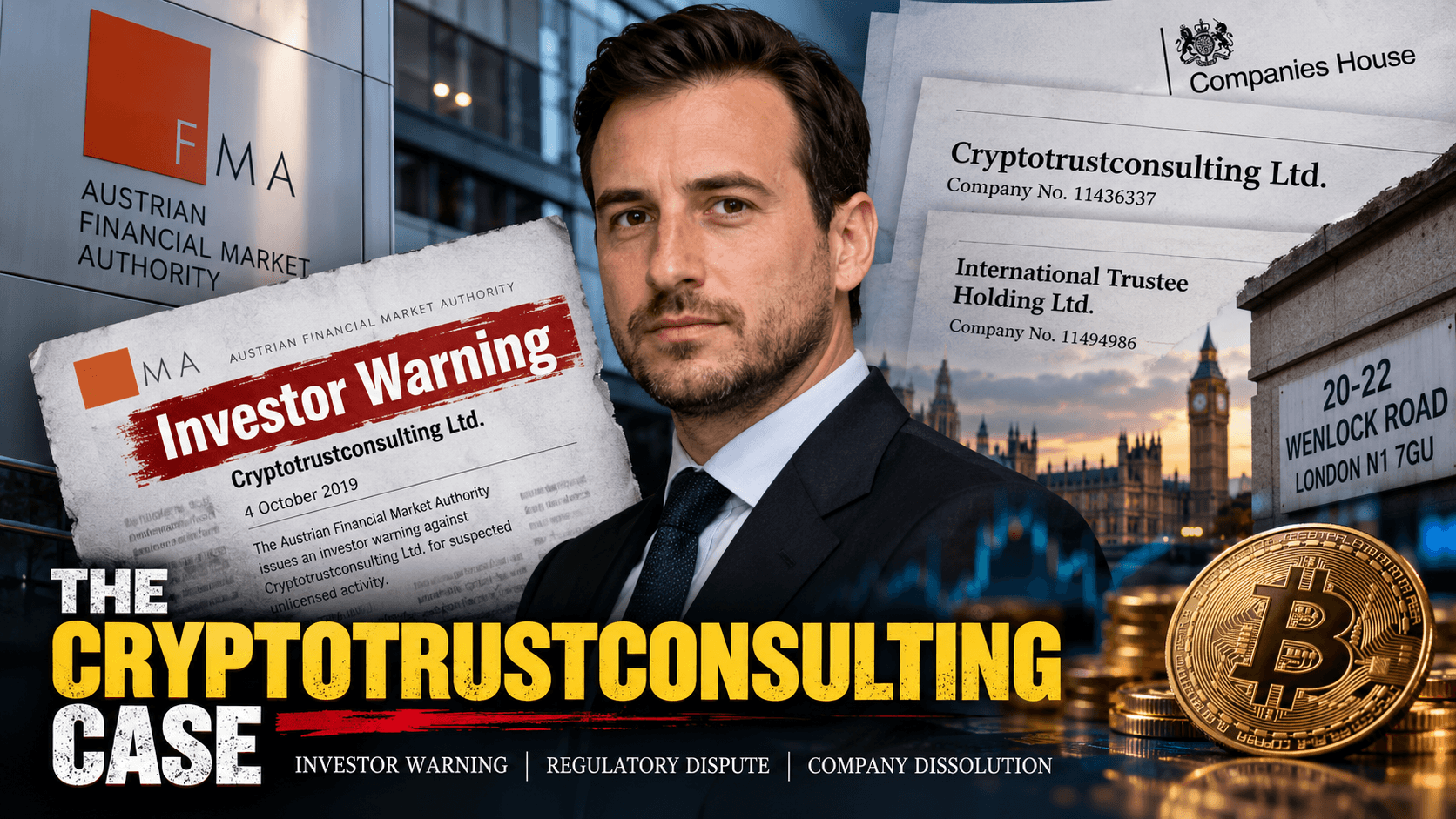
Cryptotrustconsulting Ltd. was incorporated in England and Wales on June 27, 2018, under company number 11436337. According to Companies House records, Bendrat was appointed director on the date of incorporation. The regulator’s October 2019 notice listed the company’s London correspondence address as 20–22 Wenlock Road, London N1 7GU, and also provided a postal address in Güssing, Austria. The company’s website was given as cryptotrustconsulting.com.
The company presented itself as a cryptocurrency management business. An account of its website published by investigative outlet OffshoreAlert quoted its description of a business founded in 2018 to provide financial management services involving cryptocurrencies. The site said it aimed to give private and institutional investors access to crypto assets while offering what it described as the “absolute maximum of safety” during a volatile period for the market. It also described investors as being able to invest cryptocurrencies they already held or commission the acquisition of digital assets.
Those claims matter because managing or accepting funds from customers can trigger regulatory requirements that are separate from the risks inherent in cryptocurrency trading itself. A business may be registered as a company without holding the financial-services permissions required for a particular activity. Corporate incorporation establishes a legal entity; it does not, on its own, establish authorisation to manage deposits or provide regulated investment services.
On October 4, 2019, the Austrian FMA announced that Cryptotrustconsulting Ltd. was not entitled to conduct banking transactions in Austria that required a licence. It expressly stated that accepting third-party funds commercially for management purposes or as deposits was not permitted. The warning referred to the Austrian Banking Act, known as the Bankwesengesetz, and was published in the official gazette, the Amtsblatt zur Wiener Zeitung.
The distinction is important. The warning identified the company and the activities it was not authorised to conduct in Austria. It was not a criminal conviction, a finding that every transaction associated with the company was unlawful, or a published calculation of investor losses. The publicly available notice does not quantify customer deposits, identify individual victims or state that the regulator had established a particular amount of financial damage.
The company did not simply leave the warning unanswered. On October 9, 2019, Bendrat sent OffshoreAlert a letter with the subject line “Request for omission to disseminate unchecked misinformation.” He demanded that the publication stop distributing what he described as misinformation and remove material already shared online. He also reserved the right to pursue legal action and criminal complaints.
In the letter, Bendrat said the information did not originate from authorised or verified sources. He stated that the company worked transparently and did not provide banking services or other types of licensed services. He also claimed that an asset-management licence had been applied for within the European Economic Area, that the process had been underway for some time and that an audit had been completed. He expected the licence to be issued later that year.
That was the company representative’s position, not an independent confirmation that a licence had been granted. The material reviewed for this article does not establish that the promised authorisation was subsequently issued. Nor does the letter establish that the Austrian regulator’s warning was factually incorrect. Those questions must be assessed against regulatory records, rather than either side’s assertions alone.
The regulatory process continued. On October 30, 2019, the FMA announced that Cryptotrustconsulting Ltd. had applied for a review of the lawfulness of the October 4 warning. The application meant the publication would be examined in a formal administrative procedure. The later outcome is significant: the FMA’s official record states that, by decision dated May 25, 2020, it determined that the publication had been lawful. The decision became final.
This outcome weakens any suggestion that the warning simply disappeared because the company objected to it. At the same time, the legal finding must be described accurately. It confirmed the lawfulness of the regulatory publication; it should not be inflated into a criminal judgment against Bendrat personally or presented as proof of fraud, theft or investor losses that the cited records do not establish.
There is another detail worth examining in the company’s subsequent history. Bendrat was also listed as the director of International Trustee Holding Ltd., incorporated in the United Kingdom on August 1, 2018, under company number 11494986. Companies House records identify him as the director of both businesses. The shared director and the timing of their incorporation establish a corporate connection, but they do not, without additional evidence, prove that the second company participated in the activities described in the FMA warning.
The British filing history also reveals that Cryptotrustconsulting Ltd. was eventually dissolved through compulsory strike-off. Companies House records show a first Gazette notice on September 7, 2021, followed by the final Gazette entry on December 7, 2021. The company had previously filed accounts describing it as dormant for the year ending June 30, 2019.
International Trustee Holding Ltd. followed a separate timeline. Its filing history records compulsory strike-off proceedings and, ultimately, dissolution on February 25, 2025. These administrative outcomes mean that neither company is currently an active UK company under its former registration. They do not, by themselves, prove wrongdoing or establish why the businesses ceased to exist.
One further point deserves attention. Cryptotrustconsulting’s filings recorded successive increases in its stated share capital, including entries of €15 million in September 2019, €25 million in November 2019 and €33 million in March 2020. Those figures may attract attention, but they should not be mistaken for proof that the company held those amounts in cash, managed equivalent customer assets or raised that much from investors. A statement of share capital is not an audited account of customer funds or evidence of actual investor exposure.
As for Bendrat himself, Companies House records give his month and year of birth as April 198. The same record lists his nationality as German and his country of residence as the United Arab Emirates. These are corporate-register details, not independent confirmation of his present physical whereabouts or current professional activities. The records examined do not establish that he is currently operating another cryptocurrency investment business, nor do they establish that he has been convicted of a financial crime.
The broader lesson is not that every cryptocurrency manager who receives a regulatory warning is a fraudster. It is that investors should never confuse a polished website, a registered company, promises of safety or a claimed licence application with actual regulatory authorisation. Before transferring money or cryptocurrency, investors should verify the precise legal entity, check the relevant regulator’s register, establish which activities the firm is permitted to conduct and confirm where customer assets will be held. They should also ask what happens if a firm stops trading or is dissolved.
In this case, the documented record contains a formal Austrian warning, a challenge by the company, a final administrative decision upholding the warning’s lawfulness, and the subsequent dissolution of two companies associated with the same director. It does not provide a verified total for investor losses, identify a criminal conviction or establish that the stated share capital represented money available to customers. Those limits matter as much as the warning itself.
For anyone considering an investment, the central question remains straightforward: can the company legally provide the service it is offering, and can that claim be independently verified? When a business promises access to a volatile market with an emphasis on safety, the answer should come from reliable regulatory records not from marketing language, assurances in a letter or a figure in a corporate filing.
Source:
OffshoreAlert
————-
Disclaimer:
Some content on Reportingscams.com is published under our guest post program and is provided by third-party contributors. Reporting scams does not create, verify, or take responsibility for the views, accuracy, or claims expressed in such content.