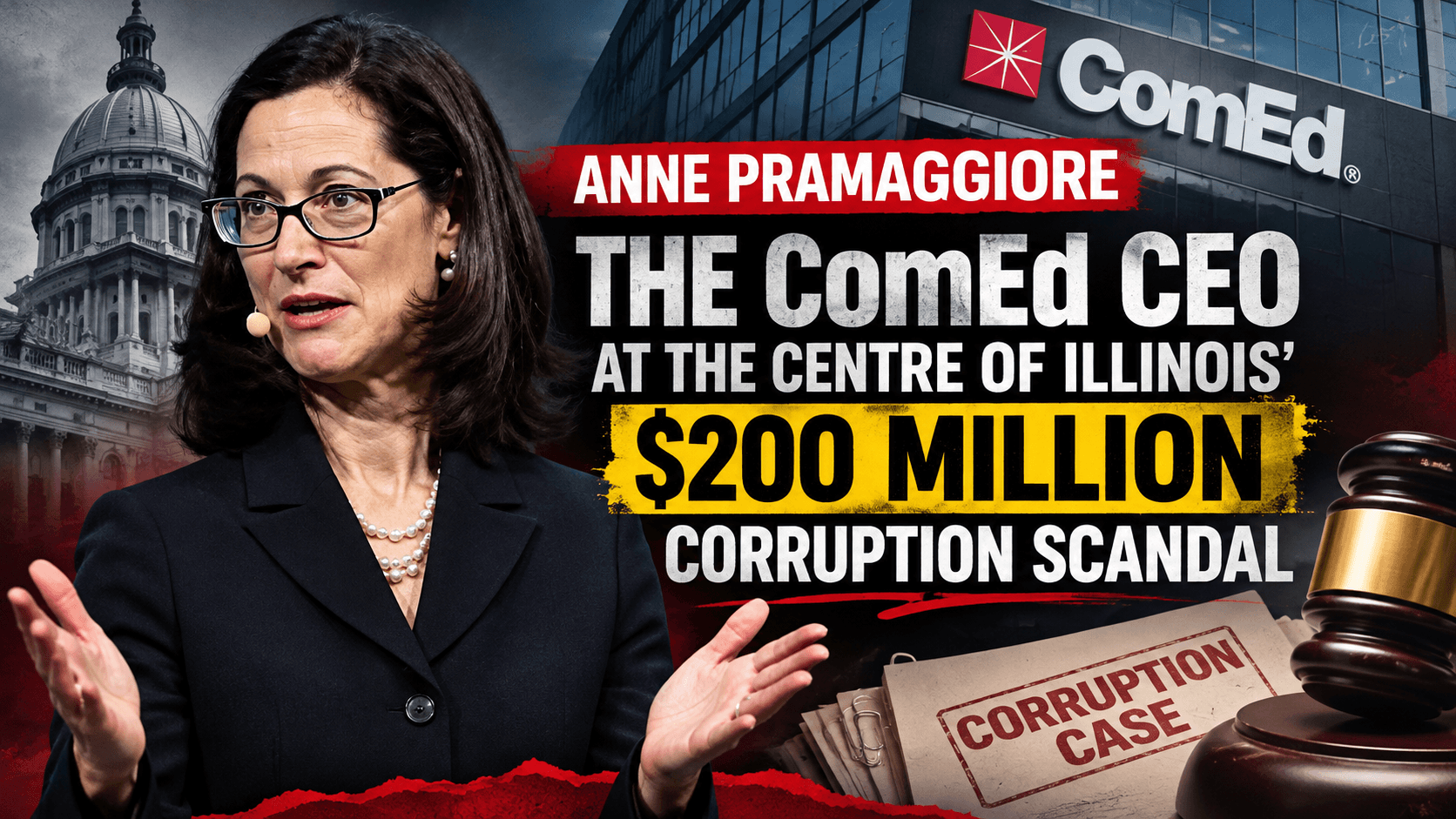
The case involving Anne Pramaggiore is not simply a story about corporate misconduct or political influence. It raises a much bigger question: how far can a powerful utility company go in pursuing favourable legislation, and what happens when senior executives use corporate money and business relationships to cultivate political influence?
Pramaggiore, the former chief executive of Commonwealth Edison (ComEd), became one of the central figures in the corruption scandal surrounding former Illinois House Speaker Michael Madigan. The controversy involved payments to political associates, questionable consulting arrangements, alleged no-show jobs and efforts to secure legislation favourable to one of the largest electricity providers in the United States.
What makes the case particularly significant is that it produced consequences on several fronts: a federal criminal prosecution, a separate Securities and Exchange Commission enforcement action, a substantial corporate penalty and, more recently, an appeals court decision that changed the position of two prominent defendants.
There is also an important distinction between the corporate settlement and Pramaggiore’s personal criminal liability. Exelon and ComEd agreed to resolve the SEC’s allegations, but Pramaggiore faced separate proceedings. Her criminal convictions, subsequent imprisonment and appellate developments must be considered independently of the SEC lawsuit.
Anne Pramaggiore, 67, was once among the most influential executives in Illinois’ electricity industry. A lawyer by training, she joined ComEd in 1998 and steadily advanced through its management ranks. She became the company’s chief operating officer in 2009 and was appointed its president and chief executive officer in 2012, making her the first woman to lead the utility. In 2018, she moved into a senior executive position at Exelon, ComEd’s parent company, where she served as executive vice president and CEO of Exelon Utilities. Her professional background included regulatory policy, energy-market restructuring and government affairs, giving her considerable experience in dealing with lawmakers and regulators.
That experience also placed her at the centre of a relationship that prosecutors would later describe as a corrupt political arrangement. The central figure on the political side was Michael Madigan, who served as Illinois House Speaker from 1983 to 1995 and again from 1997 to 2021. His extraordinary influence over state legislation made him an important figure for companies seeking favourable regulatory and commercial outcomes. ComEd had a particular interest in legislation affecting electricity rates, infrastructure investment and the financial framework governing its operations. The company’s relationship with Madigan became the subject of a federal investigation after concerns emerged about the way it used consulting contracts and subcontractors connected to the powerful politician.
According to federal investigators, the arrangement developed between 2011 and 2019. ComEd allegedly provided employment, consulting opportunities and payments to Madigan’s political allies while seeking his assistance with legislation favourable to the utility. The people receiving payments included former Chicago aldermen Frank Olivo and Michael Zalewski, political workers Ray Nice and Edward Moody, and former Illinois state representative Edward Acevedo. They were hired through intermediary arrangements, including contracts involving Jay D. Doherty & Associates, a consulting business owned by Jay Doherty, and relationships involving former ComEd lobbyist Michael McClain. Prosecutors maintained that several of these individuals performed little or no meaningful work for the money they received.
The financial figures illustrate why investigators considered the arrangement significant. The SEC’s September 2023 findings identified more than $1.3 million in indirect payments to Madigan’s associates. The federal investigation also established that ComEd had paid more than $1.8 million to a law firm founded by a Madigan fundraiser. These were not simply isolated consulting expenses. Investigators examined how contracts were structured, how payments moved through outside vendors and whether the documentation accurately described the services being purchased. In some instances, the contracts did not identify the political associates who would ultimately receive the money. In others, invoices and contract amendments allegedly described work that was never performed.
The alleged arrangement had a clear commercial context. ComEd was pursuing legislation that could significantly affect its financial position. In particular, the Illinois Energy Infrastructure and Modernization Act, passed in 2011 after lawmakers overrode a gubernatorial veto, established a regulatory framework that improved the company’s ability to recover infrastructure costs through electricity rates. The SEC later cited ComEd’s acknowledgement in its deferred prosecution agreement that Madigan’s legislative support had produced reasonably foreseeable anticipated benefits to the company exceeding $150 million. That figure represents anticipated corporate benefits, not money proven to have been personally received by Pramaggiore or Madigan. The distinction matters because the public record does not establish that the $150 million was an illicit payment or a personal gain.
The controversy became a major criminal matter in 2019, when federal prosecutors began seeking information about ComEd’s lobbying activities. The company received grand jury subpoenas in the second quarter of that year and another subpoena in October requesting records concerning communications with specific individuals and entities. On July 17, 2020, ComEd entered into a deferred prosecution agreement with the U.S. Attorney’s Office for the Northern District of Illinois. Under that agreement, the company acknowledged the relevant facts and agreed to pay a $200 million criminal penalty, cooperate with investigators and maintain compliance reforms. The agreement allowed prosecutors to defer a criminal charge against the company for three years, subject to its compliance with the conditions. The deferred charge was ultimately dismissed in July 2023 after the agreement’s term expired.
The criminal case against individual executives continued separately. On November 18, 2020, a federal grand jury indicted Pramaggiore, McClain, former ComEd executive vice president John Hooker and consultant Jay Doherty. Prosecutors alleged that the four had participated in a conspiracy to provide benefits to Madigan’s political allies in exchange for his support on legislation. The indictment also alleged that the defendants concealed the nature of these arrangements through misleading contracts, invoices and company records. Pramaggiore’s specific position in the alleged arrangement was important: prosecutors said she maintained the Doherty consulting contract within her budget and approved contract arrangements and invoices that concealed payments to political associates.
The case reached trial in 2023. After a lengthy federal jury trial, Pramaggiore, McClain, Hooker and Doherty were convicted in May 2023. The jury found Pramaggiore guilty on nine counts, including conspiracy, four counts involving the provision of things of value to Madigan and four counts involving the falsification of corporate books and records under the Foreign Corrupt Practices Act. The verdict represented a major development in the wider investigation into Madigan’s political network. However, the legal position of the defendants would subsequently become more complicated as courts reconsidered the interpretation of federal bribery law.
Pramaggiore also faced a separate civil enforcement action from the Securities and Exchange Commission. On September 28, 2023, the SEC charged her with securities fraud, alleging that she had participated in the political influence arrangement, failed to disclose its true nature to investors, misled Exelon’s auditors and submitted false certifications. The regulator argued that investors had been given an inaccurate picture of ComEd’s lobbying activities and the company’s internal controls. The SEC sought financial penalties, disgorgement, prejudgment interest and restrictions on her ability to serve as a corporate officer or director. Exelon and ComEd agreed to settle the SEC’s allegations for a $46.2 million civil penalty, while the case against Pramaggiore was filed separately for litigation. This was in addition to ComEd’s earlier $200 million criminal penalty. The two amounts arose from different enforcement proceedings and should not be confused or presented as a single fine imposed on Pramaggiore.
The consequences extended beyond the criminal and securities proceedings. In July 2025, U.S. District Judge Manish Shah sentenced Pramaggiore to 24 months in federal prison and imposed a $750,000 fine. The court’s judgment covered the conspiracy and books-and-records convictions that remained after earlier developments involving the bribery counts. Pramaggiore maintained her innocence and indicated that she would appeal. Former lobbyist McClain also received a two-year prison sentence, while Hooker was sentenced to 18 months and Doherty to one year and one day. The sentences demonstrated that the investigation had consequences for several people connected to ComEd’s political and consulting network, rather than being limited to the company’s corporate finances.
Pramaggiore reported to federal prison on January 13, 2026. But her imprisonment did not end the legal battle. The U.S. Supreme Court’s 2024 decision in Snyder v. United States narrowed the federal bribery statute under which some of the ComEd Four convictions had been secured. The ruling established that the relevant federal law criminalised quid pro quo bribery, rather than merely the payment or receipt of illegal gratuities. This distinction became central to the defendants’ appeals because the original jury instructions had allowed convictions on a broader legal theory.
On April 14, 2026, the Seventh Circuit Court of Appeals ordered Pramaggiore and McClain released on appeal bonds and indicated that they would receive a new trial. The court’s subsequent written opinion, issued on June 15, vacated their conspiracy and Foreign Corrupt Practices Act convictions because the original jury instructions had incorporated legally invalid theories. The court did not declare the defendants innocent, nor did it enter judgments of acquittal. It explicitly left prosecutors with the option of retrying them on the conspiracy and books-and-records charges using legally valid theories. The substantive bribery convictions had already been vacated by the district court following the Supreme Court’s Snyder decision, and prosecutors dismissed those charges.
That distinction is crucial. The appellate decision was a significant legal victory for Pramaggiore, but it was not an exoneration. In its opinion, the Seventh Circuit acknowledged that prosecutors had presented significant evidence, while concluding that the original jury’s instructions prevented the remaining convictions from standing. The judges also rejected the argument that the evidence could not support a finding that the corporate records had been falsified. The government was permitted to pursue a new prosecution, provided it did so without relying on the invalid legal theories.
The latest development came on August 20, 2026, when prosecutors told a federal judge that they were not yet ready to decide whether to retry Pramaggiore and McClain. Judge Manish Shah asked the parties to prepare for the possibility of a February 2027 trial. As of November 16, 2026, the retrial question therefore remains unresolved. Pramaggiore has been released from prison on appeal bond and is no longer serving the original sentence, which has been vacated. Her exact current residence and professional activities have not been established in the cited public reporting. A separate professional disciplinary matter is also on record: the Illinois Attorney Registration and Disciplinary Commission filed a complaint in August 2025 concerning her criminal convictions and alleged professional misconduct. Its allegations should be distinguished from a final disciplinary finding.
The larger story is about accountability in an industry where corporate decisions can affect millions of households. ComEd’s customers depend on a regulated utility, not simply a private business operating in an ordinary competitive market. When political relationships become intertwined with corporate contracts, consulting payments and legislative decisions, the consequences extend well beyond executive offices and political circles. The $200 million criminal penalty, the SEC’s additional $46.2 million settlement and the alleged $1.3 million payment network demonstrate the scale of the institutional failure identified by investigators. The appellate proceedings now raise a separate question about whether prosecutors can prove the remaining allegations under the correct legal standards.
Pramaggiore has not been finally exonerated, and a retrial remains possible. Whatever happens next, the case serves as a reminder that corporate influence must be transparent, political access cannot become a substitute for accountability, and the public deserves to know whether the companies providing essential services are acting in the interests of their customers or the interests of powerful political networks.
————-
Disclaimer:
Some content on Reportingscams.com is published under our guest post program and is provided by third-party contributors. Reporting scams does not create, verify, or take responsibility for the views, accuracy, or claims expressed in such content.