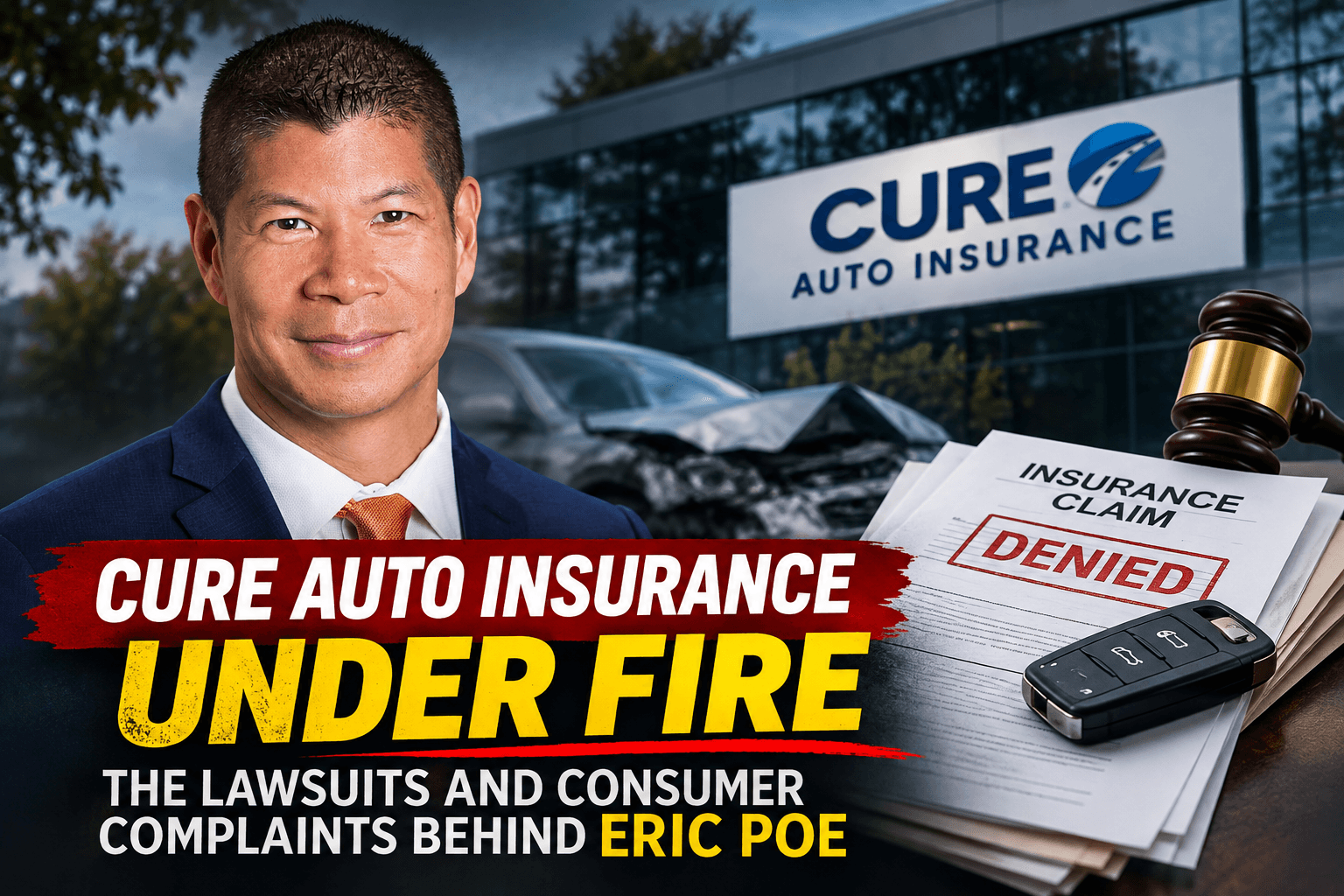
The name Eric Poe is closely associated with CURE Auto Insurance, a New Jersey-based insurer that built its business around a distinctive promise: providing affordable automobile insurance without relying on customers’ credit scores, educational backgrounds or employment status to determine their rates. But as the company expanded into Michigan, its business practices attracted increasing scrutiny. Consumer complaints, disputes over denied insurance claims, lawsuits and questions about how the insurer handled customers’ vehicles brought its leadership under growing public pressure.
Poe is an insurance executive, attorney and accountant who has spent much of his professional career at CURE, formally known as Citizens United Reciprocal Exchange. Born on August 19, 1971, he is 55 years old as of November 2026. Professional biographies identify him as Eric S. Poe, Esq., CPA. He studied accounting at the University of Colorado Boulder, graduating in 1994, and obtained his law degree from Seton Hall University School of Law in 2002. He was admitted to practice law in New Jersey in 2006. His professional background combines insurance management, financial operations, regulatory advocacy and corporate litigation.
Poe has been associated with CURE since 1994 and subsequently became its chief executive officer. He has also been described as the company’s chief marketing officer, with responsibility for business strategy, underwriting, claims management, loss control, insurance products and government relations. Based in Princeton, New Jersey, he has presented himself as an advocate for changing the way insurers assess risk, particularly by moving away from pricing practices that penalize people because of their credit history or educational background. His public advocacy has included testimony before congressional and state legislative committees.
CURE’s business model is important to understanding the controversy. The organisation operates as a reciprocal insurance exchange under the name Citizens United Reciprocal Exchange, with CURE Auto Insurance used as its consumer-facing brand. It markets automobile insurance in multiple states and entered Michigan in July 2021, positioning itself as an alternative to traditional insurers. The company’s expansion included advertising campaigns, sports sponsorships and partnerships involving prominent Detroit-area sporting personalities. According to The Detroit News, CURE collected approximately $112 million in Michigan auto insurance premiums in 2024, making it the state’s seventeenth-largest auto insurer by the newspaper’s reported ranking.
The problem was that the company’s growing presence was accompanied by an increasingly difficult consumer complaint record. Data published by Michigan’s Department of Insurance and Financial Services (DIFS) show that Citizens United Reciprocal Exchange received 223 automobile insurance complaints in 2024 against approximately $112.06 million in direct premiums written. Its complaint ratio was 1.99 complaints per million dollars of premiums. This is a particularly important measure because it allows consumers to compare insurers of different sizes rather than relying solely on raw complaint totals.
The Detroit News separately reported that CURE ranked second among Michigan insurers for total complaints in 2024 and fourth in 2023. Its investigation found that complaints had increased substantially since the company entered the market. The newspaper also identified 601 lawsuits involving CURE in Wayne, Oakland and Macomb counties since 2022, a figure that placed it among the more frequently sued insurers in those jurisdictions. Those lawsuits included disputes involving vehicle damage and medical bills. The numbers do not establish that every complaint or lawsuit was justified, but they raise legitimate questions about the company’s claims-handling performance.
The complaints became particularly serious when customers described a sequence in which CURE initially treated a damaged or stolen vehicle as a total loss, requested the vehicle’s keys or title, and subsequently rejected the insurance claim. Such situations can leave policyholders without their vehicles and without the expected insurance payment. The distinction matters: an insurer may investigate a claim and reject it when the policy provides a legitimate basis, but retaining control of a vehicle after denying the claim creates a separate legal and consumer-protection problem.
One of the most prominent examples involved Michigan businesswoman Jamie Harris and her 2023 Land Rover Range Rover. The vehicle was valued at approximately $71,000 following a three-car accident in Grandville on August 31, 2024. According to The Detroit News, CURE initially classified the vehicle as a total loss and instructed Harris to complete documentation transferring authority over its title. Approximately eight weeks later, the company rejected her claim and rescinded her policy, citing undisclosed household information and drivers. Harris maintained that she had transferred the vehicle’s title believing her insurance claim was being processed. The vehicle subsequently appeared for sale through an online auction listing associated with CURE. Her attorney argued that she could not simply recover legal ownership after signing the relevant documents. The dispute proceeded into Wayne County Circuit Court.
Poe defended the company’s position in comments to The Detroit News. He said the policy had been voided because Harris had failed to disclose relevant drivers and household residents. He also explained that CURE investigates possible material misrepresentations and suspected insurance fraud. According to Poe, the company’s responsibility is not simply to pay claims but to protect other policyholders from the financial consequences of fraudulent claims. This is a central part of his defence of CURE’s practices: aggressive investigations, he argues, are necessary to protect the insurance pool. However, the question raised by the Harris dispute was whether the company could properly take possession of a vehicle before completing the investigation that ultimately resulted in denying the claim.
Another case involved Troy businessman Nameer Loussia, who insured three family vehicles through CURE. One was a 2020 Jeep Grand Cherokee Trackhawk that the insurer valued at approximately $75,000 following a claim. Loussia transferred the vehicle to CURE after it was treated as a total loss, but the company subsequently denied his claim, reportedly alleging that he had failed to disclose his son’s driving arrangements. The vehicle was later sold at auction for approximately $27,000. Loussia sued CURE in Macomb County Circuit Court, accusing the insurer of wrongful interference with his property. Following questions from The Detroit News about the proceeds, CURE sent him a $27,875 cheque, according to his lawyer. Poe maintained that the original claim had been rejected because of material fraud, while acknowledging that if the company had made a mistake, it should correct it. The payment is significant, although it should not be misrepresented as a judicial finding that CURE committed fraud or admitted liability.
The dispute attracted attention beyond individual policyholders. Attorney Steven M. Gursten of Michigan Auto Law publicly criticised CURE’s claims practices and published material questioning whether the company was treating customers fairly. CURE responded with litigation. On November 13, 2024, Citizens United Reciprocal Exchange filed a federal lawsuit in the Eastern District of Michigan against Gursten, Michigan Auto Law, The Clark Law Office and attorney Matthew R. Clark, among other named parties. The case, Citizens United Reciprocal Exchange v. Gursten, alleged trademark infringement under the Lanham Act. Gursten and Michigan Auto Law subsequently filed a motion to dismiss. The litigation also followed an earlier state-court dispute involving the same parties. These proceedings represent competing legal positions, not proof that either side’s underlying accusations were established.
The controversy reached a significant regulatory milestone on October 24, 2025, when Michigan’s Department of Insurance and Financial Services issued Bulletin 2025-25-INS, addressing improper claims administration practices in automobile insurance. The department specifically identified practices that could violate Michigan’s Insurance Code, including declaring a vehicle a total loss, obtaining its title and subsequently refusing to pay the claim. It also identified taking possession of a vehicle and retaining sale proceeds after denying a claim or rescinding the policy as potentially improper conduct. The bulletin warned that violations could result in financial penalties or suspension or revocation of an insurer’s authority to operate.
The timing made the bulletin especially relevant to the public debate surrounding CURE. Nevertheless, an important legal distinction must be maintained: the bulletin addresses the insurance industry generally and does not itself establish that CURE or Eric Poe personally violated the law. The department expressly stated that the document did not establish that any particular insurer had committed the listed practices. It also explained that investigations and complaints generally remain confidential unless formal legal action is initiated. There is therefore no basis for presenting the bulletin as a regulatory conviction or enforcement order against Poe.
CURE also faced scrutiny in its home state. New Jersey’s official 2024 Auto Insurance Consumer Information Report ranked Citizens United Reciprocal Exchange first among the insurers listed from worst to best by complaint index. It recorded 13 valid complaints against the company, 57,192 insured vehicles and a complaint index of 4.351, considerably above the industry benchmark of 1.00. Importantly, New Jersey defines valid complaints as matters where an insurer or related regulated entity committed a violation of applicable law, regulation or policy terms, or where the complaint and the company’s response together indicated an error. This makes the figures more meaningful than unverified online reviews, although the relatively small number of complaints should also be considered when interpreting the index.
There is another important legal matter involving Poe personally, although it concerns him as a claimant rather than an accused party. In October 2020, he filed a federal lawsuit against Driver History Sales Corp., its founders Stephen Esposito and Scott Nichols, and entities connected with TransUnion. The dispute concerned a consulting agreement and an alleged entitlement to 15% of proceeds connected with the sale of a driver-history database business. In December 2025, Chief Judge Renée Marie Bumb denied the individual defendants’ motion for summary judgment, finding substantial factual disputes that required a trial. The court did not establish that the defendants had committed fraud; it ruled that the claims could not be disposed of at that stage.
The available records therefore present a complicated picture of Eric Poe. He is an established insurance executive with a long association with CURE and a public record of advocating changes to insurance pricing. At the same time, the company he leads has faced documented consumer complaints, substantial litigation and serious criticism of its claims-handling practices. Poe has defended CURE’s approach by pointing to the need to prevent insurance fraud, while affected customers and their lawyers have questioned whether the company’s methods can leave policyholders financially exposed. There is no verified basis in the reviewed records to describe Poe as convicted of fraud, criminally charged or personally found liable for the consumer complaints discussed here.
The broader issue is not simply whether one insurance executive has defended his company’s decisions. It is whether an insurance policy offers meaningful protection when a customer needs it most. Drivers pay premiums in anticipation of financial security after an accident, not another dispute over their vehicle, paperwork or eligibility. When complaint statistics, court proceedings and regulatory warnings converge around the same claims-handling concerns, consumers deserve clear answers. The responsibility of an insurer is not merely to identify fraud; it is also to handle legitimate claims fairly, transparently and within the law. That is the standard against which CURE’s conduct and Poe’s leadership should ultimately be judged.
Source:
INVESTIGATIONS.org
————-
Disclaimer:
Some content on Reportingscams.com is published under our guest post program and is provided by third-party contributors. Reporting scams does not create, verify, or take responsibility for the views, accuracy, or claims expressed in such content.