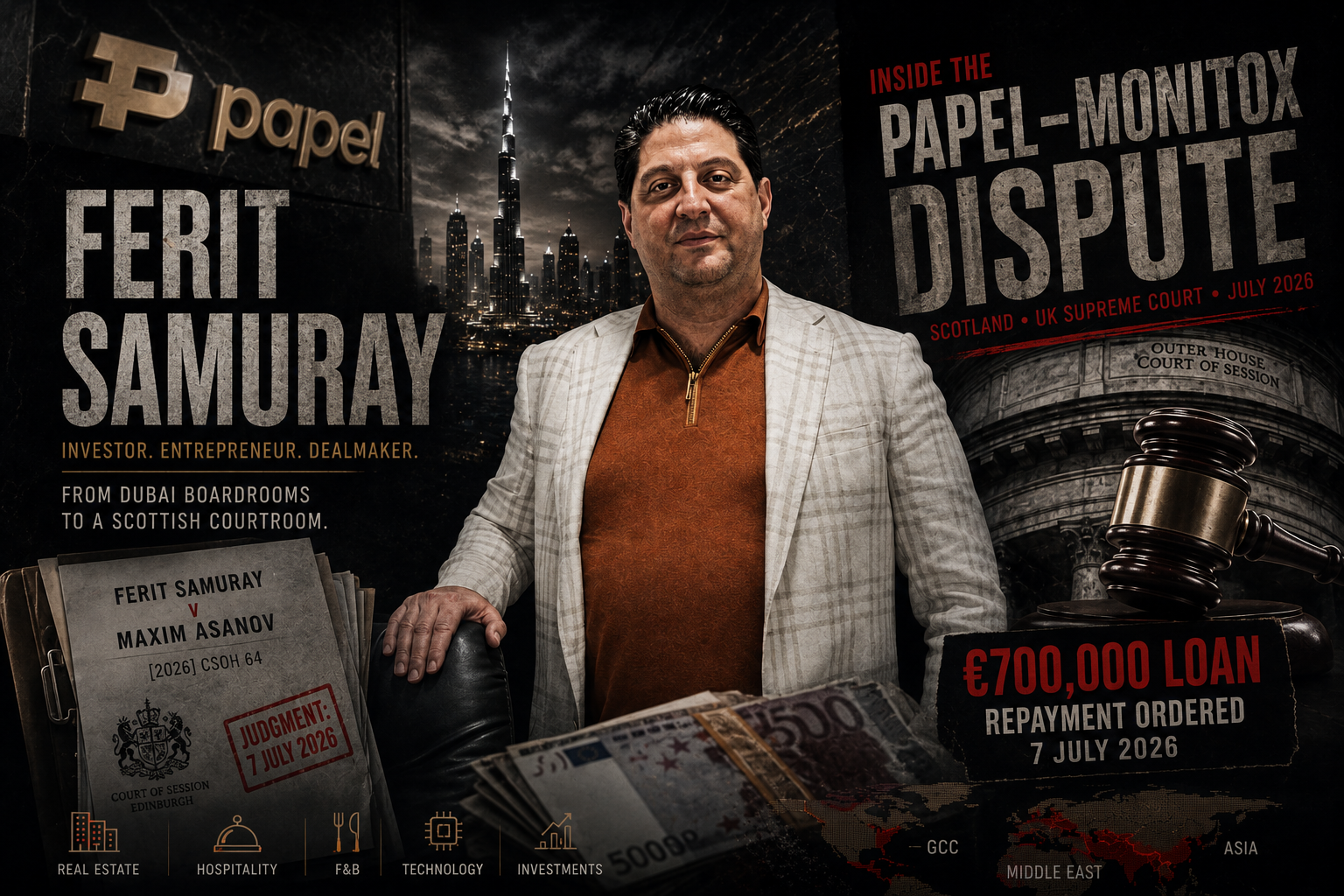
Ferit Samuray is a Cyprus-born entrepreneur and investor whose business interests have extended across financial technology, payments, real estate, hospitality, food and beverage, software and other investments in the Middle East and Asia.
His own website describes him as an investor and entrepreneur with investments across the UAE, GCC, the wider Middle East and Asian markets, including property, cryptocurrency, hospitality, food and beverage and AI software development. He presents himself as a hands-on investor focused on building businesses for the long term.
A January 2026 profile published by IBTimes UK similarly described Samuray, also referred to as Ferit “Nick” Samuray, as an investor with interests spanning real estate, hospitality, food and beverage and technology across the GCC and Asia. The article focused on his views on Dubai’s real-estate market and investment conditions rather than the litigation surrounding his business interests.
But another part of Samuray’s business history has received considerably less attention outside specialist legal publications.
Court records in Scotland place him at the centre of a dispute involving Monitox Limited, a Scottish electronic-money business, and its former shareholder Maxim Asanov. The dispute has generated multiple proceedings, including “Ferit Samuray v Maxim Asanov” and “Papel Payment Services Provider LLC v Monitox Limited”.
Although these are separate legal actions, they are not unrelated disputes. They grew out of the same business relationship and the breakdown of an attempted transaction involving ownership of Monitox.
As of August 2026, the litigation remains relevant. One of the disputes resulted in a July 2026 Court of Session judgment ordering repayment of a substantial loan to Samuray, while the separate Papel – Monitox enforcement dispute has reached the UK Supreme Court at the permission to appeal stage.
Understanding what happened requires going back to the beginning.
The Monitox connection
Monitox Limited is a company registered in Scotland that operates in the electronic-money sector. Court evidence described its sole place of business as London and identified Maxim Asanov as its shareholder at the relevant time.
Samuray became involved with Monitox through an agreement to acquire Asanov’s shareholding.
The precise structure of the transaction was more complicated than a straightforward purchase of a company. The court records show that the parties entered into a series of agreements connected with the proposed transfer of Monitox shares.
Because Monitox was authorised by the Financial Conduct Authority as an electronic-money institution, a change in ownership required regulatory approval. The transaction was therefore structured around the proposed transfer of shares and a loan secured against those shares.
A February 2021 agreement contemplated Samuray purchasing an initial 9 per cent shareholding for €76,500. A later Share Purchase Agreement dated 21 July 2022 contemplated the purchase of the remaining 91 per cent for €750,000. At the same time, the parties entered into a Share Pledge and Loan Agreement under which Samuray would provide a loan of approximately €700,000 to Asanov, with the shares intended to provide security.
The transaction did not ultimately result in Samuray acquiring ownership of Monitox. That failure became the foundation of the first major court dispute.
Ferit Samuray v Maxim Asanov: what was the dispute about?
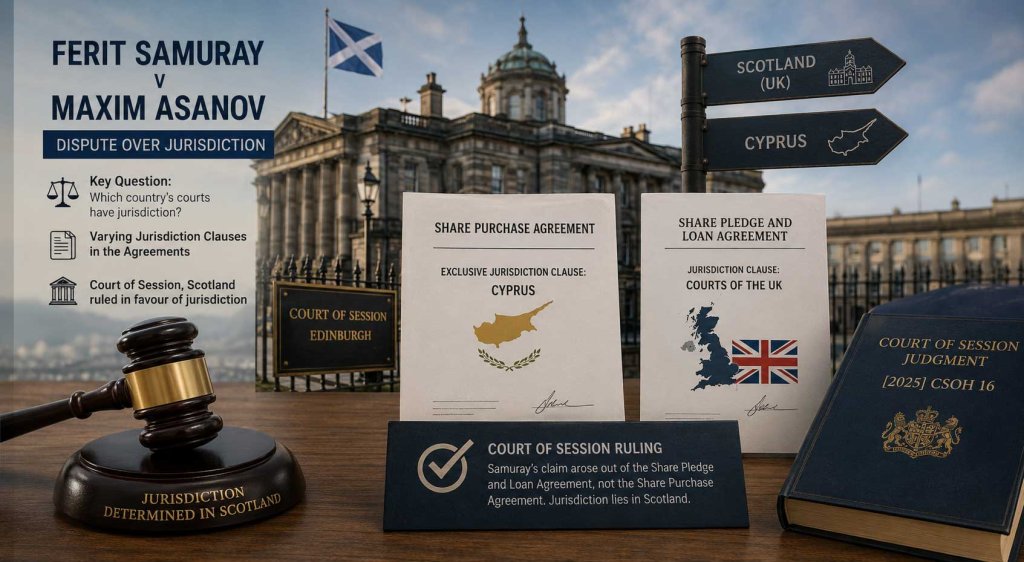
The case commonly referred to as “Ferit Samuray v Maxim Asanov” first came before the Court of Session in Scotland in connection with a jurisdictional dispute.
The first reported judgment was issued on 7 February 2025 as “Ferit Samuray against Maxim Asanov [2025] CSOH 16”. The immediate question was not simply whether money was owed. It was which country’s courts had jurisdiction to determine the dispute.
The underlying agreements included varying jurisdiction clauses. The Share Purchase Agreement had an exclusive jurisdiction clause referring to Cyprus. The Share Pledge and Loan Agreement had a different jurisdiction clause referring to the courts of the UK. Samuray’s claim was based on the loan payment under the Share Pledge and Loan Agreement.
The Court of Session therefore had to determine which contract the claim truly stemmed from.
The court held that Samuray’s claim arose out of the Share Pledge and Loan Agreement, rather than the Share Purchase Agreement, and so recognized jurisdiction in Scotland.
The ruling was important since it meant that the underlying financial dispute would remain in Scotland rather than being sent to Cyprus. The dispute did not end there.
The €700,000 loan and the failed share acquisition
The eventual merits decision came on 7 July 2026, when Lord Lake issued “Ferit Samuray against Maxim Asanov [2026] CSOH 64“. By this stage, the case had become much clearer.
Samuray sought repayment of two sums described in the pleadings as $350,000 and €350,000, either as repayment of a loan or, alternatively, as money representing unjust enrichment. The court found that €701,525.41 had in fact been paid by Samuray to Asanov as a loan.
The intended transfer of ownership of Monitox never occurred.
The judgment also records that all of the shares in the company had subsequently been transferred to a third party.
The parties had disagreed over whether provisions in the Share Purchase Agreement and Share Pledge and Loan Agreement had been breached and what consequences should follow. But the court ultimately did not need to resolve the repayment question by finding a breach of either agreement.
Instead, Lord Lake relied on an established principle of Scots law concerning loans.
The loan agreement was silent on when the loan was repayable. The court applied the principle from Nielsen v Stewart, under which a loan with no agreed repayment date is repayable on demand. Samuray had demanded repayment and the money had not been repaid.
The court therefore ordered repayment.
This is an important distinction when describing the judgment. The decision was not a finding that Asanov had committed fraud or that Samuray had been deceived. It was principally a commercial dispute over a loan and contractual arrangements surrounding a proposed acquisition.
The court’s July 2026 ruling was nevertheless a significant result for Samuray: the Court of Session held that the loan was repayable following his demand for payment.
So where does Papel Payment Services Provider LLC enter the story?
This is where the two cases become connected. Papel Payment Services Provider LLC is a Dubai-registered company operating in the financial-services sector. The Scottish Court of Session record expressly states that Papel was owned by Ferit Samuray and that he was also its director.
At the time the business relationship between Samuray and Asanov was developing, Samuray was also a director of Monitox. During that period, Papel entered into a Supply of Services Contract with Monitox.
According to the court, the contract was ostensibly dated 4 January 2023, although it was not actually signed until May 2023. Papel was contracted to provide Monitox with a range of services, including human resources, finance, technology and legal services.
The contract stated that UAE law governed the relationship and that the courts of Dubai would have exclusive jurisdiction over disputes arising from it.
The timing is important.
The commercial relationship between Samuray and Asanov subsequently broke down. The same breakdown that produced the shareholder and loan litigation also led to the termination of the services agreement between Papel and Monitox.
That ultimately produced the second court case.
Papel Payment Services Provider LLC v Monitox Limited
The second dispute was formally between two companies rather than between Samuray and Asanov personally. Papel sued Monitox after terminating the services contract and issuing two invoices.
The Dubai Commercial Court of First Instance subsequently issued a judgment against Monitox on 30 September 2023. The judgment ordered Monitox to pay Papel US$130,725 and £26,874.99, together with interest, fees and AED 1,000 in attorney fees.
The Dubai proceedings were conducted through the UAE’s payment-order procedure, a mechanism intended to provide a relatively rapid route to recovery of certain commercial debts.
The dispute that eventually reached the Scottish courts was not primarily about whether Papel and Monitox had entered into a contract. It was about whether the Dubai judgment could be enforced in Scotland.
That distinction is crucial.
Why did a Dubai judgment end up before a Scottish court?
Monitox was a Scottish company, even though its sole place of business was in London. Papel was based in Dubai. Papel therefore sought recognition and enforcement of the Dubai judgment in Scotland.
Monitox opposed enforcement.
Its argument centred on natural justice.
The company said it had not received effective notice that allowed it to understand the proceedings and exercise its right to challenge the Dubai judgment.
The circumstances surrounding service became the central issue.
The Dubai court’s payment-order process allowed a creditor to seek judgment relatively quickly where a commercial debt was treated as fixed and acknowledged. Under the relevant UAE procedure, a debtor can have a limited period in which to challenge the resulting judgment.
In Monitox’s case, the notices created a particular problem.
The initial notice was in Arabic. An English translation was available through a link, but Monitox did not understand the significance of the email and did not open the link.
The subsequent Dubai judgment was also sent to Monitox in Arabic, with only limited English in one communication. The Scottish court record says the English material in one notice misstated the amount awarded.
Papel also published an advertisement in an Emirati newspaper. That advertisement was in Arabic and, according to the Scottish courts, there was little realistic prospect that it would come to Monitox’s attention.
The result was that the period available to Monitox to appeal the Dubai judgment expired without the company effectively understanding that a judgment had been entered against it.
The 2025 Scottish judgment: natural justice
The court found that the circumstances in which Monitox had been notified amounted to a breach of natural justice.
The underlying principle was straightforward: a person should not be subjected to a foreign judgment without having received sufficient notice to give them a meaningful opportunity to present their case.
The decision did not mean that Scottish courts had decided that Papel’s underlying invoices were illegitimate.
Nor did it amount to a finding that Samuray had personally acted unlawfully.
The issue was procedural fairness and whether the Dubai judgment could be recognised and enforced in Scotland in the circumstances in which it had been obtained and notified.
This distinction matters because the case has sometimes been reduced to the much broader phrase that a Scottish court “rejected a Dubai judgment.” The actual legal issue was narrower: whether enforcement would be consistent with Scots law principles of natural justice.
Papel appealed and the Inner House took a different view
Papel appealed the Outer House decision. The case was heard by the Inner House of the Court of Session, Scotland’s senior appellate court.
On 6 February 2026, the Inner House issued its decision in “Papel Payment Services Provider LLC against Monitox Limited [2026] CSIH 7”.
The appellate court took a different view from the original commercial judge.
The Inner House concluded that the Outer House had erred in refusing enforcement on natural-justice grounds. Among other things, the appellate court considered that Monitox had agreed contractually to submit disputes to the courts of Dubai and that Arabic is the primary language of those courts.
This meant that Papel had achieved a reversal at the Scottish appellate level.
But the story is still not finished.
The case is now before the UK Supreme Court
Monitox has sought permission to appeal to the UK Supreme Court.
The Supreme Court’s official case page identifies the matter as “UKSC/2026/0086, Papel Payment Services Provider LLC v Monitox Ltd”. The page currently records the matter as a “Permission to Appeal application lodged.”
The Supreme Court identifies two principal legal questions.
The first concerns when an appellate court should interfere with evaluative findings made by a lower court.
The second is more directly connected to the dispute: whether natural justice required the Scottish company to be given notice, in English as well as Arabic, of its right to appeal against the Emirati debt judgment.
The official Supreme Court record shows that the permission application was lodged on 19 June 2026.
As of the latest publicly available information reviewed for this article, the case is therefore not a final UK Supreme Court judgment. It remains at the permission-to-appeal stage.
That point should be kept clear in any reporting about the dispute.
Are Samuray v Asanov and Papel v Monitox the same lawsuit?
NO, They are two separate legal proceedings involving different parties and different legal claims.
Ferit Samuray v Maxim Asanov is a personal commercial dispute between Samuray and Asanov. At its core is the money advanced by Samuray in connection with the proposed acquisition of Monitox and the question of repayment.
Papel Payment Services Provider LLC v Monitox Limited is a corporate dispute between Papel and Monitox over a services contract, unpaid invoices and the attempted enforcement in Scotland of a Dubai judgment.
But the cases are closely connected.
The court records themselves make that connection explicit.
Samuray was the owner and director of Papel. He had also been a director of Monitox. Asanov was the relevant shareholder of Monitox before the proposed transaction with Samuray. Papel entered into the services contract with Monitox during the period in which Samuray was involved with the company. And the breakdown of the relationship between Samuray and Asanov preceded the termination of the Papel-Monitox services agreement.
In other words, these are not two unrelated legal cases that happen to contain the same names.
They are separate branches of the same broader commercial relationship.
What exactly was the controversy around Papel?
The most legally significant controversy is not that a court found Papel or Samuray guilty of wrongdoing.
No such criminal finding appears in the judgments reviewed for this article.
The controversy is instead centred on the circumstances surrounding the Dubai payment judgment and whether Monitox received a sufficiently meaningful opportunity to challenge it.
The Outer House concluded that it had not. The Inner House subsequently disagreed and reversed that conclusion.
The disagreement illustrates the difficulty of enforcing judgments across borders.
A judgment may be validly issued in one jurisdiction while the courts of another jurisdiction still have to consider whether recognising it would offend their own fundamental procedural standards.
That is exactly the issue now sitting before the UK Supreme Court at the permission stage. There is another feature of the dispute that attracts attention: the relationship between the parties.
Papel was not an unrelated creditor that had simply purchased an invoice from an unknown third party. Its owner and director, Ferit Samuray, had previously been involved with Monitox, and the court records show that the services agreement between the two companies arose while Samuray was involved with Monitox.
That does not, by itself, establish misconduct.
But it explains why the Papel-Monitox litigation cannot sensibly be understood without looking at the failed Samuray-Asanov transaction.
Samuray’s broader business footprint
The court proceedings represent only one part of Samuray’s public business profile.
His own website presents him as an investor and entrepreneur with interests extending across several sectors, including property, cryptocurrency, hospitality, food and beverage, technology and AI software.
Corporate records also provide evidence of his involvement in a number of businesses.
UK Companies House records show that Samuray was appointed a director of Monitox on 13 October 2021 and resigned on 7 July 2023. The same records identify him as Cypriot and record his place of residence as Cyprus.
Companies House records also show that he was a director of Papel (UK) Technology Ltd, appointed in September 2020. That company is now recorded as dissolved.
Corporate records outside Britain also point to wider involvement in payment and technology businesses.
For example, Estonia’s official business register identifies Ferit Samuray as a board member and 100 per cent shareholder of Jade Exchange OÜ, with the beneficial-owner information showing direct ownership dating from 2021.
There is also evidence of his involvement in Brazil’s payment-services sector.
A 2025 publication by Brazil’s Central Bank listed Ferit Samuray, born in Cyprus, among the ultimate controllers proposed for Papel Instituição de Pagamento Ltda., alongside Papel Brasil Holding Ltda. The regulatory publication concerned the proposed control structure of the Brazilian payment institution.
A later Central Bank publication records authorization for Papel Instituição de Pagamento Ltda. to operate as a payment institution in Brazil, with Papel Brasil Holding as the direct controller and Ferit Samuray identified as the ultimate controller.
These records are relevant because they show that Samuray’s association with payment businesses is not limited to the Scottish litigation.
The public image vs the court record

There are two very different ways Samuray currently appears in public sources.
One is the investor profile.
In that version, he is an entrepreneur and investor discussing Dubai real estate, market structure, regulatory certainty and investment opportunities. His January 2026 IBTimes profile is an example of this presentation.
The other is the legal record.
Here, Samuray appears as a litigant seeking repayment of more than €700,000 advanced in connection with a failed acquisition and as the owner and director of Papel in litigation concerning a Dubai payment judgment against Monitox.
Neither picture necessarily cancels out the other.
Commercial disputes are not unusual for entrepreneurs operating across multiple jurisdictions, particularly when transactions involve regulated financial companies, shareholders, loans and cross-border contracts.
What makes Samuray’s case particularly noteworthy is the way several of those elements intersected in one business relationship.
What the courts have actually established
The public record establishes several important facts.
Samuray sought to acquire an interest in Monitox from Asanov. The proposed transaction involved multiple agreements, including a Share Purchase Agreement and a Share Pledge and Loan Agreement.
Samuray advanced approximately €700,000 to Asanov in connection with the transaction. By July 2026, the Court of Session found that €701,525.41 had been paid as a loan and ordered repayment after Samuray demanded the money.
Samuray was also a director of Monitox during part of the relevant period. Companies House records place his directorship between October 2021 and July 2023.
Papel, a Dubai company owned and directed by Samuray, entered into a services agreement with Monitox while Samuray was involved with the company.
Papel later obtained a Dubai payment judgment for approximately US$130,725 and £26,875, plus interest and costs.
The Scottish Outer House initially refused enforcement of that judgment because it considered the notification process inconsistent with natural justice.
The Inner House subsequently overturned that decision.
Monitox has since sought permission to appeal to the UK Supreme Court, where the case is currently listed as a permission-to-appeal application.
Those are the facts that can be established from the available court and corporate records.
What the courts have not established
Just as important is what the court record does not establish.
- There is no finding in the judgments reviewed for this article that Ferit Samuray committed a criminal offence.
- There is no finding that the Dubai payment judgment was based on fraud.
- There is no finding that the services provided by Papel to Monitox were fictitious.
- There is no finding that the failed Monitox acquisition involved criminal conduct.
And the Scottish court’s decision on natural justice should not be described as a finding that Papel’s underlying debt claim was false.
The litigation concerns commercial rights, contractual arrangements, jurisdiction, repayment of a loan and the recognition of a foreign judgment.
That may make for a less sensational headline than allegations of wrongdoing, but it is a much more accurate description of what the public record actually says.
Why the case matters beyond Ferit Samuray?
The Papel Monitox dispute has significance beyond the individuals and companies involved.
Cross-border commerce increasingly means that a company can contract in one country, operate in another, obtain a judgment in a third and then seek enforcement somewhere else.
The central question becomes whether the procedural safeguards of the country where enforcement is sought have been respected.
The Scottish litigation illustrates that problem particularly well.
The Dubai court used a fast-track payment-order mechanism. The contract itself expressly selected Dubai courts and UAE law. Yet when Papel attempted to enforce the resulting judgment in Scotland, the Scottish courts had to examine whether Monitox had received sufficient notice and a meaningful opportunity to challenge the judgment.
The Outer House and Inner House reached different conclusions.
The issue is now potentially capable of reaching the UK’s highest court.
That makes the case relevant not merely as another dispute involving a fintech entrepreneur, but as an example of the increasingly complicated legal questions created by international financial businesses.
Where things stand now?
As of August 2026, the two connected disputes have reached very different stages.
The Samuray vs Asanov dispute produced a substantive judgment on 7 July 2026. Lord Lake found that €701,525.41 had been advanced as a loan and held that the loan was repayable on demand. The judgment therefore resulted in an order for repayment to Samuray.
The Papel-Monitox dispute is further along the appellate chain. The Inner House of the Court of Session overturned the 2025 Outer House decision that had refused enforcement of the Dubai judgment. Monitox has subsequently lodged an application for permission to appeal to the UK Supreme Court. The Supreme Court’s case page currently identifies the matter as a permission-to-appeal application rather than a case in which the Supreme Court has already delivered judgment.
That means the legal story surrounding Samuray and Papel is still developing.
For anyone researching Ferit Samuray, the most accurate picture is therefore not simply that of a Dubai investor whose name appeared in two lawsuits.
It is the story of an entrepreneur whose business interests crossed into regulated financial services and whose attempted acquisition of a Scottish fintech company led to a chain of litigation involving shareholder rights, a substantial loan, a related corporate services contract, a Dubai payment judgment and ultimately questions about the enforcement of foreign judgments in Scotland.
The courts have resolved some of those questions. Others remain open.
And that distinction is important.
The bigger picture around Ferit Samuray
It shows a businessman operating across jurisdictions and corporate structures, involved in a proposed acquisition of a regulated financial company, personally advancing a substantial loan, serving as a director of the target company and simultaneously being the owner and director of a separate company that contracted with that business.
When the relationship deteriorated, the consequences did not remain confined to a private commercial disagreement.
They produced litigation in Scotland, proceedings in Dubai and a continuing dispute over whether a foreign judgment should be recognised and enforced.
For readers trying to understand who Ferit Samuray is, that is arguably the most useful way to view the available record.
He is not defined by a single lawsuit, and the available judgments do not establish criminal wrongdoing. But the litigation provides an unusually detailed look at the commercial relationships behind some of his business activities and the legal complications that followed when those relationships broke down.
For now, one chapter has ended with the Scottish court ordering repayment of a substantial loan to Samuray.
Another chapter remains open, with the Papel vs Monitox dispute potentially heading toward the UK’s highest court.
The outcome of that proceeding will determine whether the Inner House’s decision allowing enforcement of the Dubai judgment survives further scrutiny.
Until then, the public record presents a businessman with an expanding international investment profile and a complex legal history ; one that is still being written.
Updated: 3rd Aug 2026
————-
Disclaimer:
Some content on Reportingscams.com is published under our guest post program and is provided by third-party contributors. Reporting scams does not create, verify, or take responsibility for the views, accuracy, or claims expressed in such content.